
Every e-commerce store, SaaS platform and app in Bangladesh needs website terms and conditions that actually protect the business. Copying a foreign template rarely works: Bangladeshi contract law, consumer protection rules and the Digital Commerce Operation Guidelines all shape what your terms can say and how they must be presented.
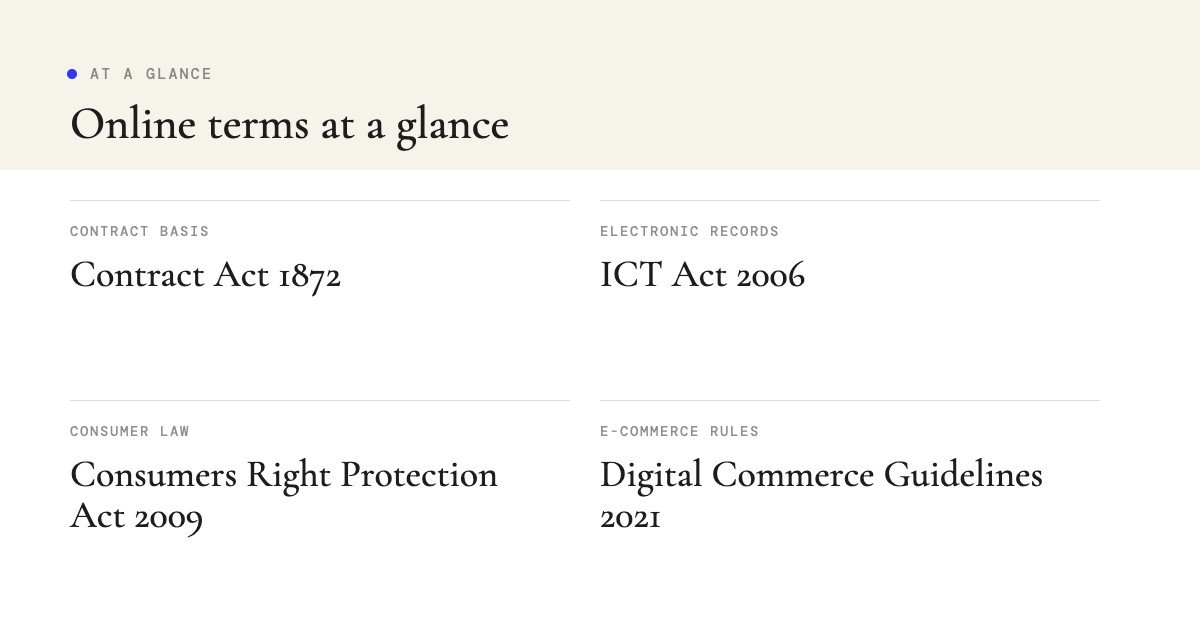
- Website terms and conditions are contracts governed by the Contract Act 1872, and electronic acceptance is recognised under the Information and Communication Technology Act 2006.
- Clickwrap acceptance, where users tick a box or click "I agree", is far more enforceable than browsewrap terms hidden in a footer.
- Consumer protection law limits how far a business can exclude liability or impose unfair terms on consumers.
- E-commerce businesses must comply with the Digital Commerce Operation Guidelines 2021, including delivery, refund and disclosure rules.
- Privacy policies should reflect data protection developments, including the Personal Data Protection Act 2026, which replaced the 2025 Ordinance.
Parliament passed the Personal Data Protection Act 2026 in April 2026, repealing the Personal Data Protection Ordinance 2025. References below to the Ordinance should be read in light of the 2026 Act.
Why website terms and conditions matter
Terms of use govern the relationship between a business and every person who uses its website or app. They allocate risk, set the rules for payments, delivery and refunds, protect intellectual property, and provide a framework for resolving disputes. Without them, a business relies on general law, which may not suit its model.
Well-drafted website terms and conditions also build trust. Customers, payment gateways, investors and regulators increasingly expect clear terms and policies. Our technology and digital practice drafts online terms for Bangladeshi and international platforms.
Are online terms enforceable in Bangladesh?
Yes, if they satisfy the basic requirements of a contract. Under the Contract Act 1872, a valid contract needs an offer, acceptance, lawful consideration, free consent and competent parties. The ICT Act 2006 gives legal recognition to electronic records and electronic signatures, which supports the formation of contracts online.
The key practical question is whether the user actually agreed. Courts in common law jurisdictions distinguish between clickwrap terms, which require positive action, and browsewrap terms, which rely on a link somewhere on the site. Bangladeshi courts are likely to follow similar reasoning, so website terms and conditions should be presented in a way that captures clear acceptance.
Clickwrap versus browsewrap
| Method | How it works | Enforceability |
|---|---|---|
| Clickwrap | User ticks a box or clicks "I agree" before proceeding | Strongest evidence of consent |
| Sign-in wrap | Notice that signing up means accepting linked terms | Reasonable if notice is clear and prominent |
| Browsewrap | Terms linked in footer; use implies acceptance | Weak; often unenforceable against consumers |
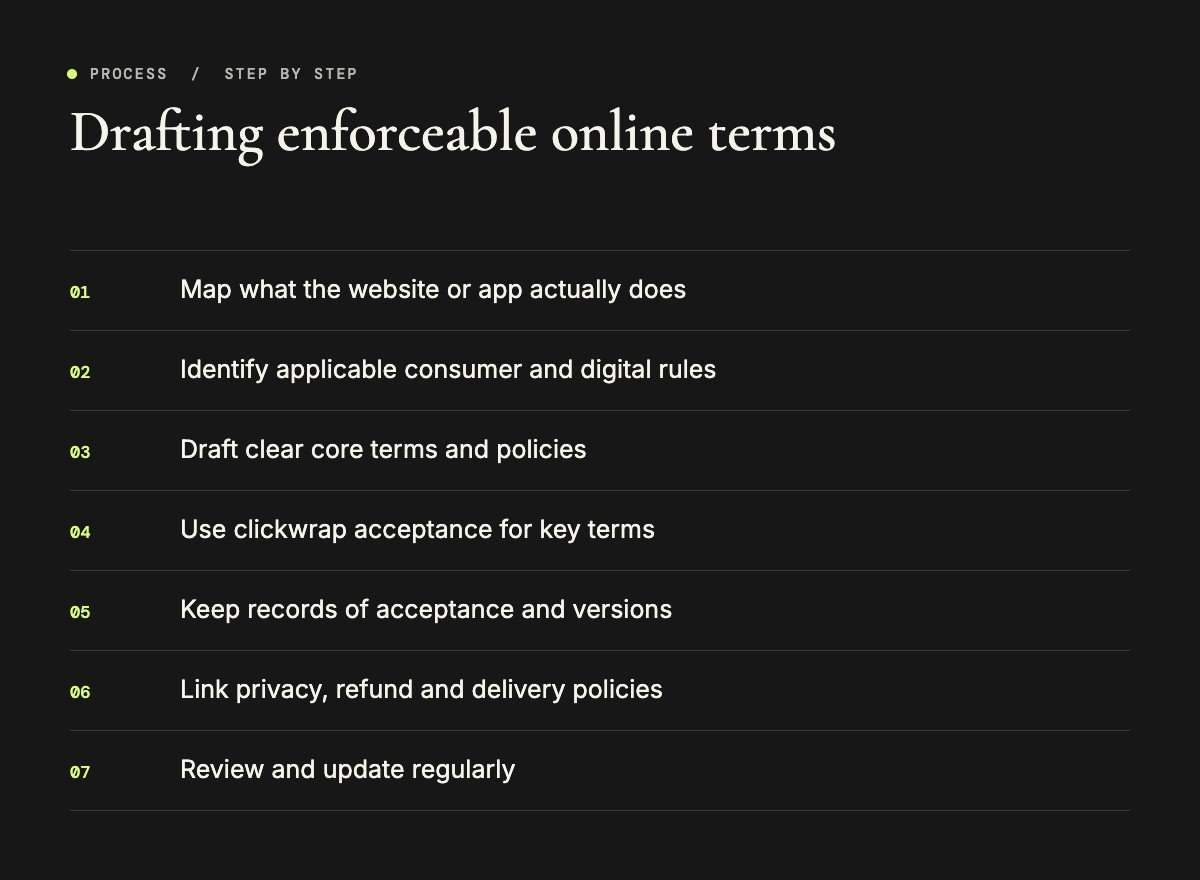
For key obligations such as payment, refunds, subscription renewal and arbitration, clickwrap acceptance is strongly recommended. Keep a record of which version each user accepted and when.
Essential clauses
- Parties and acceptance. Identify the business by its legal name, registration and address, and explain how users accept the terms.
- Eligibility. Set age and capacity requirements; minors cannot validly contract under the Contract Act.
- Accounts and security. Describe user responsibilities for credentials and account activity.
- Products, pricing and payment. Explain prices, taxes such as VAT, payment methods and errors in pricing.
- Delivery, returns and refunds. Set out timelines and conditions consistent with consumer rules.
- Intellectual property. Protect content, trademarks and software, and license user-generated content where needed.
- Liability and disputes. Limit liability lawfully, choose governing law and set a dispute resolution mechanism.
Foreign templates often choose English or Delaware law and courts. For a business serving Bangladeshi consumers, a foreign forum is unlikely to be enforced against consumers and may draw regulatory attention. Choose Bangladeshi law and courts, or arbitration in Dhaka for business users.
Consumer protection limits
The Consumers' Right Protection Act 2009 prohibits various anti-consumer practices, including selling goods at prices higher than fixed, selling adulterated or substandard goods, deceiving customers through false advertisements, and failing to deliver goods or services as promised. The Directorate of National Consumers' Right Protection can receive complaints and impose fines.
Website terms and conditions cannot override these protections. Clauses that try to exclude all liability for defective goods, or that allow the seller to change prices after payment without refund, are risky. Terms should be fair, transparent and consistent with the business's real practices.
The Digital Commerce Operation Guidelines 2021
The Ministry of Commerce issued the Digital Commerce Operation Guidelines in 2021, following high-profile e-commerce failures. Among other things, the guidelines require marketplaces and sellers to display clear product information, prices, delivery time and return policies, to deliver within specified timelines and to refund customers promptly where orders are cancelled or not delivered.
The guidelines also restrict taking advance payment for products not in stock and encourage escrow-based payment arrangements. E-commerce businesses may need a Digital Business Identity registration from the Ministry of Commerce. Website terms and conditions for e-commerce must reflect these rules precisely, because regulators compare terms with actual practice.
Privacy policy and data protection
A privacy policy explains what personal data the business collects, why, how it is used, who it is shared with and how long it is retained. The ICT Act 2006 contains provisions on unauthorised access and disclosure, and sector regulators impose their own data rules.
A Personal Data Protection Ordinance was made in 2025; check whether Parliament has since re-enacted or amended it, as its status after April 2026 should be confirmed before relying on specific provisions. In any case, a clear privacy policy, consent mechanisms for marketing and secure handling of data are now baseline expectations. See our data protection practice.
Limitation of liability
Businesses commonly cap liability at the amount paid by the customer and exclude indirect losses. Such clauses are generally enforceable between businesses, subject to the Contract Act's rules on penalties and public policy. Against consumers, exclusions must be reasonable and cannot remove statutory protections.
Liability for fraud, wilful misconduct or personal injury should not be excluded. Clear drafting, placed prominently in the website terms and conditions, improves the chances of enforcement.
Governing law and disputes
Most Bangladeshi platforms choose Bangladeshi law and the courts of Dhaka. For business-to-business platforms, arbitration under the Arbitration Act 2001 can offer confidentiality and speed. Consumer disputes are often better handled through a complaints process and, if needed, the consumer protection authority.
A good dispute clause encourages early resolution through customer support before formal proceedings. This reduces cost and protects reputation.
Intellectual property and user content
Terms should state that the website's design, content, logos and software belong to the business or its licensors, and restrict copying, scraping and reverse engineering. If users upload reviews, photos or other content, the terms should grant the business a licence to use it and prohibit unlawful content. Registering key trademarks strengthens enforcement; see our guide to trademark registration in Bangladesh.
Subscriptions and auto-renewal
SaaS and subscription businesses should disclose renewal terms clearly at the point of purchase, explain how to cancel, and send reminders before renewal. Hidden auto-renewal terms are a frequent source of consumer complaints and chargebacks. Payment gateways and card schemes also impose their own disclosure requirements.
Keeping terms up to date
Website terms and conditions should be reviewed whenever the business launches new products, changes payment methods, enters new markets or when laws change. The terms should explain how updates are notified and when they take effect. For material changes, seek fresh acceptance from existing users.
Marketplace platforms and third-party sellers
Marketplaces need two sets of terms: website terms and conditions for buyers, and seller agreements for merchants. The buyer terms should explain that the marketplace facilitates transactions, identify who the seller is for each product and describe how complaints are handled. The seller agreement should set commission, payout timelines, product standards, intellectual property warranties and indemnities.
Under the Digital Commerce Operation Guidelines, marketplaces have responsibilities for seller information and complaint handling, so they cannot simply disclaim all involvement. The website terms and conditions should reflect the platform's real role.
Payment gateways and cash on delivery
Most Bangladeshi online businesses accept cards, MFS wallets and cash on delivery. Payment gateways require merchants to publish clear refund and cancellation policies and may suspend accounts that generate excessive chargebacks. Website terms and conditions should explain when payment is captured, how refunds are processed for each payment method and how long they take.
For cash on delivery, terms should address refused deliveries, inspection on delivery and return of goods. Clear rules reduce disputes with customers and couriers.
Apps and mobile platforms
Mobile apps distributed through app stores must also comply with the store's own developer terms, which often require an end-user licence agreement and a privacy policy link. App-based website terms and conditions should cover in-app purchases, device permissions, location data and push notifications, and explain how users can delete their accounts and data.
Common drafting mistakes
- Copying foreign terms that refer to laws and regulators that do not apply in Bangladesh.
- Promising delivery or refund timelines the business cannot meet.
- Burying critical terms such as renewal or non-refundable fees.
- Failing to keep records of which version a user accepted.
- Using inconsistent terms across the website, app and invoices.
Avoiding these mistakes makes website terms and conditions a real asset rather than a liability. A short review by a lawyer familiar with Bangladeshi digital commerce often pays for itself in avoided disputes.
Bangla or English?
Many Bangladeshi consumers are more comfortable reading Bangla. Offering website terms and conditions in both Bangla and English improves transparency and supports the argument that consumers understood the terms. If both versions exist, state which prevails in case of conflict, and make sure the translations match.
Terms for business customers
Business-to-business platforms, such as procurement portals or software sold to companies, can use more robust terms than consumer sites. Liability caps, service levels, data processing terms and arbitration clauses are common. Many B2B providers combine online terms with an order form signed by the customer, which states that the online terms apply and takes priority on commercial points such as price and term.
Where large customers negotiate, keep a clear record of any agreed changes so that the standard website terms and conditions continue to apply to everyone else.
Frequently asked questions about website terms and conditions
Are website terms and conditions legally required in Bangladesh?
There is no single law requiring them for every site, but e-commerce rules require clear disclosures, and terms are essential to protect the business.
Is clicking "I agree" a valid contract?
Yes. Electronic acceptance is recognised, and clickwrap is the strongest form of consent.
Can I use a foreign template?
It is risky. Templates often conflict with Bangladeshi consumer law and digital commerce rules.
Do I need a separate privacy policy?
Yes, a separate, clear privacy policy is best practice and increasingly expected by regulators and partners.
Can I exclude all liability?
No. Exclusions must be reasonable, and consumer protections cannot be removed.
Which law should govern?
For Bangladeshi users, Bangladeshi law and courts are usually the right choice.
How we can help
We draft and review website terms and conditions, privacy policies, refund policies and merchant agreements for e-commerce, SaaS and fintech businesses. Learn more about our technology and digital practice and our consumer and retail practice.
Launching a website or app?
We draft terms that fit your business and Bangladeshi law.
Book a consultationTechnology practicePrimary sources: the Contract Act 1872, ICT Act 2006 and Consumers' Right Protection Act 2009 on the Laws of Bangladesh portal; consumer complaints through the Directorate of National Consumers' Right Protection; digital commerce rules from the Ministry of Commerce.
This article is general information about Bangladeshi law as of October 2026 and is not legal advice. Digital commerce and data protection rules are developing; check the current position.

0 Comments