
A court order is only meaningful if it is obeyed. Contempt of court in Bangladesh gives the Supreme Court and, through it, the subordinate courts the power to punish those who disobey orders or undermine the administration of justice. For litigants who have won an injunction or a writ order that the other side ignores, a contempt petition is often the most effective tool.
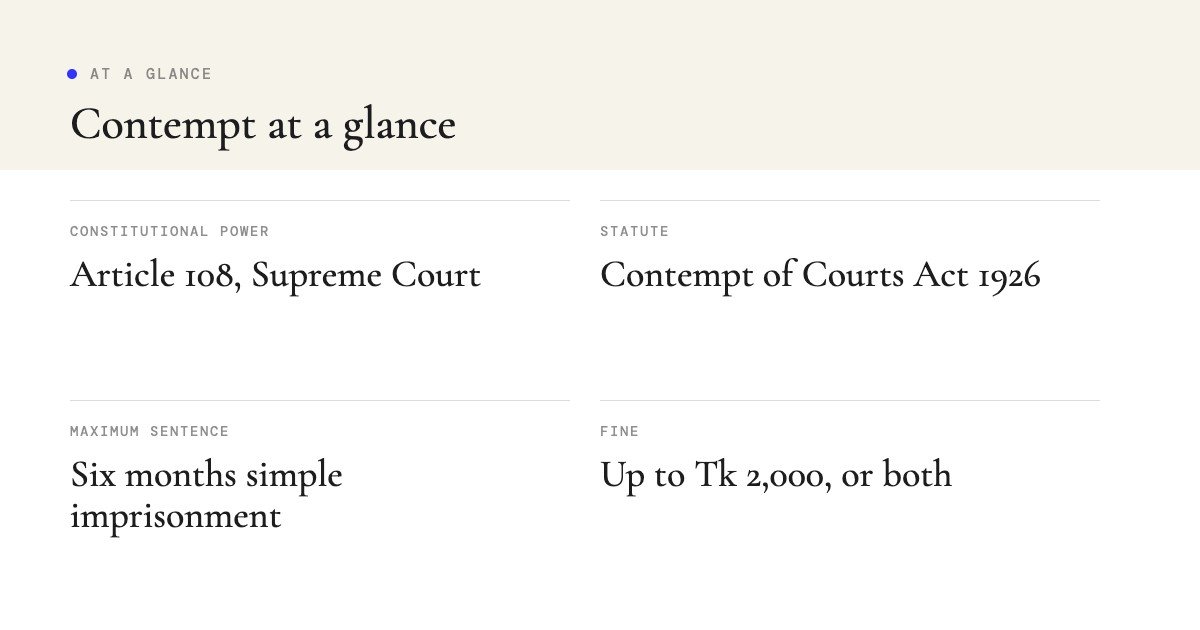
- Article 108 of the Constitution makes the Supreme Court a court of record with power to punish for contempt of itself.
- The Contempt of Courts Act 1926 provides the statutory framework and allows punishment of up to six months' simple imprisonment, a fine of up to Tk 2,000, or both.
- The Contempt of Courts Act 2013 was declared unconstitutional by the High Court Division, so the 1926 Act continues to apply.
- Contempt may be civil, such as wilful disobedience of an order, or criminal, such as scandalising the court or interfering with justice.
- A bona fide unconditional apology can lead the court to discharge the contemnor or remit the punishment.
The legal basis of contempt of court in Bangladesh
Contempt of court in Bangladesh rests on two foundations. The first is Article 108 of the Constitution, which declares the Supreme Court a court of record with all the powers of such a court, including the power, subject to law, to order investigation of or punishment for any contempt of itself. The second is the Contempt of Courts Act 1926, which defines punishment and extends the High Court Division's protection to subordinate courts.
Parliament enacted a new Contempt of Courts Act in 2013, but the High Court Division declared it unconstitutional in the same year, finding that it unduly restricted the court's power. As a result, the 1926 Act remains the governing statute. Our Supreme Court practice regularly handles contempt petitions.
Civil and criminal contempt
| Type | Examples |
|---|---|
| Civil contempt | Wilful disobedience of a judgment, decree, direction, order, writ or other process; wilful breach of an undertaking given to the court |
| Criminal contempt | Scandalising or lowering the authority of the court; prejudicing or interfering with judicial proceedings; obstructing the administration of justice |
Most commercial and administrative disputes involve civil contempt, where a party, often a government officer or a company, fails to comply with a court order. Criminal contempt cases frequently involve publications or statements attacking judges or commenting on pending cases in a way that prejudices a fair trial.
Punishment for contempt of court in Bangladesh
Under section 3 of the Contempt of Courts Act 1926, a contemnor may be punished with simple imprisonment for a term which may extend to six months, or with fine which may extend to two thousand taka, or with both. The proviso allows the court to discharge the accused or remit the punishment on an apology being made to the satisfaction of the court.
The modest fine reflects the age of the statute, but the threat of imprisonment, and the reputational consequences for officials and businesses, make contempt of court in Bangladesh a serious matter. The Supreme Court also uses its inherent powers under Article 108 to give directions that secure compliance.
Contempt of subordinate courts
Section 2 of the 1926 Act gives the High Court Division the same jurisdiction to punish contempt of courts subordinate to it as it has for contempt of itself. The High Court Division does not generally take cognisance of contempt of a subordinate court where the act is punishable under the Penal Code.
For disobedience of injunctions granted by civil courts, Order 39 rule 2A of the Code of Civil Procedure provides a separate remedy of attachment of property and civil detention. Litigants should consider which route is faster and more effective in their case.
Bringing a contempt petition
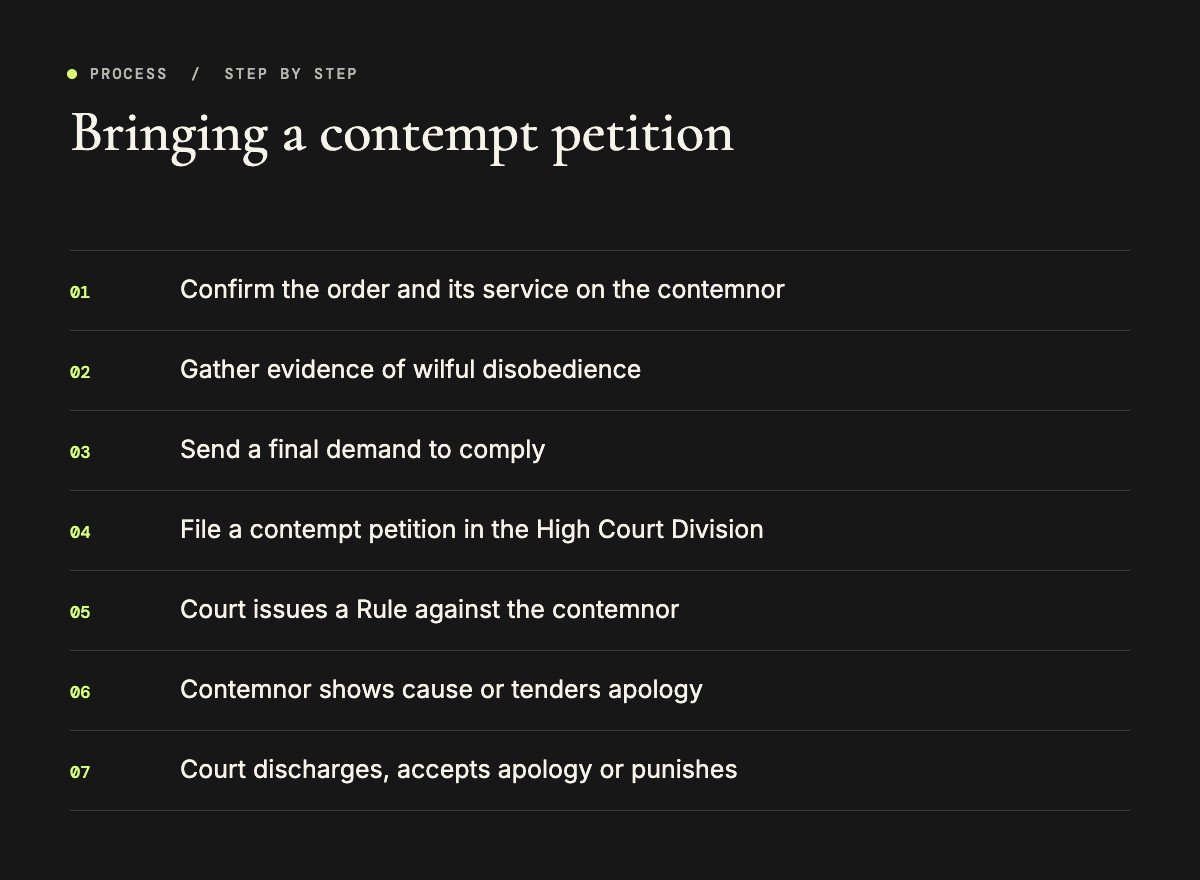
- Confirm the order. Obtain a certified copy of the order and proof that it was communicated to the respondent.
- Gather evidence. Collect documents, correspondence, photographs or other proof of non-compliance.
- Send a demand. A final legal notice demanding compliance shows that disobedience is wilful.
- File the petition. File a contempt petition in the High Court Division, supported by affidavit.
- Rule issued. If satisfied, the court issues a Rule calling on the respondent to show cause why contempt proceedings should not be drawn.
- Show cause or apologise. The respondent appears personally or through a lawyer, explains or tenders an apology.
- Decision. The court discharges the Rule, accepts the apology with directions, or punishes the contemnor.
Courts focus on whether disobedience was wilful. A respondent who genuinely could not comply, or who reasonably misunderstood an ambiguous order, may escape punishment. Ask for clear, specific orders at the outset, so later contempt proceedings have a firm foundation.
Contempt against government officials
Many contempt petitions in Bangladesh concern government officers who fail to implement writ judgments, for example on service matters, land acquisition compensation or regularisation. The High Court Division has summoned secretaries and other senior officials to appear in person and has, in some cases, imposed fines or sentences.
Officials often tender unconditional apologies and undertake to comply within a set time. Courts frequently accept such apologies with directions and keep the matter pending until compliance is reported. For litigants, contempt of court in Bangladesh is therefore a practical lever to secure implementation of judgments against the state.
Apology as a defence
An apology must be genuine, unconditional and timely to be accepted. Courts have repeatedly said that an apology is not a weapon of defence to be used to escape punishment, and that a qualified or belated apology tendered only when punishment seems likely may be rejected.
Compliance with the original order usually accompanies a successful apology. An apology without compliance rarely satisfies the court.
Media, social media and criminal contempt
Publications that scandalise the court or prejudge pending cases can amount to criminal contempt. With social media, individuals now face contempt proceedings for posts attacking judges or judgments. Fair and accurate reporting of proceedings and fair criticism of judgments in temperate language are generally protected, but imputing improper motives to judges is not.
Journalists, editors and commentators should take care when reporting on pending matters, particularly in criminal cases where comment can prejudice a fair trial.
Defences and mitigating factors
- The order was not served or communicated to the respondent.
- The order was ambiguous and the respondent acted on a reasonable interpretation.
- Compliance was impossible for reasons beyond the respondent's control.
- The respondent has complied, even if late, and tenders an unconditional apology.
- The statement complained of was fair comment or accurate reporting.
Contempt of court in Bangladesh and undertakings
Parties often give undertakings to the court, for example to maintain the status quo, deposit money or refrain from selling property. A wilful breach of an undertaking is treated as seriously as disobeying an order, and is a common basis for contempt of court in Bangladesh in commercial cases. Companies giving undertakings should ensure their officers understand and follow them.
Directors and senior officers can be held personally responsible where a company disobeys an order or breaches an undertaking with their knowledge. Internal compliance procedures that track court orders protect both the company and its managers.
Time and urgency
There is no rigid limitation period in the 1926 Act, but delay can weaken a petition. Courts expect applicants to act promptly once disobedience becomes clear. Bringing contempt of court in Bangladesh proceedings soon after the deadline for compliance passes shows the seriousness of the breach and increases pressure on the respondent to comply.
Practical outcomes
In practice, the most common outcome of contempt proceedings is compliance. Faced with a Rule and the prospect of personal appearance, many respondents implement the order quickly and apologise. Where respondents persist, the court may impose punishment, give strict timelines or direct senior authorities to ensure compliance.
For applicants, the goal is usually enforcement rather than punishment, and petitions should be framed with that objective. Seeking specific directions for compliance, reporting dates and costs keeps the focus on getting the original order implemented.
Strategic considerations
Before filing for contempt of court in Bangladesh, consider whether a simpler remedy is available, such as execution of a decree or an application under Order 39 rule 2A. Contempt is a quasi-criminal jurisdiction, and courts require proof beyond reasonable doubt in many cases, so weak evidence can lead to dismissal. A well-documented petition, filed after a clear demand, is far more likely to succeed.
Appeals in contempt matters
A person punished by the High Court Division for contempt of court in Bangladesh may seek leave to appeal to the Appellate Division under Article 103 of the Constitution. The Appellate Division can stay the sentence, accept an apology, or set aside the conviction where the High Court Division erred. Applicants who lose a contempt petition can also seek leave, though the Appellate Division rarely interferes with discretionary decisions.
Because contempt of court in Bangladesh carries possible imprisonment, the Appellate Division looks closely at whether the contemnor had a fair opportunity to be heard and whether wilful disobedience was clearly proved.
Companies and contempt of court in Bangladesh
Companies cannot be imprisoned, but their directors, managing directors and responsible officers can. When a company disobeys an injunction, for example by transferring shares or selling property in breach of an order, the court may summon the officers responsible. Businesses should keep a register of court orders affecting them, circulate orders to relevant managers and obtain legal advice before taking any step that might breach an order.
Taking these precautions reduces the risk that contempt of court in Bangladesh proceedings will disrupt operations or damage the company's reputation with banks, regulators and partners.
Costs
The court may order the contemnor to pay costs to the applicant, in addition to any punishment. Costs awards help compensate applicants for the expense of enforcement and discourage respondents from waiting until a Rule is issued before complying. Applicants should keep records of their legal expenses and ask for costs at the hearing.
Frequently asked questions about contempt of court in bangladesh
Which law governs contempt in Bangladesh?
Article 108 of the Constitution and the Contempt of Courts Act 1926.
What is the maximum punishment?
Simple imprisonment of up to six months, a fine of up to Tk 2,000, or both.
What happened to the 2013 Act?
The High Court Division declared it unconstitutional in 2013, so the 1926 Act applies.
Can government officials be punished?
Yes. Officials who wilfully disobey court orders can be summoned and punished.
Does an apology end the case?
Only if it is genuine and unconditional and usually accompanied by compliance.
Where is a contempt petition filed?
In the High Court Division, including for contempt of subordinate courts.
How we can help
We bring and defend contempt of court in Bangladesh proceedings, from enforcing writ judgments against government bodies to defending businesses and individuals. Learn more about our Supreme Court practice, our guide to the structure of the Supreme Court and our public and administrative law team.
Court order being ignored?
We file contempt petitions to secure compliance.
Book a consultationSupreme Court practicePrimary sources: the Constitution of Bangladesh and the Contempt of Courts Act 1926 on the Laws of Bangladesh portal; cause lists and judgments from the Supreme Court of Bangladesh.
This article is general information about Bangladeshi law as of October 2026 and is not legal advice. Contempt proceedings are fact-sensitive and discretionary.


0 Comments