
Every acquisition in Bangladesh begins with a structural choice: buy the company, or buy the business out of the company. The asset purchase vs share purchase decision drives liability exposure, tax and stamp duty, regulatory approvals, the treatment of employees and how long completion takes. Getting it right at the term sheet stage saves cost and risk later.
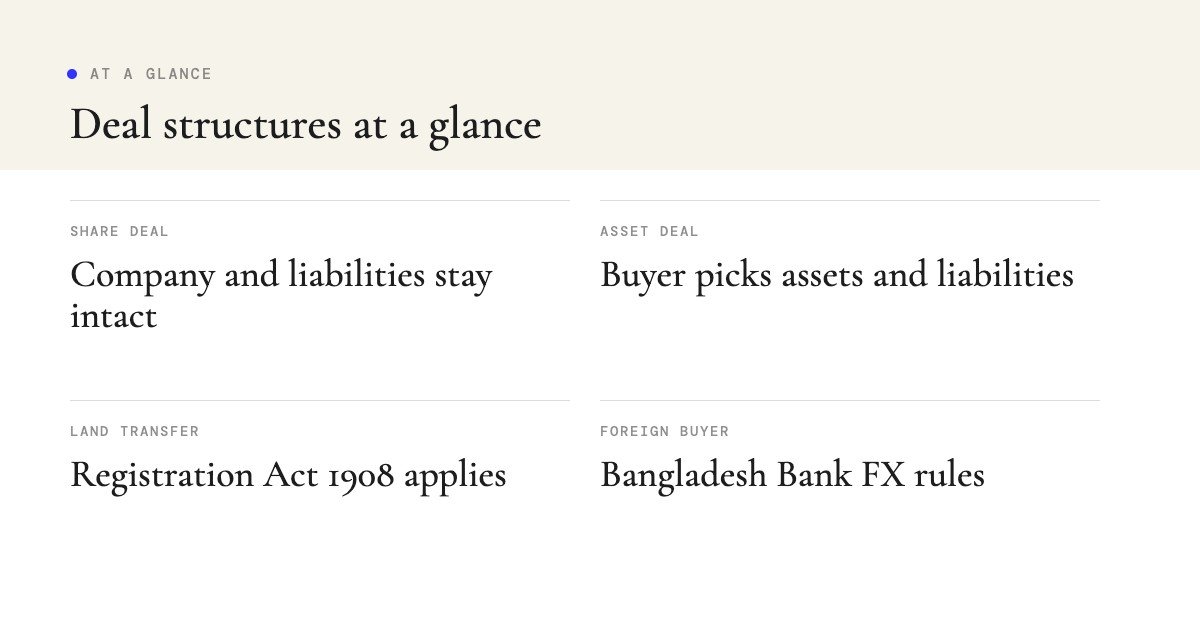
- In a share purchase, the buyer acquires the company with all its assets, licences, contracts and liabilities, known and unknown.
- In an asset purchase, the buyer selects specific assets and liabilities, but each asset must be transferred separately, often with third-party consents.
- Land transfers in an asset deal require registered deeds, stamp duty, registration fees and mutation, which can be costly and slow.
- Licences and permits are often not transferable, which favours a share purchase for regulated businesses.
- Foreign buyers must consider Bangladesh Bank rules on share pricing and remittance, and competition law on combinations.
The basic difference
A share purchase changes who owns the company. The company itself stays the same legal person, so its land, bank accounts, contracts, licences, employees, tax history and disputes remain with it. The buyer steps into the shoes of the selling shareholders and inherits the company's entire history.
An asset purchase moves selected assets and liabilities from the seller company to the buyer. The seller company continues to exist, keeping anything not transferred. The asset purchase vs share purchase choice is therefore a choice between taking everything with protection through warranties, or taking only what you want at the cost of a more complex transfer. Our mergers and acquisitions practice advises buyers and sellers on this decision.
Asset purchase vs share purchase: comparison table
| Issue | Share purchase | Asset purchase |
|---|---|---|
| Liabilities | All stay with the company | Buyer takes only agreed liabilities, subject to exceptions |
| Licences and permits | Usually remain with the company, subject to change of control conditions | Often need new applications or regulator consent |
| Contracts | Continue, subject to change of control clauses | Need assignment or novation with counterparty consent |
| Land | No land transfer; company keeps title | Registered transfer deeds, stamp duty, mutation |
| Employees | Employment continues automatically | Transfer, re-hiring and settlement of dues must be handled |
| Tax history | Inherited by buyer through the company | Generally stays with seller, with some exceptions |
| Documentation | Share transfer forms, board approvals, RJSC filings | Multiple transfer instruments for each asset class |
Liability exposure in asset purchase vs share purchase
The biggest attraction of an asset purchase is the ability to leave unwanted liabilities behind. Old tax disputes, litigation, environmental problems and bank debts can remain with the seller company. In a share purchase, the buyer inherits all of these through the company and must rely on due diligence, price adjustments, warranties, indemnities and escrow to manage the risk.
However, an asset purchase does not always provide a clean break. Some liabilities may follow the assets, such as charges registered against property, land development tax arrears or obligations attached to specific licences. Workers' dues and statutory claims also need careful handling. In the asset purchase vs share purchase analysis, buyers should not assume that an asset deal eliminates all risk.
Licences, permits and regulated businesses
Many Bangladeshi businesses depend on licences: trade licences, factory licences, environmental clearances, import registration certificates, DGDA drug licences, BTRC licences, bank or insurance licences, and incentives from economic zones or export processing zones. These are typically issued to the company and are not freely transferable.
In a share purchase, the licences usually stay with the company, although some regulators require approval for a change of control. In an asset purchase, the buyer often needs to obtain fresh licences, which can take months. For regulated sectors, this is frequently the decisive factor in the asset purchase vs share purchase choice.
Land and real estate
Land transfers in Bangladesh are expensive and procedurally demanding. A sale deed must be registered under the Registration Act 1908, with stamp duty, registration fees, local government tax and source tax on gains. The seller's name must appear in the latest record of rights under section 52A before registration, and mutation must follow.
Where the target owns significant land, buying shares avoids these transfer costs because title stays with the company. See our guide to land registration in Bangladesh.
Asset purchase vs share purchase: tax and stamp duty
Tax outcomes differ significantly. In a share purchase, the seller may be liable for tax on gains from the share sale under the Income Tax Act 2023, and stamp duty is payable on the share transfer instruments. In an asset purchase, the seller company may face tax on gains or recaptured depreciation, the buyer may get a stepped-up cost base for depreciation, and VAT may apply to transfers of certain goods and services.
Because rates and exemptions change through the annual Finance Act, parties should obtain current tax advice before fixing the structure. Tax considerations frequently determine the outcome of the asset purchase vs share purchase debate. Our tax practice models both options.
Employees in asset purchase vs share purchase
In a share purchase, employees remain employed by the same company, with their service and benefits continuing. In an asset purchase, employees must be transferred, which normally means terminating their employment with the seller and re-hiring them, or agreeing a transfer with their consent. Accrued benefits such as gratuity, provident fund and leave encashment must be settled or assumed.
The Bangladesh Labour Act 2006 contains protections for workers, and mishandling transfers can trigger claims. A clear employee transfer plan should be part of any asset deal.
Regulatory approvals for asset purchase vs share purchase
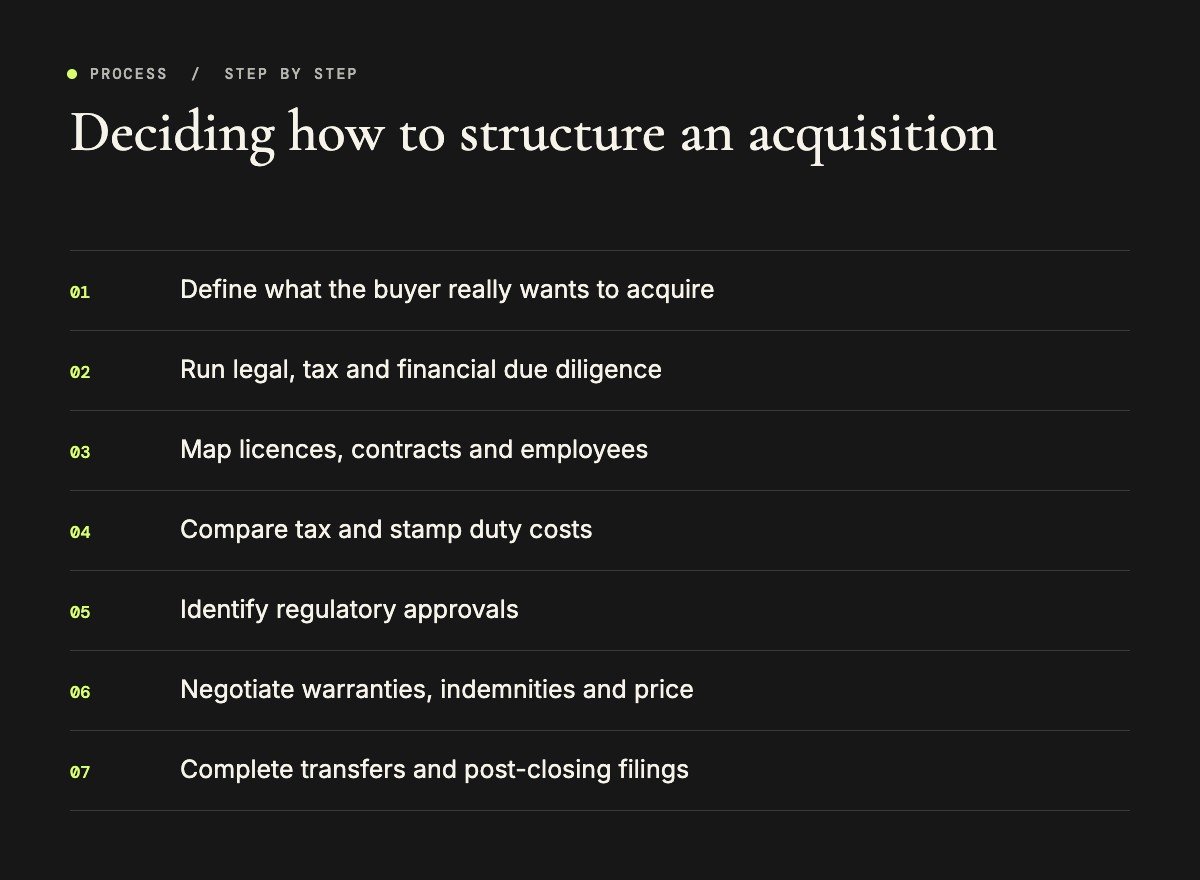
- Bangladesh Bank. Transfers of shares between residents and non-residents must comply with foreign exchange rules on pricing and remittance, now consolidated in a March 2026 master circular.
- Competition Commission. The Competition Act 2012 regulates combinations that may adversely affect competition; detailed combination regulations were still described as draft in late 2025.
- Sector regulators. Banks, insurers, telecom operators and others need regulator consent for changes of control.
- Invest Bangladesh. Investment registrations and approvals may need updating.
- RJSC. Share transfers and director changes must be filed.
- Land authorities. Asset deals require registration and mutation of land.
- Tax authorities. Clearances and withholding obligations must be met.
Change of control clauses in loan agreements, leases and key customer contracts can give counterparties the right to terminate on a share sale. Review these early, because obtaining waivers can affect both timing and price.
Hybrid structures
Sometimes the best answer is neither pure option. A seller may transfer the desired business into a new subsidiary, a process often called hive-down, and the buyer then buys the shares of the new company. This can combine the clean liability profile of an asset deal with the simpler completion of a share deal, although the hive-down itself triggers transfer costs and approvals.
Schemes of arrangement and amalgamations under the Companies Act, approved by the High Court Division, are another route for complex restructurings.
Due diligence differences
Due diligence in a share purchase must cover the whole company: corporate records, title to all assets, contracts, employees, litigation, tax, regulatory compliance and environmental matters. In an asset purchase, diligence can focus on the specific assets and liabilities being acquired, though buyers still need to check title, encumbrances and any obligations that may follow the assets.
In the asset purchase vs share purchase comparison, broader diligence in a share deal means higher upfront cost but better understanding of what the buyer is taking on. For Bangladeshi targets, land title, tax assessments and RJSC filings are frequent problem areas.
Speed and complexity
Share purchases are usually faster to complete because a single transfer of shares moves the entire business. Asset purchases involve many separate transfers, consents and registrations, and land registration alone can take weeks. On the other hand, a share deal may be delayed by regulatory approvals for change of control. Timing is therefore another factor in deciding between asset purchase vs share purchase.
Seller preferences
Sellers often prefer share sales because they achieve a clean exit, with all liabilities going with the company, and the proceeds go directly to the shareholders. In an asset sale, the proceeds go to the seller company, which may then face further tax when distributing them to shareholders. Understanding the seller's priorities helps buyers negotiate price and protections when weighing asset purchase vs share purchase.
Warranties and indemnities
Contract protection differs between the two structures. In a share purchase, the buyer relies heavily on warranties about the company's accounts, tax, litigation, compliance and assets, backed by indemnities for specific known risks and sometimes an escrow or deferred payment. In an asset purchase, warranties focus on title to the assets, their condition and the liabilities assumed.
Whichever side of the asset purchase vs share purchase line a deal falls on, warranties are only as good as the seller's ability to pay claims. Buyers should consider holdbacks, guarantees from parent companies or individual sellers, and warranty and indemnity insurance where available.
Making the decision
There is no universal answer to asset purchase vs share purchase. Buyers of regulated businesses with valuable licences and land usually favour a share purchase with strong protections. Buyers of a single division, or of a business with serious legacy problems, often prefer an asset purchase despite the extra work. A structured comparison of liabilities, tax, approvals, timing and seller expectations, carried out early with legal and tax advisers, produces the best result.
Financing the acquisition
Lenders view the two structures differently. In a share purchase, acquisition finance is usually secured over the purchased shares and, after completion, over the target's assets, subject to restrictions on financial assistance under company law. In an asset purchase, the buyer can grant security directly over the acquired assets once they are transferred and charges are registered with the RJSC within the statutory period. Foreign currency acquisition loans require compliance with Bangladesh Bank rules on offshore borrowing, which can affect timing. Discussing the financing plan with lenders early helps avoid last-minute changes to the structure.
Frequently asked questions about asset purchase vs share purchase
Which is cheaper in Bangladesh?
It depends on the assets. Where land is significant, a share purchase often avoids high transfer costs.
Which is safer for the buyer?
An asset purchase limits inherited liabilities, but some liabilities can still follow the assets.
Do licences transfer in an asset deal?
Often not; the buyer may need new licences or regulator consent.
What happens to employees?
In a share deal they continue; in an asset deal they must be transferred and dues settled or assumed.
Is competition approval needed?
The Competition Act 2012 regulates combinations; check the current regulations for thresholds and procedure.
What approvals do foreign buyers need?
Compliance with Bangladesh Bank rules on share pricing and remittance, plus any sector approvals.
How we can help
We advise on asset purchase vs share purchase structuring, due diligence, transaction documents and completion for Bangladeshi and foreign clients. Learn more about our M&A practice and our corporate team.
Planning an acquisition?
We compare structures and design the most efficient route to completion.
Book a consultationM&A practicePrimary sources: the Companies Act 1994, Registration Act 1908 and Competition Act 2012 on the Laws of Bangladesh portal; foreign exchange circulars from Bangladesh Bank; company filings at the RJSC.
This article is general information about Bangladeshi law as of October 2026 and is not legal advice. Tax rates and regulatory requirements change frequently.



0 Comments