
Bangladeshi exporters, importers, banks and shipping companies operate in markets shaped by international sanctions. Sanctions compliance in Bangladesh means meeting domestic obligations to implement United Nations sanctions, following Bangladesh Financial Intelligence Unit directives, and managing the practical reach of US, EU and UK sanctions, which can block payments and damage banking relationships even where Bangladeshi law does not prohibit a transaction.
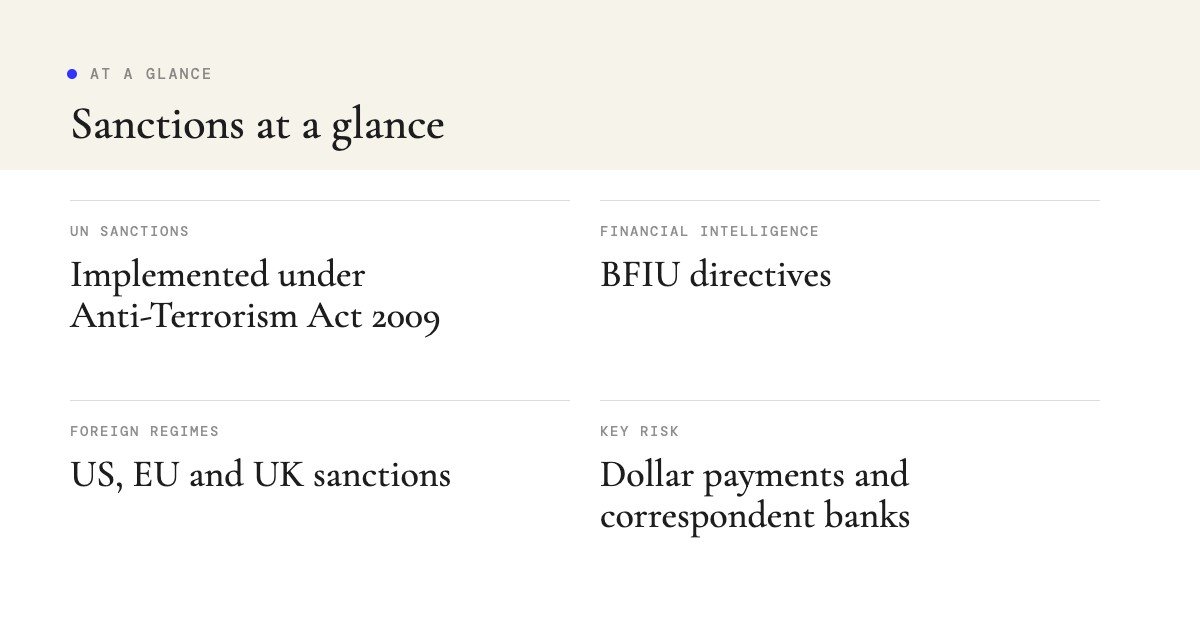
- Bangladesh implements United Nations Security Council sanctions, particularly terrorism and proliferation-related listings, through the Anti-Terrorism Act 2009 and related rules.
- Banks and other reporting organisations must screen customers and transactions under BFIU directives and the Money Laundering Prevention Act 2012.
- Bangladesh has no general autonomous sanctions regime, but US, EU and UK sanctions affect Bangladeshi businesses through dollar clearing, correspondent banks and foreign counterparties.
- High-risk areas include trade with sanctioned jurisdictions, shipping and vessel ownership, dual-use goods and complex ownership chains.
- A risk-based programme with screening, due diligence, contract clauses and training is the best protection.
Why sanctions matter for Bangladeshi businesses
Bangladesh's economy depends heavily on international trade and remittances, much of which is settled in US dollars through foreign correspondent banks. Those banks apply their own sanctions policies, which reflect US, EU and UK laws. A payment that touches a sanctioned person, vessel or country may be blocked, delayed or rejected, and the Bangladeshi bank or business involved may lose access to correspondent relationships.
Sanctions compliance in Bangladesh is therefore a commercial necessity as well as a legal obligation. Our compliance and risk practice helps banks, exporters, shipping companies and investors design practical controls.
The domestic framework for sanctions compliance in Bangladesh
The Anti-Terrorism Act 2009 gives the government power to implement United Nations Security Council resolutions, including freezing assets of listed individuals and entities and prohibiting dealings with them. Rules and statutory orders issued under the Act give effect to resolutions on terrorism financing and proliferation financing.
The Money Laundering Prevention Act 2012 and BFIU circulars require banks, financial institutions, insurers, capital market intermediaries and other reporting organisations to conduct customer due diligence, screen against sanctions lists, freeze funds where required and report suspicious transactions. Failures can lead to fines and other regulatory action.
Foreign sanctions with practical reach
| Regime | How it affects Bangladesh |
|---|---|
| US sanctions (OFAC) | Dollar payments clearing through US banks; secondary sanctions risk for dealings with certain targets |
| EU sanctions | Dealings with EU banks, buyers and insurers; export controls on goods |
| UK sanctions | Sterling payments, UK banks, insurers and shipping services |
| UN sanctions | Binding obligations implemented domestically |
Even where Bangladeshi law does not prohibit a transaction, foreign sanctions may make it impossible to finance, insure, ship or get paid for it. Effective sanctions compliance in Bangladesh therefore looks at the whole transaction chain.
High-risk areas for sanctions compliance in Bangladesh
- Trade with sanctioned jurisdictions. Imports or exports involving heavily sanctioned countries or regions.
- Shipping and ship recycling. Vessels with sanctioned owners, flags, histories of dark activity or sanctioned cargoes, including vessels sold for demolition.
- Energy and commodities. Fuel, fertiliser and metals from sanctioned sources.
- Dual-use goods. Electronics, chemicals and machinery with potential military use.
- Complex ownership. Counterparties owned or controlled by sanctioned persons through layers of companies.
- Large infrastructure projects. Contractors or financiers subject to sanctions, affecting payment channels.
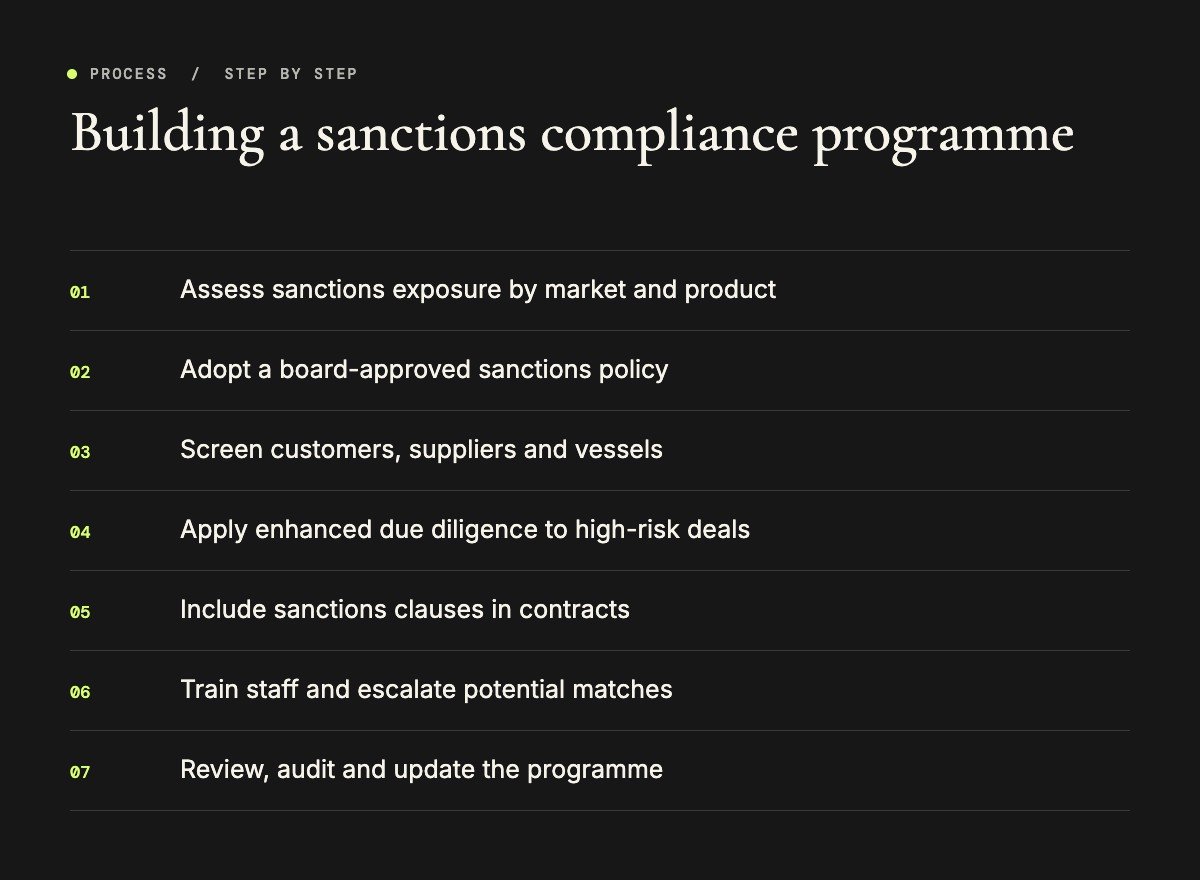
Building a programme step by step
- Risk assessment. Identify exposure by country, product, customer type and payment channel.
- Policy. Adopt a board-approved sanctions policy with clear responsibilities.
- Screening. Screen customers, suppliers, beneficial owners, vessels and banks against relevant lists.
- Enhanced due diligence. Investigate high-risk transactions, ownership and end use.
- Contract protection. Include sanctions warranties, termination rights and payment clauses.
- Training and escalation. Train staff and set procedures for potential matches.
- Review. Audit and update the programme as sanctions change.
Screening only the direct counterparty is not enough. Correspondent banks often reject payments because of a sanctioned vessel, port, intermediary or beneficial owner further down the chain. Ask for full shipping and ownership information before accepting high-risk orders.
Sanctions compliance in Bangladesh for banks
Banks face the most detailed obligations. BFIU directives require automated screening of customers and transactions against UN lists and domestic lists, and banks routinely also screen against OFAC, EU and UK lists to maintain correspondent relationships. Trade finance departments must review letters of credit for sanctioned parties, vessels and goods, and refuse or report transactions as required.
Bangladesh Bank inspections and correspondent bank due diligence questionnaires examine the quality of sanctions controls. Weak controls can lead to regulatory penalties and the loss of correspondent banking lines, which can cripple a bank's trade business.
Sanctions compliance in Bangladesh for exporters
Exporters must consider sanctions affecting buyers, sources of raw materials and shipping routes. Buyers in the US and EU increasingly require suppliers to certify that cotton and other inputs do not come from regions subject to forced labour restrictions or sanctions, and may audit supply chains. Failure to comply can lead to detained shipments and cancelled orders.
Sanctions compliance in Bangladesh for exporters therefore overlaps with supply chain due diligence and human rights compliance.
Shipping, ship recycling and vessel screening
Bangladesh is one of the world's largest ship recycling destinations, and Chattogram handles large volumes of bulk and container traffic. Vessels sold for demolition may have complex ownership histories, changes of flag and name, or past involvement in sanctioned trades. Sanctions compliance in Bangladesh for ship recyclers, agents and banks financing purchases requires checking vessel identification numbers, ownership, flag history and recent voyages.
Shipping agents and freight forwarders should also screen cargo, consignees and routes. Insurers and P&I clubs may refuse cover for sanctioned voyages, leaving operators exposed to uninsured liabilities.
Contract clauses
Well-drafted contracts help manage risk. Sanctions clauses typically include warranties that parties are not sanctioned or owned by sanctioned persons, undertakings not to involve sanctioned goods or routes, rights to suspend or terminate if performance would breach sanctions, and flexibility over payment currency and channels where lawful. Clear clauses support sanctions compliance in Bangladesh by allocating risk before problems arise and giving parties a lawful exit.
Responding to a blocked payment
When a correspondent bank blocks or rejects a payment, the Bangladeshi party should gather full information about the reason, review the transaction chain and take legal advice before trying another route. Attempting to evade foreign sanctions through alternative channels can create serious legal and reputational risk, including for the banks involved. In some cases, licences or clarifications from foreign authorities may be available. Careful documentation of the transaction and the steps taken is essential for future dealings with banks and regulators.
Governance and accountability
Boards should receive regular reports on sanctions risk and compliance, appoint a responsible senior officer and allocate adequate resources for screening tools and training. Sanctions compliance in Bangladesh works best when it is embedded in commercial decision-making, not left solely to the compliance department.
Screening tools and data
Manual checks against published lists are rarely enough for active traders and banks. Commercial screening tools aggregate UN, OFAC, EU, UK and other lists, flag name variations and identify beneficial ownership links. For sanctions compliance in Bangladesh, tools should handle Bangla and transliterated names, common spelling variations and vessel identifiers. Small businesses can start with free official lists and simple procedures, scaling up as volumes grow.
False positives are common. A clear escalation procedure, with documented reasons for clearing or confirming matches, demonstrates good faith to regulators and correspondent banks.
Investors and joint ventures
Foreign investors entering Bangladesh should screen local partners, their owners and directors, and key suppliers and customers. Joint venture agreements should include sanctions representations and exit rights. For investors from the US, EU or UK, sanctions compliance in Bangladesh also means ensuring the local company does not involve them in prohibited dealings, which could create liability in their home jurisdictions.
Training and culture
Staff in sales, procurement, finance, logistics and trade operations are the first line of defence. Regular, practical training using real examples, such as a suspicious vessel change or a buyer reluctant to disclose ownership, helps staff recognise red flags. Encouraging employees to raise concerns without fear of blame supports effective sanctions compliance in Bangladesh and reduces the risk that a single transaction damages the whole business.
Export controls and dual-use goods
Export controls overlap with sanctions. Many countries restrict exports of sensitive technology, electronics, chemicals and software, and require end-use assurances from buyers. Bangladeshi importers of such goods may be asked to sign end-user certificates promising not to re-export to sanctioned destinations or use goods for military purposes. Breaching these undertakings can lead to blacklisting by foreign suppliers and governments. Companies should keep records of end use and avoid re-exporting controlled goods without checking the rules of the country of origin.
Universities, research institutions and technology companies should also be aware that sharing certain technical data with foreign nationals may be treated as an export under some foreign regimes.
Remittances and money transfer businesses
Bangladesh receives large inward remittances from workers abroad. Remittance channels, exchange houses and mobile financial services must screen senders and beneficiaries and comply with BFIU directives. Informal hundi channels bypass these controls and create money laundering and sanctions risks, which is one reason regulators encourage formal remittance channels through incentives and enforcement.
Money transfer operators should maintain strong customer due diligence and transaction monitoring, especially for corridors linked to higher-risk jurisdictions.
Record-keeping and audit trail
Keep records of screening results, due diligence, approvals and decisions for every high-risk transaction. Regulators and correspondent banks may ask how a decision was made months or years later. A clear audit trail shows that the business applied its policy consistently and acted in good faith, which can make a decisive difference if a transaction later turns out to involve a sanctioned party. Periodic independent reviews of the programme help identify gaps before regulators or banks do.
Building these habits now costs far less than repairing a damaged banking relationship or defending a regulatory investigation later, and it gives international partners confidence to keep trading with Bangladeshi businesses.
Frequently asked questions about sanctions compliance in bangladesh
Does Bangladesh have its own sanctions law?
It implements UN sanctions under the Anti-Terrorism Act 2009 and related rules, but has no general autonomous sanctions regime.
Do US sanctions apply in Bangladesh?
Not directly as Bangladeshi law, but they affect dollar payments, US banks and dealings with US persons.
Who supervises sanctions screening by banks?
The Bangladesh Financial Intelligence Unit and Bangladesh Bank.
What should exporters check?
Buyers, suppliers, beneficial owners, vessels, shipping routes and sources of raw materials.
What contract clauses help?
Sanctions warranties, termination rights, payment flexibility and indemnities.
What happens if a payment is blocked?
Funds may be frozen or returned; seek advice before attempting alternative channels.
How we can help
We advise on sanctions compliance in Bangladesh for banks, exporters, shipping companies and investors, from risk assessments and policies to transaction reviews and blocked payments. Learn more about our compliance and risk practice, our trade finance team and our shipping practice.
Worried about sanctions exposure?
We design screening programmes that protect your banking relationships.
Book a consultationCompliance practicePrimary sources: the Anti-Terrorism Act 2009 and Money Laundering Prevention Act 2012 on the Laws of Bangladesh portal; directives from the Bangladesh Financial Intelligence Unit; banking circulars from Bangladesh Bank.
This article is general information as of October 2026 and is not legal advice. Sanctions lists change frequently; screen against current lists and take specific advice.

0 Comments