
Investors, lenders and regulators rely on accurate financial statements. An audit committee in Bangladesh is the board committee responsible for overseeing financial reporting, internal controls, internal audit and the external auditor. For listed companies, the BSEC Corporate Governance Code 2018 sets detailed requirements, and banks and financial institutions face additional Bangladesh Bank rules.
- Listed companies must have an audit committee under the BSEC Corporate Governance Code issued in June 2018.
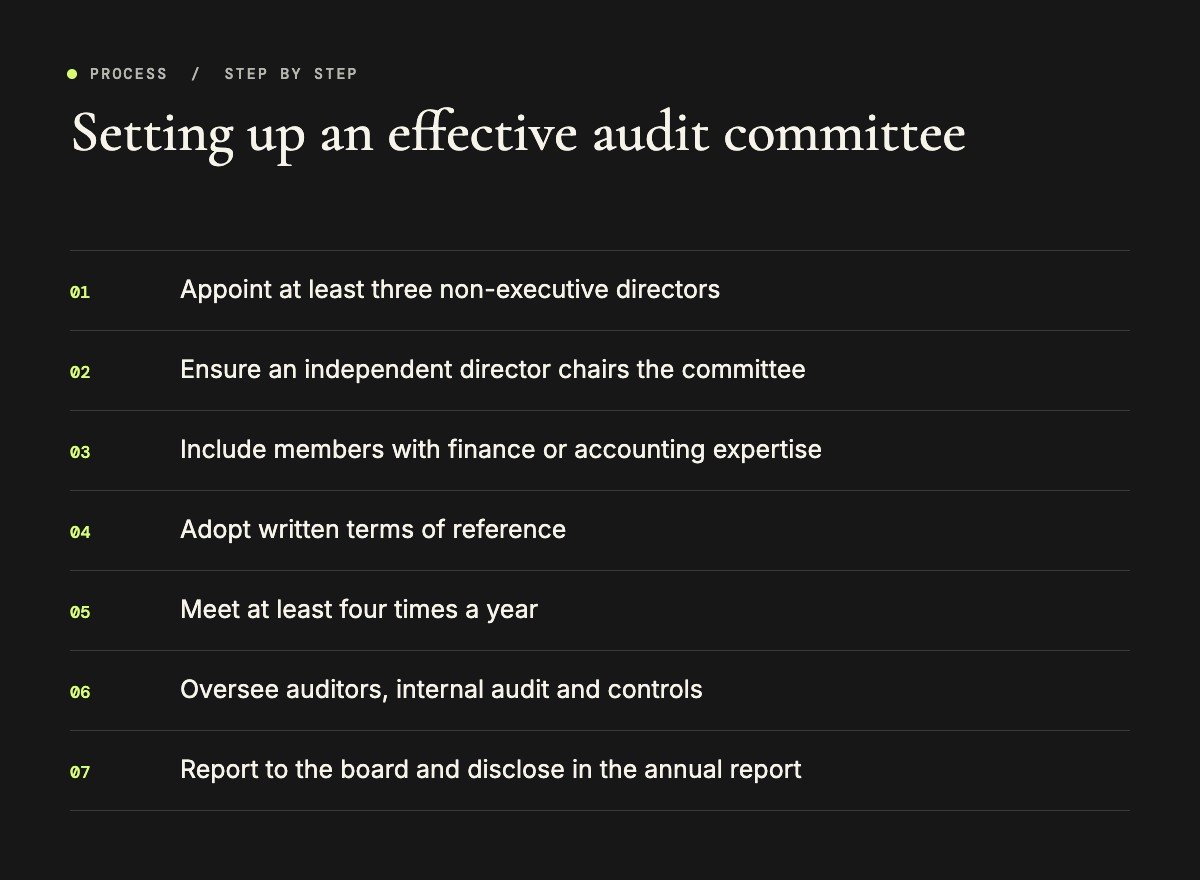
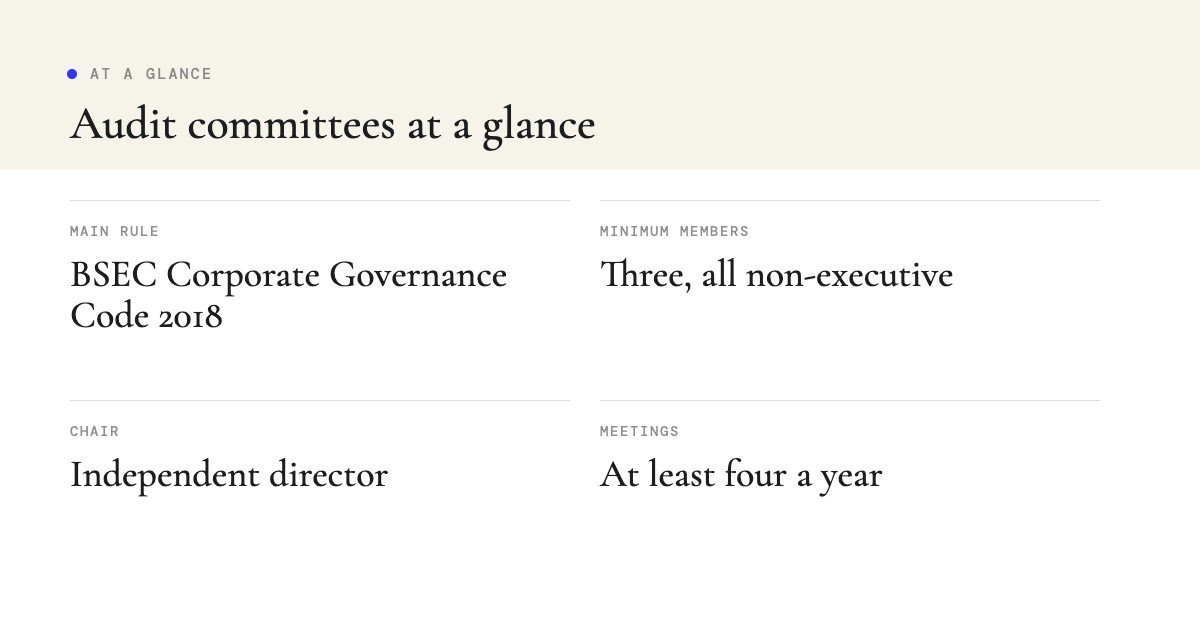
- The committee must have at least three members, all non-executive directors, including at least one independent director.
- The chair must be an independent director, and at least one member must have accounting or related financial management expertise.
- The committee should meet at least four times a year and report to the board, with disclosures in the annual report.
- Banks and financial institutions must also follow Bangladesh Bank guidelines on board audit committees.
Why audit committees matter
An audit committee gives independent directors a focused forum to challenge management on financial reporting and risk. It acts as a bridge between the board, management, internal auditors and external auditors, and helps detect problems early. Financial scandals in Bangladesh and abroad have shown how weak oversight can destroy value.
A well-functioning audit committee in Bangladesh also improves access to capital, as investors and lenders place greater trust in companies with strong governance. Our corporate governance practice advises boards on committee structure and compliance.
The legal framework for an audit committee in Bangladesh
The Bangladesh Securities and Exchange Commission issued the Corporate Governance Code by notification in June 2018, replacing earlier corporate governance guidelines. The Code applies to companies listed on the Dhaka and Chittagong stock exchanges on a comply basis for most requirements, and sets out rules on board composition, independent directors, the chief financial officer, company secretary, head of internal audit, the audit committee and the nomination and remuneration committee.
The Financial Reporting Act 2015 established the Financial Reporting Council, which oversees accounting and auditing standards and the conduct of auditors of public interest entities. Banks are also governed by the Bank Company Act 1991 and Bangladesh Bank circulars on board committees.
Composition of an audit committee in Bangladesh
| Requirement | Rule under the Code |
|---|---|
| Size | At least three members |
| Membership | All non-executive directors, with at least one independent director |
| Chair | An independent director, selected by the board |
| Expertise | All members financially literate; at least one with accounting or related financial management background and experience |
| Secretary | The company secretary acts as secretary of the committee |
| Quorum | Includes the presence of an independent director, as specified in the Code |
When a member's term ends or a vacancy arises, the board must fill it within the period set by the Code to keep the audit committee in Bangladesh properly constituted.
Meetings of the audit committee in Bangladesh
The Code requires the audit committee to meet at least four times in a financial year, and additional meetings may be called by the chair or at the request of members, auditors or the board. Meetings should be scheduled around the quarterly and annual financial reporting cycle so the committee can review statements before the board approves them.
The chair of the committee should attend the annual general meeting to answer shareholders' questions. Minutes should be properly recorded and circulated to the board.
Duties of the audit committee in Bangladesh
- Financial reporting. Oversee the financial reporting process and review quarterly, half-yearly and annual statements before board approval.
- Accounting policies. Monitor the choice and application of accounting policies and principles.
- Internal control. Review the adequacy of internal control and risk management systems.
- Internal audit. Oversee the internal audit function, its plan, resources and findings.
- External auditor. Oversee hiring and performance of external auditors and review their findings and management letters.
- Related-party transactions. Review significant related-party transactions submitted by management.
- Use of IPO proceeds. Review the utilisation of funds raised through public offerings.
Many audit committees spend most of their time on the financial statements and too little on internal controls and fraud risk. Schedule at least one meeting a year focused specifically on control weaknesses, whistleblowing reports and the internal audit plan.
Reporting to the board and regulators
The audit committee reports its activities to the board. Under the Code, if the committee finds conflicts of interest, suspected fraud or material irregularity in internal control, or suspected infringement of laws, it must report to the board immediately. If the board fails to rectify a reported matter that the committee considers material, the committee must report it to the Commission, after reporting to the board and management on at least two occasions or after a set period, as specified in the Code.
The annual report must include a report of the audit committee, signed by its chair, describing its activities during the year. This disclosure allows shareholders to assess how effectively the audit committee in Bangladesh performs its role.
Relationship with external auditors
External auditors of listed companies are appointed by shareholders, and the Code restricts auditors from providing certain non-audit services to audit clients, such as bookkeeping, valuation, internal audit and certain consulting work, to protect independence. Auditor rotation rules also apply. The audit committee should meet external auditors without management present at least once a year to discuss any concerns.
Banks and financial institutions
Banks must have a board audit committee under Bangladesh Bank guidelines, with requirements on size, independence, qualifications and frequency of meetings. Bank audit committees review inspection reports from Bangladesh Bank, compliance with regulatory directives, loan classification and provisioning, and internal audit findings. Finance companies under the Finance Company Act 2023 face similar governance expectations.
Because bank requirements are more detailed and frequently updated, banks should follow both the BSEC Code, if listed, and the latest Bangladesh Bank circulars for their audit committee in Bangladesh.
Terms of reference
Every audit committee in Bangladesh should have written terms of reference approved by the board. These set out the committee's purpose, authority, membership, meeting frequency, duties, reporting lines and access to information and advisers. The terms should authorise the committee to investigate any matter within its remit, seek information from any employee and obtain outside legal or professional advice at the company's expense when needed.
Reviewing the terms of reference annually ensures they remain aligned with the Code, Bangladesh Bank requirements where relevant and the company's risk profile.
Whistleblowing and fraud
An effective audit committee in Bangladesh oversees the company's whistleblowing arrangements, ensuring employees can report concerns about fraud, accounting irregularities or misconduct confidentially and without retaliation. The committee should receive regular reports on whistleblowing cases, investigations and outcomes, and ensure that serious allegations involving senior management are investigated independently.
Common weaknesses
- Members lacking the time or financial expertise to challenge management.
- Board papers circulated too late for proper review.
- Limited direct access to internal auditors.
- Failure to follow up on audit findings.
- Boilerplate annual report disclosures.
Addressing these weaknesses turns the audit committee in Bangladesh from a compliance formality into a genuine safeguard for shareholders.
Independent directors on the committee
Independent directors bring objectivity to the audit committee in Bangladesh. The Code sets criteria for independence, such as not holding significant shares, not having material business relationships with the company and not being related to sponsors or directors, and limits their tenure. Independent directors are appointed by the board and approved by shareholders, and the Code requires a minimum proportion of independent directors on the board.
For the committee to work well, independent members must be genuinely independent in mind as well as in form, willing to ask difficult questions and able to devote enough time. Companies should provide induction and ongoing training so that members understand the business, its risks and recent changes in accounting standards.
The role of the chief financial officer and head of internal audit
The Code requires listed companies to appoint a chief financial officer, a head of internal audit and compliance, and a company secretary, with defined roles. The head of internal audit should have direct access to the audit committee in Bangladesh, and the committee should be involved in the appointment and evaluation of this position. Regular private sessions between the committee and the head of internal audit encourage candid reporting.
The chief financial officer and chief executive must certify the financial statements to the board, confirming that they present a true and fair view and comply with standards. The committee reviews these certifications as part of its oversight.
Private companies and voluntary committees
Private companies are not required by the Code to form an audit committee, but many choose to do so, particularly those with private equity investors, development finance lenders or plans to list. A voluntary audit committee in Bangladesh can follow the Code as a benchmark while adapting the requirements to the company's size. Investors often require an audit committee as a condition of investment, with the right to appoint a member.
Establishing good practices early makes the transition to listed company governance much smoother.
Evaluating performance
Boards should evaluate the audit committee in Bangladesh annually, considering whether it has the right skills, receives timely information, challenges management effectively and follows up on issues. Feedback from auditors and management can help. Evaluation results should lead to concrete improvements, such as training, changes in membership or better meeting planning.
Technology, cyber risk and ESG reporting
Audit committees increasingly oversee risks beyond traditional accounting. Cyber security incidents can disrupt operations and expose customer data, while digital payment systems create new fraud risks. Many committees now receive regular briefings from the chief information security officer and review results of IT audits and penetration tests.
Sustainability and climate-related reporting is another growing area. As investors and lenders ask for environmental, social and governance information, the committee may be asked to review the reliability of non-financial data in annual reports. Clarifying which board committee owns each risk area avoids gaps and duplication, and helps the board demonstrate that emerging risks receive proper oversight.
Frequently asked questions about audit committee in bangladesh
Which companies must have an audit committee?
Listed companies under the BSEC Corporate Governance Code, and banks and financial institutions under Bangladesh Bank rules.
How many members are required?
At least three, all non-executive directors, including at least one independent director.
Who chairs the committee?
An independent director selected by the board.
How often must it meet?
At least four times in a financial year.
Must the committee report to BSEC?
Yes, in specified circumstances where the board fails to act on material findings.
Do private companies need one?
Not under the Code, but many adopt one voluntarily, especially with investors or lenders.
How we can help
We advise boards on establishing and running an audit committee in Bangladesh, drafting terms of reference, compliance reviews and investigations. Learn more about our corporate governance practice, our BSEC regulatory team and our compliance practice.
Strengthening board oversight?
We help audit committees meet the Code and add real value.
Book a consultationGovernance practicePrimary sources: the Corporate Governance Code from the Bangladesh Securities and Exchange Commission; board committee guidelines from Bangladesh Bank; the Financial Reporting Act 2015 on the Laws of Bangladesh portal.
This article is general information about Bangladeshi corporate governance rules as of October 2026 and is not legal advice. BSEC and Bangladesh Bank may revise requirements; check the current text.



0 Comments