
The quality of an arbitration depends on the arbitrators. Arbitrator appointment in Bangladesh is governed by the Arbitration Act 2001, which lets parties agree the number of arbitrators and the appointment procedure, provides default rules where they do not, and gives the courts power to appoint when a party refuses to cooperate. Getting appointment right avoids delay, challenges and later attacks on the award.
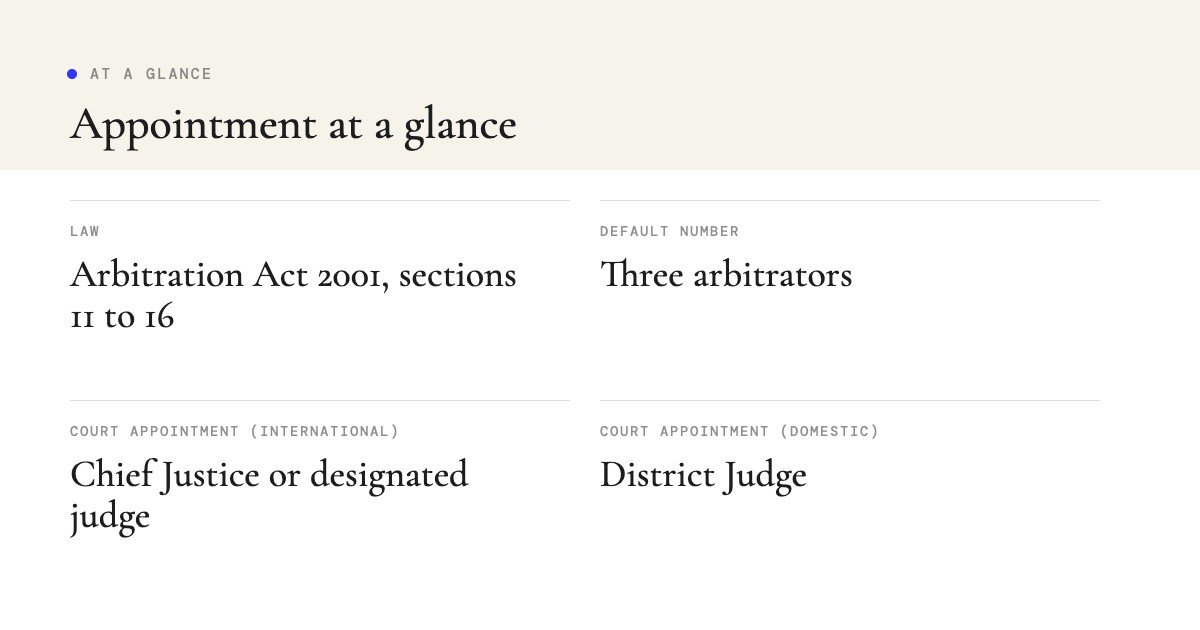
- Parties are free to agree the number of arbitrators; if they do not, the Arbitration Act 2001 provides for three.
- In a three-member tribunal, each party appoints one arbitrator and the two appointed arbitrators appoint the chair, unless agreed otherwise.
- If a party fails to appoint, the Chief Justice or a designated Supreme Court judge appoints in international commercial arbitration, and the District Judge in other arbitrations.
- Arbitrators must disclose circumstances likely to give rise to justifiable doubts about their independence or impartiality.
- Challenges must be made within the time allowed, and a successful challenge leads to appointment of a substitute.
The legal framework for arbitrator appointment in Bangladesh
Sections 11 to 16 of the Arbitration Act 2001 deal with the composition of the arbitral tribunal, appointment, grounds and procedure for challenge, failure or impossibility to act, and appointment of substitutes. Institutional rules, such as those of the Bangladesh International Arbitration Centre, ICC or SIAC, often supplement or modify these provisions where the parties have chosen them.
Arbitrator appointment in Bangladesh therefore starts with the arbitration agreement: the number of arbitrators, qualifications, the appointing authority and any time limits. Our international arbitration practice advises on appointments and challenges.
Number of arbitrators
Section 11 allows the parties to agree on the number of arbitrators; in practice, a sole arbitrator or a three-member tribunal is most common. If the parties have not agreed, the tribunal consists of three arbitrators.
A sole arbitrator is cheaper and faster, suitable for smaller disputes. Three arbitrators allow each party to nominate one and bring broader expertise, suitable for complex or high-value disputes.
Procedure for arbitrator appointment in Bangladesh
| Situation | Default procedure under the Act |
|---|---|
| Sole arbitrator | Parties agree; if they cannot within the time allowed, the court appoints on application |
| Three arbitrators | Each party appoints one; the two appoint the third, who presides |
| Party fails to appoint | On application, the court appoints |
| Appointed arbitrators fail to agree on the chair | On application, the court appoints |
The Act sets time limits, commonly thirty days, for appointments after a request by the other party. Parties may agree different time limits or an appointing institution.
Court-assisted arbitrator appointment in Bangladesh
When the agreed procedure fails, section 12 allows a party to apply for appointment. In international commercial arbitration, the application goes to the Chief Justice of Bangladesh or a judge of the Supreme Court designated by him. In other arbitrations, the application goes to the District Judge. The appointing authority considers any qualifications required by the agreement and the need for an independent and impartial arbitrator.
Court appointment is a common feature of arbitrator appointment in Bangladesh where one side is reluctant to arbitrate. Decisions on such applications are generally treated as final, to prevent delay.
Independence, impartiality and disclosure
Under section 13, a person approached for appointment must disclose any circumstances likely to give rise to justifiable doubts about their independence or impartiality, and this duty continues throughout the proceedings. Relevant circumstances include financial interests, past or present relationships with a party or its lawyers, prior involvement in the dispute and repeat appointments by the same party.
Many practitioners refer to the IBA Guidelines on Conflicts of Interest in International Arbitration as a benchmark when assessing disclosures, although they are not binding law in Bangladesh.
Challenges after arbitrator appointment in Bangladesh
An arbitrator may be challenged only if circumstances give rise to justifiable doubts about independence or impartiality, or if the arbitrator does not possess qualifications agreed by the parties. A party may challenge an arbitrator it appointed only for reasons it became aware of after the appointment.
Section 14 sets the procedure. Unless the parties agree otherwise, the challenging party must send a written statement of reasons to the tribunal within the time allowed after becoming aware of the grounds. If the arbitrator does not withdraw and the other party does not agree, the tribunal decides. Further recourse to the court may be available as the Act provides, and the arbitration can continue meanwhile.
Step by step
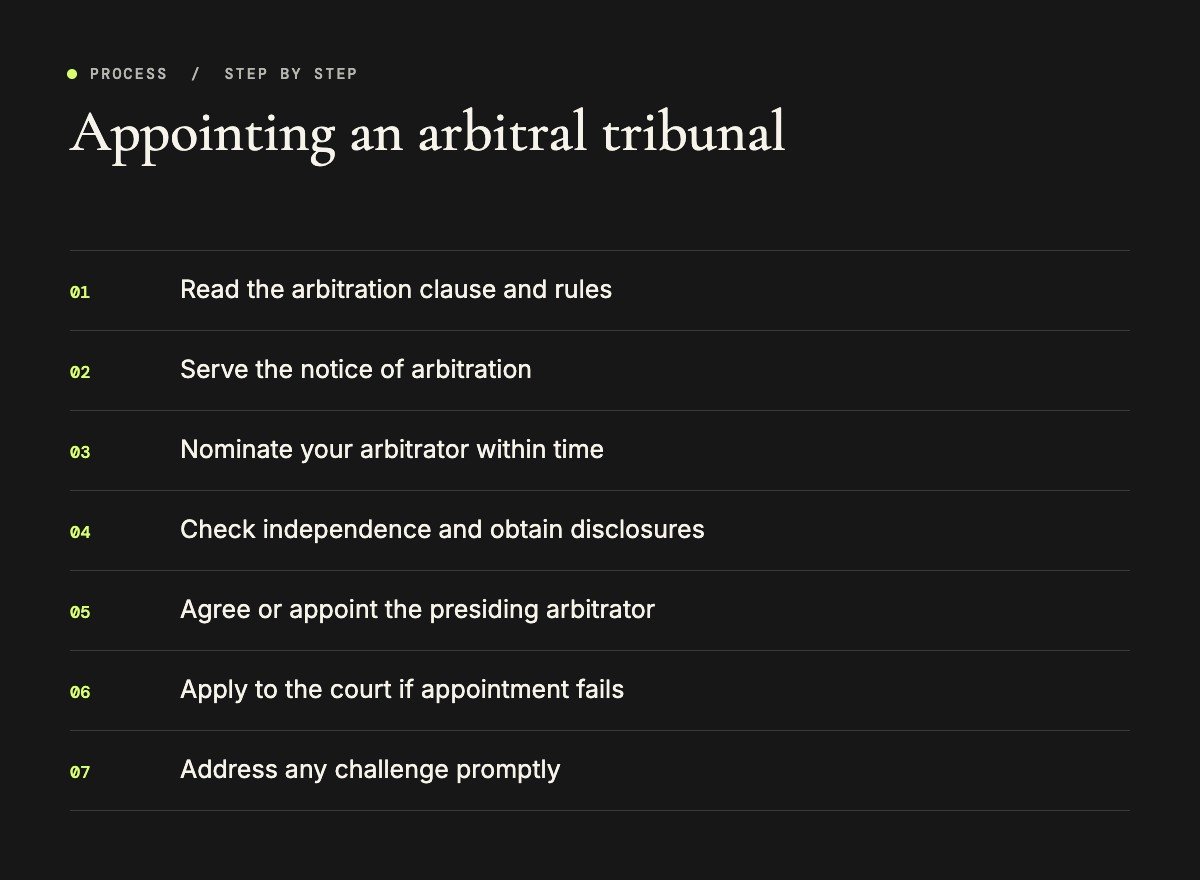
- Read the clause. Check the number, qualifications, appointing authority and deadlines.
- Serve notice. Send a notice of arbitration naming your arbitrator where required.
- Vet candidates. Check expertise, availability and conflicts.
- Obtain disclosures. Ask candidates for written disclosure statements.
- Agree the chair. Allow party-appointed arbitrators to select the presiding arbitrator.
- Apply to court. If appointment fails, apply to the Chief Justice's designee or District Judge.
- Manage challenges. Raise or answer challenges within time.
Do not contact a prospective arbitrator about the merits of the dispute. Limited pre-appointment interviews about availability, expertise and conflicts are generally acceptable, but discussions about the case can later be used to challenge the arbitrator.
Substitute arbitrator appointment in Bangladesh
If an arbitrator withdraws, is removed after a challenge, becomes unable to act or dies, a substitute is appointed under section 16 according to the rules that applied to the original appointment. The reconstituted tribunal decides whether earlier hearings need to be repeated. Delays caused by repeated withdrawals can be significant, so careful initial selection matters.
Choosing the right arbitrator
Successful arbitrator appointment in Bangladesh involves more than avoiding conflicts. Parties should consider legal expertise, industry knowledge, procedural experience, language skills, availability and reputation for managing cases efficiently. For construction disputes, an arbitrator with engineering or construction experience can be valuable; for financial disputes, banking expertise helps. Retired judges of the Supreme Court are frequently appointed in domestic arbitrations, while international cases often involve specialist practitioners from several jurisdictions.
Availability is critical. An excellent arbitrator who cannot schedule hearings for many months may delay the case significantly. Ask candidates about their current caseload before appointment.
Institutional appointments
Where parties choose institutional arbitration, the institution's rules usually govern appointment and challenges, and the institution acts as appointing authority if parties fail to agree. The Bangladesh International Arbitration Centre maintains a panel of arbitrators and rules for appointment. ICC and SIAC rules provide for confirmation of party nominations by the institution after reviewing disclosures. Institutional support can make arbitrator appointment in Bangladesh faster and reduce the need for court applications.
Fees and terms of appointment
Arbitrators' fees should be agreed at the outset, either by reference to institutional scales or by agreement with the parties. Clear terms covering hourly or fixed fees, deposits, cancellation charges and expenses avoid later disputes. In ad hoc arbitrations, parties and arbitrators often sign terms of appointment setting out fees, procedural matters and confidentiality.
Drafting the arbitration clause
Most problems with arbitrator appointment in Bangladesh can be prevented at the drafting stage. A good clause specifies the number of arbitrators, the method of appointment, the appointing authority if parties fail to agree, time limits, any required qualifications, the seat, the language and the applicable rules. Vague clauses such as "disputes shall be settled by arbitration" invite arguments about the procedure and delay the start of proceedings.
Naming an institution or a neutral appointing authority avoids reliance on court appointment and can save months. For international contracts, parties should also consider whether the chair should be of a different nationality from the parties.
Multi-party arbitrations
Where there are several claimants or respondents, appointment becomes more complicated, because each side must agree on a joint nominee. If they cannot, institutional rules often allow the institution to appoint the entire tribunal to ensure equal treatment. Ad hoc clauses should address multi-party appointment expressly, because the default provisions governing arbitrator appointment in Bangladesh assume two parties.
Common mistakes
- Missing the deadline to nominate an arbitrator.
- Appointing someone with an undisclosed connection to your company or lawyers.
- Discussing the merits with a prospective arbitrator.
- Delaying a challenge after learning of the grounds.
- Choosing an arbitrator without checking availability.
Avoiding these mistakes keeps arbitrator appointment in Bangladesh smooth and protects the eventual award from challenge.
Effect on the award
Improper composition of the tribunal can be a ground for setting aside an award or refusing enforcement, for example where the tribunal was not constituted in accordance with the parties' agreement or the Act. Parties who know of a defect but proceed without objection may lose the right to raise it later. Careful attention to arbitrator appointment in Bangladesh therefore protects the value of the final award.
Emergency arbitrators and expedited procedures
Modern institutional rules provide emergency arbitrator procedures, under which an institution appoints a single arbitrator within days to decide urgent interim relief before the full tribunal is constituted. Expedited procedures for smaller claims often provide for a sole arbitrator appointed by the institution even if the clause provides for three. The ICC Rules that apply to agreements concluded from June 2026 raised the expedited threshold for many cases. Parties should understand how these procedures interact with their clause, because they can change the appointment process significantly.
Whether emergency arbitrator decisions are enforceable in Bangladesh is uncertain, so parties needing urgent protection over local assets often also seek interim measures from the court under section 7A of the Arbitration Act 2001.
Arbitrator conduct after appointment
Once appointed, arbitrators must act fairly, give each party a reasonable opportunity to present its case and conduct the proceedings without unnecessary delay. Communications with one party in the absence of the other should be avoided. Parties concerned about an arbitrator's conduct should raise issues promptly with the tribunal and, where appropriate, through the challenge procedure.
Government parties
When a ministry or state-owned enterprise is a party, appointment may require internal approvals, which can cause delay. Clauses in government contracts often name an appointing authority. Private parties should build in realistic timelines and be ready to apply to court if the public body does not nominate its arbitrator within the agreed period, while keeping communications courteous and documented.
Frequently asked questions about arbitrator appointment in bangladesh
How many arbitrators are there by default?
Three, unless the parties agree otherwise.
Who appoints if a party refuses?
The Chief Justice or a designated judge in international arbitration, and the District Judge in domestic arbitration.
What must arbitrators disclose?
Any circumstances likely to give rise to justifiable doubts about independence or impartiality.
Can I challenge my own appointee?
Only for reasons you learned after the appointment.
Does the arbitration stop during a challenge?
Generally no; the tribunal may continue while the challenge is decided.
Can parties choose foreign arbitrators?
Yes, nationality does not bar appointment unless the parties agree otherwise.
How we can help
We advise on arbitrator appointment in Bangladesh, from drafting clauses and selecting arbitrators to court appointment applications and challenges. Learn more about our international arbitration practice, our ICC and LCIA team and our guide to arbitration in Bangladesh.
Starting an arbitration?
We help you build the right tribunal from the outset.
Book a consultationArbitration practicePrimary sources: the Arbitration Act 2001 on the Laws of Bangladesh portal; the UNCITRAL Model Law from UNCITRAL; institutional rules from the ICC.
This article is general information about Bangladeshi arbitration law as of October 2026 and is not legal advice. Time limits and procedures depend on the agreement and applicable rules.




0 Comments