
Contracts, tax filings, tenders and board approvals are increasingly signed online. A digital signature in Bangladesh has legal recognition under the Information and Communication Technology Act 2006, provided it meets the Act’s requirements and is backed by a certificate from a licensed certifying authority. Understanding what counts as a valid signature, and which documents still need wet ink or registration, helps businesses go paperless safely.
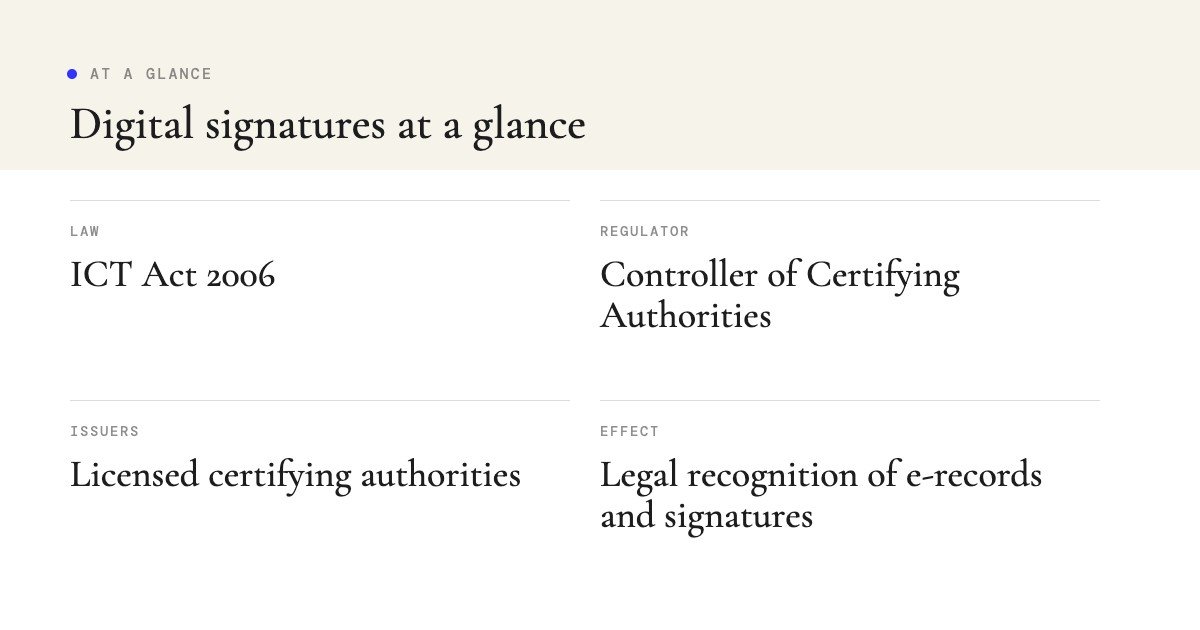
- The ICT Act 2006 gives legal recognition to electronic records and digital signatures, so that a legal requirement for signature can be satisfied electronically.
- Digital signatures are issued through licensed certifying authorities supervised by the Controller of Certifying Authorities.
- A digital signature certificate links a person's identity to a cryptographic key pair, enabling secure and verifiable signing.
- Certain documents, particularly those requiring registration such as conveyances of land, still follow traditional formalities.
- Simple electronic signatures, such as typed names or click-to-accept, may evidence agreement but carry less evidential weight than certified digital signatures.
The legal framework for digital signature in Bangladesh
The Information and Communication Technology Act 2006 is the main law. It recognises electronic records and digital signatures, provides for the appointment of a Controller of Certifying Authorities, licensing of certifying authorities, issue of digital signature certificates and the duties of subscribers. Some provisions of the ICT Act dealing with offences were later repealed and replaced by cyber security legislation, but the framework for electronic records and digital signatures continues.
A digital signature in Bangladesh therefore relies on a public key infrastructure overseen by the state. Our technology and digital practice advises businesses on e-signing and electronic contracts.
What a digital signature is
In the technical sense used by the ICT Act, a digital signature is created using asymmetric cryptography. The signer uses a private key to create a signature on a document, and anyone can verify it using the corresponding public key contained in a certificate issued by a certifying authority. If the document is altered after signing, verification fails, which protects integrity.
This differs from a scanned image of a handwritten signature pasted into a PDF, which offers little security. Businesses should understand this distinction when relying on a digital signature in Bangladesh for important documents.
Certifying authorities and certificates
| Role | Function |
|---|---|
| Controller of Certifying Authorities | Licenses and supervises certifying authorities and maintains standards |
| Licensed certifying authority | Verifies identity and issues digital signature certificates |
| Subscriber | Person or organisation holding the certificate and private key |
| Relying party | Person who verifies the signature using the certificate |
To obtain a certificate, the applicant provides identity documents, and organisational certificates require company documents and authorisation. Certificates have validity periods and must be renewed. If a private key is compromised, the subscriber must ask the certifying authority to revoke the certificate.
Legal effect of a digital signature in Bangladesh
Under the ICT Act, where any law requires information to be in writing or signed, that requirement is satisfied by an electronic record authenticated by a digital signature in the manner prescribed. Electronic records are admissible in evidence, and amendments to the Evidence Act have strengthened the treatment of digital evidence.
In practice, a certified digital signature in Bangladesh provides strong evidence of who signed and that the document has not changed. Courts will still consider the surrounding circumstances, such as whether the private key was properly controlled.
Documents that may need traditional formalities
Some transactions require specific formalities that electronic signing may not satisfy, particularly where registration with a sub-registry is required, such as sale deeds, mortgages and gifts of immovable property. Powers of attorney, wills and certain negotiable instruments have also traditionally required physical execution or special procedures. The ICT Act and related laws should be checked for exclusions and any reforms, as digital registration initiatives continue to develop.
When in doubt, use wet-ink signatures and the prescribed registration process for documents affecting title to land or requiring stamping and registration.
Using digital signatures in business
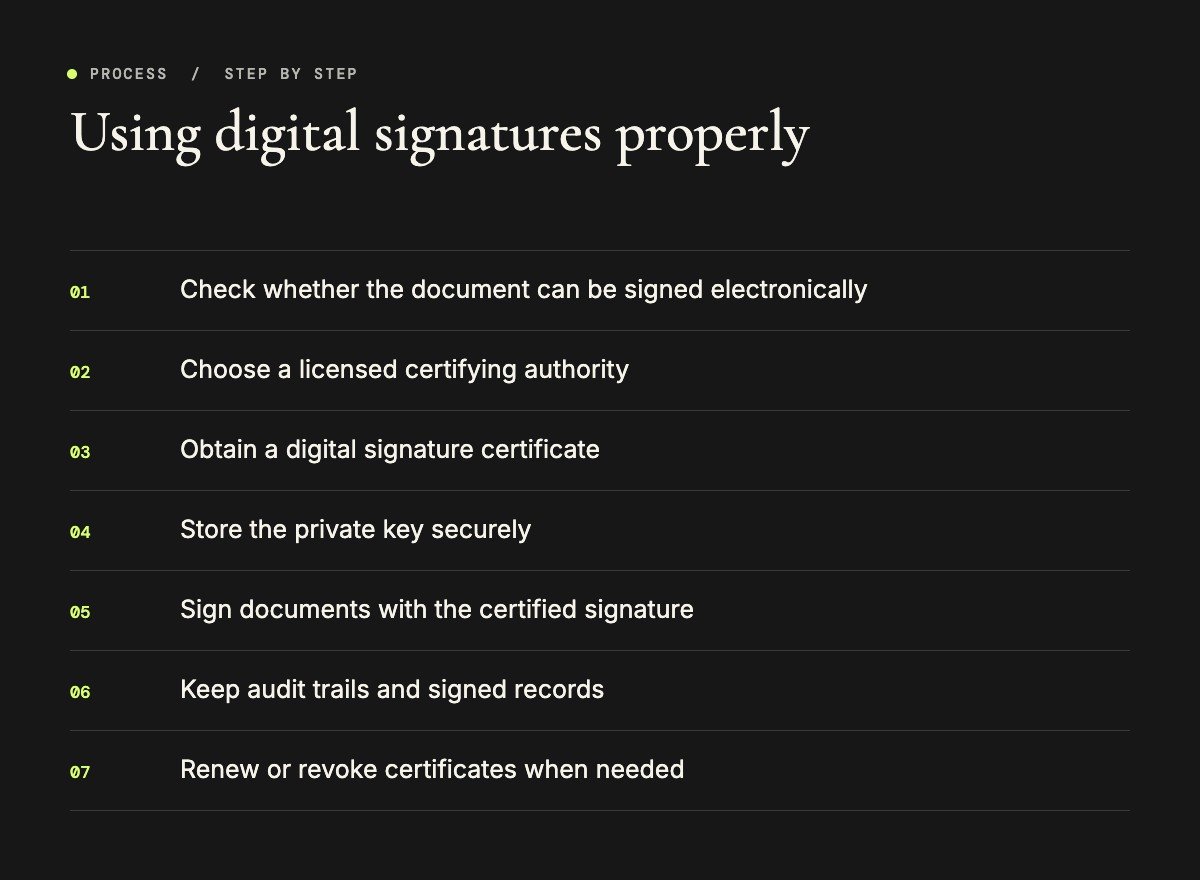
- Classify documents. Identify which can be signed electronically.
- Choose a provider. Obtain certificates from a licensed certifying authority.
- Issue certificates. Provide certificates to authorised signatories.
- Secure keys. Use tokens or secure modules to protect private keys.
- Sign and verify. Use compatible software and verify counterparty signatures.
- Keep records. Retain signed files and audit trails.
- Manage lifecycle. Renew, revoke and update authorisations as staff change.
Board resolutions should specify who may sign electronically on behalf of the company and for which documents. Without clear authority, counterparties may question whether an electronically signed document binds the company.
Electronic contracts and simple e-signatures
Many online contracts are formed by clicking "I agree" or exchanging emails. Under the Contract Act 1872 and ICT Act, such contracts can be valid, but proving who agreed may be harder than with a certified signature. For high-value or sensitive agreements, a certified digital signature in Bangladesh offers stronger protection. For routine transactions, simple e-signatures with good audit trails may be sufficient.
Digital signature in Bangladesh for government services
Government digitisation has expanded the use of electronic authentication. Online tax returns, e-procurement through the e-GP system, company filings with the RJSC and other services use electronic credentials, and some require or accept certified digital signatures for submissions. Public bodies increasingly issue digitally signed certificates with QR codes for verification. As more services move online, a digital signature in Bangladesh becomes a practical necessity for businesses that deal regularly with government.
Organisations should check each portal's requirements, as some use their own login credentials rather than certified signatures.
Banks and financial services
Banks use digital authentication for online banking, trade finance documents and internal approvals. Bangladesh Bank has encouraged digital onboarding and e-KYC. For high-value transactions, banks may require certified signatures or additional verification. Companies using a digital signature in Bangladesh for bank instructions should agree the process in writing with the bank, including authorised signatories and limits.
Cross-border signing
When contracting with foreign parties, consider whether the counterparty's electronic signature will be recognised in Bangladesh and vice versa. Foreign certificates may not be issued by authorities recognised under the ICT Act, which can affect evidential weight. Many international contracts rely on platform signatures with audit trails and choose foreign governing law and arbitration. For documents that must be used before Bangladeshi authorities, a digital signature in Bangladesh from a licensed authority, or traditional execution with notarisation and apostille, may be safer.
Security of private keys
The strength of a digital signature depends on the security of the private key. If someone else gains access to a signer's key, they can create signatures that appear genuine. Keys should be stored on secure hardware tokens or modules protected by PINs, never shared between employees and never stored in unprotected files or emails. Organisations should maintain registers of issued certificates and tokens, and recover tokens when employees leave.
The ICT Act places duties on subscribers to take reasonable care to keep their private keys secure. A subscriber who negligently allows misuse may face difficulty disputing a signature later, which makes key management a legal as well as technical issue.
Evidence in disputes
When a dispute arises over an electronically signed document, the party relying on it should be ready to show the certificate details, the verification result, the audit trail of the signing process and the integrity of the stored file. Expert evidence may be needed to explain how the signature was created and verified. Keeping complete records at the time of signing makes this much easier and strengthens reliance on a digital signature in Bangladesh in court or arbitration.
Practical tips
- Adopt an e-signing policy approved by the board.
- Use licensed certifying authorities for important documents.
- Protect private keys with hardware tokens and PINs.
- Keep audit trails and original signed files.
- Use wet ink and registration where the law requires.
These steps help organisations use digital signature in Bangladesh efficiently while managing legal risk.
HR documents and employment
Employers increasingly issue offer letters, employment contracts, policies and payslips electronically. Most of these can be signed or acknowledged electronically, but employers should keep reliable records of employee acceptance. For documents with significant legal consequences, such as settlement agreements or resignations in disputed situations, a certified digital signature in Bangladesh or wet-ink signature provides stronger evidence. Workers covered by the Bangladesh Labour Act 2006 should receive documents in a language and format they understand, so electronic processes should remain accessible to staff who may not use email or smartphones regularly.
Corporate filings and records
Companies maintain statutory registers, minutes and resolutions. Electronic minutes and registers can be kept if they satisfy legal requirements for accuracy and accessibility, and company secretaries should ensure that electronically signed resolutions comply with the articles of association. Filings with the RJSC are increasingly made online. Where the articles require a common seal or specific signatories, check whether electronic execution is permitted and amend the articles if necessary to allow digital execution.
Cost and adoption
Certificates from licensed authorities are relatively inexpensive compared with the time and courier costs saved by signing remotely. For organisations with many signatories, enterprise solutions integrating digital signatures into document workflows can improve efficiency and control. Start with internal approvals and low-risk documents, then extend use as staff gain confidence and processes mature.
Future developments
Bangladesh continues to expand digital government services, e-registration initiatives and digital identity systems linked to the national ID database. Reforms may extend electronic execution to more document types, including some that currently require physical registration. Businesses should monitor changes to the ICT Act, registration laws and sector rules, and update their e-signing policies so that a digital signature in Bangladesh remains effective as the legal landscape evolves. Working with advisers who follow these developments helps organisations adopt new options early and safely, while avoiding reliance on processes the law does not yet recognise.
Training staff
Technology alone is not enough. Staff who sign documents need to understand how certificates work, why private keys must never be shared and how to verify signatures from others. Short training sessions and simple written guidance prevent many security incidents and disputes.
Frequently asked questions about digital signature in bangladesh
Are digital signatures legally valid in Bangladesh?
Yes, under the ICT Act 2006 when created in the prescribed manner.
Who issues digital signature certificates?
Licensed certifying authorities supervised by the Controller of Certifying Authorities.
Is a scanned signature a digital signature?
No, a scanned image is not a cryptographic digital signature, though it may still evidence intent.
Can I sign a land sale deed digitally?
Land transfers generally require registration under the Registration Act; follow the prescribed process.
Are emails binding contracts?
They can be, if offer, acceptance and other elements are present.
What if my private key is stolen?
Ask the certifying authority to revoke the certificate immediately.
How we can help
We advise on digital signature in Bangladesh, electronic contracts, e-signing policies and disputes over electronic evidence. Learn more about our technology and digital practice, our corporate team and our guide to board resolutions.
Going paperless?
We help you sign electronically with confidence.
Book a consultationTechnology practicePrimary sources: the ICT Act 2006, Contract Act 1872 and Evidence Act 1872 on the Laws of Bangladesh portal; e-procurement using digital processes on e-GP.
This article is general information about Bangladeshi law as of October 2026 and is not legal advice. Check current rules and exclusions before relying on electronic signing for a particular document.




0 Comments