
When a borrower defaults and secured assets are at risk of being stripped, sold or neglected, lenders need a way to take control quickly. Receiver appointment in Bangladesh is one of the most effective tools available: a court can appoint a neutral person to take possession of property, collect income and preserve value until the dispute is resolved or the asset is sold.
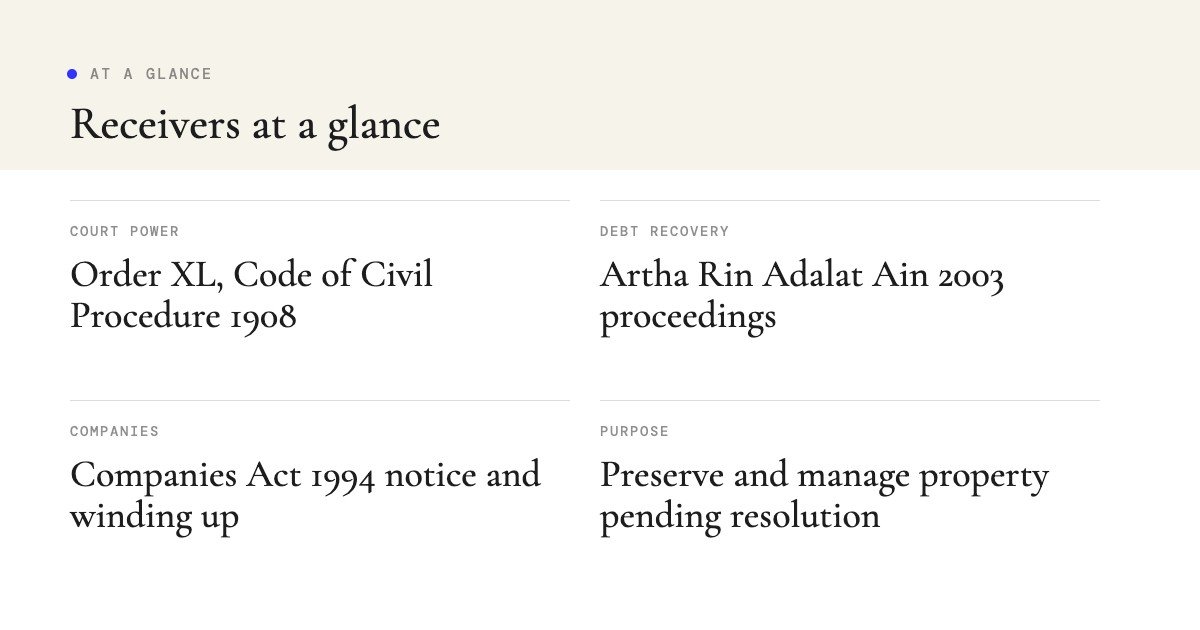
- Courts in Bangladesh can appoint a receiver under Order XL of the Code of Civil Procedure 1908 where it appears just and convenient.
- Receivers can take possession of property, collect rents and profits, manage businesses and preserve assets pending litigation.
- Secured lenders use receivers in mortgage suits, Artha Rin Adalat proceedings and company disputes.
- Out-of-court receivers appointed under security documents have limited practical use without court support.
- Appointment of a receiver over company property should be notified to the Registrar of Joint Stock Companies and Firms.
What a receiver does
A receiver is an independent person appointed to take control of property that is the subject of a dispute or security. The receiver acts as an officer of the court, not as an agent of either party, and must manage the property impartially. Typical tasks include taking possession, collecting rents and receivables, paying necessary expenses, maintaining insurance, keeping accounts and, where authorised, running a business or selling assets.
For a secured lender, receiver appointment in Bangladesh stops a defaulting borrower from dissipating assets while recovery proceedings move through the courts. Our restructuring and insolvency practice regularly advises lenders on interim protection.
The legal basis for receiver appointment in Bangladesh
Order XL, rule 1 of the Code of Civil Procedure 1908 allows a court, where it appears just and convenient, to appoint a receiver of any property, remove any person from possession or custody of the property, commit the property to the receiver, and confer on the receiver powers of management, collection of rents and profits, and realisation. The court may also fix the receiver’s remuneration and require security and accounts.
| Source | Context |
|---|---|
| Code of Civil Procedure 1908, Order XL | General power of civil courts in suits, including mortgage and partition suits |
| Artha Rin Adalat Ain 2003 | Money loan court proceedings by financial institutions, applying civil procedure where consistent |
| Companies Act 1994 | Notice of appointment of receivers over company property; official liquidators in winding up |
| Bankruptcy Act 1997 | Receivers in bankruptcy proceedings |
| Security documents | Contractual powers to appoint a receiver on default |
Statutes are available on the official Laws of Bangladesh website.
When courts grant receiver appointment in Bangladesh
Receivership is a discretionary and serious remedy because it takes property out of the hands of the person in possession. Courts usually look for a good prima facie case, a real risk that the property will be wasted, damaged, alienated or misapplied, and a finding that other remedies, such as an injunction, are inadequate. The applicant’s own conduct matters, and courts are slow to remove a party in long, settled possession without strong grounds.
In practice, receiver appointment in Bangladesh is most often granted where rental income is being diverted, where a mortgaged property is deteriorating, where co-owners or partners are in deadlock, or where a borrower is moving hypothecated stock or machinery out of reach.
Receivers in money loan court proceedings
Banks and financial institutions recover defaulted loans through the Artha Rin Adalat under the Artha Rin Adalat Ain 2003. The Act provides for sale of mortgaged and pledged property without court intervention in certain cases and for execution of decrees, and the civil procedure code applies where it is not inconsistent. Lenders can therefore seek interim relief, including a receiver, to protect secured assets while the suit is pending or during execution.
A receiver appointment in Bangladesh in this context is especially useful for income-generating property, such as a leased commercial building or a running factory, where the borrower would otherwise keep collecting income while the lender waits for a decree. Our banking and finance team handles these applications.
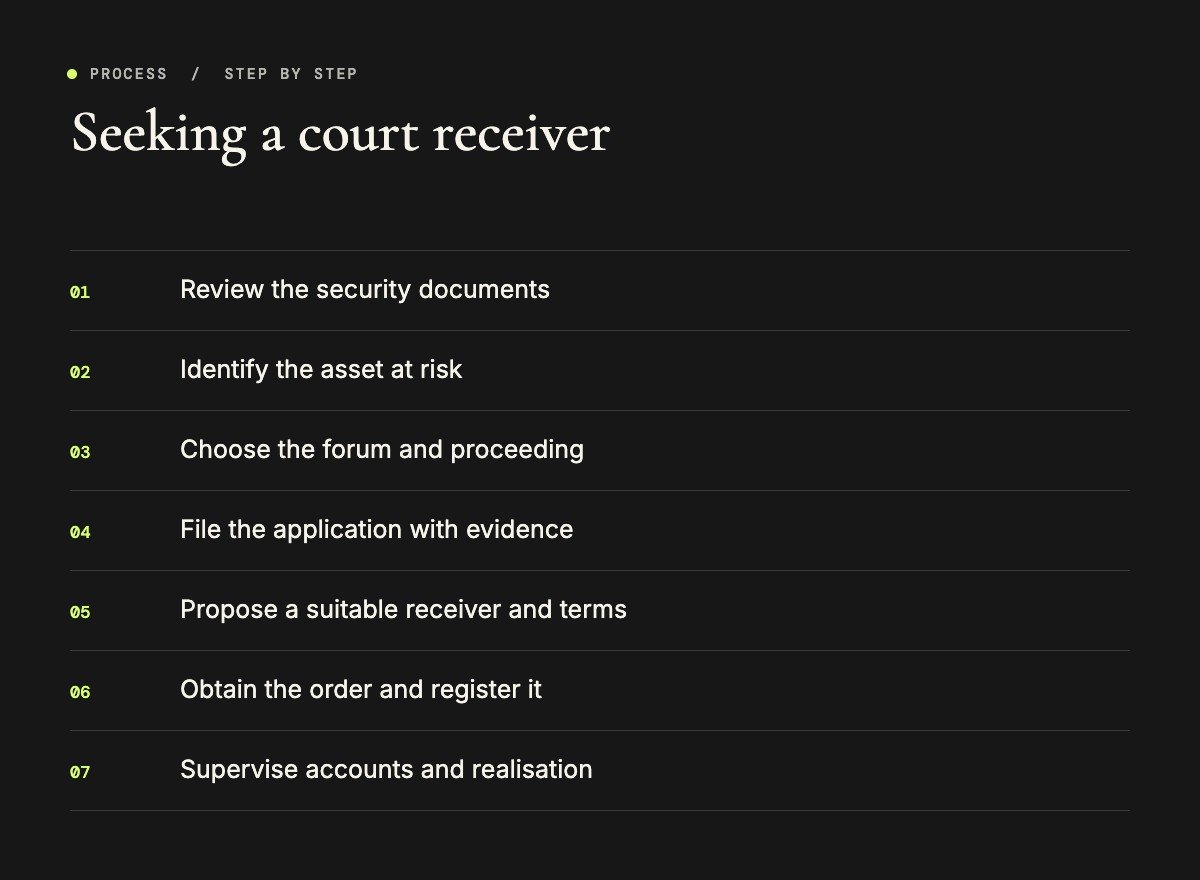
Seeking a court receiver step by step
- Review the security. Confirm the mortgage, hypothecation or pledge is valid, registered and enforceable.
- Identify the risk. Gather evidence that the asset or its income is at risk.
- Choose the forum. Civil court, Artha Rin Adalat, company bench of the High Court Division or bankruptcy court.
- File the application. Support it with affidavits, documents and valuation evidence.
- Propose a receiver. Suggest an independent, competent person and draft terms covering powers, remuneration and reporting.
- Obtain and register the order. Notify the RJSC where company property is involved, and inform tenants and debtors.
- Supervise. Review accounts and apply for further directions, including sale, as needed.
Courts are more willing to appoint a receiver when the applicant proposes clear, limited terms. An order to collect rents into a designated account and report quarterly is easier to grant than a broad order to take over a business.
Contractual receivers under security documents
Mortgage deeds and debentures, especially those drafted on English models, often give the lender power to appoint a receiver on default without going to court. In Bangladesh, such a receiver’s practical power is limited: if the borrower refuses to hand over possession, the receiver usually cannot use force and must go to court. Contractual receivership clauses remain useful, however, because they show the parties agreed to receivership and can support an application for a court order.
For transactions with foreign lenders, it is common to combine a contractual receivership clause with an agreement to submit to the jurisdiction of Bangladeshi courts for interim relief. That combination gives the best chance of a swift receiver appointment in Bangladesh when it matters.
Powers and duties after receiver appointment in Bangladesh
The receiver’s powers come from the court order, so they should be drafted carefully. Common powers include taking possession, collecting rents and debts, paying outgoings, insuring and repairing property, bringing and defending proceedings in relation to the property, and, if authorised, carrying on business or selling assets. The receiver must act with reasonable care, keep proper accounts, file them as directed and pay balances as the court orders.
A receiver who fails to account, causes loss through wilful default or gross negligence, or acts beyond the order can be held personally liable, and the court can attach the receiver’s property to make good the loss. These safeguards protect both lenders and owners in any receiver appointment in Bangladesh.
Receivers and companies
Where a receiver is appointed over the property of a company, notice should be filed with the Registrar of Joint Stock Companies and Firms, and company documents may need to state that a receiver has been appointed. If the company later goes into winding up, the official liquidator takes control of the company’s assets, and the relationship between the receiver and liquidator must be managed through court directions. Secured creditors can generally stand outside the winding up and realise their security, but timing and court supervision are important.
Shareholder disputes can also lead to a receiver appointment in Bangladesh where the company’s business is at risk from deadlock or mismanagement, often in proceedings before the company bench of the High Court Division.
Resisting or discharging a receiver appointment in Bangladesh
Borrowers and owners can oppose an application by showing there is no real risk to the property, that the lender has adequate security, that the debt is disputed, or that a less drastic remedy will do. Once appointed, a receiver can be discharged when the purpose has been achieved, when the dispute is settled, when the debt is repaid, or if the receiver misconducts the receivership. Appeals lie against orders under Order XL, and the High Court Division can stay or vary them.
Costs and timing
The cost of a receiver appointment in Bangladesh includes court fees, legal fees, the receiver’s remuneration and expenses of managing the property. These are usually paid from income or sale proceeds, but the applicant may need to fund initial costs. Timing varies by court and urgency; an ex parte interim order can sometimes be obtained quickly where there is clear evidence of imminent harm, followed by a full hearing.
Choosing the right receiver
The success of a receiver appointment in Bangladesh often depends on the person chosen. For a rented commercial building, an experienced property manager or chartered accountant may be best. For a running factory, the receiver needs operational knowledge or must be able to engage managers. Courts look for independence, so a lender’s own employee is rarely appropriate. Proposing a candidate with relevant experience, clear fee terms and willingness to give security makes the application more persuasive.
Receivership versus other remedies
Lenders should weigh receivership against alternatives. A temporary injunction can stop a sale or transfer but does not secure income. Attachment before judgment under Order XXXVIII of the civil procedure code can freeze assets where the defendant is trying to defeat a decree. The Artha Rin Adalat Ain allows sale of mortgaged property in specified circumstances. Each remedy has different thresholds and effects, and in many cases a combination works best, with receiver appointment in Bangladesh reserved for assets that generate income or require active management.
Evidence that persuades the court
Judges decide receivership applications largely on documents. Strong applications include certified copies of the registered mortgage or hypothecation, loan statements showing default, demand notices, recent photographs or inspection reports showing deterioration, tenancy schedules showing diverted rent, and valuation reports. Where the borrower is moving stock or machinery, evidence such as gate passes, witness statements or bank statements can show urgency. Presenting this material clearly and concisely, with a draft order, improves the chance of interim relief.
Lenders should also be candid about any weaknesses, such as disputed amounts or competing charges, because failure to disclose material facts in an ex parte application can lead to the order being set aside.
Frequently asked questions about receiver appointment in bangladesh
Which law allows a court to appoint a receiver?
Order XL of the Code of Civil Procedure 1908, together with special statutes such as the Bankruptcy Act 1997.
Can a bank appoint a receiver without court?
Security documents may allow it, but without court backing a private receiver often cannot take possession if the borrower resists.
Who can be appointed receiver?
Any suitable independent person, often a lawyer, accountant or court official, approved by the court.
Who pays the receiver?
The court fixes remuneration, usually paid from the income or proceeds of the property.
Can the receiver sell the property?
Only if the court authorises sale or the governing statute permits it.
Does a receiver over company property need registration?
Yes, notice of the appointment should be given to the Registrar of Joint Stock Companies and Firms.
How we can help
We act for banks, financial institutions and investors seeking receiver appointment in Bangladesh, and for borrowers and owners resisting or discharging receivership. Learn more about our restructuring and insolvency practice, our banking and finance team and our commercial litigation practice.
Secured assets at risk?
We move quickly to protect collateral through the courts.
Book a consultationRestructuring and insolvencyPrimary sources: the Code of Civil Procedure 1908, the Artha Rin Adalat Ain 2003, the Companies Act 1994 and the Bankruptcy Act 1997 on Laws of Bangladesh; court information from the Supreme Court of Bangladesh.
This article is general information about Bangladeshi law as of October 2026 and is not legal advice. Receivership is discretionary and fact-specific.




0 Comments