
Foreign investors weighing Bangladesh want to know one thing first: how safe is my capital? Foreign investment law in Bangladesh rests on the Foreign Private Investment (Promotion and Protection) Act 1980, which promises fair treatment, protection against expropriation and the right to repatriate capital and returns. These promises are reinforced by exchange control rules, investment treaties and international arbitration options.
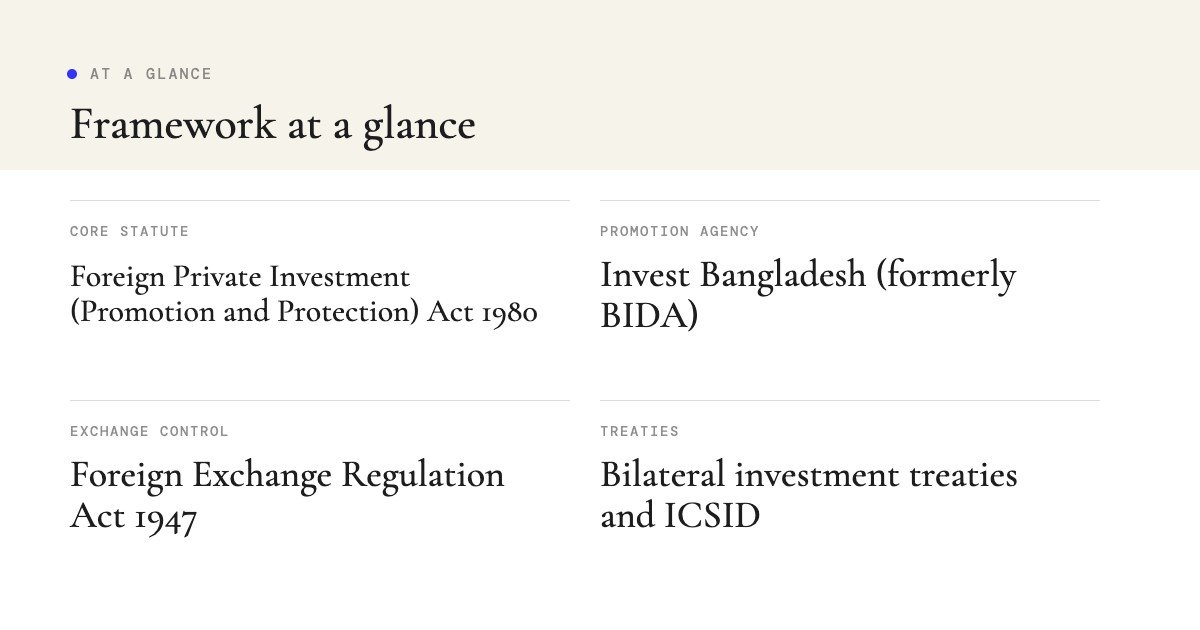
- The Foreign Private Investment (Promotion and Protection) Act 1980 is the cornerstone of foreign investment law in Bangladesh.
- The Act provides for fair and equitable treatment, protection against expropriation without compensation, and repatriation of invested capital and profits.
- Invest Bangladesh (formerly BIDA) registers and facilitates most investment outside the economic and export processing zones.
- Exchange control under the Foreign Exchange Regulation Act 1947 governs how money comes in and goes out, so correct documentation is essential.
- Bilateral investment treaties and ICSID membership give an additional layer of international protection.
Why foreign investment law in Bangladesh matters
Bangladesh has opened most sectors to foreign ownership, with 100% foreign shareholding allowed in the large majority of industries. Openness alone is not enough, though. Investors need legal assurance that their assets will not be taken arbitrarily, that they can move money out, and that disputes will be resolved fairly. Foreign investment law in Bangladesh supplies these assurances through a mix of domestic statutes and international commitments.
Our foreign direct investment practice helps investors structure entry so they benefit from every available protection.
The Foreign Private Investment (Promotion and Protection) Act 1980
The 1980 Act applies to foreign private investment sanctioned or approved under it and covers investment in industrial undertakings. It sets out the core guarantees that the government gives to foreign investors. Although the Act is short, its principles have been repeated in investment policy statements, industrial policies and treaties for over four decades.
| Protection | What it means in practice |
|---|---|
| Fair and equitable treatment | Foreign investment receives treatment no less favourable than comparable domestic investment |
| Protection and security | The state undertakes to protect foreign investment |
| Expropriation | No expropriation or nationalisation except for public purpose and against adequate compensation |
| Repatriation | Transfer of invested capital, profits and sale proceeds abroad, subject to exchange control procedure |
| Double taxation | Relief under double taxation agreements where applicable |
The text of the Act is available on the official Laws of Bangladesh website.
Protection against expropriation under foreign investment law in Bangladesh
A central promise of foreign investment law in Bangladesh is that foreign investment will not be expropriated or nationalised except for a public purpose and against adequate compensation, payable and repatriable in foreign currency. This guarantee is particularly important for capital-intensive projects in energy, infrastructure and manufacturing, where assets are immovable and the investment horizon is long.
Indirect expropriation, such as regulatory measures that destroy the value of an investment, is less clearly addressed in the domestic Act. Investment treaties often provide broader protection here, which is one reason structuring through a treaty partner jurisdiction can add value.
Repatriation of capital and profits
The right to repatriate is only as good as the paperwork behind it. Capital must be brought into Bangladesh through formal banking channels, and the investee company should hold encashment certificates and properly issued share certificates. Dividends, sale proceeds and liquidation proceeds can then be remitted through an authorised dealer bank in line with the Bangladesh Bank Guidelines for Foreign Exchange Transactions, after tax is paid.
Share transfers between residents and non-residents also need correct valuation and reporting. Bangladesh Bank has issued circulars on share transfer procedures, including a March 2026 circular on transfers involving non-residents, so current requirements should be checked before closing a deal. Exchange control rules are published by Bangladesh Bank.
Institutions that administer foreign investment law in Bangladesh
Invest Bangladesh, formerly the Bangladesh Investment Development Authority, registers industrial projects and branch, liaison and representative offices, approves work permits for foreign nationals and provides one-stop services. Investment inside export processing zones is handled by the Bangladesh Export Processing Zones Authority, economic zones by BEZA, and hi-tech parks by the Hi-Tech Park Authority. Sector regulators, such as BTRC for telecoms or the Bangladesh Energy Regulatory Commission for energy, add licensing layers.
Detailed information is available from Invest Bangladesh.
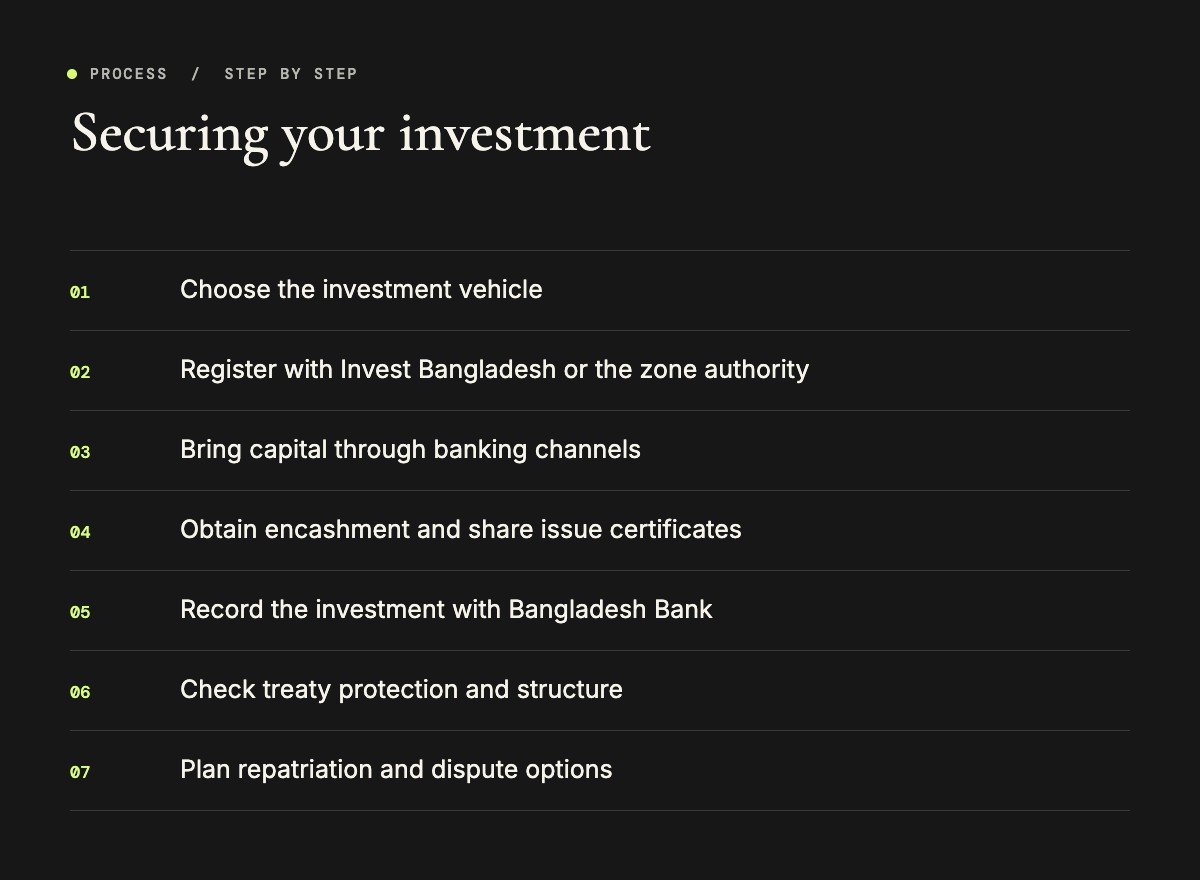
Securing your investment step by step
- Choose the vehicle. Subsidiary, joint venture, branch or liaison office, each with different protection and tax outcomes.
- Register. With Invest Bangladesh or the relevant zone authority.
- Bring in capital properly. Through an authorised dealer bank, with inward remittance documentation.
- Document the shares. Obtain encashment certificates and file allotment returns with the RJSC.
- Report. Ensure the bank reports the investment to Bangladesh Bank.
- Consider treaty structuring. Review whether a holding company in a treaty jurisdiction adds protection.
- Plan exits and disputes. Agree arbitration clauses and repatriation mechanics in shareholder agreements.
The most common reason investors struggle to repatriate is missing documentation from the original investment, such as a lost encashment certificate or capital brought in informally. Fixing this years later is slow, so get it right at entry.
Bilateral investment treaties and ICSID
Bangladesh has signed bilateral investment treaties with a range of countries in Europe, Asia and the Middle East, including the United Kingdom, Germany, the Netherlands, Singapore and China among others. These treaties typically protect against unlawful expropriation, guarantee fair and equitable treatment and free transfers, and allow investors to bring claims directly against the state before international arbitration tribunals.
Bangladesh is also a party to the ICSID Convention and a member of the Multilateral Investment Guarantee Agency, which offers political risk insurance. For large projects, these international instruments complement foreign investment law in Bangladesh and give investors a neutral forum if a dispute with the state arises. Investors should check whether their home country, or an intermediate holding jurisdiction, has an in-force treaty with Bangladesh and what it covers.
Sector restrictions and approvals under foreign investment law in Bangladesh
Although most sectors are open, some activities are reserved for the state or restricted, and others require prior permission or are subject to foreign ownership caps. Examples include arms and ammunition, nuclear energy and certain security printing activities, which are reserved, and sectors such as telecoms, banking, insurance and broadcasting, which require licences and may carry ownership limits. The current industrial policy and Invest Bangladesh guidance list these sectors and should be reviewed before committing capital.
Sector regulators may impose their own conditions on foreign shareholders, such as minimum capital, local partners or approvals for change of control, so foreign investment law in Bangladesh must be read alongside the relevant sector legislation.
Tax incentives and treaty relief
Foreign investors may benefit from tax holidays and reduced rates in priority sectors and in economic and export processing zones, subject to conditions set by the Income Tax Act 2023 and statutory regulatory orders. Bangladesh has also entered into double taxation agreements with many countries, which can reduce withholding tax on dividends, interest and royalties. Planning these incentives at the outset improves returns and avoids disputes with tax authorities later.
Dispute resolution options
Disputes between foreign investors and private Bangladeshi parties are usually resolved by arbitration under the Arbitration Act 2001, with seats in Dhaka, Singapore or London depending on the contract. Bangladesh is a party to the New York Convention, so foreign arbitral awards can be enforced through the Bangladeshi courts. Disputes with the state may also be brought under an applicable investment treaty. Choosing the right forum early is one of the most practical ways to make foreign investment law in Bangladesh work for an investor.
Reform and the future of foreign investment law in Bangladesh
Successive governments have discussed modernising the 1980 Act, including proposals for a new foreign investment law that would consolidate protections, clarify investor-state dispute settlement and streamline approvals. Investors should monitor developments, but existing protections continue to apply to investments made under the current framework, and treaties generally protect existing investments even if domestic law changes.
Joint ventures and shareholder protection
Many foreign investors enter through a joint venture with a Bangladeshi partner. In that case, the protections in foreign investment law in Bangladesh operate against the state, but day-to-day protection against the partner comes from the company’s articles of association and the shareholders’ agreement. Key terms include reserved matters requiring the foreign investor’s consent, board composition, deadlock resolution, pre-emption rights, drag and tag rights, and exit mechanisms such as put and call options.
Because Bangladeshi courts give primacy to the articles of association, important shareholder agreement terms should be reflected in the articles so they bind the company and future shareholders. Pricing formulas for exits must also be compatible with exchange control rules on valuation of shares transferred between residents and non-residents.
Foreign loans and other inflows
Equity is not the only form of investment. Foreign shareholder loans and external commercial borrowing are regulated by Bangladesh Bank and Invest Bangladesh, with consolidated rules issued in 2026 covering long-term borrowing and intra-group short-term loans. Interest rate caps, tenor requirements and registration rules apply. Correctly approved and registered loans can be repaid and serviced abroad, which is another practical dimension of foreign investment law in Bangladesh that investors must plan for.
Practical checklist for investors
Before investing, confirm that the sector is open, identify the licences required, choose the investment vehicle, check treaty coverage, and set up banking arrangements for inward remittance. After investing, keep complete records of every inflow, file annual returns, pay taxes on time and obtain tax clearance before repatriation. Following this checklist keeps the protections of foreign investment law in Bangladesh available when they are needed most.
Employment of foreign nationals
Foreign-owned companies often need expatriate managers and technical staff. Work permits are issued by Invest Bangladesh, BEPZA, BEZA or the Hi-Tech Park Authority depending on where the company operates, and the employee also needs the correct employment visa. Ratio rules between local and foreign staff, salary remittance limits and tax registration apply. Getting these approvals right supports the smooth running of the investment and avoids penalties.
Frequently asked questions about foreign investment law in bangladesh
What is the main foreign investment statute?
The Foreign Private Investment (Promotion and Protection) Act 1980.
Can foreigners own 100% of a company?
Yes in most sectors, though some sectors are restricted or require sector approvals.
Is expropriation possible?
Only for public purpose and against adequate compensation, according to the 1980 Act.
Can profits be repatriated?
Yes, after tax, through an authorised dealer bank with proper documentation.
Does Bangladesh have investment treaties?
Yes, Bangladesh has signed bilateral investment treaties with a number of countries and is a member of ICSID.
Who registers foreign investment?
Invest Bangladesh (formerly BIDA), or BEPZA, BEZA or the Hi-Tech Park Authority for zone projects.
How we can help
We advise investors on entry structuring, registration, exchange control compliance, repatriation and treaty protection under foreign investment law in Bangladesh. See our foreign direct investment practice, our corporate team and our international arbitration practice.
Planning to invest in Bangladesh?
We help you structure an investment that is protected from day one.
Book a consultationForeign investmentPrimary sources: the Foreign Private Investment (Promotion and Protection) Act 1980 on Laws of Bangladesh; foreign exchange guidance from Bangladesh Bank; registration information from Invest Bangladesh.
This article is general information about Bangladeshi law as of October 2026 and is not legal advice. Investment rules and circulars change; take advice on your specific project.




0 Comments