
Jamdani, Ilish, Khirsapat mango, Dhakai muslin: these products owe their reputation to the places where they are made or grown. A geographical indication in Bangladesh protects that link in law, preventing others from using the name for goods that do not come from the region or meet its standards. With 64 registered GIs reported in Parliament in June 2026, and many more in the pipeline, GI protection has become a practical tool for producers and exporters.
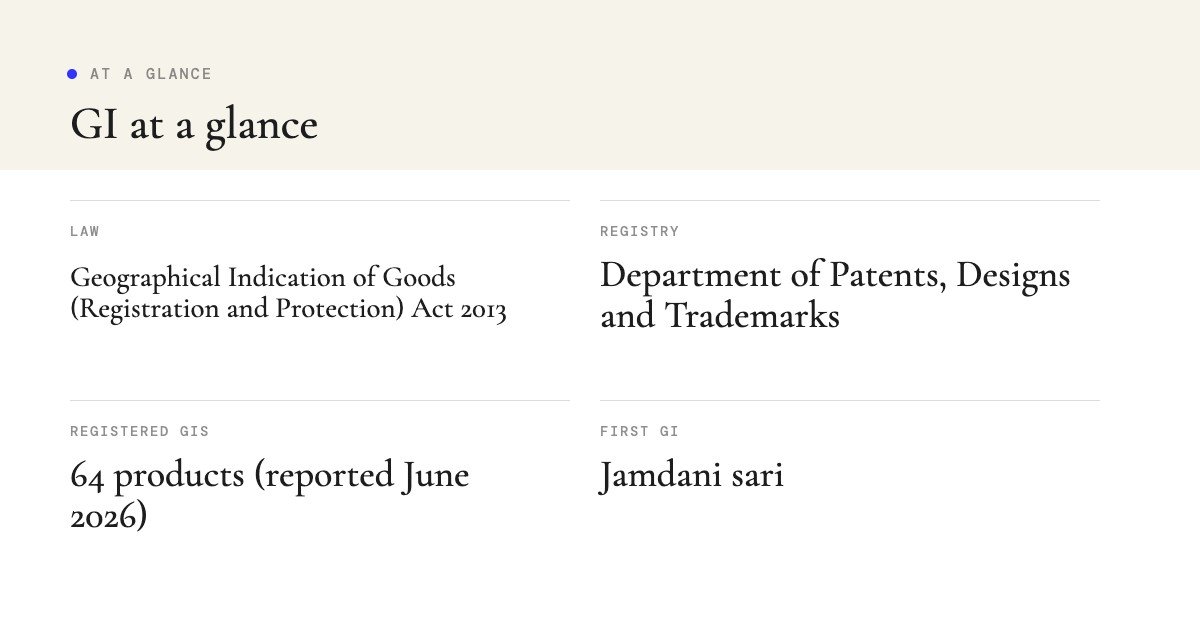
- The Geographical Indication of Goods (Registration and Protection) Act 2013 and the related Rules of 2015 govern GI registration and protection.
- The Department of Patents, Designs and Trademarks (DPDT) maintains the GI register.
- Applications are filed by associations of producers, organisations or authorities representing the producers of the goods.
- Bangladesh had 64 registered GI products by June 2026, starting with Jamdani.
- Registered GIs can be enforced against unauthorised use and misleading indications.
What a geographical indication in Bangladesh protects
A geographical indication identifies goods as originating in a particular territory, region or locality, where a given quality, reputation or other characteristic of the goods is essentially attributable to that origin. GIs can cover agricultural products, foodstuffs, handicrafts, textiles and manufactured goods. Unlike a trademark owned by one business, a GI belongs collectively to producers in the defined area who meet the specified standards.
Our intellectual property practice advises producer groups, exporters and brand owners on GI registration and enforcement.
The legal framework for geographical indication in Bangladesh
The 2013 Act sets out what can be registered, who may apply, the examination and opposition process, the rights of registered proprietors and authorised users, and remedies for infringement. The Act also prohibits registration of GIs that are misleading, contrary to public order or morality, or generic. The 2015 Rules provide forms, fees and procedural details. The law is available on Laws of Bangladesh, and the register and forms on the DPDT website.
Examples of a registered geographical indication in Bangladesh
| Product | Category | Milestone |
|---|---|---|
| Jamdani sari | Textile | First GI, certificate issued 2016 |
| Bangladesh Ilish (hilsa) | Fish | Certificate issued 2017 |
| Khirsapat mango of Chapainawabganj | Fruit | Certificate issued 2019 |
| Dhakai muslin | Textile | Certificate issued 2021 |
| Bagda shrimp | Fish | Certificate issued 2022 |
| Bogura doi and Sherpur Tulshimala rice | Food | Recognised 2023 |
The government has also prepared a list of hundreds of potential GI products for future registration, reflecting the variety of regional specialities across the country.
Who can apply for a geographical indication in Bangladesh
An application may be made by any association of persons, producers, organisation or authority established by law that represents the interests of the producers of the goods. In practice, applicants include government agencies, such as the Bangladesh Small and Cottage Industries Corporation or agricultural research institutes, district administrations and producer associations. Individual businesses cannot own a GI on their own, but they can register as authorised users once the GI is registered.
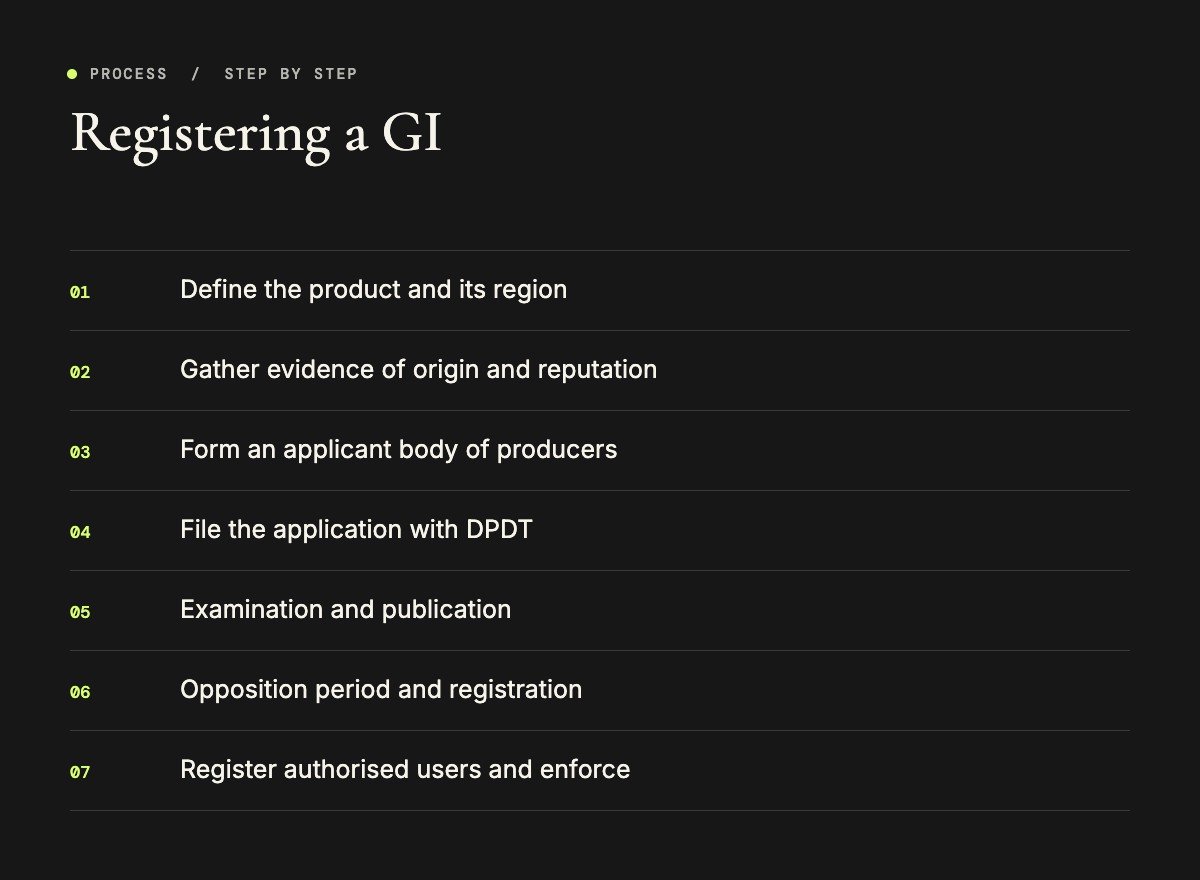
Registering a GI step by step
- Define the product. Specify the goods, their characteristics and the geographical area.
- Gather evidence. Collect historical records, publications, studies and evidence of reputation and production methods.
- Organise the applicant. Identify the association or authority representing producers.
- File with DPDT. Submit the application with the statement of case, map, specifications and fees.
- Examination and publication. DPDT examines the application and publishes accepted applications in the GI journal.
- Opposition and registration. After the opposition period, if unopposed or opposition fails, the GI is registered.
- Authorised users and enforcement. Producers register as authorised users and the GI is monitored and enforced.
Weak applications usually lack a clear product specification and a precise map. Invest in documenting what makes the product distinctive and how it is made; this specification also becomes the basis for quality control after registration.
Rights of registered proprietors and authorised users
Registration gives the registered proprietor and authorised users the exclusive right to use the GI in relation to the goods for which it is registered, and the right to take action against infringement. Authorised users must be producers of the goods in the defined area and must apply to be entered on the register. Their registration is subject to renewal and to compliance with the product specification. A geographical indication in Bangladesh therefore functions as a collective quality label backed by legal enforcement.
Enforcing a geographical indication in Bangladesh
Infringement includes using the GI on goods that do not originate in the area, using it in a way that misleads the public about origin, and unfair competition through use of the GI. The Act provides civil remedies, such as injunctions and damages, and criminal penalties for falsifying a GI or selling goods with a false GI. Enforcement in practice requires monitoring markets, online platforms and export channels, gathering evidence, and working with the police, customs and mobile courts.
Producers should also consider registering logos associated with the GI as collective or certification trademarks, which can make enforcement easier in some contexts and abroad.
Cross-border and shared GIs
Some products, such as Jamdani, hilsa and certain textiles and sweets, share cultural roots with West Bengal in India, leading to debates over overlapping GI claims. Policy researchers have recommended cooperation with India to protect shared heritage products. For exporters, protection abroad requires separate registration in each target market, either directly or through bilateral or regional arrangements, because a geographical indication in Bangladesh does not automatically protect the name overseas.
Commercial benefits of a geographical indication in Bangladesh
GI status can raise prices, build consumer trust, support rural livelihoods and help products stand out in export markets. Studies of GIs elsewhere show that benefits depend on effective marketing, quality control and enforcement, not registration alone. Producer associations should develop branding, traceability systems and inspection arrangements to turn a GI into a lasting market advantage.
Quality control after registration
Once registered, the GI is only valuable if products sold under it actually meet the specification. Producer associations, often with government support, should set up inspection and certification systems, train producers and maintain records of authorised users. Weak quality control invites counterfeits and damages reputation, undermining the purpose of the geographical indication in Bangladesh.
Preparing the statement of case
The statement of case is the heart of the application. It should explain the name of the goods, the precise geographical boundaries, the special characteristics of the product, the human and natural factors that give rise to those characteristics, the method of production, the history of the product and evidence of its reputation. Supporting materials may include old documents, newspaper articles, academic research, laboratory analyses and testimonials from traders and consumers. A well-documented statement of case reduces examination objections and strengthens the geographical indication in Bangladesh against later challenges.
The map should clearly mark the production area, and the specification should be detailed enough to allow inspectors to judge whether a given product qualifies.
Opposition and objections
After publication, any person may oppose the registration within the prescribed period, for example on the grounds that the name is generic, the area is wrongly defined or the applicant does not represent the producers. Opponents might be producers outside the proposed area, traders using the name generically, or foreign parties with competing claims. Applicants should anticipate likely objections and prepare evidence to answer them, while opponents should file detailed grounds and evidence within time.
GIs and trademarks
Conflicts can arise between GIs and existing trademarks containing the same name. The Act contains provisions on how prior trademarks and GIs interact, and DPDT may refuse a trademark that contains a GI for goods not originating in the region. Businesses selling regional products should review their brand portfolios to avoid conflict with a geographical indication in Bangladesh and, where appropriate, align their branding with authorised user status.
Role of government agencies
Government agencies have played a leading role in GI applications, given the cost and coordination required. The Ministry of Industries oversees DPDT and has announced plans to expand GI coverage, while district administrations, the Bangladesh Small and Cottage Industries Corporation and research institutes have filed applications for local products. Producer communities should engage with these agencies early, both to support applications and to ensure that registration translates into benefits for actual producers.
Registering as an authorised user
Producers, manufacturers and traders within the GI area who want to use the name must apply to DPDT to be registered as authorised users, providing evidence that they produce the goods in the defined area in accordance with the specification. The registered proprietor’s views may be considered. Authorised user registration has a fixed term and must be renewed. Keeping an accurate list of authorised users helps buyers and enforcement authorities distinguish genuine products from imitations.
Online sales and labelling
E-commerce has made GI products accessible nationwide and abroad, but also easier to counterfeit. Sellers advertising Khirsapat mangoes, Jamdani saris or Bogura doi online should be able to show the product’s origin and, ideally, authorised user status. Producer associations can work with marketplaces to remove listings that misuse a geographical indication in Bangladesh and can use QR codes or certification labels to help consumers verify authenticity.
Practical checklist for producer groups
Agree on the product specification and area; collect historical and scientific evidence; choose a representative applicant; budget for fees and expert reports; file and respond to examination; prepare for opposition; register authorised users; establish quality control; and plan marketing and enforcement. Following this checklist turns registration into real value for the community.
International framework
Bangladesh’s GI law reflects its obligations under the WTO Agreement on Trade-Related Aspects of Intellectual Property Rights, which requires members to provide legal means to prevent misleading use of geographical indications. As a least developed country graduating from LDC status, Bangladesh is expected to strengthen IP enforcement over time. Exporters targeting the European Union and other markets with strong GI systems should explore registration there, as foreign protection can be a powerful marketing tool for Bangladeshi specialities.
Early foreign filings matter, because a name left unprotected abroad can be registered or used by others, making later recovery costly and uncertain.
Frequently asked questions about geographical indication in bangladesh
Which law governs GIs?
The Geographical Indication of Goods (Registration and Protection) Act 2013 and its 2015 Rules.
Who registers GIs?
The Department of Patents, Designs and Trademarks.
How many GIs does Bangladesh have?
64 registered GI products were reported in Parliament in June 2026.
Can a company own a GI?
No, GIs are collective; companies can register as authorised users.
Can foreign GIs be registered?
Generally yes, if protected in their country of origin and meeting the Act’s requirements.
What if someone misuses a GI?
Registered proprietors and authorised users can take civil and criminal action under the Act.
How we can help
We assist with applications for a geographical indication in Bangladesh, oppositions, authorised user registrations and enforcement, as well as trademark strategies around GI products. See our intellectual property practice, our agriculture and food team and our consumer and retail practice.
Protecting a regional product?
We build GI applications that withstand scrutiny.
Book a consultationIntellectual propertyPrimary sources: the Geographical Indication of Goods (Registration and Protection) Act 2013 on Laws of Bangladesh; GI register and forms from the Department of Patents, Designs and Trademarks.
This article is general information about Bangladeshi law as of October 2026 and is not legal advice. Figures on registered GIs change as new products are added.




0 Comments