
Across Dhaka and Chattogram, most apartment buildings are built under a joint venture: the landowner provides the plot and the developer builds, with the flats shared between them. A land development agreement in Bangladesh sets the terms of that deal. When it is poorly drafted, landowners wait years for flats, developers sell more than their share, and disputes end up in court. This guide sets out the terms that matter most.
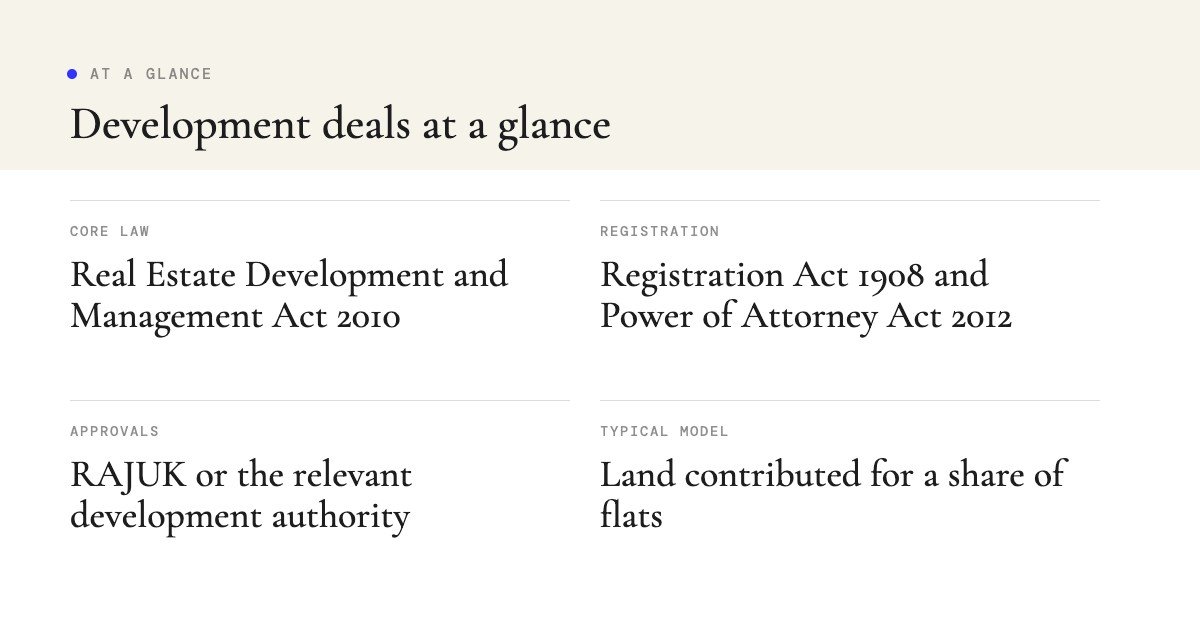
- Joint venture agreements between landowners and developers are governed by the Real Estate Development and Management Act 2010, the Contract Act 1872 and property registration laws.
- The development agreement and the power of attorney given to the developer must be registered.
- Key terms include the sharing ratio, signing money, the building design, completion deadline, delay compensation and flat allocation.
- The developer should be registered with the relevant development authority and have a track record.
- Disputes can be resolved by arbitration, the special mechanisms under the 2010 Act or the courts.
How a land development agreement in Bangladesh works
In a typical deal, the landowner contributes the land, and the developer bears the costs of design, approvals and construction. In return, the parties share the completed flats, parking spaces and sometimes commercial space according to an agreed ratio. The landowner usually also receives signing money, a non-refundable or adjustable payment made at signing, and sometimes rent for alternative accommodation during construction.
The developer typically receives a registered power of attorney to apply for approvals, deal with authorities and sell the developer’s share of flats. Our real estate practice acts for both landowners and developers in negotiating and documenting these deals.
The legal framework for a land development agreement in Bangladesh
| Law | Relevance |
|---|---|
| Real Estate Development and Management Act 2010 | Developer registration, obligations to landowners and buyers, offences and dispute mechanisms |
| Contract Act 1872 | Formation, performance and breach of the agreement |
| Registration Act 1908 | Compulsory registration of development agreements |
| Power of Attorney Act 2012 | Registration and effect of the developer’s power of attorney |
| Building Construction Act 1952 and building rules | Planning permission and building approvals |
Statutes are published on Laws of Bangladesh, and building approval information is available from RAJUK.

Sharing ratio and signing money in a land development agreement in Bangladesh
The sharing ratio depends on land value, location, permitted floor area under the current Detailed Area Plan, and market conditions. In prime areas of Dhaka, landowners may obtain a larger share, while in less developed areas the developer’s share is usually higher. The agreement should specify not only the percentage but also the actual allocation of flats, floors, orientation and parking, to avoid later disputes over which units each party receives.
Signing money should be clearly described, including whether it is refundable or adjustable, how it is paid and what happens if the project does not proceed. Payments should be made through banking channels.
Essential terms of a land development agreement in Bangladesh
- Description of the land, title documents and boundaries.
- Building specifications, number of floors and quality of materials.
- Sharing ratio and specific allocation of units and parking.
- Signing money and any rent for the landowner during construction.
- Responsibility for approvals, utility connections and costs.
- Completion deadline, grace period and delay compensation.
- Restrictions on the developer selling the landowner’s share or mortgaging the land.
- Handover procedure, defects liability and formation of the owners’ association.
- Termination rights and dispute resolution.
From negotiation to handover
- Due diligence. Verify land title and the developer’s registration, finances and past projects.
- Commercial terms. Agree ratio, signing money and timeline.
- Drafting. Prepare a detailed agreement with specifications and schedules.
- Registration. Register the agreement and the power of attorney at the sub-registry office.
- Approvals. Developer obtains land use clearance and building approval.
- Construction. Landowner monitors progress and quality against milestones.
- Handover. Allocate flats, execute deeds and form the owners’ association.
Many disputes arise because the power of attorney is broader than the agreement. Limit the power of attorney to the developer’s share and the tasks needed for the project, and link its validity to the agreement.
Due diligence on title
Before signing, the developer and its lenders will check the landowner’s title, and the landowner should insist on this being done properly because defects can halt the project midway. Title checks include the chain of deeds, khatian records under the CS, SA, RS and city surveys, mutation, payment of land development tax, absence of mortgages and litigation, and compliance with acquisition or requisition notices. Where land is owned by several heirs, all of them must sign the land development agreement in Bangladesh, or the project will face challenges from co-sharers later.
Due diligence on the developer
Landowners should check that the developer is registered under the Real Estate Development and Management Act 2010 and its rules, is a member of the industry association where relevant, has completed similar projects on time, and has the financial capacity to build. Visiting completed buildings and speaking to other landowners gives valuable insight. Bank references and audited accounts can also help, especially for larger projects.
Delay and compensation under a land development agreement in Bangladesh
Delay is the most common complaint. The agreement should set a realistic completion date measured from approval, with a limited grace period, and specify monthly compensation payable to the landowner for delay, often linked to the rental value of the landowner’s flats. It should also define force majeure narrowly so that ordinary business difficulties do not excuse delay. If delay becomes excessive, the landowner should have a right to terminate, take over the project or appoint another developer.
Protecting the landowner’s share
The landowner’s flats should be identified early, ideally in the agreement or by a fixed allocation method, and the developer should be prohibited from selling, mortgaging or advertising them. The power of attorney should exclude the landowner’s share. Landowners should ask for copies of approvals and sale agreements for the developer’s share and monitor any loans the developer takes against the project.
Resolving disputes over a land development agreement in Bangladesh
A land development agreement in Bangladesh usually includes an arbitration clause under the Arbitration Act 2001, which allows disputes to be decided privately by arbitrators experienced in construction and real estate. The 2010 Act also contains provisions for settlement of disputes and offences for certain developer misconduct. Courts may grant injunctions to stop unauthorised sales or construction. Early negotiation and mediation often save time and preserve the project.
Planning approvals and the Detailed Area Plan
The number of floors and total floor area a plot can support depend on planning rules, including the Dhaka Detailed Area Plan, floor area ratio limits and road width. Changes to planning rules can significantly alter the economics of a project, so the agreement should address what happens if permitted floor area turns out to be lower or higher than expected. A common approach is to adjust the number of flats while keeping the sharing ratio fixed. A well-drafted land development agreement in Bangladesh also requires the developer to share copies of all applications and approvals with the landowner.
Construction must follow the approved plan. Unauthorised extra floors expose both parties to demolition orders and penalties and can make flats impossible to register or finance.
Taxes and costs
Registration of the development agreement and power of attorney attracts registration fees, stamp duty and source tax as prescribed, and later transfers of flats to buyers attract their own charges. Gains for the landowner may have income tax consequences, and the developer must account for VAT and taxes on sales. The agreement should allocate responsibility for each cost clearly, including utility connection charges and land development tax during construction.
Handover, defects and the owners’ association
At completion, the developer should hand over the landowner’s flats with occupancy certificates, utility connections and common facilities working. A defects liability period, during which the developer must repair defects at its own cost, protects owners against hidden problems. Ownership of common areas is shared, and an owners’ association is usually formed to manage the building, collect service charges and maintain lifts, generators and security. The land development agreement in Bangladesh should set out how the association will be formed and when the developer’s management responsibility ends.
Termination and project rescue
If the developer abandons the project, becomes insolvent or commits serious breaches, the landowner needs a clear exit route. The agreement should allow termination after notice, cancellation of the power of attorney, and the right to complete the project with another developer, with a mechanism to compensate the original developer only for value actually added. Buyers who purchased the developer’s share complicate termination, so rescue arrangements often require negotiation among landowners, buyers and a new developer.
Multiple landowners and adjoining plots
Developers sometimes combine adjoining plots to build larger projects, which means negotiating with several landowners at once. Each landowner’s contribution, share and rights must be clearly defined, and the agreement should address what happens if one landowner withdraws or has a title defect. Where heirs jointly own land, internal agreement among them on how the landowners’ share will be divided should be documented before signing a land development agreement in Bangladesh, to prevent family disputes from stalling the project.
Non-resident landowners should appoint a trusted attorney under a properly executed and authenticated power of attorney, so decisions and signatures are not delayed.
Construction quality and supervision
Landowners often lack technical knowledge, so the agreement should attach detailed specifications for structure, materials, fittings and finishes, and allow the landowner to appoint an engineer to inspect work at key stages. Compliance with the Bangladesh National Building Code, including fire safety and structural requirements, should be expressly required, with test reports for concrete and steel shared on request.
Frequently asked questions about land development agreement in bangladesh
Must the development agreement be registered?
Yes, development agreements and related powers of attorney must be registered.
What is a typical sharing ratio?
It varies by location and land value; prime Dhaka plots often achieve around half for the landowner.
What is signing money?
A payment by the developer to the landowner at signing, refundable or adjustable as agreed.
What if the developer delays?
The agreement should provide compensation, and the landowner may have remedies under the 2010 Act and contract law.
Can the developer sell the landowner’s flats?
Not if the agreement and power of attorney are properly limited.
How are disputes resolved?
By arbitration, mechanisms under the 2010 Act, or the civil courts.
How we can help
We negotiate, draft and register every land development agreement in Bangladesh we handle, conduct title and developer due diligence, and represent clients in disputes. See our real estate practice, our real estate and construction sector team and our construction disputes practice.
Giving your land to a developer?
We protect your share from signing to handover.
Book a consultationReal estatePrimary sources: the Real Estate Development and Management Act 2010, the Registration Act 1908 and the Power of Attorney Act 2012 on Laws of Bangladesh; building approvals from RAJUK; land records from the Ministry of Land.
This article is general information about Bangladeshi property law as of October 2026 and is not legal advice. Planning rules, including the Detailed Area Plan, change; take advice on your plot.




0 Comments