
Bangladesh’s export processing zones host hundreds of factories producing garments, footwear, electronics and other goods for global markets. Export processing zone investment offers ready infrastructure, one-stop services from BEPZA, duty-free imports and attractive incentives. This guide explains how the zones work, who can invest, the approval process and the special labour and regulatory rules that apply inside them.
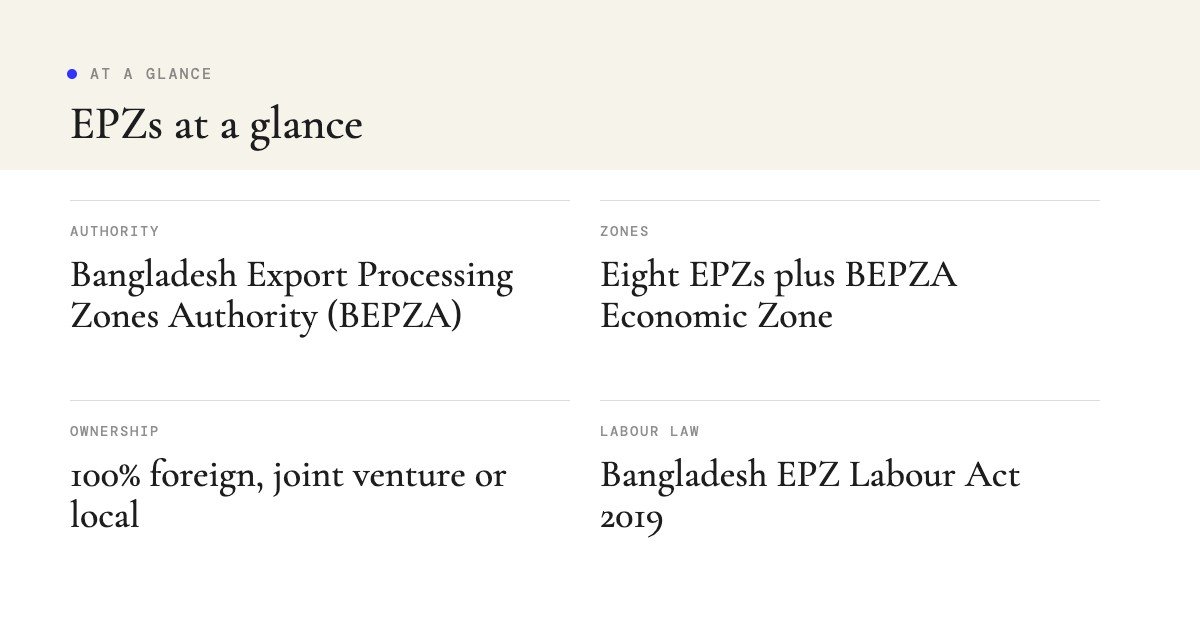
- EPZs are administered by the Bangladesh Export Processing Zones Authority under the Bangladesh Export Processing Zones Authority Act 1980, as amended.
- BEPZA operates eight EPZs, at Chattogram, Dhaka, Mongla, Ishwardi, Cumilla, Uttara, Adamjee and Karnaphuli, plus the BEPZA Economic Zone at Mirsarai.
- Investors can establish 100% foreign-owned, joint venture or local enterprises, primarily for export.
- Incentives include duty-free import of machinery and raw materials, tax benefits subject to conditions, and one-stop services.
- Employment in EPZs is governed by the Bangladesh EPZ Labour Act 2019 rather than the general Labour Act.
Under the Invest Bangladesh Act 2026, effective 23 August 2026, the Bangladesh Investment Development Authority (BIDA), the Bangladesh Economic Zones Authority (BEZA) and the PPP Authority were merged into a single body, Invest Bangladesh. References below to BIDA, BEZA or the PPP Authority should be read as references to Invest Bangladesh. BEPZA continues as a separate authority.
What export processing zone investment offers
EPZs are fenced industrial enclaves designed for export-oriented manufacturing. They provide developed plots and standard factory buildings, utilities, security, customs facilities and administrative services in one place. BEPZA acts as a one-stop authority, issuing investment approvals, import and export permits, work permits and many other licences that would otherwise involve multiple agencies. For foreign manufacturers, export processing zone investment reduces the time and uncertainty of setting up in Bangladesh.
Our foreign direct investment practice helps investors evaluate zones and navigate BEPZA approvals.
Zones available for export processing zone investment
| Zone | Location advantages |
|---|---|
| Chattogram EPZ and Karnaphuli EPZ | Close to Chattogram port |
| Dhaka EPZ and Adamjee EPZ | Near the capital and airport |
| Mongla EPZ | Near Mongla port in the southwest |
| Ishwardi, Uttara and Cumilla EPZs | Regional locations with labour availability |
| BEPZA Economic Zone, Mirsarai | Large new zone in the Mirsarai industrial area of Chattogram |
Information on zones, plots and procedures is available from BEPZA.
Eligibility and types of export processing zone investment
BEPZA classifies enterprises by ownership: Type A, 100% foreign-owned including Bangladeshi nationals residing abroad; Type B, joint ventures between foreign and Bangladeshi investors; and Type C, 100% Bangladeshi-owned. Projects should be export-oriented, though limited domestic sales may be allowed under BEPZA rules with duties payable. BEPZA evaluates proposals based on product, investment size, employment, technology, environmental impact and export potential.
Setting up in an EPZ step by step
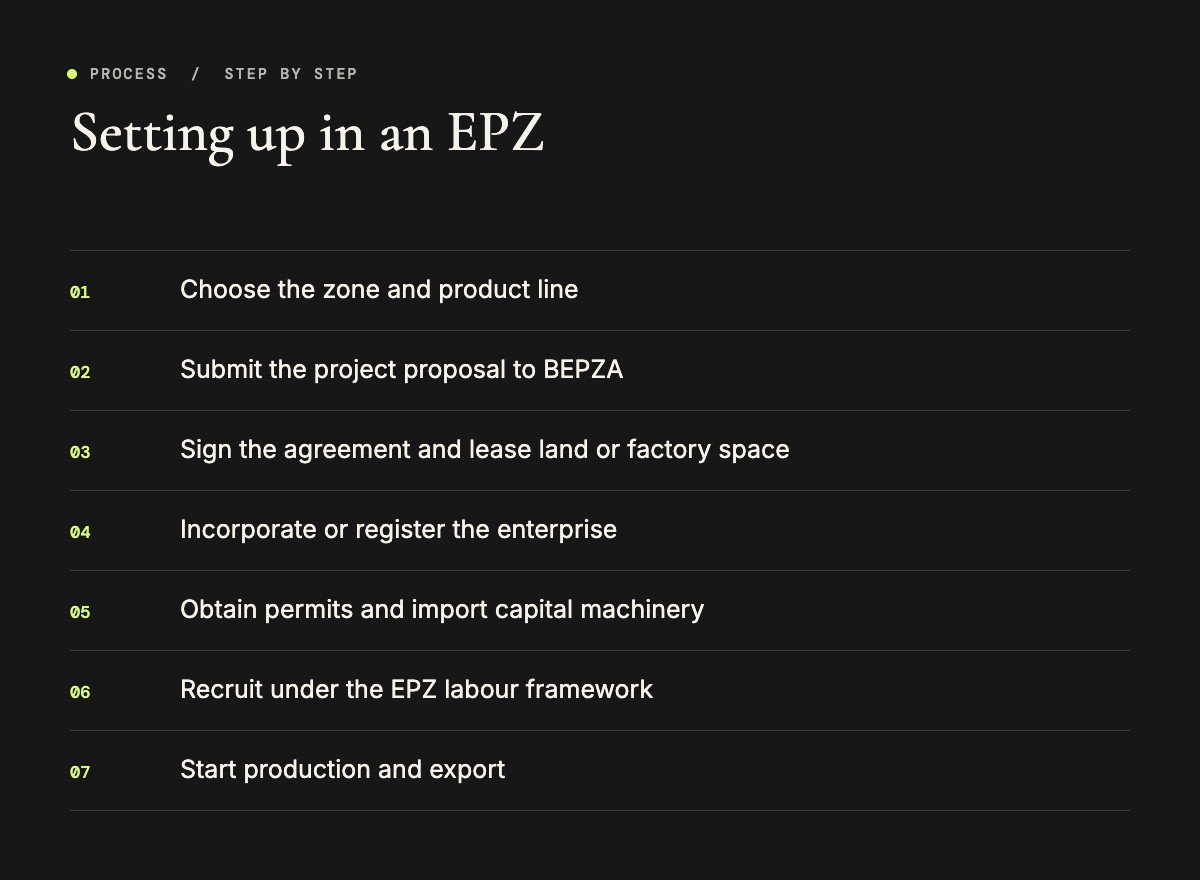
- Choose the zone. Consider logistics, land availability and labour market.
- Submit a proposal. Apply to BEPZA with project details, financing and layout.
- Agreement and lease. Sign the agreement with BEPZA and lease a plot or factory building.
- Register the company. Incorporate with the RJSC or register a branch, as required.
- Permits and imports. Obtain permits and import capital machinery duty-free.
- Recruit. Hire workers under the EPZ labour framework and obtain work permits for expatriates.
- Operate. Begin production and export through BEPZA procedures.
Plot availability in popular zones can be limited. Discuss options with BEPZA early, including ready factory buildings, which can shorten the time to production.
Incentives for export processing zone investment
EPZ enterprises have traditionally enjoyed duty-free import of construction materials, machinery, raw materials and office equipment, exemption from certain local taxes, tax holidays for specified periods depending on location and date of commencement, relief from double taxation under treaties, and full repatriation of capital and dividends subject to foreign exchange rules. The exact tax benefits now depend on the Income Tax Act 2023 and statutory regulatory orders, which have been revised over time. Investors should confirm current incentives before finalising export processing zone investment plans.
EPZ enterprises can also access offshore banking facilities and foreign currency loans subject to Bangladesh Bank rules.
Labour law and export processing zone investment
The Bangladesh EPZ Labour Act 2019 governs employment in EPZs. It covers appointment, working hours, wages, leave, benefits, termination, workers’ welfare associations and dispute resolution, with EPZ labour tribunals and BEPZA’s own inspection system. Workers in EPZs organise through workers’ welfare associations rather than trade unions under the general Labour Act, a feature that has been the subject of international scrutiny and reform discussions. Employers must follow the minimum wage structures set for EPZs and BEPZA instructions.
Foreign exchange and banking
EPZ enterprises maintain foreign currency accounts and operate under Bangladesh Bank rules tailored to zone enterprises. Capital must be brought in through banking channels, and export proceeds must be realised within the prescribed time. Type A enterprises can usually borrow from abroad within regulatory limits, and BEPZA and Bangladesh Bank have special arrangements for inter-zone and zone-to-domestic transactions. Accurate documentation of investment and export receipts is essential for repatriation and compliance.
Environmental and building compliance
Enterprises must comply with environmental requirements, including environmental clearance from the Department of Environment where applicable, effluent treatment for wet processing industries, and BEPZA’s own environmental and building standards. Fire and building safety, a priority since the Rana Plaza disaster, is monitored closely in export industries. Building these requirements into factory design from the start avoids costly retrofits.
EPZs compared with economic zones and hi-tech parks
Bangladesh also offers economic zones under BEZA and hi-tech parks under the Hi-Tech Park Authority. Economic zones are typically larger, can host both export and domestic-oriented industries, and include private zones developed by local and foreign developers. Hi-tech parks target technology and IT businesses. Export processing zone investment remains attractive for export manufacturers who want ready facilities, an established track record and BEPZA’s one-stop service, while economic zones may suit investors who need larger land parcels or significant domestic sales.
Comparing incentives, land costs, utility availability and labour rules across these options helps investors choose the best location.
Domestic sales and sub-contracting
EPZ enterprises are primarily for export, but BEPZA rules allow limited sales into the domestic tariff area in certain cases, subject to customs duties and approval. Sub-contracting arrangements with factories outside the zones, or between zone enterprises, also require permission and proper customs documentation. Investors planning a mixed export and domestic business should check these limits before choosing export processing zone investment over an economic zone or domestic location.
Expatriate staff and work permits
BEPZA issues work permits for foreign nationals employed by zone enterprises, subject to requirements such as qualifications, a ratio of local to foreign staff, and security clearance. Expatriates also need appropriate employment visas. Salary remittance is permitted within rules, and expatriates are subject to income tax in Bangladesh. Planning expatriate staffing early avoids delays in commissioning factories.
Customs and logistics
Each EPZ has customs facilities to process imports and exports under BEPZA procedures, which simplify clearance compared with domestic factories. Goods move in bond between the port and the zone, and zone enterprises must maintain records of imported inputs and exported outputs. Efficient logistics, particularly proximity to Chattogram port for Chattogram and Karnaphuli EPZs, can make a substantial difference to lead times and costs, an important factor in export processing zone investment decisions.
Exit and transfer of enterprises
Investors may sell shares in a zone enterprise, transfer it to another investor or close it, subject to BEPZA approval, settlement of dues, labour obligations and foreign exchange rules for repatriation of sale proceeds. Land in EPZs is leased, not owned, so transfers involve assignment of the lease with BEPZA consent. Planning exit routes in the investment agreement and maintaining clean records simplifies future transactions.
Sectors that thrive in the zones
Garments and textiles remain the largest sector in the EPZs, but zones also host footwear and leather goods, electronics and electrical products, plastics, metal products, wigs and hair accessories, toys, packaging, pharmaceuticals inputs and service industries. BEPZA has encouraged diversification into higher-value products and technology-intensive manufacturing, especially in newer zones. Investors in emerging sectors may find BEPZA particularly supportive.
Compliance and inspections after export processing zone investment
BEPZA monitors zone enterprises through inspections covering labour, safety, environment, customs and operational compliance. Enterprises must submit periodic reports and maintain records. International buyers often conduct their own audits, and compliance with buyer codes of conduct is a commercial necessity. A compliance programme covering labour, safety, environment and anti-corruption protects the enterprise’s licence and customer relationships.
Disputes with BEPZA or within zones
Disputes over leases, approvals or charges are usually resolved through dialogue with BEPZA, and where necessary through administrative appeal or the courts, including writ jurisdiction for public law issues. Commercial disputes between zone enterprises and their partners follow ordinary contract law and arbitration clauses. Labour disputes go to EPZ labour tribunals and appellate tribunals under the EPZ Labour Act.
Financing an EPZ project
EPZ projects are financed through equity from the parent company, foreign loans, local bank loans in foreign or local currency, and supplier credit. Foreign borrowing must comply with Bangladesh Bank rules, and long-term foreign loans for industrial projects require the relevant approvals. Zone enterprises often use back-to-back letters of credit for imported inputs linked to export orders. A well-planned financing structure lowers the cost of export processing zone investment and ensures that dividends and loan repayments can be remitted smoothly.
Lenders will typically take security over machinery and assignment of export proceeds, since land is leased from BEPZA and cannot be mortgaged in the usual way without consent.
Timeline to production
With a ready factory building and complete documents, an investor can move from approval to production relatively quickly, while projects requiring construction on a vacant plot take longer. Key milestones include BEPZA approval, lease agreement, company registration, building plan approval, construction, machinery import and installation, recruitment and trial production. Regular engagement with BEPZA’s investment promotion and zone management teams keeps the project on schedule.
Sustainability and green factories
Global buyers increasingly demand environmentally responsible production. Many EPZ factories have pursued green building certifications, invested in rooftop solar, water recycling and efficient effluent treatment, and adopted chemical management standards. BEPZA has promoted green initiatives across its zones. Building sustainability into a new project improves buyer appeal and may reduce long-term operating costs.
Investors should also consider carbon reporting expectations from European buyers, which are becoming part of sourcing decisions for factories in Bangladesh.
Early investment in energy metering and data systems makes such reporting far easier later.
Frequently asked questions about export processing zone investment
Who regulates EPZs?
The Bangladesh Export Processing Zones Authority (BEPZA).
How many EPZs are there?
Eight EPZs plus the BEPZA Economic Zone at Mirsarai.
Can foreigners own 100%?
Yes, Type A enterprises are fully foreign-owned.
Are imports duty-free?
Capital machinery and raw materials for export production are generally imported duty-free.
Which labour law applies?
The Bangladesh EPZ Labour Act 2019.
Can EPZ firms sell locally?
Limited domestic sales may be permitted under BEPZA rules, with applicable duties.
How we can help
We advise on export processing zone investment from project proposals and BEPZA agreements to corporate setup, labour compliance and exits. See our foreign direct investment practice, our manufacturing sector team and our employment and labour practice.
Considering an EPZ?
We help you secure the right zone and approvals.
Book a consultationForeign investmentPrimary sources: the Bangladesh Export Processing Zones Authority Act 1980 and the Bangladesh EPZ Labour Act 2019 on Laws of Bangladesh; zone information from BEPZA; foreign exchange rules from Bangladesh Bank.
This article is general information about Bangladeshi investment rules as of October 2026 and is not legal advice. Incentives and procedures change; confirm current terms with BEPZA.




0 Comments