
Economic shocks, supply disruptions and high interest rates have pushed many businesses into default. Loan rescheduling in Bangladesh gives viable borrowers a way to regularise classified loans by agreeing a new repayment schedule with their bank, usually after a down payment. Bangladesh Bank has repeatedly revised the rules, most recently in September 2026 as part of its roadmap to reduce non-performing loans.
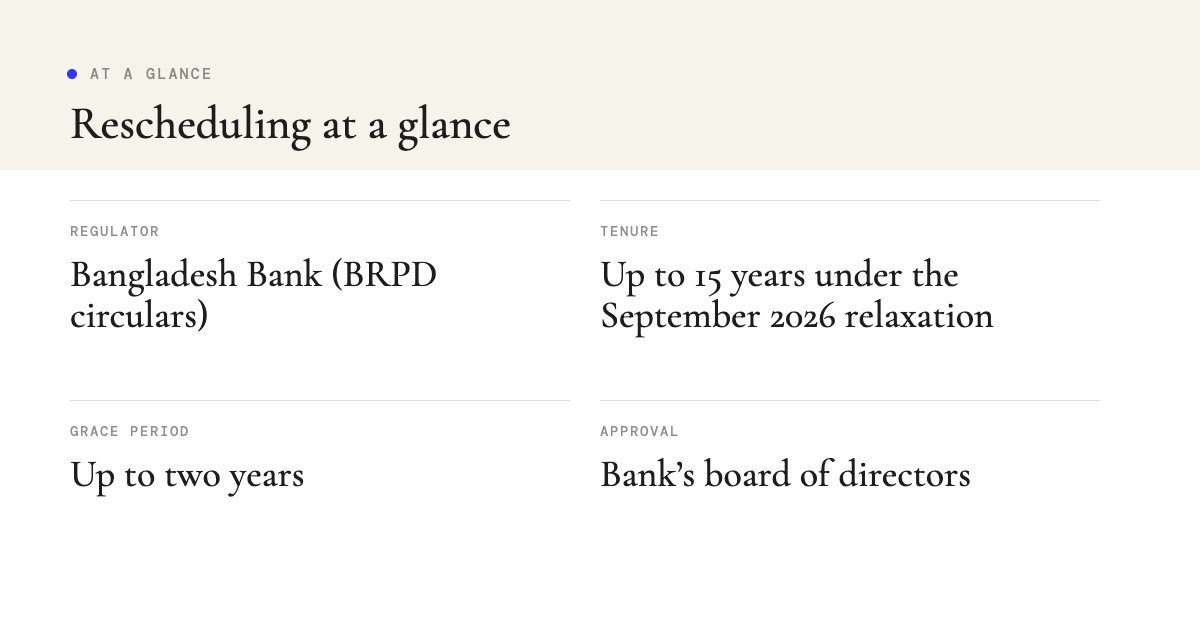
- Rescheduling and restructuring of loans are governed by Bangladesh Bank circulars issued by its Banking Regulation and Policy Department (BRPD).
- A September 2025 circular allowed defaulted loans to be rescheduled for up to 10 years with a minimum 2% down payment and a two-year grace period.
- A September 2026 supplement extended the maximum tenure to 15 years and allowed banks to set down payments based on the borrower relationship.
- Approval generally rests with the bank’s board, with large exposures referred to a Bangladesh Bank committee for policy support.
- Loans obtained through fraud are not eligible, and breach of the new terms allows the bank to cancel the facility.
What loan rescheduling in Bangladesh means
Rescheduling changes the repayment schedule of a classified or stressed loan, typically extending the tenure, adding a grace period and sometimes adjusting the interest rate, in exchange for a down payment and a commitment to the new schedule. Restructuring may go further, converting parts of the loan into term loans, blocked accounts or other facilities. A one-time exit allows a borrower to settle the loan at an agreed amount and leave the bank. Each option has different consequences for the borrower’s credit status and the bank’s provisioning.
Our banking and finance practice advises borrowers and banks on rescheduling, restructuring and recovery.
The current rules for loan rescheduling in Bangladesh
| Feature | September 2025 policy | September 2026 supplement |
|---|---|---|
| Maximum tenure | 10 years | 15 years |
| Grace period | 2 years | Up to 2 years |
| Down payment | Minimum 2%, plus 1% for loans rescheduled three or more times | Banks may set based on the relationship |
| Interest | One percentage point below the lowest sector rate | Banks may waive eligible interest |
| Approval | Bank board; large loans to Bangladesh Bank committee | Builds on BRPD Circular No 07/2025 |
These are summaries from published reports; borrowers should read the actual circulars on the Bangladesh Bank website before negotiating.
Eligibility for loan rescheduling in Bangladesh
Eligibility depends on the circular in force. The 2025 policy applied to loans classified as adverse as of a cut-off date and required applications by a deadline, with banks deciding within six months. The 2026 supplement covers loans created up to 30 September 2026. Loans created through fraud or deceit are excluded. Borrowers with multiple banks need the consent of the lead bank or all lenders. Wilful defaulters face restrictions under banking law and may not benefit from relaxed terms.
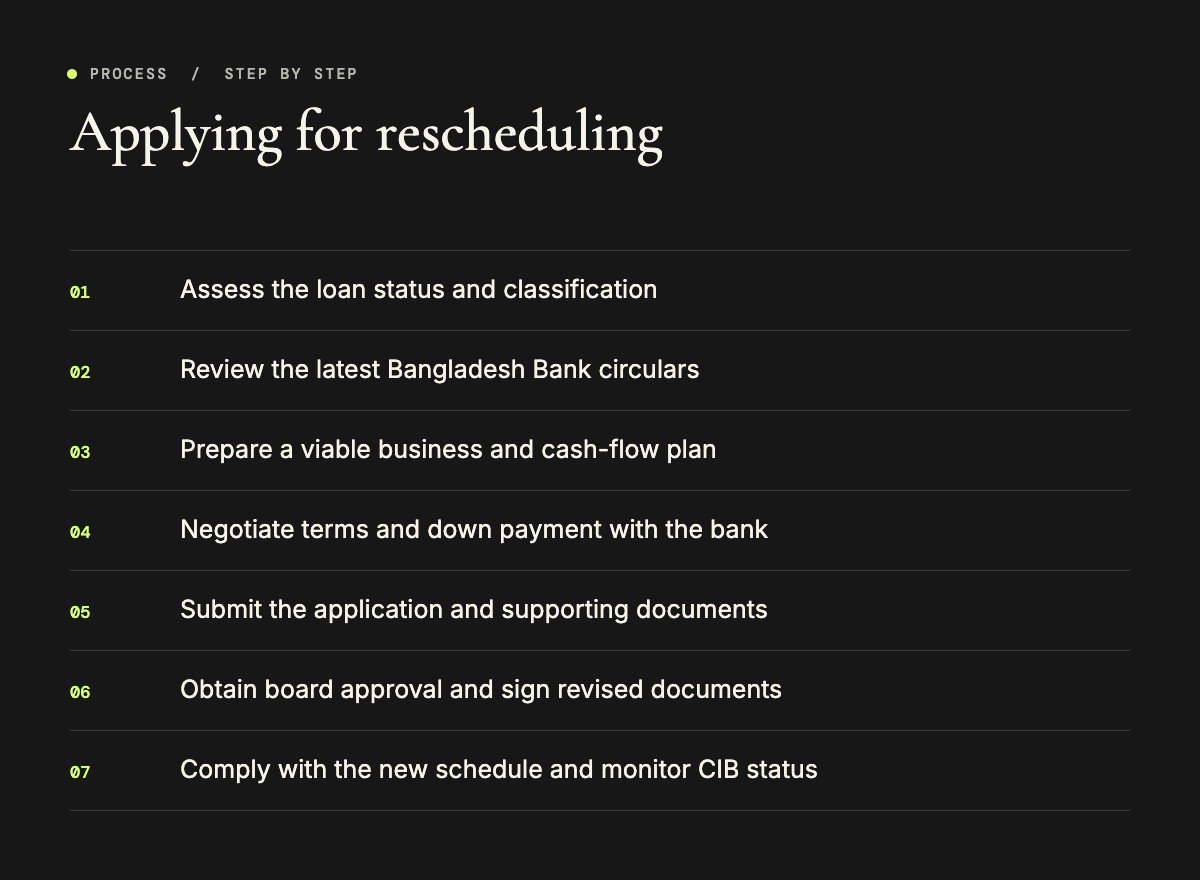
Applying for rescheduling step by step
- Assess status. Confirm classification, overdue amounts and any suits filed.
- Check the rules. Identify which circular applies and its deadlines.
- Prepare a plan. Build a realistic business and cash-flow projection showing ability to pay.
- Negotiate. Agree down payment, tenure, grace period and interest with the bank.
- Apply. Submit the application with financial statements and supporting documents.
- Approval and documentation. Obtain board approval and sign revised loan and security documents.
- Comply. Pay instalments on time and monitor CIB reporting.
Banks look for credible cash flows, not promises. A plan supported by order books, cost reductions and realistic assumptions is far more persuasive than a request for a longer tenure alone.
Why rules keep changing
Non-performing loans have been a persistent problem in Bangladesh’s banking sector. Bangladesh Bank has alternated between liberal rescheduling facilities, such as the 2019 scheme allowing rescheduling with a 2% down payment over 10 years, and tighter rules aimed at aligning classification with international standards, including stricter overdue thresholds introduced from 2025. The September 2026 relaxation is described as part of an 18-month roadmap running to the end of 2026 to reduce non-performing loans, combining support for viable borrowers with stronger recovery against wilful defaulters. Borrowers seeking loan rescheduling in Bangladesh therefore need to check the rules in force at the time of application.
Down payment for loan rescheduling in Bangladesh
The down payment demonstrates commitment and reduces the bank’s exposure. Under the 2025 policy, the minimum was 2%, rising for repeatedly rescheduled loans, while the 2026 supplement allows banks more flexibility. In practice, banks may demand more than the regulatory minimum based on the borrower’s history, collateral and cash flows. Borrowers should negotiate on the overall package, including grace period, interest waiver and treatment of suspended interest, not just the headline down payment.
How loan rescheduling in Bangladesh affects litigation
Where a bank has filed a suit in the Artha Rin Adalat or other courts, rescheduling usually requires the suit to be kept in abeyance or withdrawn within a set period after the facility is granted. If the borrower breaches the rescheduled terms, the bank can cancel the facility and resume recovery, often with the full outstanding amount becoming due. Borrowers should ensure that settlement documents clearly address pending cases, cheque dishonour complaints and enforcement of security.
Credit status after loan rescheduling in Bangladesh
Bangladesh Bank’s Credit Information Bureau records loan status. A rescheduled loan is reported accordingly, and a borrower who defaults again may be classified once more, with tighter limits on further rescheduling. Classification affects the borrower’s ability to obtain new loans, open letters of credit and, for directors of borrowing companies, to hold positions in banks. Keeping a rescheduled loan regular is therefore critical.
Restructuring versus rescheduling
For large borrowers, simple rescheduling may not be enough. Restructuring can involve converting overdue amounts into term loans, splitting debt into sustainable and unsustainable portions, adding new security, converting debt to equity in limited cases, or selling non-core assets. Large exposures may be considered by a Bangladesh Bank committee under special policy support. Restructuring requires more detailed financial analysis, often by independent advisers, and coordination among multiple lenders. Choosing between restructuring and loan rescheduling in Bangladesh depends on the size of the debt and the borrower’s long-term viability.
Documents banks typically require
Banks usually ask for an application letter explaining the reasons for default, audited and management accounts, cash-flow projections, details of all bank exposures, security documents, valuation reports for collateral, tax returns, trade licence and company documents, and a board resolution of the borrowing company. Personal guarantors may need to sign fresh guarantees. Providing a complete, well-organised file speeds up approval.
Common pitfalls
Borrowers often agree to schedules they cannot meet, simply to stop litigation, and then default again with worse consequences. Others overlook conditions in the sanction letter, such as restrictions on dividends, new borrowings or asset sales. Some fail to obtain the consent of all lenders, leaving them exposed to recovery by a non-participating bank. A realistic plan and careful review of the sanction terms make loan rescheduling in Bangladesh sustainable.
Personal guarantees and directors
Directors and shareholders often give personal guarantees for company loans. Rescheduling does not automatically release guarantors; banks usually require them to confirm or renew their guarantees. Directors of defaulting companies can face restrictions, including being treated as defaulters in CIB records and limits on travel or holding certain positions where courts or regulators impose them. Directors should take advice on their personal exposure before signing.
Sector-specific loan rescheduling in Bangladesh
Bangladesh Bank has periodically issued special rescheduling facilities for particular sectors, such as raw jute traders, export-oriented garments, agriculture, cottage, micro, small and medium enterprises, and borrowers affected by natural disasters or the pandemic. These facilities may offer lower down payments, longer tenures or interest relief, and they usually have their own deadlines. Borrowers in eligible sectors should check whether a sector-specific circular offers better terms than the general policy.
Finance companies
Non-bank financial institutions, now governed by the Finance Company Act 2023, operate under their own Bangladesh Bank circulars on classification and rescheduling issued by the Department of Financial Institutions and Markets. Bangladesh Bank has extended special rescheduling facilities for finance companies at various times. Borrowers from finance companies should not assume that bank circulars apply and should check the specific rules for their lender.
One-time exit
A one-time exit allows a borrower to settle the loan for an agreed amount, often with a partial waiver of interest, and close the relationship with the bank. Banks may consider this where the borrower cannot sustain a long rescheduling but can raise a lump sum, for example by selling assets. Approval follows the bank’s policies and Bangladesh Bank guidance. The settlement agreement should clearly provide for release of security, withdrawal of suits and updating of CIB records.
Working with multiple lenders
Borrowers with loans from several banks face the challenge of coordinating terms. The lead bank often takes the initiative, and the rules may require the consent of the lead bank or all concerned banks. Inconsistent schedules across banks can make the overall plan unworkable, so borrowers should aim for a coordinated approach, sometimes through a lenders’ forum or consortium arrangement. Clear information sharing and a single business plan presented to all lenders improve the chance of success for loan rescheduling in Bangladesh across a group of banks.
Inter-creditor arrangements should also address priority of security and how proceeds of asset sales will be shared, to prevent disputes among lenders later.
Tax and accounting effects
Interest waivers and write-offs agreed in a rescheduling or exit may have tax consequences for both borrower and bank, and accounting standards require proper recognition of modified loans. Borrowers should consult their auditors and tax advisers on how waived interest, restructured principal and any gains on settlement will be treated in their financial statements and tax returns, so that the relief obtained is not undermined by unexpected tax liabilities.
Lenders, for their part, must maintain provisions on rescheduled loans as Bangladesh Bank requires, which influences how much flexibility a bank can offer in negotiations.
Understanding the bank’s provisioning position helps borrowers frame proposals that the bank can realistically accept.
Frequently asked questions about loan rescheduling in bangladesh
Who approves rescheduling?
Generally the bank’s board, with large exposures referred to Bangladesh Bank for policy support.
What down payment is required?
The 2025 policy set a 2% minimum; the 2026 supplement lets banks set it based on the relationship.
How long can a loan be rescheduled?
Up to 15 years under the September 2026 supplement, including up to two years’ grace.
Are pending suits stopped?
Suits are typically suspended after the facility is granted, but can revive if the borrower defaults.
Does rescheduling clear my CIB status?
The loan is reported as rescheduled; repeated default affects classification again.
Can fraudulent loans be rescheduled?
No, loans created through fraud are excluded.
How we can help
We negotiate loan rescheduling in Bangladesh for borrowers and advise banks on structuring, documentation and recovery when rescheduling fails. See our banking and finance practice, our restructuring and insolvency team and our commercial litigation practice.
Struggling with a classified loan?
We help you negotiate a workable path with your bank.
Book a consultationBanking and financePrimary sources: BRPD circulars from Bangladesh Bank; the Bank Company Act 1991 and the Artha Rin Adalat Ain 2003 on Laws of Bangladesh.
This article is general information about Bangladeshi banking regulation as of October 2026 and is not legal or financial advice. Bangladesh Bank revises rescheduling rules frequently; read the current circulars.




0 Comments