
Court cases in Bangladesh can take years. Institutional arbitration offers a faster, more predictable alternative, and BIAC arbitration is the leading institutional option in Dhaka. The Bangladesh International Arbitration Centre administers domestic and international commercial disputes under its own rules, supports parties with appointments and hearing facilities, and works within the framework of the Arbitration Act 2001.
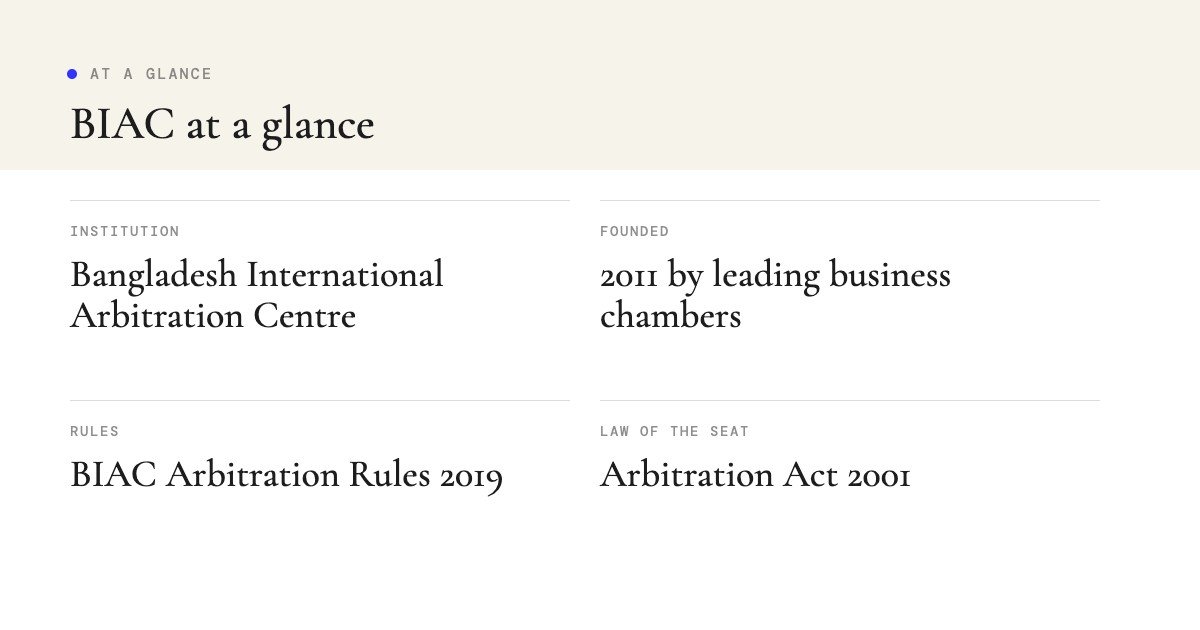
- The Bangladesh International Arbitration Centre (BIAC) was established in 2011 by leading business chambers with international development support.
- BIAC administers arbitrations under the BIAC Arbitration Rules 2019, which replaced the original 2011 rules.
- The rules include provisions for emergency arbitrators and expedited procedures for urgent or smaller disputes.
- BIAC arbitration seated in Dhaka is governed by the Arbitration Act 2001, and awards are enforceable as court decrees.
- BIAC also offers mediation under separate rules.
What BIAC arbitration offers
BIAC provides institutional administration: it receives requests, manages communications and deposits, appoints arbitrators where parties fail to do so, monitors timelines and provides hearing rooms and support services. Compared with ad hoc arbitration, where parties and arbitrators manage everything themselves, institutional administration reduces delays and procedural disputes. Fees are generally lower than those of major international institutions, making BIAC arbitration attractive for domestic and regional disputes.
Our international arbitration practice represents clients in BIAC, SIAC, ICC and LCIA proceedings.
The legal framework for BIAC arbitration
When the seat is Dhaka, the Arbitration Act 2001 governs the arbitration, including court assistance, interim measures, challenges to arbitrators, setting aside and enforcement. The BIAC Rules operate within that framework and fill in procedural details. The Act is based largely on the UNCITRAL Model Law, giving parties wide autonomy over procedure. The Act is available on Laws of Bangladesh, and the Model Law on the UNCITRAL website.
Key features of the BIAC arbitration rules
| Feature | How it works |
|---|---|
| Commencement | Claimant files a request for arbitration with BIAC and pays the registration fee |
| Tribunal | Sole arbitrator or three arbitrators; BIAC appoints from its panel if parties default |
| Emergency arbitrator | Urgent interim relief before the tribunal is constituted |
| Expedited procedure | Faster process with a sole arbitrator for agreed or smaller cases |
| Fees | Registration, administrative and arbitrator fees under the fee schedule |
| Award | Reasoned award, enforceable as a decree under the Arbitration Act |
How a BIAC case runs
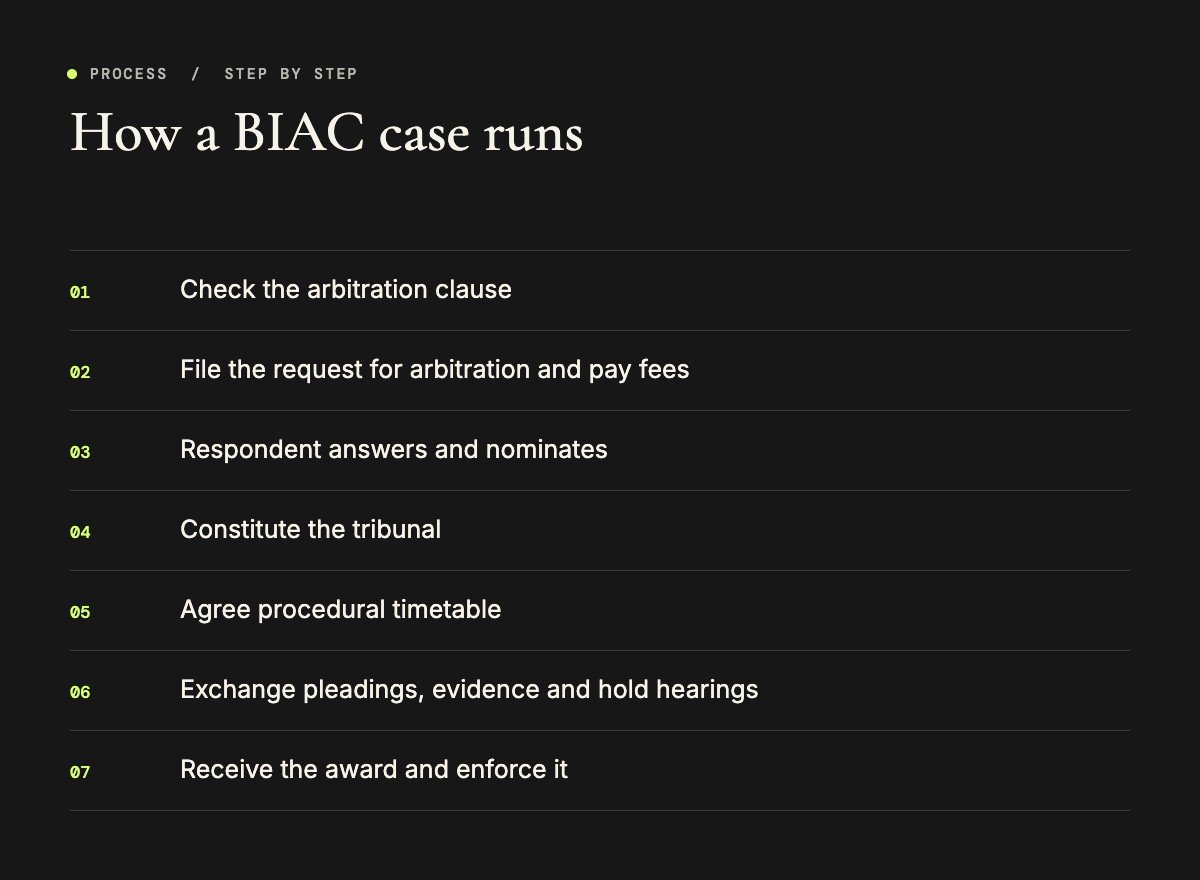
- Check the clause. Confirm the contract refers disputes to BIAC arbitration and identifies the seat.
- File the request. Submit the request with a summary of the claim and pay the registration fee.
- Response. The respondent replies, may counterclaim and nominates an arbitrator.
- Constitute the tribunal. Parties nominate; BIAC appoints if they do not.
- Procedural conference. The tribunal sets the timetable and procedures.
- Pleadings and hearings. Parties exchange statements, documents and witness evidence, followed by hearings.
- Award and enforcement. The tribunal issues the award, which can be enforced through the courts.
Use BIAC’s model clause when drafting contracts. Clauses that name the institution incorrectly or mix arbitration with court jurisdiction invite preliminary challenges that delay the case.
Drafting a BIAC arbitration clause
A sound clause refers all disputes arising out of or in connection with the contract to arbitration administered by BIAC under its rules, states the seat (usually Dhaka), the number of arbitrators, the language of the arbitration and the governing law. Parties may also opt into or out of expedited procedures and specify qualifications for arbitrators. Using BIAC’s recommended model clause, adapted to the transaction, reduces the risk of a defective clause and makes BIAC arbitration straightforward to commence when a dispute arises.
For multi-contract projects, consistent clauses across all documents allow related disputes to be heard together, saving time and cost.
Appointing arbitrators
Parties can choose arbitrators with relevant expertise, such as retired judges, senior lawyers, engineers or accountants. Where there are three arbitrators, each party usually nominates one and the two nominees or BIAC select the presiding arbitrator. BIAC maintains a panel of domestic and international arbitrators and appoints from it if a party fails to nominate. Arbitrators must disclose circumstances that might raise doubts about their impartiality or independence, and parties can challenge appointments on those grounds.
Emergency and expedited procedures
Where urgent relief is needed before the tribunal is formed, such as preserving assets or evidence, a party can apply for an emergency arbitrator under the BIAC Rules. The emergency arbitrator can issue interim orders, which the tribunal may later confirm, vary or discharge. For smaller or simpler disputes, the expedited procedure provides for a sole arbitrator and shortened timelines. These features make BIAC arbitration more responsive to commercial needs than traditional ad hoc arbitration.
Costs and fees
BIAC charges a registration fee on filing, administrative fees based on the amount in dispute, and arbitrators’ fees according to its schedule, plus hearing facility charges and applicable taxes. Parties pay deposits as directed during the proceedings. The tribunal decides how costs are ultimately allocated, often ordering the losing party to bear a substantial share. Compared with litigation, the upfront cost may be higher, but the shorter timeframe and finality often reduce total cost.
Interim measures from the courts
Even with an emergency arbitrator available, parties may need court orders that bind third parties, such as banks holding funds, or that require coercive enforcement. Under the Arbitration Act 2001, courts can grant interim measures in support of arbitration, including injunctions, preservation of property and appointment of receivers. Applications must show urgency and a prima facie case. Coordinating court applications with the arbitral process avoids conflicting orders and keeps the dispute on track.
Hearings and evidence
Tribunals typically allow written statements of case, documentary evidence, witness statements and expert reports, followed by oral hearings for cross-examination and argument. Parties can agree on procedural rules, such as limits on document production or use of the IBA Rules on the Taking of Evidence as guidance. Hearings may be held at BIAC’s facilities, at another venue or virtually. Efficient case management by the tribunal, with clear deadlines, is key to keeping costs under control.
Setting aside and enforcement
An award in a Dhaka-seated arbitration can be challenged in the court on limited grounds under the Arbitration Act, such as invalidity of the agreement, lack of proper notice, excess of jurisdiction, improper tribunal composition, non-arbitrability or conflict with public policy, including fraud or corruption. If no challenge is made within the time allowed, or a challenge fails, the award is enforced as a decree of the court. Parties should prepare for possible court proceedings by keeping a clean procedural record throughout the arbitration.
International parties
Foreign companies sometimes hesitate to agree to arbitration in Bangladesh, preferring Singapore or London. BIAC arbitration can be a reasonable compromise for mid-sized disputes where the Bangladeshi party’s assets are local, because a Dhaka award becomes a domestic decree without recognition proceedings. Foreign parties can appoint international arbitrators and counsel, use English as the language of the arbitration, and hold virtual hearings to reduce travel. For very large or politically sensitive disputes, a foreign seat may still be preferred.
Mediation at BIAC
BIAC also administers mediation under its mediation rules, offering a confidential, consensual process with trained mediators. Parties can mediate before or during arbitration, and many contracts include a step clause requiring negotiation and mediation before arbitration. A settlement reached in mediation can be recorded as a binding agreement or, if arbitration has begun, as a consent award.
Typical disputes handled
BIAC has handled disputes arising from construction and engineering contracts, supply and distribution agreements, joint ventures and shareholder arrangements, banking and finance transactions, insurance claims, energy projects and technology contracts. Its panel includes specialists in these sectors. Parties with long-term commercial relationships often value the confidentiality and less adversarial atmosphere of BIAC arbitration compared with public court proceedings.
Confidentiality
Arbitration is generally private, and parties can agree that documents, evidence and the award remain confidential. However, confidentiality is not absolute: court proceedings related to the arbitration, such as setting-aside or enforcement applications, may make information public, and disclosure may be required by law or regulators. Including an express confidentiality obligation in the arbitration clause or procedural order strengthens protection.
Practical tips for parties
Before commencing, assess the strength of the claim, the respondent’s assets and the likely cost. Preserve documents and witness evidence early. Choose arbitrators with relevant expertise and availability. Propose a realistic timetable and comply with deadlines. Consider settlement opportunities throughout. After the award, act promptly on enforcement or challenge within the statutory time limits.
BIAC compared with ad hoc arbitration
Many Bangladeshi contracts still provide for ad hoc arbitration, where each party appoints an arbitrator and the arbitrators run the process without an institution. Ad hoc arbitration can work well between cooperative parties, but it often suffers from delays in appointments, disputes over fees and lack of procedural discipline, and parties frequently end up in court seeking appointments or extensions. Institutional administration addresses many of these problems through default appointments, fee schedules and case management. For parties seeking a predictable process at moderate cost, BIAC arbitration is often the better choice.
Existing contracts with ad hoc clauses can be amended by agreement to refer future disputes to BIAC, or parties can agree to BIAC administration after a dispute arises.
Government and public entities
Contracts with state-owned enterprises and government bodies sometimes provide for arbitration in Bangladesh, and BIAC can administer such disputes if the parties agree. Public procurement contracts may contain standard dispute clauses, so contractors should review them carefully and negotiate institutional arbitration where possible. Public entities may face internal approval requirements for settlement, which should be anticipated in case planning.
Timeline expectations
The length of an arbitration depends on the complexity of the dispute, the number of witnesses and experts, the cooperation of the parties and the availability of arbitrators. Expedited cases can conclude within months, while complex construction or shareholder disputes may take longer. Agreeing a clear procedural timetable at the outset, and enforcing it, is the best way to keep the process efficient. Parties should also budget for possible court proceedings after the award.
Early agreement on document production limits, witness numbers and hearing length is one of the most effective ways to keep timelines realistic and costs proportionate to the amount in dispute.
Tribunals generally welcome such proposals when both parties support them.
Frequently asked questions about biac arbitration
What is BIAC?
The Bangladesh International Arbitration Centre, an institution that administers arbitration and mediation in Dhaka.
Which rules apply?
The BIAC Arbitration Rules 2019, unless the parties agree otherwise.
Can foreign parties use BIAC?
Yes, BIAC handles international as well as domestic disputes.
Is emergency relief available?
Yes, the rules provide for emergency arbitrators.
How are awards enforced?
As decrees of court under the Arbitration Act 2001, after any setting-aside challenge.
Does BIAC offer mediation?
Yes, under its separate mediation rules.
How we can help
We act as counsel in BIAC arbitration, draft arbitration clauses, and handle related court proceedings for interim relief, challenges and enforcement. See our international arbitration practice, our mediation and ADR team and our guide to the arbitration process in Bangladesh.
Facing a commercial dispute?
We guide you through BIAC proceedings from request to award.
Book a consultationInternational arbitrationPrimary sources: the Arbitration Act 2001 on Laws of Bangladesh; the UNCITRAL Model Law; the New York Convention; court information from the Supreme Court of Bangladesh.
This article is general information about arbitration in Bangladesh as of October 2026 and is not legal advice. Check BIAC’s current rules and fee schedule before filing.




0 Comments