
Disputes over dower, maintenance, divorce or children are among the most personal and urgent legal matters. A family court in Bangladesh is the specialised forum for these disputes. The Family Courts Act 2023 replaced the Family Courts Ordinance 1985, keeping the emphasis on reconciliation and speedy disposal while updating procedure. This guide explains what family courts can decide, how a case proceeds and how decrees are enforced.
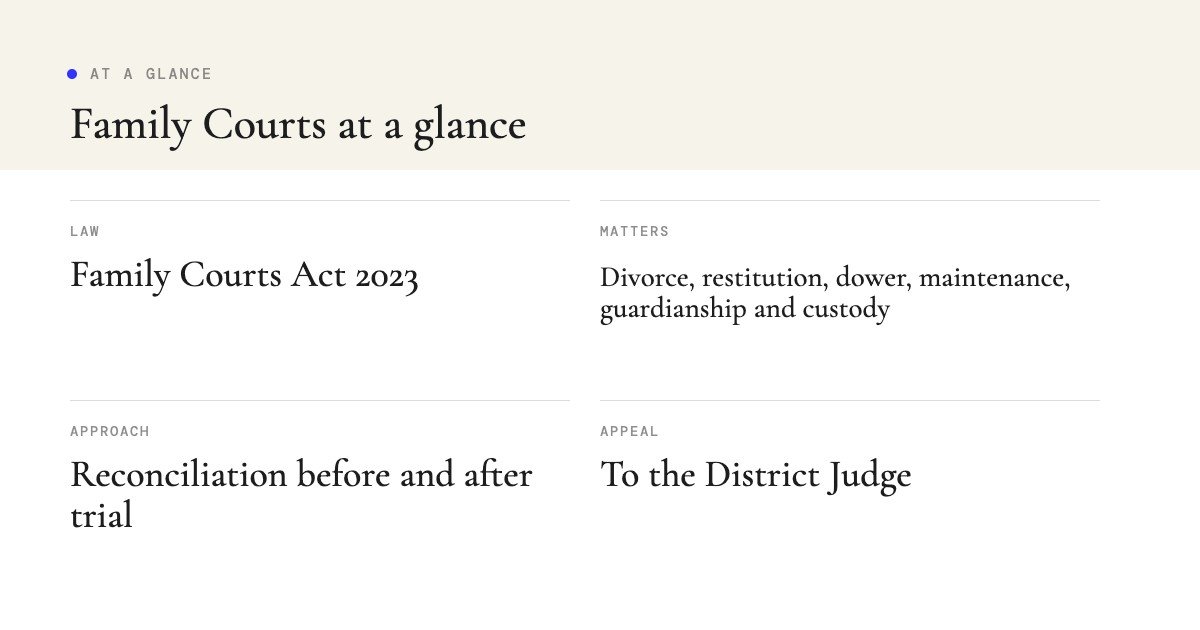
- Family courts have exclusive jurisdiction over dissolution of marriage, restitution of conjugal rights, dower, maintenance, and guardianship and custody of children.
- The Family Courts Act 2023 replaced the Family Courts Ordinance 1985.
- Reconciliation is built into the process, with attempts at settlement before and after trial.
- Appeals from family court decrees lie to the District Judge.
- Decrees for dower and maintenance can be executed through attachment, garnishment and, in some cases, detention.
What a family court in Bangladesh decides
Family courts hear suits on five core matters: dissolution of marriage, restitution of conjugal rights, dower, maintenance, and guardianship and custody of children. Related issues, such as the validity of a marriage, may arise within these suits. The courts apply the personal law of the parties, most commonly Muslim family law as modified by the Muslim Family Laws Ordinance 1961 and the Dissolution of Muslim Marriages Act 1939. The extent to which members of other communities use family courts depends on their personal law, an area where codification is limited.
Our family law team, part of the practice described on our about page, represents clients in family courts across Bangladesh.
The Family Courts Act 2023 and the family court in Bangladesh
Parliament passed the Family Courts Act 2023 to replace the 1985 Ordinance, consolidating and updating the law on family courts. The Act preserves the core features of the old system, including simplified procedure, reconciliation and limited appeals, while addressing procedural gaps identified over decades of practice. The text is available on Laws of Bangladesh. Because the Act is relatively new, practitioners continue to rely on earlier case law where provisions are similar.
Remedies available from a family court in Bangladesh
| Matter | Typical claim |
|---|---|
| Dissolution of marriage | Wife seeks divorce on grounds under the 1939 Act |
| Restitution of conjugal rights | Spouse seeks return of the other spouse to the marital home |
| Dower | Wife claims unpaid prompt or deferred dower |
| Maintenance | Wife or children claim maintenance, including arrears |
| Guardianship and custody | Parent seeks custody, visitation or guardianship of a child |
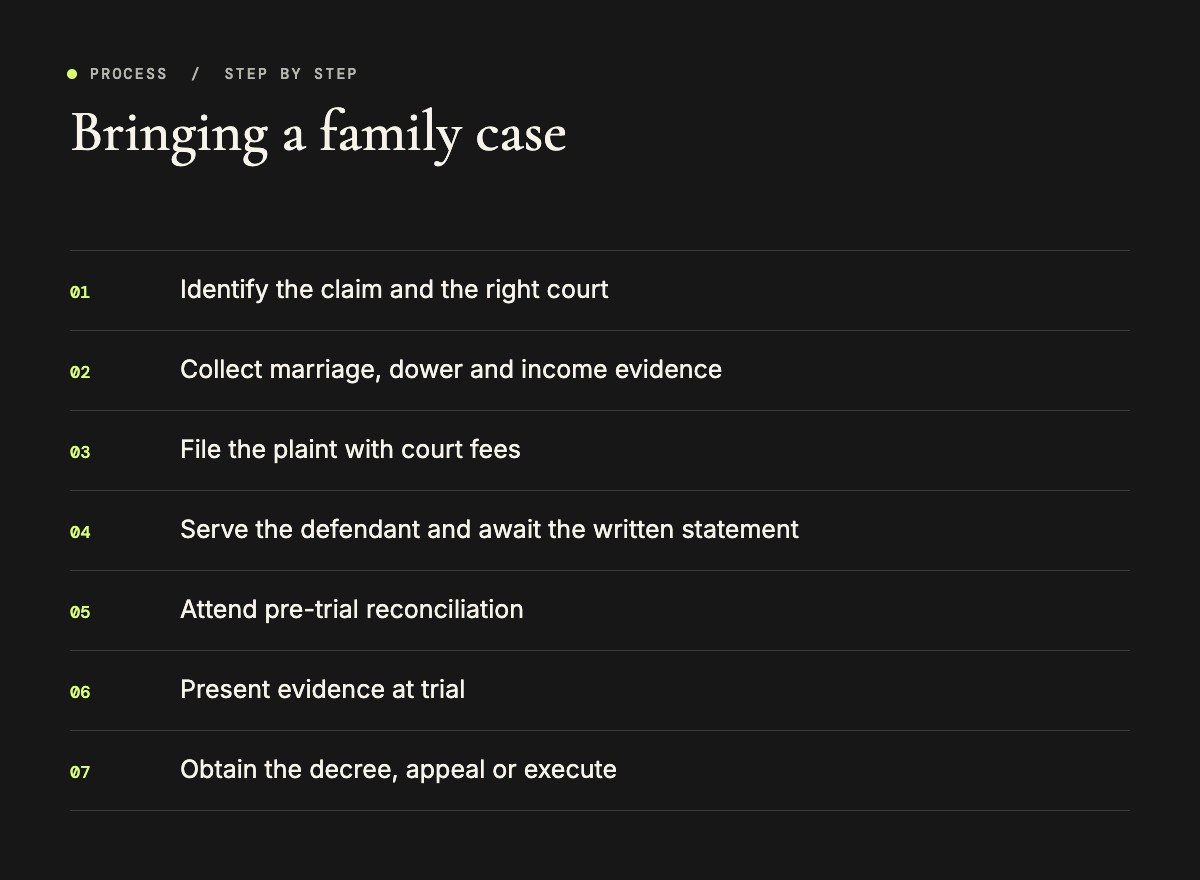
Bringing a family case
- Identify the claim and court. File where the cause of action arose or where the wife ordinarily resides, as permitted.
- Collect evidence. Gather the kabinnama, birth certificates, income evidence and correspondence.
- File the plaint. Submit the plaint with the prescribed court fee.
- Service and reply. The defendant is summoned and files a written statement.
- Pre-trial reconciliation. The court explores settlement between the parties.
- Trial. If no settlement, witnesses are examined and evidence presented.
- Decree and next steps. Obtain the decree, appeal if necessary, or execute it.
Wives often combine claims for dower, maintenance and custody in related suits. Coordinating these claims avoids inconsistent findings and strengthens the overall position.
Dower claims in a family court in Bangladesh
Dower (mohrana) is the wife’s right under Muslim law, recorded in the kabinnama. Prompt dower is payable on demand, while deferred dower becomes payable on dissolution of marriage by death or divorce. A wife can sue in the family court for unpaid dower, and the court decides the amount based on the kabinnama and evidence of any payment. Claims must be brought within the limitation period, which generally runs from demand or dissolution. A family court in Bangladesh frequently hears dower claims alongside maintenance after a talaq.
Maintenance claims in a family court in Bangladesh
A husband must maintain his wife during the marriage and, after divorce, during the iddat period, and a father must maintain his children. The court considers the husband’s means and the wife’s and children’s needs. Arrears may be awarded for a period before the suit, subject to limits. Under the Muslim Family Laws Ordinance 1961, maintenance claims can also be raised before the Arbitration Council of the local union parishad or city corporation, but family courts remain the main forum for enforceable decrees.
Dissolution of marriage
A wife can seek dissolution of marriage under the Dissolution of Muslim Marriages Act 1939 on grounds such as the husband’s absence for four years, failure to maintain for two years, taking an additional wife in contravention of the 1961 Ordinance, imprisonment, impotence, insanity, cruelty, or other recognised grounds. She can also exercise a delegated right of divorce (talaq-e-tafweez) if granted in the kabinnama, without going to court, following the notice procedure under the 1961 Ordinance. Family courts adjudicate disputed dissolution claims.
Custody and guardianship
Custody disputes are decided according to personal law and the Guardians and Wards Act 1890, with the welfare of the child as the paramount consideration. The court can award custody, set visitation, and make orders to prevent removal of the child from Bangladesh. Custody claims are often linked to maintenance claims for the child.
Reconciliation and mediation
A defining feature of the family court in Bangladesh is reconciliation. After the written statement is filed, the court holds a pre-trial hearing to examine the issues and explore settlement. If no settlement is reached, the case proceeds to trial, and the court may attempt reconciliation again after evidence is taken and before the decree. Settlements recorded by the court have the force of a decree. Legal aid offices can also facilitate mediation. Many cases, particularly on dower and maintenance, are resolved through negotiated settlements at these stages.
Evidence in family cases
Key evidence includes the kabinnama, birth certificates, evidence of the husband’s income and assets, receipts of any payments, correspondence, and witnesses who can speak to the marriage, cohabitation or treatment. In custody cases, evidence of the child’s schooling, health and care arrangements is important. Family courts follow simplified procedure, but parties must still prove their claims, so organising documents before filing makes a significant difference.
Appeals and revision
A party dissatisfied with a decree can appeal to the District Judge within the time permitted under the Act. Some interim orders may also be challenged. Further recourse to the High Court Division is limited, usually through revision on questions of law or jurisdiction. Because appeals add time and cost, parties should weigh the strength of their case and possible settlement before appealing a decision of a family court in Bangladesh.
Executing a decree of a family court in Bangladesh
A decree for dower or maintenance is enforced through execution proceedings. The court can order attachment and sale of the judgment debtor’s property, deductions from salary through the employer, and in some cases detention for wilful non-payment. Maintenance decrees may be payable monthly, and arrears can be enforced. Accurate information about the debtor’s assets and employment helps make execution effective.
Choosing the right family court in Bangladesh
Choosing the right court matters. Under the family courts framework, suits can generally be filed in the court within whose local limits the cause of action arose or where the parties reside or last resided together, and for dissolution of marriage, dower and maintenance claims, the court where the wife ordinarily resides has jurisdiction. This rule is designed to make access easier for women, who are most often the claimants. Filing in the wrong court can lead to return of the plaint and delay.
Restitution of conjugal rights
A spouse, usually the husband, may sue for restitution of conjugal rights when the other spouse has left the marital home without lawful excuse. Courts examine whether the wife had reasonable grounds to leave, such as cruelty, non-payment of prompt dower or failure to maintain. Restitution suits are sometimes filed in response to maintenance or dower claims, and courts look at the overall circumstances rather than granting restitution mechanically.
Domestic violence and protection orders
Family disputes sometimes involve violence. Protection orders, residence orders and maintenance under the Domestic Violence (Prevention and Protection) Act 2010 are sought before magistrate courts rather than family courts, but the two processes can run in parallel. Criminal complaints may also be filed under the Penal Code or special laws. Victims should prioritise safety and seek urgent legal and practical support.
Legal aid and support
Many litigants in family courts, especially women, cannot afford private lawyers. The National Legal Aid Services Organisation provides free legal advice, representation and mediation through district legal aid offices, and NGOs offer additional support. Access to a family court in Bangladesh is designed to be affordable, with modest court fees, but legal help remains important for preparing claims, gathering evidence and enforcing decrees.
Applicants for legal aid usually need to show limited means, and certain vulnerable groups may qualify more easily.
Practical tips for litigants
Keep the original kabinnama safe and obtain certified copies from the marriage registrar if needed. Document all payments of dower and maintenance. Record dates and details of key events. Attend every hearing, as absence can lead to dismissal or an ex parte decree. Consider settlement offers seriously, especially when they provide prompt payment. Seek advice early on time limits for claims and appeals.
Non-resident parties
Where one spouse lives abroad, service of summons, evidence and enforcement become more complex. Courts can serve notice through recognised methods, and parties abroad can appoint lawyers and give evidence in ways permitted by the court. Enforcing maintenance or dower decrees against a spouse abroad may require proceedings in the foreign country or attachment of assets in Bangladesh. Expatriate spouses should take advice early, as ignoring proceedings can lead to ex parte decrees that are later enforced against property in Bangladesh.
A properly executed and authenticated power of attorney allows a trusted representative in Bangladesh to instruct lawyers, receive notices and attend mediation on the absent party’s behalf, which keeps the case moving and avoids default orders.
Frequently asked questions about family court in bangladesh
Which law governs family courts?
The Family Courts Act 2023, which replaced the 1985 Ordinance.
What cases do family courts hear?
Divorce, restitution of conjugal rights, dower, maintenance, and guardianship and custody.
Is mediation required?
The court attempts reconciliation before and after trial.
Where do appeals go?
To the District Judge, within the time allowed.
How are decrees enforced?
Through execution, including attachment of property and garnishment of salary.
Are court fees high?
Family court fees have traditionally been modest to keep access affordable.
How we can help
We represent clients before every family court in Bangladesh in claims for dower, maintenance, divorce, custody and guardianship, and in appeals and execution. Learn more about our practice, our mediation services and our guide to the Muslim Family Laws Ordinance 1961.
Facing a family dispute?
We provide discreet, practical representation.
Book a consultationAbout usPrimary sources: the Family Courts Act 2023, the Muslim Family Laws Ordinance 1961 and the Dissolution of Muslim Marriages Act 1939 on Laws of Bangladesh; legal aid from the National Legal Aid Services Organisation; courts information from the Supreme Court of Bangladesh.
This article is general information about Bangladeshi family law as of October 2026 and is not legal advice. Procedure under the 2023 Act is still developing through practice.




0 Comments