
Foreign companies that need to perform contracts, provide services or trade in Bangladesh without incorporating a subsidiary often consider a branch. Branch office registration in Bangladesh requires permission from Invest Bangladesh, an inward remittance of capital, and filings with the RJSC as a foreign company. A branch is simpler to set up than a subsidiary in some respects, but its activities are restricted and the parent company remains fully liable.

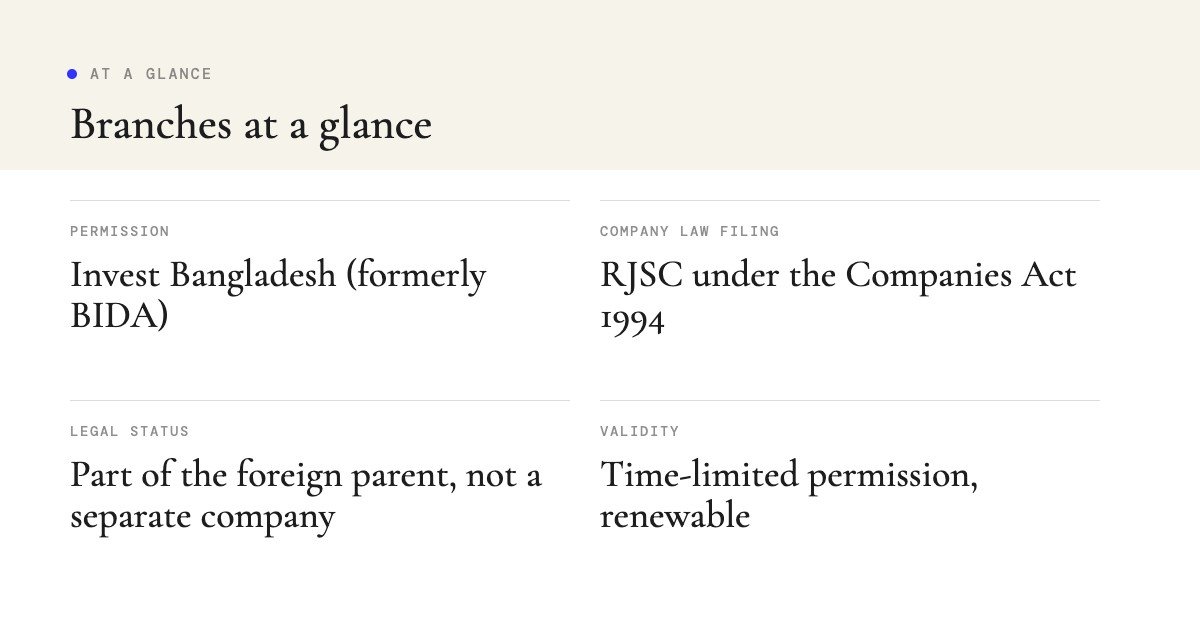
- Foreign companies need permission from Invest Bangladesh (formerly BIDA) to open a branch office.
- A branch is not a separate legal entity; the foreign parent is liable for its obligations.
- Permission is time-limited and renewable, and conditions typically include an initial inward remittance of capital.
- Foreign companies establishing a place of business must file documents with the RJSC under the Companies Act 1994.
- Branches are taxed on their Bangladesh-source income and must comply with VAT, withholding and foreign exchange rules.
When branch office registration in Bangladesh makes sense
A branch suits foreign companies carrying out specific projects, such as construction, engineering or consultancy contracts, providing services under contracts with Bangladeshi clients, or operating in sectors where regulators permit branches, such as some banking and airline operations. Where the business plans to manufacture, hold land, or grow a long-term local operation, a subsidiary is usually better. Liaison offices, by contrast, cannot earn income and are limited to promotional and liaison activities.
Our corporate practice helps foreign companies choose the right structure and handle branch office registration in Bangladesh.
Invest Bangladesh permission for branch office registration in Bangladesh
The application to Invest Bangladesh includes the parent company’s certificate of incorporation, memorandum and articles, latest audited accounts, a board resolution approving the branch, details of proposed activities, the proposed office address, and information about expatriate staff. Documents executed abroad generally need notarisation and attestation by the Bangladesh mission. Permission is issued for a fixed period with conditions, such as remitting a minimum amount of initial capital within a set time and confining activities to those approved. Information is available from Invest Bangladesh.
Branch office registration in Bangladesh versus a subsidiary or liaison office
| Feature | Branch office | Subsidiary | Liaison office |
|---|---|---|---|
| Legal personality | Part of parent | Separate company | Part of parent |
| Income generation | Permitted for approved activities | Permitted | Not permitted |
| Liability | Parent fully liable | Limited to subsidiary | Parent liable |
| Approval | Invest Bangladesh permission | RJSC incorporation | Invest Bangladesh permission |
| Duration | Time-limited, renewable | Perpetual | Time-limited, renewable |
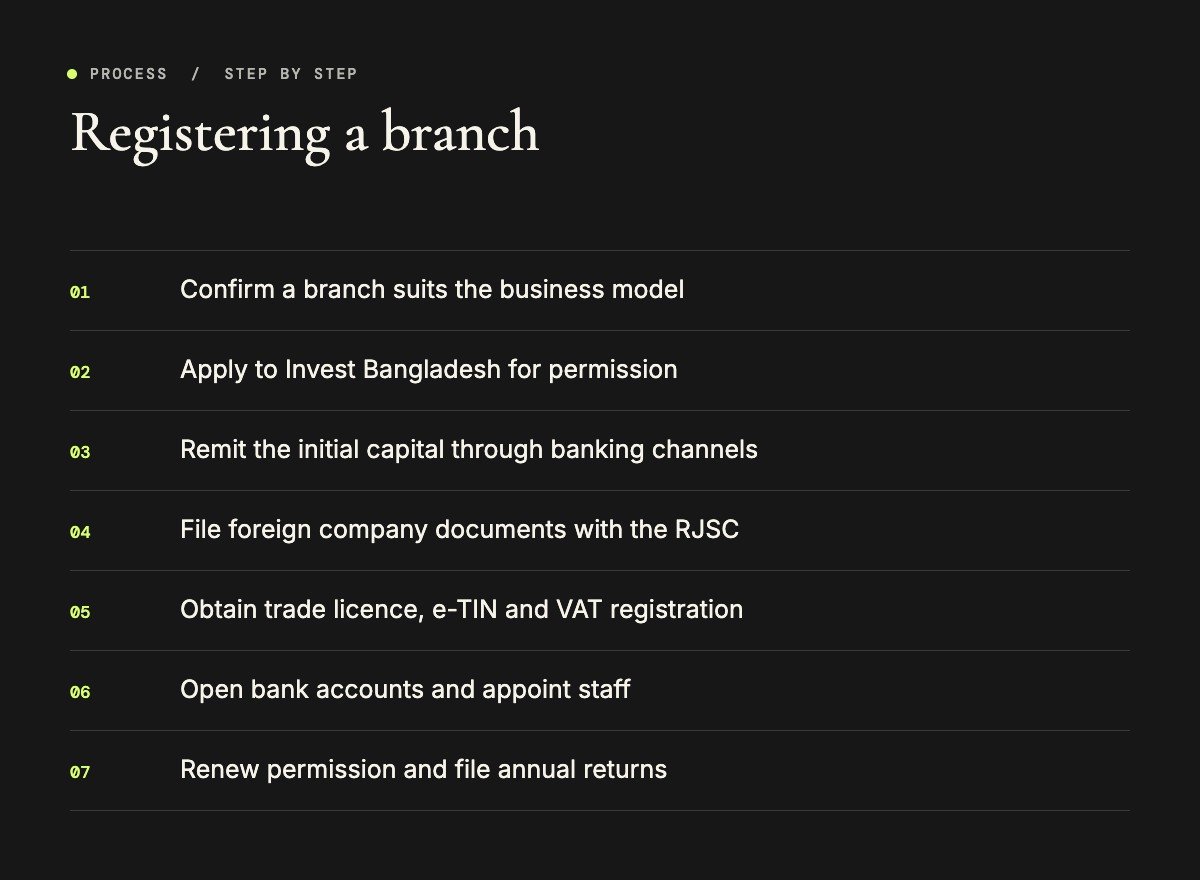
Registering a branch step by step
- Assess structure. Confirm that a branch fits the activities and sector rules.
- Apply for permission. File with Invest Bangladesh with attested parent documents.
- Remit capital. Bring initial funds through banking channels and obtain encashment certificates.
- RJSC filing. File the foreign company documents with the RJSC.
- Local registrations. Obtain trade licence, e-TIN and VAT registration.
- Banking and staff. Open accounts and obtain work permits for expatriates.
- Ongoing compliance. Renew permission, file returns and submit audited accounts.
Branch permissions are tied to approved activities. Taking on contracts outside those activities can jeopardise renewal and create tax issues, so seek an amendment before expanding scope.
RJSC filing as part of branch office registration in Bangladesh
Under the Companies Act 1994, a foreign company that establishes a place of business in Bangladesh must file prescribed documents with the RJSC within the statutory period, including a certified copy of its charter, a list of directors, the address of its principal office in Bangladesh, and the names and addresses of persons resident in Bangladesh authorised to accept service on its behalf. Changes must be notified, and annual accounts filed as required. Completing the RJSC filing is an essential part of branch office registration in Bangladesh, separate from Invest Bangladesh permission.
Initial capital and remittance
Permission conditions commonly require the branch to bring a minimum amount of foreign currency into Bangladesh within a set period to cover start-up expenses, supported by encashment certificates. Thereafter, the branch funds its operations from local income or further remittances from the parent. All inward and outward remittances must follow Bangladesh Bank rules, and the branch must keep records to support later repatriation of surplus funds.
Tax after branch office registration in Bangladesh
A branch is taxed on income attributable to its Bangladesh operations under the Income Tax Act 2023, generally at the rate applicable to non-listed companies, subject to treaty provisions. It must deduct withholding tax on payments to staff, suppliers and contractors, register for VAT where required and file returns. Payments to the head office, such as management fees, may face restrictions on deductibility and withholding. Remittance of branch profits to the parent may attract tax under the Act or treaty. Careful planning reduces tax leakage.
Employing staff
Branches can employ local staff under the Bangladesh Labour Act 2006 and service rules, and may employ foreign nationals with work permits from Invest Bangladesh and appropriate visas. Permission conditions may limit the number of expatriates. Payroll taxes, contributions and employment benefits must be managed in compliance with local law.
Sector-specific branches
Certain sectors have their own rules. Foreign bank branches require a licence from Bangladesh Bank under the Bank Company Act 1991; foreign insurers face the insurance regulator’s requirements; foreign airlines and shipping lines deal with aviation and shipping authorities. Contractors performing public projects may need registration with procuring entities and compliance with public procurement rules. In these sectors, branch office registration in Bangladesh involves both Invest Bangladesh permission and sector licensing, which should be planned together.
Renewal after branch office registration in Bangladesh
Before permission expires, the branch must apply to Invest Bangladesh for renewal, typically submitting audited accounts, tax returns and payment evidence, encashment certificates for remittances, details of activities and staff, and the parent’s confirmation of continued support. Late renewal can lead to penalties and difficulty operating bank accounts or remitting funds. Keeping compliance documents current throughout the year makes renewal straightforward.
Bank accounts and remittances
A branch opens accounts with an authorised dealer bank to receive initial capital, collect income and pay expenses. Remittance of surplus funds or profits to the head office requires audited accounts, tax clearance and other documents, and must follow Bangladesh Bank procedures. Banks review documentation carefully, so branches should keep a clear record of all inflows and outflows from the start.
Closing a branch
When the project ends or the parent decides to exit, the branch must settle liabilities, pay taxes and staff dues, close bank accounts and repatriate any remaining funds, obtain the required clearances and inform Invest Bangladesh and the RJSC. Closure can take time, particularly obtaining tax clearance. Planning the exit well before operations wind down helps avoid lingering obligations in Bangladesh.
Converting a branch into a subsidiary
Some foreign companies begin with a branch and later convert to a subsidiary as their business grows. Conversion involves incorporating a new company, transferring assets, contracts and employees, and closing the branch, with tax and regulatory consequences at each step. Considering the long-term plan at the outset can avoid a costly conversion later.
Permanent establishment and contracts
A registered branch is clearly a permanent establishment for tax purposes. Foreign companies sometimes perform work in Bangladesh without a branch, relying on short visits or local agents, but this can still create a taxable presence and regulatory issues if activities are substantial. Formal registration provides clarity and allows the foreign company to sign local contracts, open bank accounts and hire staff lawfully. Contracts with Bangladeshi clients should specify which entity performs which work, especially where both the parent and the branch are involved, to avoid disputes over tax and liability.
Accounting and audit
Branches must keep books of account in Bangladesh for their local operations, prepare financial statements and have them audited by a chartered accountant. These accounts support tax returns, renewal applications and profit remittances. Allocation of head office expenses to the branch must follow tax rules on deductibility, and transfer pricing requirements may apply to dealings with the parent and group companies.
Practical checklist
Prepare and attest parent documents early; confirm activities match the permission sought; plan initial remittance; complete RJSC filings promptly; obtain trade licence, e-TIN and VAT registration; set up accounting and payroll; diarise renewal and annual filing dates; and keep all remittance records. Following this checklist keeps branch office registration in Bangladesh on track and the branch compliant throughout its life.
Documents checklist for the parent company
Invest Bangladesh and the RJSC typically require the parent’s certificate of incorporation, memorandum and articles or equivalent charter, a board resolution approving the branch and appointing an authorised representative, the latest audited accounts, a profile of the company and its activities, a power of attorney for the local representative, and details of directors. Documents in languages other than English need certified translations. Most must be notarised in the home country and attested by the Bangladesh embassy or high commission there, which can take several weeks, so preparation should start early.
Keeping a set of certified copies available in Bangladesh speeds up later filings with banks, tax authorities and regulators.
Compliance risks
Common compliance failures include operating outside approved activities, late renewal, failure to file RJSC documents or annual accounts, under-deduction of withholding tax, and missing documentation for remittances. These can lead to penalties, frozen bank accounts or refusal of renewal. Assigning responsibility for compliance to a named person, supported by local advisers, helps avoid these problems.
Timeline for branch office registration in Bangladesh
With complete, attested documents, Invest Bangladesh permission can often be obtained within weeks, followed by RJSC filing, local registrations and bank account opening. The longest step is frequently preparing and attesting documents abroad. Building a realistic timeline helps align the branch’s opening with project start dates and client expectations, and allows time for work permits for expatriate managers who need to arrive early.
Foreign companies bidding for contracts should start the process before award where possible, because many clients expect a registered local presence before signing, and delays in registration can push back mobilisation and the first invoices.
Early engagement with local advisers usually shortens the overall process.
Frequently asked questions about branch office registration in bangladesh
Who approves foreign branch offices?
Invest Bangladesh (formerly BIDA), with RJSC filings under company law.
Is a branch a separate company?
No, it is part of the foreign parent, which remains liable.
Can a branch earn income?
Yes, within approved activities, unlike a liaison office.
How long is permission valid?
For a fixed period, renewable on application with compliance documents.
Can a branch remit profits?
Yes, after tax and with supporting documents under Bangladesh Bank rules.
Do branches pay corporate tax?
Yes, on income attributable to Bangladesh, at rates set by the Income Tax Act 2023.
How we can help
We manage branch office registration in Bangladesh, renewals, tax and exchange control compliance, and conversion or closure. See our corporate practice, our foreign direct investment team and our tax law practice.
Opening a branch in Bangladesh?
We secure permission and keep you compliant.
Book a consultationCorporatePrimary sources: the Companies Act 1994 on Laws of Bangladesh; permissions from Invest Bangladesh; filings with the RJSC; foreign exchange rules from Bangladesh Bank.
This article is general information about Bangladeshi law as of October 2026 and is not legal advice. Invest Bangladesh conditions, including capital requirements, change; confirm current requirements.




0 Comments