
Bangladesh has planned a network of economic zones to attract manufacturing and services investment, with serviced land, utilities and streamlined approvals. Economic zone investment in Bangladesh was historically administered by the Bangladesh Economic Zones Authority (BEZA). In August 2026 the Invest Bangladesh Act 2026 merged BEZA with BIDA and the PPP Authority into a single agency, Invest Bangladesh, which now handles zone investment alongside general investment facilitation.
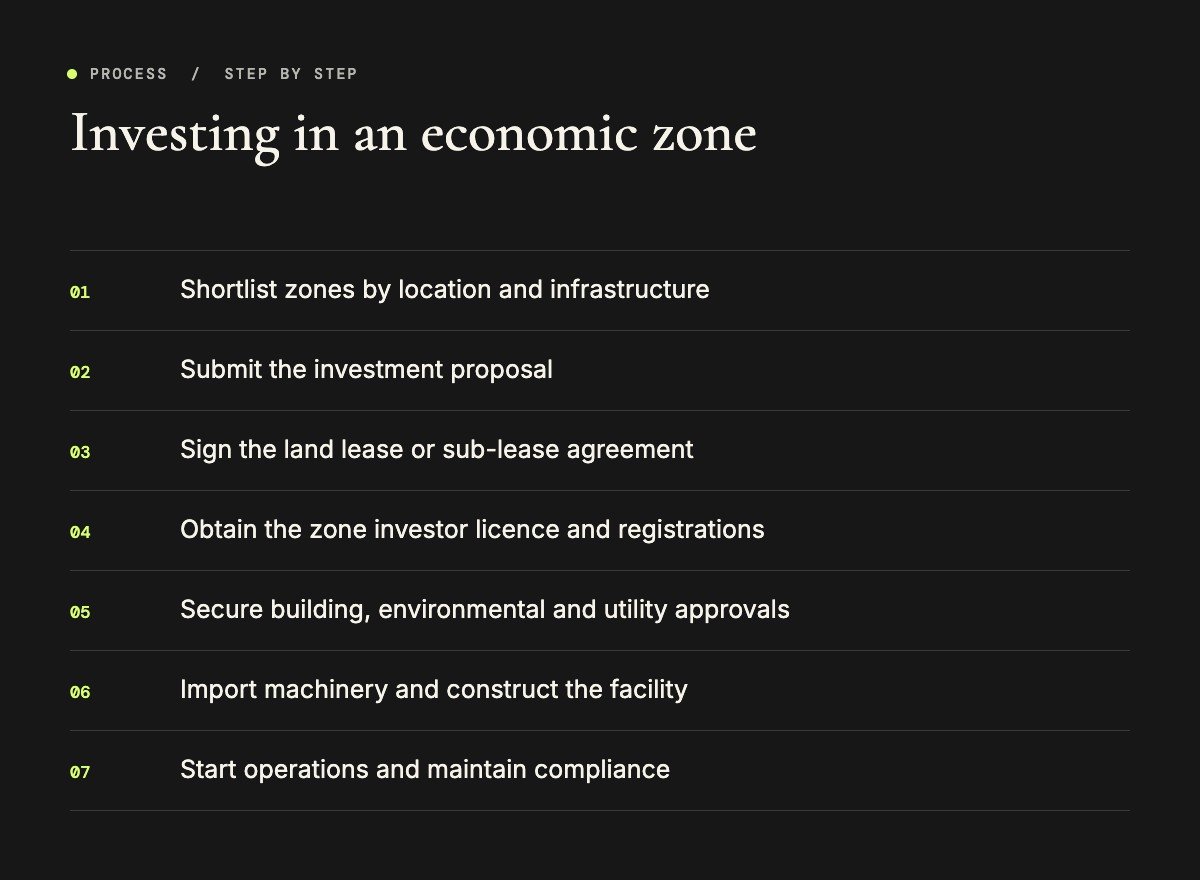
- Economic zones are established under the Bangladesh Economic Zones Act 2010.
- The Invest Bangladesh Act 2026 merged BEZA, BIDA and the PPP Authority into Invest Bangladesh, which began operating on 23 August 2026.
- Zones include government-owned, private, public-private partnership and government-to-government zones developed with foreign partners.
- Zone investors can benefit from tax and duty incentives, subject to conditions, and one-stop services for licences.
- Both export-oriented and domestic-market industries can locate in economic zones, unlike EPZs, which focus on exports.
Why economic zone investment in Bangladesh appeals to investors
Economic zones offer large, serviced plots with access to power, gas, water, roads and in some cases ports, reducing the land acquisition and infrastructure problems that often delay industrial projects elsewhere in Bangladesh. Zone authorities provide one-stop services for many permits. Zones can host both export and domestic-market industries, giving investors flexibility. Several zones are designed for specific investor countries or sectors, such as zones developed with Japanese, Chinese and Indian partners.
Our foreign direct investment practice advises investors on zone selection and approvals.
The framework for economic zone investment in Bangladesh
The Bangladesh Economic Zones Act 2010 provides for the establishment of economic zones, the rights of developers and investors, incentives and the regulator’s powers. For years, BEZA administered the zones. Under the Invest Bangladesh Act 2026, BEZA was merged with BIDA and the PPP Authority into Invest Bangladesh under the Prime Minister’s Office, which began work on 23 August 2026. Existing investment services continue, and the BanglaBiz digital platform remains the one-stop portal. The One Stop Service Act 2018 also underpins streamlined approvals. Laws are on Laws of Bangladesh, and current guidance on Invest Bangladesh.
Types of zones for economic zone investment in Bangladesh
| Zone type | Description |
|---|---|
| Government economic zones | Developed by the state, such as the large industrial area at Mirsarai in Chattogram |
| Private economic zones | Developed and operated by licensed private developers |
| PPP zones | Developed through public-private partnerships |
| G2G zones | Developed with foreign governments for their investors, for example a Japanese economic zone at Araihazar |
| Special zones | Zones for specific sectors such as tourism or technology |
Investing in an economic zone
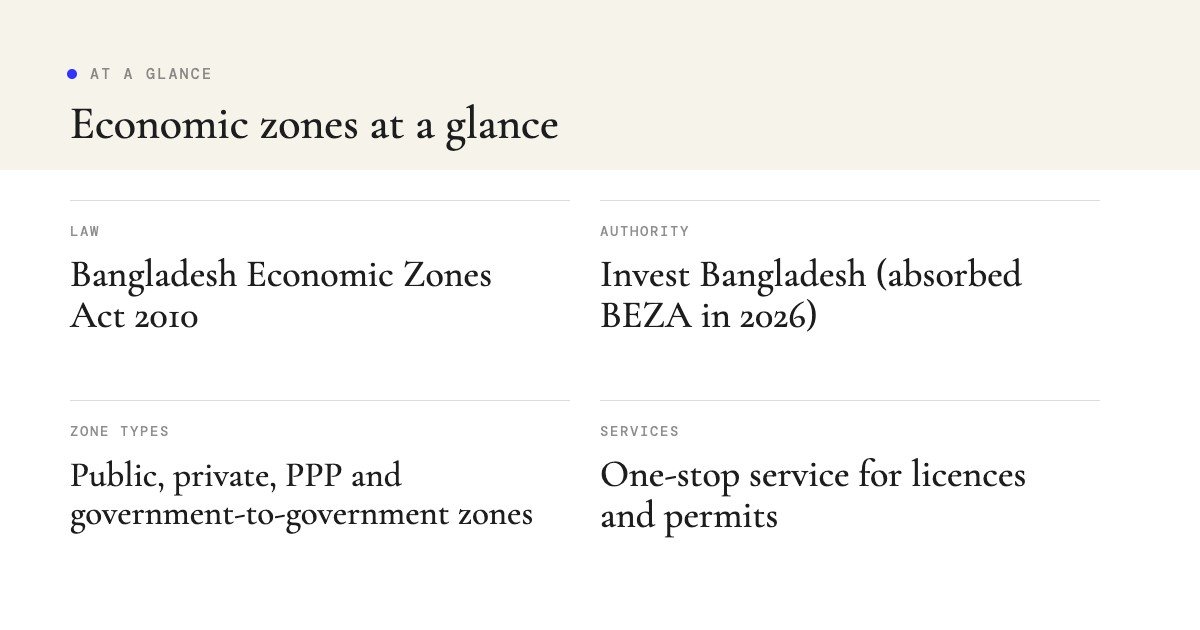
- Shortlist zones. Compare location, logistics, utilities and land costs.
- Submit a proposal. Apply with project details, investment plan and land requirement.
- Land agreement. Sign a lease with the zone authority or a sub-lease with a private developer.
- Licences. Obtain the investor licence and register the company or branch.
- Approvals. Secure building plan, environmental clearance and utility connections.
- Construction and imports. Import machinery under applicable incentives and build the facility.
- Operate. Begin operations and comply with zone rules and reporting.
Check the actual status of infrastructure, especially gas and power connections, before committing. Some zones have land ready but utilities still under development, which can delay production.
Incentives for economic zone investment in Bangladesh
Economic zone investors have historically been offered tax holidays for a period of years with declining exemption percentages, duty-free import of capital machinery and construction materials, exemptions from certain local taxes, and facilities such as offshore banking and work permits through the zone authority. Developers of private zones receive their own incentives. The exact incentives now depend on the Income Tax Act 2023, customs law and statutory regulatory orders, which have been revised over time, so investors should confirm current benefits before relying on them in financial models for economic zone investment in Bangladesh.
Private economic zones and developers
Private economic zones are developed by licensed developers who build infrastructure and lease plots to investors. Some are operated by large Bangladeshi conglomerates, others in partnership with foreign developers. Investors in private zones negotiate sub-lease terms with the developer, including rent, service charges, utility arrangements and transfer rights, while regulatory approvals still come from the zone authority. Due diligence on the developer’s licence, land title and infrastructure delivery is essential.
Land leases and economic zone investment in Bangladesh
Land in economic zones is generally leased, not sold. Lease terms, often long-term with renewal options, set rent, development obligations, timelines for construction and commencement, restrictions on use and transfer, and termination for non-performance. Investors should check whether the lease allows mortgage of leasehold interests to lenders, which is often essential for project finance, and what happens if the project is delayed.
Labour and environmental compliance
Unlike EPZs, which have a separate labour law, economic zones are generally subject to the Bangladesh Labour Act 2006, subject to any special provisions. Environmental clearance from the Department of Environment is required according to the project category, and zones may have central effluent treatment and waste facilities. Building and fire safety standards apply. Planning these requirements early avoids delays in commissioning.
What the 2026 merger means for investors
The creation of Invest Bangladesh as a single agency aims to reduce duplication and give investors one point of contact for registration, zone land, PPP opportunities and aftercare. For existing zone investors, licences and agreements issued by BEZA are expected to continue, with Invest Bangladesh stepping into BEZA’s role. Investors should nonetheless check whether any procedures, forms or contact points have changed, and ensure that renewals and applications are addressed to the correct authority. During the transition, keeping copies of all BEZA approvals and correspondence is prudent for anyone involved in economic zone investment in Bangladesh.
BEPZA, which runs the export processing zones, was not reported as part of the merger, so EPZ investors continue to deal with BEPZA.
Financing economic zone investment in Bangladesh
Zone projects can be financed through equity, foreign loans approved under Bangladesh Bank and Invest Bangladesh rules, local bank lending and development finance institutions. Lenders typically require security over leasehold land, buildings and machinery, so lease terms permitting mortgage are important. Some zones developed with foreign governments offer access to development finance from the partner country. Structuring finance early supports timely construction and commissioning.
Customs and domestic sales
Goods moving between economic zones and the domestic tariff area are subject to customs procedures. Export-oriented units may import inputs duty-free under bond, while sales into the domestic market attract applicable duties and taxes. Companies producing for both markets must manage customs documentation carefully to remain compliant and preserve incentives. Clear internal systems for tracking inputs and outputs are essential for economic zone investment in Bangladesh involving mixed markets.
Work permits and expatriates
Investors in economic zones obtain work permits for foreign staff through the zone authority, now Invest Bangladesh, subject to conditions on qualifications and local staff ratios. Expatriates also need suitable visas, and their salaries are subject to Bangladeshi income tax. Planning expatriate staffing alongside construction milestones avoids delays in commissioning machinery and training local employees.
Disputes and investor protection
Investors in economic zones benefit from the protections of the Foreign Private Investment (Promotion and Protection) Act 1980 and any applicable bilateral investment treaty. Lease agreements with zone authorities or private developers should include clear dispute resolution clauses, often arbitration. Administrative decisions can be challenged through review processes or the courts. Documenting all approvals and commitments protects investors if disputes arise.
Choosing between zones
Key factors include proximity to ports and markets, availability and reliability of power and gas, road and rail connectivity, labour availability, land cost and lease terms, the zone’s track record in delivering infrastructure, and the presence of suppliers or clusters in the same sector. Visiting shortlisted zones and speaking to existing tenants provides practical insight. G2G zones may offer dedicated support for investors from the partner country, while private zones may offer faster delivery and flexible terms.
Timeline from approval to production
Timelines vary widely. Investors leasing ready plots with utilities in place can move to construction quickly after approvals, while those in zones still under development may wait for infrastructure. Building approvals, environmental clearance, machinery import and installation, recruitment and trial production all take time. A realistic schedule, agreed with the zone authority or developer and reflected in lease milestones, protects the investor from penalties for delay.
Practical checklist
Confirm the zone’s legal status and infrastructure; review lease terms, including mortgage and transfer rights; verify incentives in current law; plan corporate structure and capital remittance; secure environmental and building approvals; arrange utilities; obtain work permits; set up customs and accounting systems; and keep copies of every approval. This checklist keeps economic zone investment in Bangladesh on schedule.
Sectors targeted by the zones
Economic zones host a wide range of industries, including garments and textiles, pharmaceuticals and active pharmaceutical ingredients, automobiles and motorcycles, electronics, steel and metal products, agro-processing, chemicals, light engineering and logistics. Some zones target specific sectors, such as pharmaceutical parks or IT and services zones, and the government has promoted higher-value manufacturing to diversify exports beyond garments. Matching the project to a zone with suitable infrastructure and supplier networks improves competitiveness.
Investors in heavy or polluting industries should confirm that the zone permits their activity and has adequate environmental infrastructure, as some zones restrict certain categories of industry.
Exit after economic zone investment in Bangladesh
Investors may sell their shares, transfer leasehold interests or close operations, subject to approval of the zone authority, settlement of dues and compliance with foreign exchange rules for repatriation. Lease agreements usually require consent for assignment. Planning exit routes in the lease and shareholder agreements at the outset simplifies future transactions and protects the value of the investment.
Keeping records of all lease payments, approvals and remittances in good order is the best preparation for any future sale or restructuring of a zone enterprise.
Buyers will expect to see that the lease is in good standing and that no incentive conditions have been breached, since breaches can trigger repayment of benefits.
Frequently asked questions about economic zone investment in bangladesh
Who regulates economic zones now?
Invest Bangladesh, which absorbed BEZA under the Invest Bangladesh Act 2026.
What law governs economic zones?
The Bangladesh Economic Zones Act 2010.
Can zone companies sell locally?
Yes, economic zones allow domestic-market industries, subject to customs rules.
Are there tax incentives?
Yes, subject to conditions in tax law and statutory regulatory orders.
Can foreigners own 100%?
Yes, in most sectors.
What is the difference from an EPZ?
EPZs, run by BEPZA, focus on exports; economic zones host both export and domestic industries.
How we can help
We advise on economic zone investment in Bangladesh, from zone selection and land agreements to licences, incentives and disputes. See our foreign direct investment practice, our manufacturing sector team and our infrastructure and energy practice.
Considering an economic zone?
We help you secure land, licences and incentives.
Book a consultationForeign investmentPrimary sources: the Bangladesh Economic Zones Act 2010 and the One Stop Service Act 2018 on Laws of Bangladesh; investment guidance from Invest Bangladesh; environmental clearance from the Department of Environment.
This article is general information about Bangladeshi investment rules as of October 2026 and is not legal advice. Institutional arrangements changed in 2026; confirm current procedures with Invest Bangladesh.




0 Comments