
Disputes over rent increases, advance payments, repairs and eviction are among the most common legal problems in Bangladesh’s cities. A clear rent agreement in Bangladesh protects both landlord and tenant by recording the rent, term, responsibilities and exit rules in writing. The Premises Rent Control Act 1991 adds statutory protections that apply regardless of what the parties agree, so agreements should be drafted with the Act in mind.
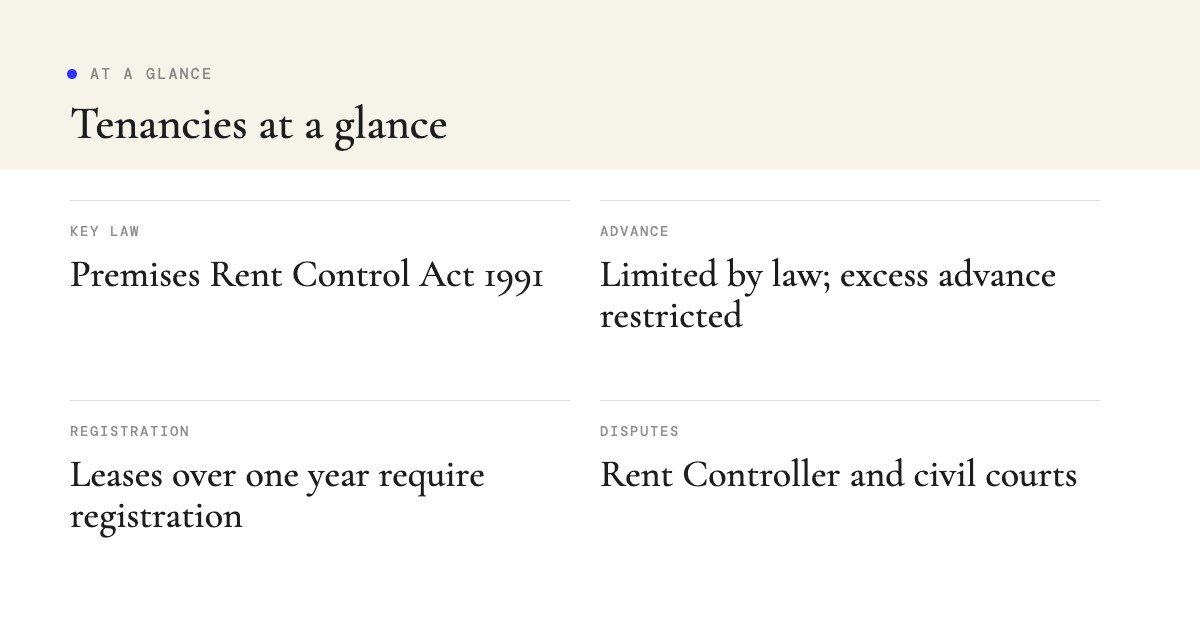
- The Premises Rent Control Act 1991 governs residential and commercial tenancies in urban areas, including standard rent, advances and eviction.
- The Act restricts landlords from taking advance rent or deposits beyond the limits it sets.
- A lease for more than one year, or from year to year, must be registered under the Registration Act 1908, and stamp duty applies.
- Landlords must issue rent receipts, and tenants can deposit rent with the Rent Controller if a landlord refuses to accept it.
- Eviction is only permitted on grounds and procedures set by law, not by force.
The legal framework for a rent agreement in Bangladesh
The Premises Rent Control Act 1991 applies to premises in specified urban areas and sets rules on standard rent, rent increases, advances, receipts, repairs and recovery of possession. The Contract Act 1872 and the Transfer of Property Act 1882 govern the agreement itself, while the Registration Act 1908 and the Stamp Act 1899 govern registration and stamp duty. City corporations have at times issued rent guidelines for different areas. Statutes are available on Laws of Bangladesh.
Our real estate practice drafts and reviews tenancy agreements and handles rent disputes. See also our guide to landlord and tenant rights.
Essential clauses in a rent agreement in Bangladesh
| Clause | What to cover |
|---|---|
| Parties and premises | Full names, identification, address and description of the premises |
| Term | Start date, duration and renewal options |
| Rent and payment | Amount, due date, method of payment and receipts |
| Advance or security deposit | Amount within legal limits and refund conditions |
| Utilities and service charges | Who pays electricity, gas, water and maintenance |
| Repairs | Allocation of minor and major repairs |
| Use and alterations | Permitted use, restrictions and consent for changes |
| Rent increase | Timing and method, consistent with the Act |
| Termination | Notice periods, grounds and handover |
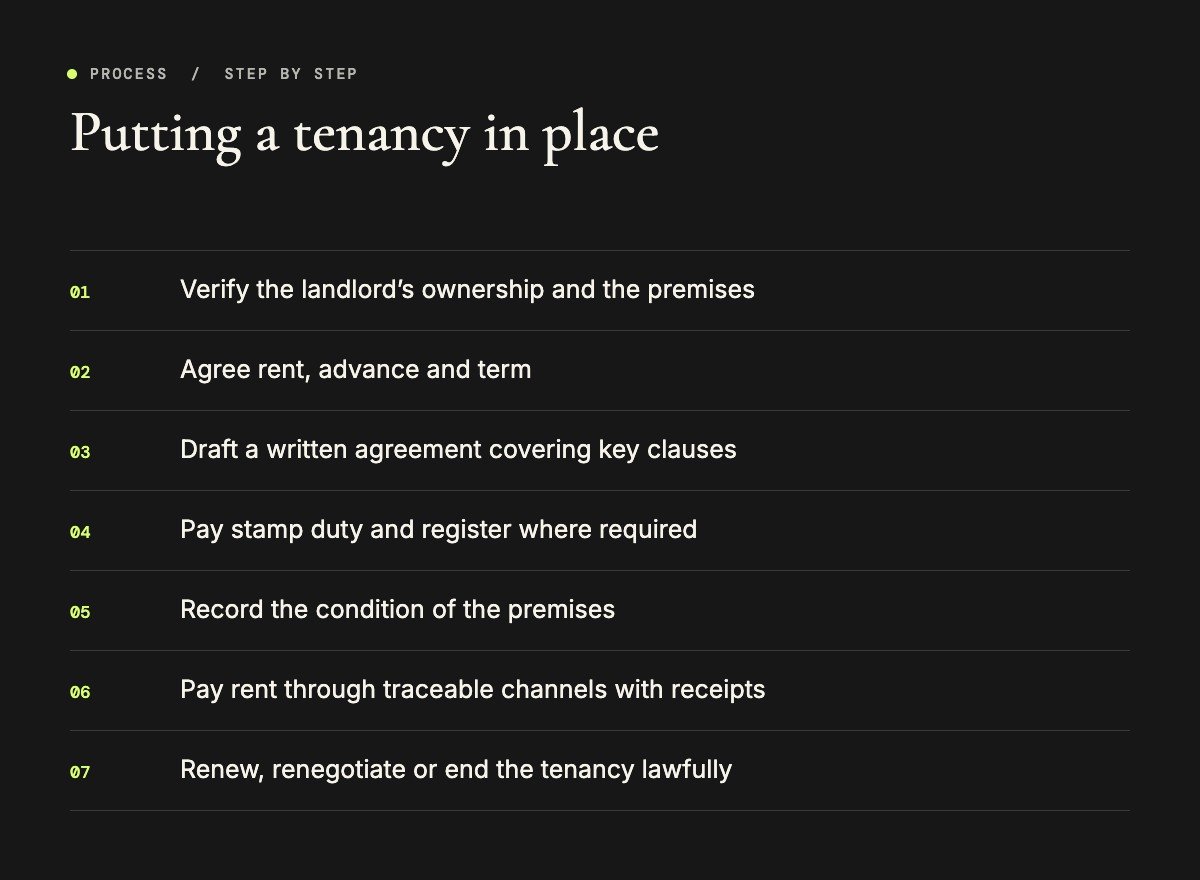
Putting a tenancy in place
- Verify. Check the landlord’s ownership or authority and the condition of the premises.
- Agree terms. Settle rent, advance, term and responsibilities.
- Draft. Prepare a written agreement covering all key clauses.
- Stamp and register. Pay stamp duty and register leases exceeding one year.
- Inventory. Record the condition of the premises and fixtures with photographs.
- Pay properly. Pay rent by bank or mobile transfer and obtain receipts.
- End lawfully. Give notice and hand over in accordance with the agreement and the Act.
Always obtain a receipt for rent and advances. If a landlord refuses to issue receipts or accept rent to manufacture a default, the tenant can deposit rent with the Rent Controller.
Advance and security deposits
Large advances have long been a source of hardship for tenants. The Premises Rent Control Act 1991 limits how much advance or security a landlord may take, generally to a modest amount equivalent to a short period of rent, with exceptions for certain commercial arrangements. Landlords who take excessive advances risk penalties, and tenants may be able to recover or adjust them. A rent agreement in Bangladesh should state the advance clearly, how it will be adjusted against rent or refunded, and deductions permitted for damage beyond normal wear and tear.
In practice, commercial landlords often negotiate larger adjustable advances, so both parties should take advice on enforceability.
Rent increases under a rent agreement in Bangladesh
The Act provides for standard rent, which can be fixed by the Rent Controller on application, and limits how often and by how much rent can be increased, generally not more than once within a set period. Agreements that provide for unreasonable or frequent increases may be challenged. Clear clauses on the timing and amount of increases, consistent with the Act, reduce disputes at renewal.
Registering a rent agreement in Bangladesh
Under the Registration Act 1908, leases of immovable property for any term exceeding one year, or from year to year, must be registered. Unregistered leases that require registration may not be admissible as evidence of the lease terms, weakening either party’s position in a dispute. Stamp duty under the Stamp Act 1899 depends on the rent and term. Many short residential tenancies are made for eleven months to avoid registration, but parties should understand the legal consequences of such arrangements.
Repairs under a rent agreement in Bangladesh
The agreement should allocate responsibility for repairs. Typically, landlords handle structural repairs, roofs, plumbing and electrical systems, while tenants handle minor repairs and damage they cause. The Act also contains provisions on landlord’s obligations to maintain premises in a habitable condition. Clear allocation, with a process for reporting and completing repairs, avoids friction.
Eviction and recovery of possession
Landlords can recover possession only on grounds allowed by the Premises Rent Control Act and through the courts, such as non-payment of rent for a specified period, subletting without consent, use for unlawful purposes, causing damage, or the landlord’s bona fide requirement for personal use in some cases. Forcible eviction, cutting utilities or locking out tenants is unlawful and can lead to criminal complaints. A rent agreement in Bangladesh should set out notice periods consistent with law, but it cannot override the tenant’s statutory protections.
Tenants facing harassment can seek help from the Rent Controller, police and courts, and should document every incident.
Commercial leases
Commercial tenancies for shops, offices and warehouses often involve longer terms, larger advances, fit-out works, service charges and rent escalation clauses. They should address permitted use, signage, compliance with trade licence and fire requirements, insurance, assignment and subletting, and the landlord’s obligations on common areas. Because commercial leases usually exceed one year, registration and proper stamping are essential for enforceability.
Foreign tenants and companies
Expatriates and foreign-owned companies often rent residential and office premises. Agreements should be in English or bilingual, specify payment in Bangladeshi taka through banks, address early termination if the expatriate is transferred, and clarify tax deduction obligations, since companies paying rent may need to deduct tax at source under the Income Tax Act 2023. Landlords receiving rent from companies should expect withholding and provide their TIN.
Tax on rental income
Landlords must declare rental income in their tax returns, with allowances for repairs and certain expenses under the Income Tax Act 2023. Companies and certain organisations paying rent deduct tax at source and provide certificates, which landlords can credit against their liability. VAT may apply to rent of commercial premises in some cases, collected by the tenant at source. Accurate records protect both parties.
Subletting under a rent agreement in Bangladesh
Most residential agreements prohibit subletting without the landlord’s written consent, and the Premises Rent Control Act treats unauthorised subletting as a ground for eviction. Commercial tenants may negotiate rights to assign or sublet to group companies or with consent not to be unreasonably withheld. Clear clauses avoid disputes when a tenant’s circumstances change, such as relocation or business restructuring.
Ending the tenancy
At the end of the term, either party may terminate by giving notice as the agreement and law require. The tenant should hand over the premises in the agreed condition, settle utility bills and obtain written confirmation of handover. The landlord should refund the deposit after lawful deductions within a reasonable time. Joint inspection with photographs at handover, compared with the inventory taken at the start, reduces disputes over damage and deductions under any rent agreement in Bangladesh.
Disputes over a rent agreement in Bangladesh
The Rent Controller hears applications on standard rent, deposit of rent and certain other matters under the Act, while eviction suits and claims for damages go to the civil courts. Mediation, either informally or under court procedures, can resolve many disputes faster. Keeping written records, such as the agreement, receipts, notices and correspondence, is essential for any proceeding.
Tenant verification and police information
In Dhaka and other cities, landlords are often asked to submit tenant information forms to the local police station, recording tenants’ identity and contact details for security purposes. Landlords should also verify tenants’ identity documents and, for companies, their registration and authority to sign. Tenants should verify that the person signing as landlord is the owner or authorised representative, by checking deeds, holding tax receipts or a power of attorney. Mutual verification prevents fraud and future disputes.
Keeping copies of identity documents securely, and using them only for legitimate purposes, also respects privacy obligations.
Practical checklist
Verify identities and ownership; agree terms in writing; keep advances within legal limits; stamp and register longer leases; record the premises’ condition; pay and receive rent through traceable channels with receipts; allocate repairs and utilities clearly; follow lawful procedures for increases and termination; and keep all documents. This checklist makes any rent agreement in Bangladesh clearer and easier to enforce.
Model terms versus tailored drafting
Printed standard forms are widely used for residential tenancies, but they often omit important points, such as utilities, repairs, early termination, or the condition of fixtures, and may include clauses that conflict with the Act. Using a model as a starting point is fine, but each agreement should be reviewed and tailored to the property and the parties’ needs. For commercial premises, professional drafting is strongly recommended because the financial stakes and complexity are higher.
Both parties should keep a signed original, and any later changes should be recorded in a signed addendum rather than agreed verbally.
Signing in the presence of witnesses, and attaching copies of identity documents and the inventory of fixtures, gives the agreement stronger evidential value if a dispute later reaches the Rent Controller or the courts.
Store the signed originals safely with rent receipts for the whole term.
Digital copies kept in a secure folder provide a useful backup if paper records are lost.
Frequently asked questions about rent agreement in bangladesh
Which law governs tenancies?
The Premises Rent Control Act 1991, together with contract and property laws.
Is there a limit on advance?
Yes, the Act limits advances landlords can take; check the current limit.
Must a rent agreement be registered?
Leases for more than one year or year to year must be registered.
Can a landlord raise rent at will?
Increases are regulated by the Act and the agreement.
Can a landlord evict without court?
No, eviction must follow legal grounds and procedures.
What if the landlord refuses rent?
The tenant can deposit rent with the Rent Controller.
How we can help
We draft and negotiate every kind of rent agreement in Bangladesh, from apartments to commercial and industrial premises, and represent clients in rent disputes. See our real estate practice, our litigation team and our real estate and construction sector practice.
Renting out or renting in?
We draft agreements that prevent disputes.
Book a consultationReal estatePrimary sources: the Premises Rent Control Act 1991, the Registration Act 1908 and the Transfer of Property Act 1882 on Laws of Bangladesh; land records from the Ministry of Land; court information from the Supreme Court of Bangladesh.
This article is general information about Bangladeshi tenancy law as of October 2026 and is not legal advice. Check current rules and local guidelines for your area.




0 Comments