
Every manufacturing operation in Bangladesh, from a small workshop to a large garment factory, must meet safety, health and welfare standards set by the Bangladesh Labour Act 2006. A factory licence in Bangladesh issued by the Department of Inspection for Factories and Establishments (DIFE) confirms that the premises and operations comply. Operating without a licence, or letting it lapse, exposes owners to penalties, closure orders and buyer audit failures.
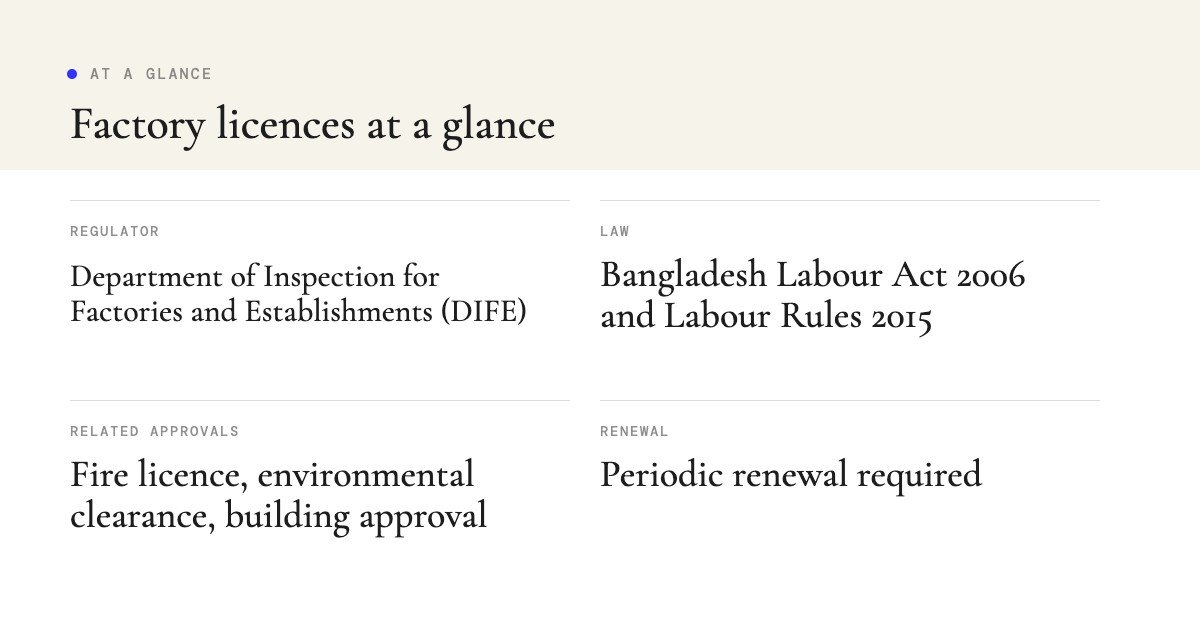
- Premises qualifying as a factory under the Bangladesh Labour Act 2006 need a licence from DIFE under the Bangladesh Labour Rules 2015.
- Layout plan approval from DIFE is required before constructing or significantly altering a factory building.
- Applications are made online through DIFE’s licensing system, with documents and fees based on workforce and power use.
- Fire safety, building and environmental approvals from other authorities are closely linked to the factory licence.
- Licences must be renewed on time, and DIFE inspections monitor ongoing compliance.
When a factory licence in Bangladesh is required
The Labour Act defines a factory broadly as premises where a manufacturing process is carried out with a minimum number of workers. Garment, textile, food processing, pharmaceutical, chemical, engineering, printing and many other operations fall within the definition. Shops and commercial establishments are regulated separately. Factories located in export processing zones are supervised by BEPZA under the EPZ Labour Act, but most factories elsewhere require a DIFE licence.
Our employment and labour practice advises manufacturers on licensing, inspections and compliance.
Layout plan approval before a factory licence in Bangladesh
Before constructing a new factory building, extending an existing one or changing its use, the occupier must obtain approval of the layout plan from DIFE. The plan shows the building, machinery layout, exits, ventilation, lighting, sanitation, canteen and other facilities. Approval ensures that safety and welfare are designed in from the start. Building without approval can make it impossible to obtain a factory licence later without costly modifications.
Documents for a factory licence in Bangladesh
| Document or approval | Issuing authority |
|---|---|
| Trade licence and company documents | Local authority and RJSC |
| Approved building plan and layout plan | Development authority and DIFE |
| Fire licence or safety certificate | Fire Service and Civil Defence |
| Environmental clearance certificate | Department of Environment |
| Boiler registration, where applicable | Office of the Chief Inspector of Boilers |
| Ownership or lease documents | Land records and agreements |
Information on licensing is available from DIFE, environmental clearance from the Department of Environment, and fire licensing from the Fire Service and Civil Defence.
Obtaining a factory licence step by step
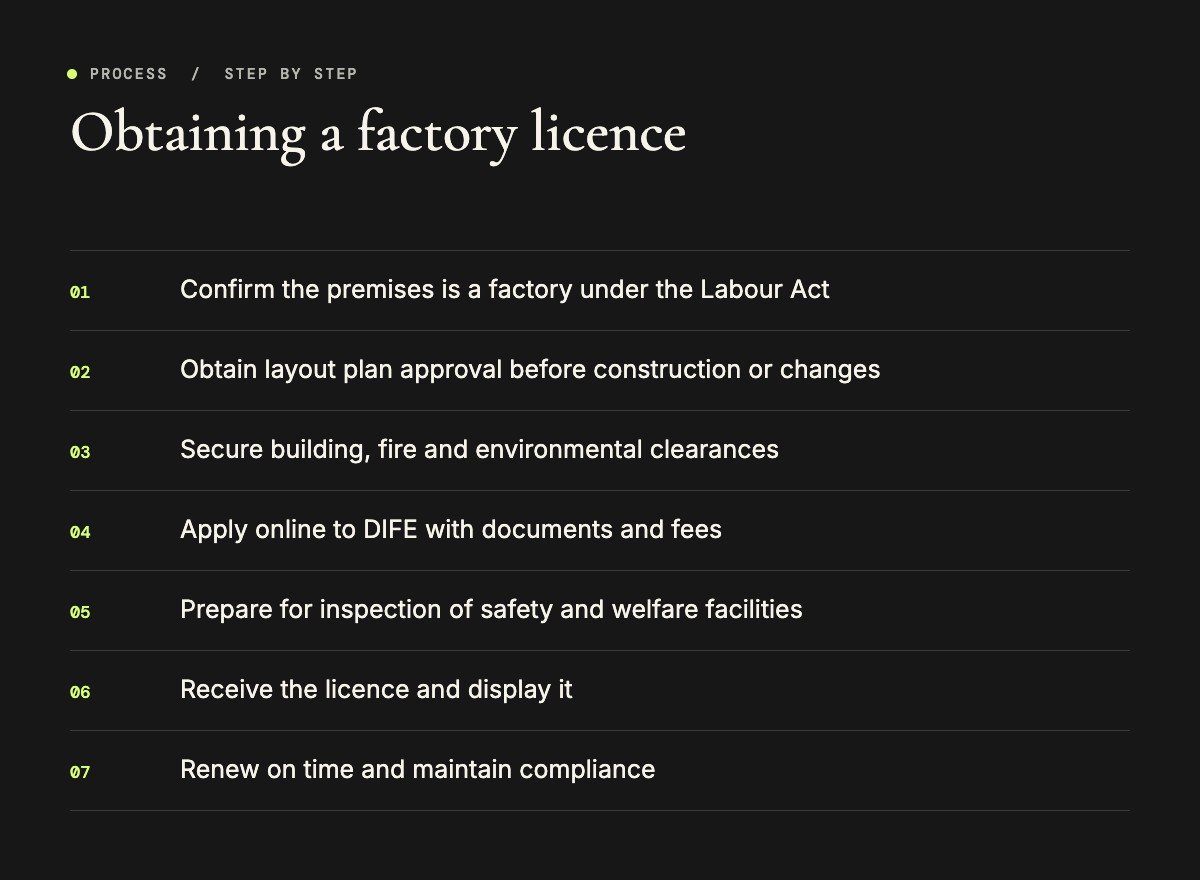
- Confirm status. Check whether the premises is a factory under the Labour Act.
- Layout approval. Obtain DIFE layout plan approval before construction or alteration.
- Other clearances. Secure building approval, fire licence and environmental clearance.
- Apply online. Submit the application, documents and fees through DIFE’s system.
- Inspection. DIFE inspectors verify safety, health and welfare arrangements.
- Licence issue. Receive and display the licence at the factory.
- Renewal and compliance. Renew on time and maintain standards.
Changes in workforce size, machinery or power load can affect licence category and fees. Update DIFE when operations change, rather than waiting for renewal.
Safety, health and welfare standards
To obtain and keep a factory licence in Bangladesh, the factory must meet the Labour Act’s standards on cleanliness, ventilation, temperature, dust and fumes, lighting, drinking water, toilets, fire exits and fire-fighting equipment, machinery guarding, protective equipment, first aid, canteens, rest rooms and child care rooms where required. Larger factories must establish safety committees and appoint welfare officers. These requirements are checked during inspections and are frequently examined by international buyers’ auditors as well.
Following the Rana Plaza collapse in 2013, structural, fire and electrical safety inspections intensified, and remediation programmes became a condition of doing business with many brands.
Inspections linked to a factory licence in Bangladesh
DIFE inspectors can enter factories, examine records, interview workers and issue notices requiring corrective action. Serious hazards can lead to orders prohibiting use of dangerous premises or machinery. Non-compliance can result in fines, prosecution and refusal to renew the licence. Factories should treat inspection findings seriously, implement corrective action plans and keep evidence of compliance. DIFE has also developed online systems for complaints and inspection data.
Renewing a factory licence in Bangladesh
Factory licences must be renewed before expiry, typically with updated documents, payment of renewal fees, and confirmation that related approvals such as fire licences and environmental clearance remain valid. Late renewal can attract penalties. Maintaining a compliance calendar that covers all licences, including fire, environmental, boiler and trade licences, prevents gaps that could disrupt operations or buyer relationships.
Occupational safety and health obligations
Beyond licensing, employers must manage workplace hazards, provide training, maintain accident registers, report serious accidents to DIFE, and provide compensation for workplace injuries under the Labour Act. The national occupational safety and health policy and buyer standards encourage risk assessments, safety management systems and worker participation through safety committees.
Fire safety licensing
A fire licence or fire safety certificate from the Fire Service and Civil Defence is usually required before DIFE grants a factory licence, particularly for industries handling flammable materials or employing large workforces. Requirements include adequate fire exits, alarm and detection systems, sprinklers or hydrants where necessary, fire-resistant doors, trained fire fighters among staff and regular drills. The fire licence must be renewed periodically, and lapses can affect the factory licence in Bangladesh as well as insurance coverage.
Environmental clearance
Under the Bangladesh Environment Conservation Act 1995 and its rules, industries are classified by pollution potential, and most factories need an environmental clearance certificate from the Department of Environment before operating. Higher-risk categories require environmental impact assessments and effluent treatment plants. Environmental clearance must also be renewed, and non-compliance can lead to fines and closure. Our guide on obtaining an environmental licence explains the process.
Leased and shared buildings
Many small and medium factories operate in leased or shared buildings, sometimes not originally designed for industrial use. This creates risks around structural capacity, fire exits and approvals. Before leasing, manufacturers should confirm that the building has the necessary approvals for industrial use, that the landlord will cooperate with DIFE and fire requirements, and that lease terms allocate responsibility for compliance works. Shared buildings require coordination among occupiers on common safety systems.
Buyer audits and the factory licence in Bangladesh
Export-oriented factories undergo frequent social and safety audits by buyers and certification schemes. Auditors typically check the factory licence, related approvals and evidence of compliance with the Labour Act. An expired licence or missing approval is a common critical finding that can suspend orders. Keeping licences current and documentation organised supports both legal compliance and commercial relationships.
Changes to the factory
Expanding production lines, adding floors, installing new boilers or generators, increasing workforce or changing the manufacturing process can require amendments to the factory licence, updated layout approval and new clearances. Owners should consult DIFE and other authorities before making changes, rather than after. Unapproved changes are a frequent cause of inspection findings and accidents, and can complicate insurance claims.
When a factory changes ownership, the licence and related approvals may need to be transferred or reissued in the new owner’s name, and the buyer should check compliance history during due diligence.
Workers’ welfare facilities
Factories employing more than specified numbers of workers must provide canteens, rest rooms, child care rooms and medical facilities, and appoint welfare officers. Safety committees must be formed in factories above a set size, with worker and management representatives. These requirements are part of licensing conditions and are increasingly scrutinised following the Labour (Amendment) Act 2026, which strengthened worker protections in several areas.
Penalties for operating without a factory licence in Bangladesh
The Labour Act provides penalties for operating without a licence, failing to comply with safety and welfare provisions, obstructing inspectors and failing to report accidents. Directors and managers can be held personally liable in some cases. Beyond legal penalties, serious incidents can lead to criminal investigations, compensation claims and reputational damage. Proactive compliance is far less costly than dealing with enforcement after an accident.
Small factories and workshops
Small manufacturers, such as light engineering workshops, food processors and printing presses, sometimes assume that licensing rules only apply to large factories. If they meet the Labour Act definition, they need a factory licence in Bangladesh too, along with fire and environmental approvals appropriate to their size and risk. DIFE has simplified some procedures for smaller units, but the core safety obligations remain. Small businesses that formalise early find it easier to access bank finance, supply larger customers and avoid sudden enforcement.
Electrical and structural safety
Electrical faults are a leading cause of factory fires. Factories should have electrical installations designed and certified by qualified engineers, regular thermal scanning and maintenance, and proper load management. Structural safety requires buildings designed for industrial loads, with periodic assessments, especially where floors have been added or heavy machinery installed. Reports from qualified engineers support licence applications and renewals and are often requested by buyers.
Practical checklist
Confirm factory status; obtain layout approval before building; secure fire, environmental and building approvals; apply online with complete documents; prepare for inspection; display the licence; renew on time; update DIFE after changes; maintain safety committees and welfare facilities; and keep records of training, drills and maintenance. Following this checklist keeps a factory licence in Bangladesh valid and the workplace safe.
Digital records and transparency
DIFE has moved many services online, including licence applications, renewals and some inspection records, improving transparency. Factories should maintain digital copies of licences, approvals, inspection reports, corrective action plans, training records and accident registers, organised for quick retrieval during inspections or audits. Assigning a compliance officer to manage these records and deadlines reduces the risk of lapses and demonstrates commitment to safety.
Regular internal audits against DIFE checklists help identify gaps before official inspections do.
Involving safety committee members in these internal audits builds worker confidence and often uncovers practical hazards that managers overlook, such as blocked aisles or faulty wiring in less visible areas of the building.
Record each finding and the action taken to close it.
Frequently asked questions about factory licence in bangladesh
Who issues factory licences?
The Department of Inspection for Factories and Establishments (DIFE).
Is layout plan approval required?
Yes, before constructing or significantly altering a factory building.
Can I apply online?
Yes, DIFE accepts applications through its online licensing system.
Does the licence expire?
Yes, it must be renewed periodically.
Do EPZ factories need a DIFE licence?
EPZ factories are regulated by BEPZA under the EPZ Labour Act.
What if I operate without a licence?
Penalties, closure orders and difficulties with buyers and banks can follow.
How we can help
We assist with every factory licence in Bangladesh application, renewals, inspection responses and enforcement matters. See our employment and labour practice, our manufacturing sector team and our regulatory compliance practice.
Setting up or expanding a factory?
We help you secure licences and pass inspections.
Book a consultationEmployment and labourPrimary sources: the Bangladesh Labour Act 2006 and the Bangladesh Labour Rules 2015 on Laws of Bangladesh; licensing from DIFE; environmental clearance from the Department of Environment.
This article is general information about Bangladeshi labour regulation as of October 2026 and is not legal advice. Fees and procedures change; confirm current requirements with DIFE.




0 Comments