
A person who occupies land openly, as if they were the owner and against the true owner’s rights, for long enough can end up with better title than the person named on the deed. Adverse possession in Bangladesh works through the Limitation Act 1908: once the owner’s time to sue for possession expires, usually after twelve years, section 28 extinguishes the owner’s title and the possessor’s position becomes secure. The doctrine is strict, heavily litigated and depends entirely on evidence.
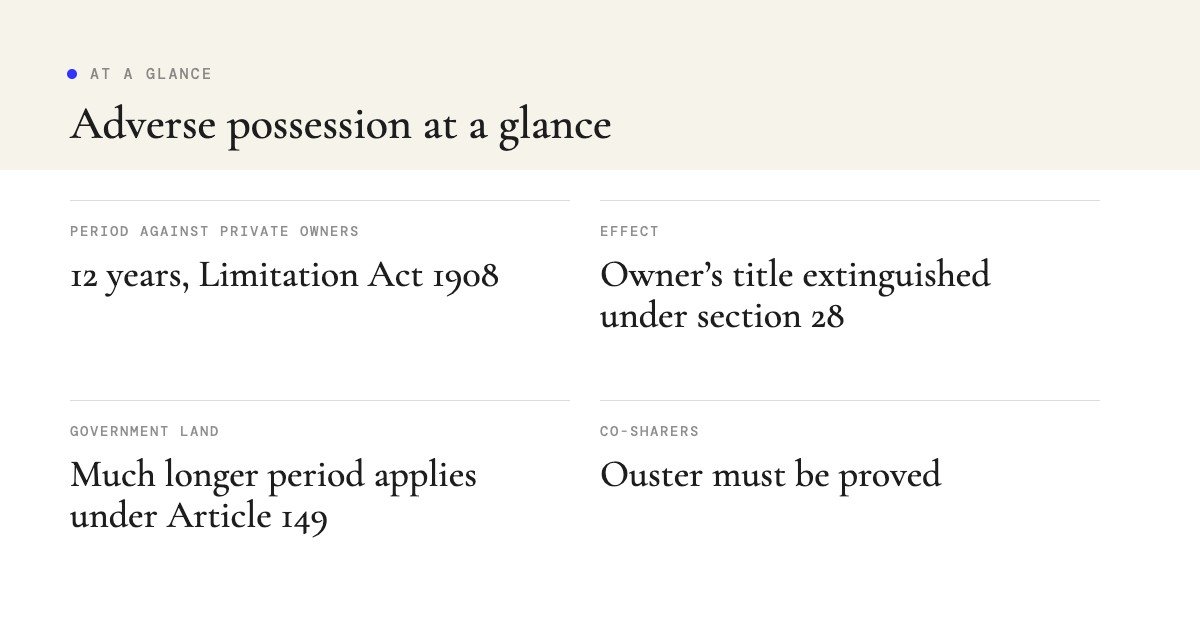
- A suit for possession of immovable property based on title generally must be brought within twelve years under Articles 142 and 144 of the Limitation Act 1908.
- When that period expires, section 28 extinguishes the owner’s right, and the adverse possessor acquires title.
- Possession must be open, continuous, exclusive and hostile, with the knowledge of the true owner, not by permission.
- Possession by a tenant, licensee, mortgagee or co-sharer is not adverse unless there is a clear change in character, such as ouster.
- Claims against government land face a much longer limitation period and are rarely successful.
How adverse possession in Bangladesh works
Bangladeshi law does not contain a statute that grants title for possession as such. Instead, the Limitation Act 1908 sets time limits for suits to recover land. Article 142 covers suits by a person dispossessed or who discontinued possession, and Article 144 covers suits for possession not otherwise provided for, where time runs from when the defendant’s possession became adverse. Both give twelve years. Section 28 then provides that at the end of the period limited for a suit for possession, the right to the property is extinguished.
The effect is that the person in adverse possession for the full period has a title that can be used both as a shield against the former owner and as a sword, for example in a suit for declaration of title. The Limitation Act is available on Laws of Bangladesh.
Our civil litigation team, described on our about page, acts for owners and possessors in title disputes.
The legal tests for adverse possession in Bangladesh
| Test | What it means | Typical evidence |
|---|---|---|
| Open (nec clam) | Possession visible to the owner and the public | Cultivation, buildings, fencing, witnesses |
| Peaceful (nec vi) | Not maintained by force | Absence of disputes or complaints |
| Hostile (nec precario) | Not by permission; claiming as owner | Refusal to pay rent, assertion of ownership |
| Continuous | Uninterrupted for the full period | Tax receipts, utility bills, records over years |
| Exclusive | Excluding the true owner and others | Boundaries, sole use |
All of these must be proved together and for the full period. Courts repeatedly emphasise that mere long possession is not enough; possession must be adverse to the true owner’s title and with an animus to hold as owner.
Permissive possession is not adverse possession in Bangladesh
Possession that starts with permission, such as by a tenant, licensee, caretaker, family member allowed to live in a house or mortgagee in possession, cannot ripen into title however long it lasts, unless the possessor clearly repudiates the owner’s title and the owner has notice of that repudiation. Only from that point does time start running. This is why owners who allow relatives or employees to use land should keep written records of the permission.
Co-sharers, ouster and adverse possession in Bangladesh
Among co-sharers, possession by one is treated in law as possession on behalf of all. A co-sharer in exclusive possession of joint land therefore does not acquire title against the others merely by long use. To claim adverse possession, the possessing co-sharer must prove ouster: a clear, open denial of the other co-sharers’ rights, brought to their knowledge, followed by twelve years of exclusive possession. Ouster is difficult to prove and courts require strong evidence, such as express refusal to share produce or rent, or a public assertion of exclusive ownership.
Government land and adverse possession in Bangladesh
Article 149 of the Limitation Act gives the government a much longer period, sixty years, for suits by or on behalf of the government. In practice, claims of adverse possession against khas land, railway land, forest land and other public property very rarely succeed, and occupants are frequently evicted under special laws. Anyone buying land should check whether it is recorded as khas or government land before relying on a seller’s claim of long possession. Records can be checked through the Ministry of Land services.
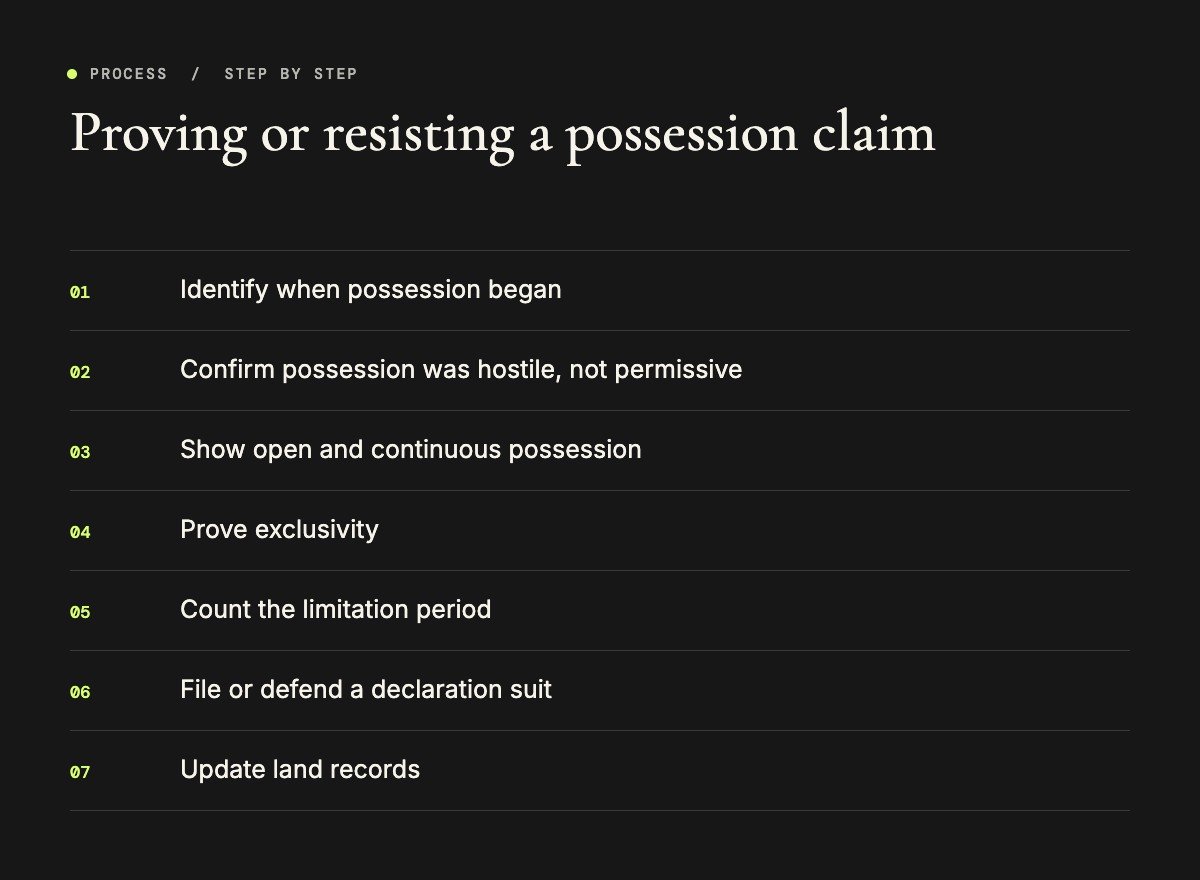
Proving or resisting a claim step by step
- Start date. Identify when possession began and in what capacity.
- Hostility. Show that possession was as owner, not with permission.
- Openness and continuity. Gather evidence of visible, uninterrupted use.
- Exclusivity. Show the true owner was excluded.
- Limitation. Count twelve years, or the applicable period, from when possession became adverse.
- Litigation. File or defend a suit for declaration of title and possession.
- Records. Use the decree to correct the khatian and mutation records.
Owners should never ignore an occupier. A legal notice asserting ownership, a suit, or a written acknowledgement from the occupier can each interrupt or defeat a developing adverse possession claim. Silence for twelve years is what the doctrine rewards.
Evidence in adverse possession in Bangladesh cases
Because the doctrine depends on facts over many years, evidence is everything. Useful documents include land development tax receipts (dakhila) in the possessor’s name, record of rights entries showing possession, utility bills, holding tax receipts from the municipality, building approvals, photographs over time and statements from neighbours and local elders. Survey records, where the possessor’s name appears in the possession column, can be powerful but are not conclusive of title.
Owners resisting a claim should show acts of ownership during the period, such as paying tax, granting permission, receiving rent, filing objections in survey proceedings or bringing earlier suits. Any acknowledgement of the owner’s title by the possessor in writing restarts the limitation period under section 19 of the Limitation Act.
Owner remedies against adverse possession in Bangladesh
An owner who has been dispossessed has several remedies. A suit under section 9 of the Specific Relief Act 1877 allows recovery of possession within six months of dispossession without proving title. A suit for declaration of title and recovery of possession under section 42 and related provisions can be brought within the twelve-year period. Criminal proceedings under section 145 of the Code of Criminal Procedure address disputes likely to cause a breach of the peace, though they decide only possession, not title.
Remedies for possessors
A possessor who has completed the period can file a suit for declaration of title by adverse possession, with a prayer for correction of the record of rights. They can also raise adverse possession as a defence in a suit brought by the former owner. Courts require the claim to be specifically pleaded, with the date possession became adverse stated clearly.
Adverse possession in Bangladesh and buyers
Buyers should be cautious about purchasing land from a seller whose title rests only on long possession. A title by adverse possession is valid in law, but it is not recorded in any deed until a court declares it, and banks and developers are often unwilling to rely on it. Ask for a court decree declaring title, or ensure the khatian and mutation are already in the seller’s name, before paying. Conversely, a buyer of documentary title should physically inspect the land: if someone else has been in possession for years, the paper title may already have been extinguished.
Common mistakes
Common mistakes include assuming that long possession alone gives title, failing to plead the date possession became adverse, relying only on oral evidence, ignoring the different rules for co-sharers and government land, and owners delaying action against occupiers for years. Early advice prevents most of these problems.
Survey records and possession
Bangladesh’s successive land surveys, from the Cadastral Survey through the State Acquisition, Revisional and Bangladesh Surveys, record both ownership and possession. During each survey, possessors often try to have their names recorded, and owners must object through the attestation and objection stages. An entry in the record of rights carries a presumption of correctness, but it can be rebutted by evidence and is not itself a title document. Where a survey records an occupier in possession and the owner fails to object, that entry can later become strong evidence of adverse possession.
Owners should therefore follow survey operations in their area carefully and file objections under the survey rules where entries are wrong. Corrections can also be sought later through the Land Survey Tribunal, which hears disputes about final record-of-rights entries.
Interruption of the limitation period
Several events can stop the clock. A suit for possession filed by the owner within time interrupts the period. A written acknowledgement of the owner’s title signed by the possessor starts a fresh period under section 19 of the Limitation Act. Payment of rent to the owner shows that possession is permissive. Even a break in physical possession, if the owner re-enters, can defeat continuity. Possessors must therefore show not only twelve years in total, but twelve years without any such interruption.
Tacking and adverse possession in Bangladesh
A possessor can sometimes add the period of possession of a predecessor, such as a seller or the person from whom they inherited, to their own, provided there is privity between them and the possession has been continuous. Courts examine carefully whether the earlier possession was itself adverse and whether there was any gap. A purchaser from an adverse possessor should obtain documents showing the predecessor’s possession history.
Possession and criminal proceedings
Land disputes in Bangladesh frequently lead to proceedings under sections 144 and 145 of the Code of Criminal Procedure, where an Executive Magistrate can make orders to prevent a breach of the peace. These orders decide who is in actual possession for the time being, not who owns the land, and the civil court’s decision on title ultimately prevails. Still, findings about possession in such proceedings are often used as evidence later in civil suits.
Checklist for owners
Visit your land regularly, pay land development tax in your own name, keep tenancy and permission arrangements in writing and respond promptly to any occupation.
Frequently asked questions about adverse possession in bangladesh
How many years for adverse possession?
Generally twelve years against private owners under the Limitation Act 1908.
Can a tenant claim adverse possession?
Not while in possession as a tenant; only after clearly repudiating the landlord’s title.
Can one heir claim against other heirs?
Only by proving ouster followed by twelve years of exclusive possession.
Can government land be acquired?
Claims face a sixty-year period and rarely succeed.
Does paying land tax prove title?
It is evidence of possession, not conclusive proof of title.
How can an owner stop a claim?
By asserting ownership, obtaining acknowledgement or suing within the limitation period.
How we can help
We advise owners and occupiers on adverse possession in Bangladesh, investigate title and possession history, and bring or defend declaration and possession suits through trial and appeal. Learn more about our practice, and our guides to types of civil cases and land registration.
Primary sources: the Limitation Act 1908, the Specific Relief Act 1877 and the Code of Criminal Procedure 1898 on Laws of Bangladesh; land records via Ministry of Land.
This article is general information about Bangladeshi land law as of October 2026 and is not legal advice. Take advice on your circumstances.




0 Comments