
If a co-owner of your family land sells their share to an outsider, the law may let you step into the buyer’s shoes. Pre-emption in Bangladesh is the statutory right of a co-sharer to buy back a share of a holding transferred to a stranger, by applying to the civil court and depositing the price with compensation. For agricultural land the right is governed by section 96 of the State Acquisition and Tenancy Act 1950, substantially amended in 2006, and the time limits are short.
- Pre-emption allows a co-sharer tenant to acquire a share of the holding sold to a stranger, keeping family land within the family.
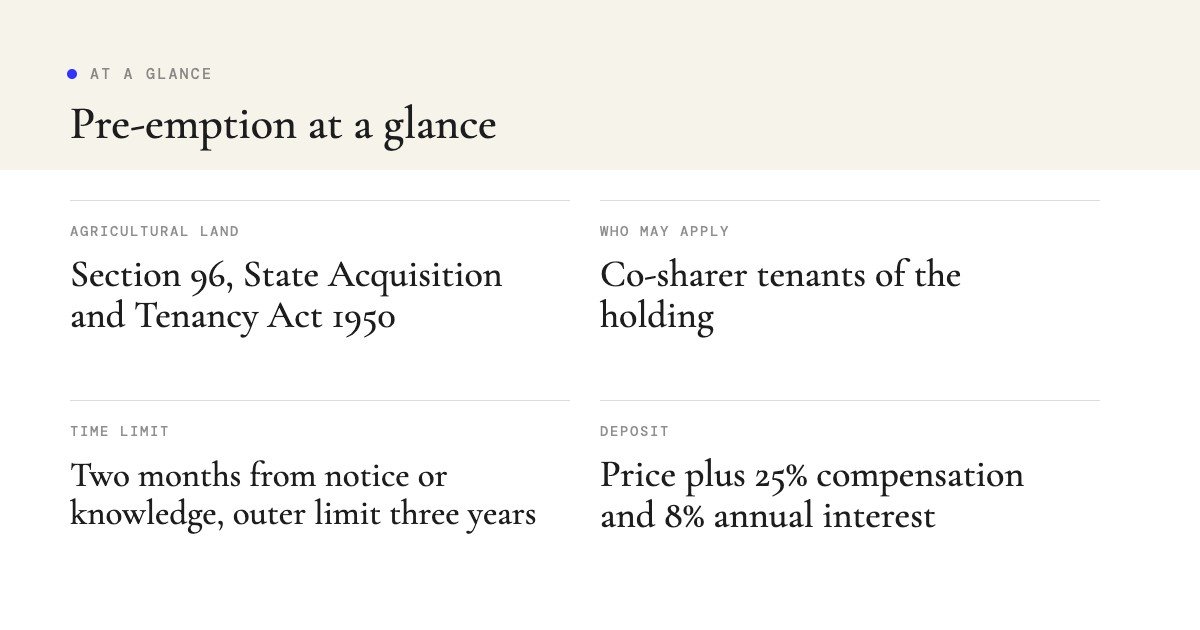
- Since the 2006 amendment, the right under section 96 belongs to co-sharer tenants, with co-sharers by inheritance given priority; contiguous landowners no longer have the right.
- The application must usually be filed within two months of service of the statutory notice or of knowledge of the sale, and not later than three years from registration.
- The applicant must deposit the consideration money plus 25% compensation and simple interest at 8% a year.
- Non-agricultural land is governed by a separate regime under the Non-Agricultural Tenancy Act 1949.
What pre-emption in Bangladesh means
Pre-emption is a right of substitution. The pre-emptor does not cancel the sale; instead, the court transfers the purchaser’s title to the pre-emptor on payment of the price and statutory compensation. The policy behind the rule is to prevent fragmentation of holdings and to stop strangers from entering family land against the wishes of the remaining co-sharers. It is one of the most frequently litigated land rights in rural Bangladesh.
Historically, Muslim law recognised a right of pre-emption (shufa), but in Bangladesh the statutory right under the State Acquisition and Tenancy Act 1950 and the Non-Agricultural Tenancy Act 1949 is the one courts apply in practice. These statutes are available on Laws of Bangladesh.
Our civil litigation team, described on our about page, acts for both pre-emptors and purchasers in land disputes.
Who can claim pre-emption in Bangladesh
| Position | Right after 2006 amendment |
|---|---|
| Co-sharer tenant by inheritance | First priority to pre-empt |
| Co-sharer tenant otherwise than by inheritance (for example by purchase) | May pre-empt where no inheritance co-sharer applies, subject to the section |
| Holder of contiguous land | No longer entitled following the 2006 amendment |
| Stranger purchaser | Liable to have the share pre-empted |
A co-sharer tenant is a person who holds an undivided interest in the same holding (the same khatian) as the transferor. Where a transfer is made to another existing co-sharer of the holding, pre-emption generally does not arise, because no stranger is entering the holding.
Time limits for pre-emption in Bangladesh
Section 89 of the SAT Act requires notice of the transfer to be served on co-sharers through the registration office. An application for pre-emption must be made within two months of service of that notice. Where no notice was served, the two months run from the date the applicant came to know of the transfer, but in no case can an application be made more than three years after the date of registration of the deed.
Disputes about the date of knowledge are common. Purchasers often argue that the applicant knew of the sale much earlier, for example because they witnessed the deed, lived next to the land or saw the purchaser take possession. Applicants should be ready to explain exactly when and how they learned of the transfer.
The deposit required for pre-emption in Bangladesh
When filing, the applicant must deposit in court the amount of consideration money stated in the deed, together with compensation at 25% of that amount and simple interest at 8% a year from the date of registration to the date of filing. Failure to deposit the full amount at the time of filing is fatal to the application. Where the applicant believes the price stated in the deed was inflated to discourage pre-emption, they must still deposit the stated amount and can then ask the court to determine the true price.
The compensation and interest compensate the purchaser for the disturbance and for the use of their money. On a successful application, the deposit is paid to the purchaser.
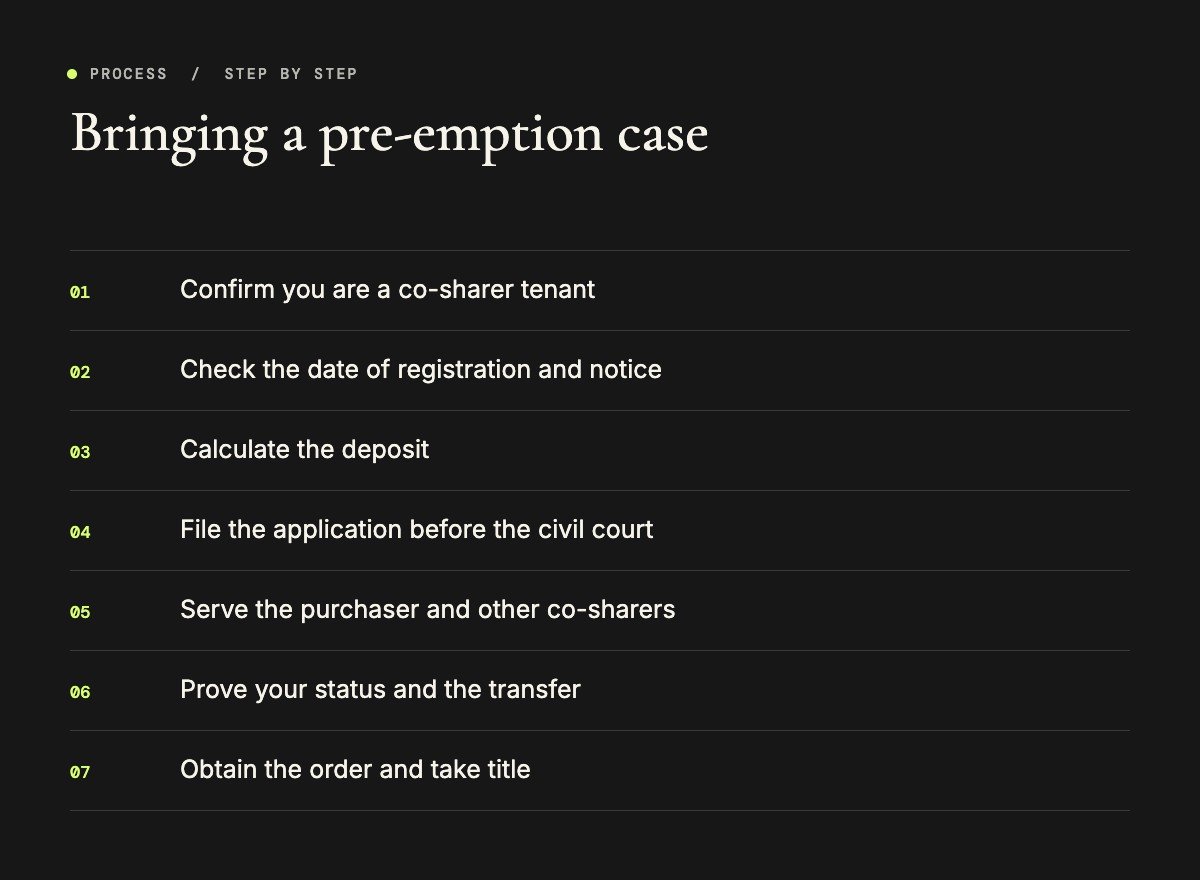
Filing a pre-emption case step by step
- Confirm status. Verify through khatians and title documents that you are a co-sharer tenant of the holding.
- Check dates. Find the date of registration and of any section 89 notice or your knowledge of the sale.
- Calculate the deposit. Add the price, 25% compensation and 8% annual simple interest.
- File the application. Apply as a miscellaneous case before the competent civil court.
- Serve parties. Make the purchaser, vendor and other co-sharers parties.
- Prove the case. Give evidence of co-sharership, the transfer and the timing.
- Order and title. On allowing the application, the court directs transfer of the share to you.
Get a certified copy of the sale deed and the land records before filing. Small errors in describing the holding, the dag number or the share can be exploited by the purchaser, and the deposit calculation must match the figures in the deed exactly.
Transfers outside pre-emption in Bangladesh
Pre-emption applies to transfers by sale. Gifts, waqf, transfers by inheritance, and certain other transfers are generally outside the right, although disputes often arise where a sale has been disguised as a gift or exchange. Courts look at the substance of the transaction; if consideration was in fact paid, a so-called heba may be treated as a sale. Transfers to co-sharers, transfers by court sale in some circumstances and certain transfers to government or statutory bodies are also outside the right.
Common defences for purchasers
Purchasers commonly argue that the application is time-barred, that the applicant is not a co-sharer of the same holding, that the transfer was not a sale, that the applicant waived the right by acquiescing in or encouraging the sale, that the deposit was short, or that the purchaser was already a co-sharer before the transfer. Evidence that the applicant was offered the land first and refused can support a waiver argument.
Purchasers can reduce risk by buying from all co-sharers together, by obtaining written consent or waivers from co-sharers, and by ensuring the section 89 notice is properly served so that the two-month period starts to run.
Pre-emption in Bangladesh for non-agricultural land
Land in urban areas and land used for non-agricultural purposes is governed by the Non-Agricultural Tenancy Act 1949, which contains its own pre-emption provisions with separate notice requirements, time limits and compensation rules. Whether land is agricultural or non-agricultural is itself often disputed, and the answer determines which statute and which limits apply. Take advice on classification at the outset.
Procedure, appeal and revision in pre-emption in Bangladesh cases
A pre-emption application is heard by the civil court with jurisdiction over the land, usually the court of an Assistant Judge or Senior Assistant Judge. The case is decided on evidence, including oral testimony and documents. An appeal lies to the District Judge, and a further civil revision may be filed in the High Court Division under section 115 of the Code of Civil Procedure 1908 on questions of law.
After a successful application
When the court allows pre-emption, the pre-emptor steps into the purchaser’s position from the date of the order. The pre-emptor should obtain a certified copy of the order, apply for mutation of the land records in their name through the land office, and pay land development tax. Possession may need to be recovered from the purchaser if they do not leave voluntarily.
Evidence that wins pre-emption in Bangladesh cases
The applicant must prove three things: that they are a co-sharer of the holding, that the transfer was a sale to a stranger, and that the application is within time. Co-sharership is usually proved through the CS, SA, RS or BS khatian showing the holding, together with inheritance documents or deeds tracing the applicant’s share. The transfer is proved by a certified copy of the registered deed. Timing is proved through the section 89 notice records at the sub-registry, or through the applicant’s own testimony and supporting witnesses about when they learned of the sale.
Purchasers, for their part, should collect evidence that the applicant knew of the sale early, such as their presence at the registry, signatures as witnesses, or correspondence. Evidence of prior co-sharership, for example an earlier purchase of another share in the same holding, can defeat the application entirely.
Advice for buyers of shared land
Anyone buying an undivided share of a holding should assume that pre-emption in Bangladesh is a real risk. Before paying, check the khatian to identify all co-sharers, approach them to offer the land or obtain written no-objection statements, and consider buying all shares together or waiting until the land is partitioned. Make sure the registry serves the section 89 notice properly, keep proof of service, and do not invest heavily in buildings or improvements until the pre-emption period has expired.
Advice for co-sharers
Co-sharers who want to keep land in the family should monitor the registry and the land office for transfers of shares in their holding, respond quickly to any notice, and keep funds available to make the deposit. Delay is the most common reason pre-emption claims fail. Where several co-sharers wish to pre-empt, they can apply jointly or the court may apportion the share among them according to the statute.
Pre-emption in Bangladesh and partition
Pre-emption often arises alongside a partition suit. A stranger who buys an undivided share may seek partition to obtain a defined plot, while the family co-sharers seek pre-emption to remove the stranger altogether. The order in which these cases are decided can matter, so they should be managed together.
Inflated prices and sham deeds
Sellers and buyers sometimes state an artificially high price in the deed to make pre-emption unaffordable. The applicant must still deposit the stated amount, but can ask the court to determine the real consideration from evidence such as market value and payment records, and any excess may be refunded.
Frequently asked questions about pre-emption in bangladesh
Who can claim pre-emption?
Co-sharer tenants of the holding, with priority to those who are co-sharers by inheritance.
Can a neighbour pre-empt?
Not under section 96 after the 2006 amendment, which removed contiguous landowners.
How long do I have?
Two months from notice or knowledge, with an outer limit of three years from registration.
How much must I deposit?
The price plus 25% compensation and 8% simple interest a year from registration.
Can a gift be pre-empted?
A genuine gift generally cannot, but a sale disguised as a gift may be.
Can I appeal?
Yes, to the District Judge, and then by revision to the High Court Division.
How we can help
We advise co-sharers and purchasers on pre-emption in Bangladesh, calculate deposits, file and defend applications, and handle appeals, revisions and mutation. Learn more about our practice, and see our guides to land registration and buying property.
Family land sold to a stranger?
Act within the two-month window.
Book a consultationAbout usPrimary sources: the State Acquisition and Tenancy Act 1950, the Non-Agricultural Tenancy Act 1949 and the Code of Civil Procedure 1908 on Laws of Bangladesh; land records via Ministry of Land.
This article is general information about Bangladeshi land law as of October 2026 and is not legal advice. Take advice on your circumstances.




0 Comments