
Acid attacks cause devastating, lifelong injuries, and in the early 2000s Bangladesh had one of the highest rates of such attacks in the world. In response, Parliament passed two laws in 2002. The acid crime law in Bangladesh now combines the Acid Crime Control Act 2002, which creates severe offences tried by special tribunals, with the Acid Control Act 2002, which licenses and restricts the import, production and sale of acid. Together with sustained public campaigns, these laws have sharply reduced attacks.
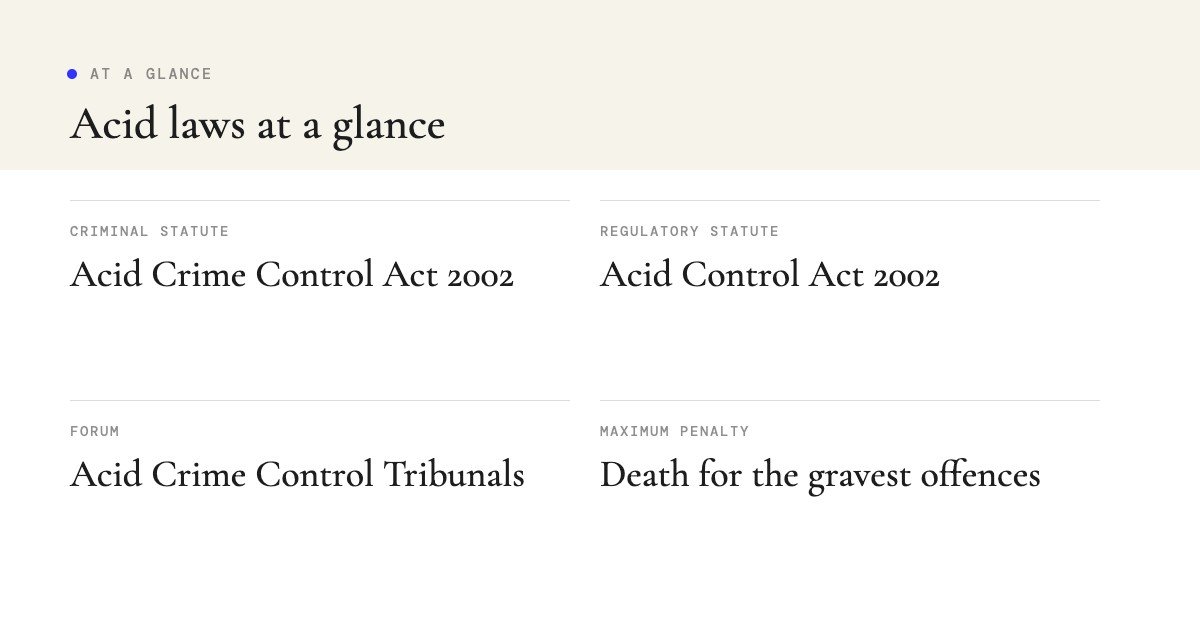
- The Acid Crime Control Act 2002 punishes causing death or injury with acid, attempts and abetment, with the death penalty available for the gravest offences.
- Cases are tried by special Acid Crime Control Tribunals with fixed time limits for investigation and trial.
- Bail is restricted, and the Act provides for fines that can be paid to victims as compensation.
- The Acid Control Act 2002 requires licences to import, produce, transport, store, sell and use acid, and created a National Acid Control Council.
- Immediate first aid with large amounts of water and urgent medical treatment are vital for victims.
Why acid crime law in Bangladesh was created
Acid attacks in Bangladesh were often linked to rejected marriage proposals, dowry disputes, family conflicts and land disputes, and the victims were frequently young women and girls. Acid was cheap and easily available. The two 2002 Acts responded by making acid offences among the most severely punished crimes in the country and by controlling access to acid. Reported attacks have declined dramatically since, though cases still occur. The Acts are available on Laws of Bangladesh.
Our criminal law team, described on our about page, represents victims and accused persons in serious criminal cases, including before special tribunals.
Offences under acid crime law in Bangladesh
| Offence | Punishment (summary) |
|---|---|
| Causing death with acid | Death or imprisonment for life, and fine |
| Causing loss of sight, hearing, or disfigurement of face, breast or sexual organs | Death or imprisonment for life, and fine |
| Causing other bodily injury with acid | Rigorous imprisonment for a substantial term, and fine |
| Throwing or attempting to throw acid, even without injury | Rigorous imprisonment, and fine |
| Abetment of acid offences | Punishable as the main offence |
The precise terms vary by section, and the tribunal considers the nature of the injury in deciding which offence is proved. Fines can be recovered from the offender’s property and paid to the victim.
Using acid crime law in Bangladesh after an attack
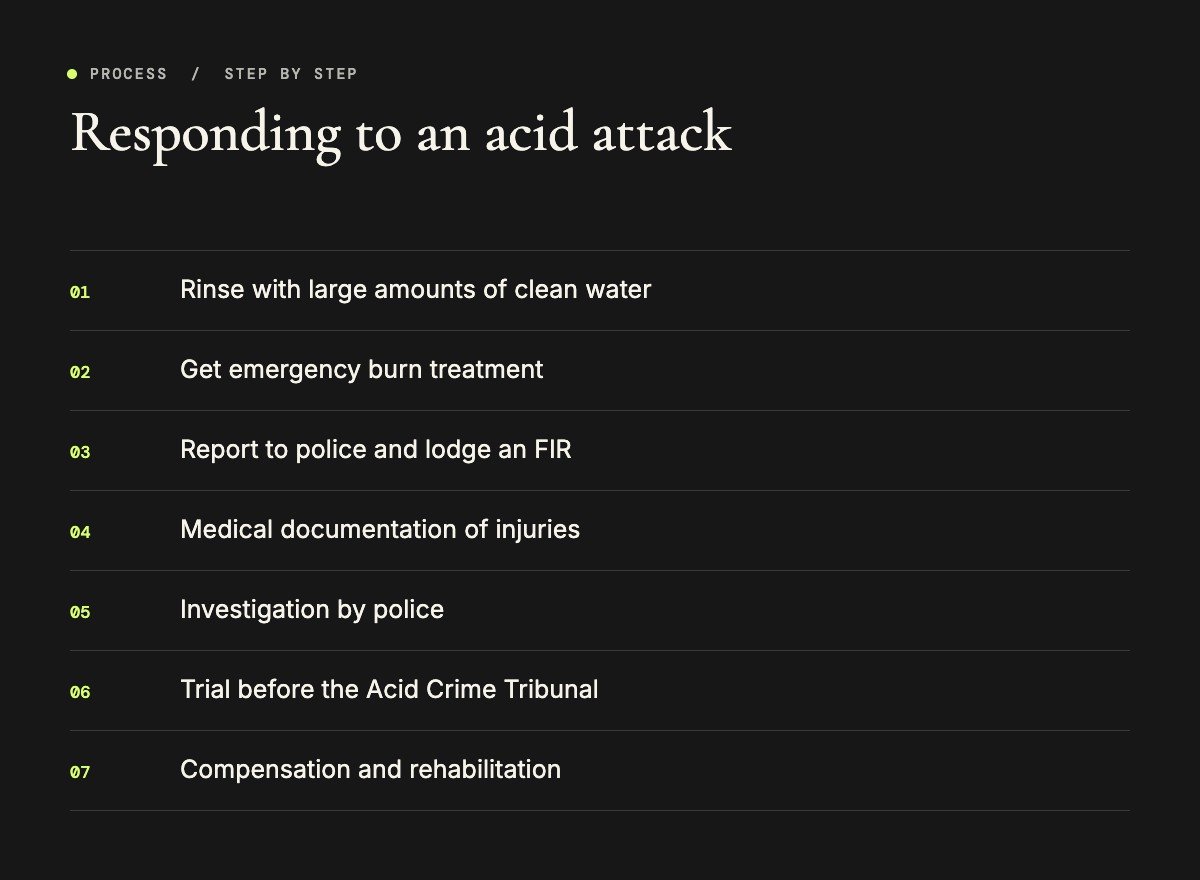
- Water first. Rinse the affected area with large amounts of clean water for a prolonged period; remove contaminated clothing.
- Emergency care. Go to a hospital burn unit as quickly as possible.
- Report. Inform the police and lodge an FIR, or ask a relative to do so.
- Medical evidence. Ensure injuries are documented in a medico-legal report and photographs.
- Investigation. Police investigate within the statutory time and arrest suspects.
- Trial. The Acid Crime Control Tribunal hears the case.
- Compensation and recovery. Seek compensation and access long-term medical and rehabilitation support.
Preserve the container, clothing and any residue as evidence, and identify witnesses quickly. Forensic analysis of the substance and early witness statements greatly strengthen the prosecution.
Tribunals under acid crime law in Bangladesh
The Acid Crime Control Act provides for special tribunals in each district, presided over by Sessions-level judges, to try acid offences exclusively. Where no separate tribunal has been established, designated judges act as the tribunal. The Act fixes time limits for police investigation and for completion of trial, and allows trial in the absence of an accused who has absconded. The tribunal follows the Code of Criminal Procedure where the Act is silent.
Investigation time limits in acid crime law in Bangladesh
Investigation of acid offences must be completed within a short period fixed by the Act, with limited extensions on written reasons, and trial must be concluded within a set number of days from receipt of the case by the tribunal. Where investigators fail to meet the deadline, the tribunal may order investigation by another officer and action against the defaulting officer. These provisions reflect the urgency the law attaches to acid crimes.
Bail under acid crime law in Bangladesh
The Act restricts bail for offences under it. The tribunal must hear the prosecution and be satisfied that there are reasonable grounds to believe the accused is not guilty, or that other special circumstances apply, before granting bail. Women, children and sick or infirm accused may receive particular consideration. Bail orders can be challenged in the High Court Division.
Regulation under acid crime law in Bangladesh
The Acid Control Act 2002 regulates the acid trade. Anyone importing, producing, transporting, storing, selling or using acid for industrial or other purposes must hold a licence issued by the Deputy Commissioner or another designated authority, maintain records and comply with storage conditions. Unlicensed dealing and failure to keep records are offences. A National Acid Control Council and district committees oversee implementation, victim support and awareness programmes. Businesses in garments, tanneries, batteries, jewellery and laboratories should ensure their licences and records are in order.
Victim support under acid crime law in Bangladesh
Acid survivors need long-term medical care, reconstructive surgery, psychological support and help returning to education or work. The Acid Control Act provides for a fund and for measures to support treatment and rehabilitation, and specialised NGOs work closely with hospitals and courts. Survivors are entitled to free legal aid through the National Legal Aid Services Organisation, and their identity can be protected during proceedings.
Compensation under acid crime law in Bangladesh
Fines imposed under the Acid Crime Control Act can be directed to be paid to the victim or, where the victim has died, to their heirs. The fine can be recovered from the offender’s movable and immovable property, including property acquired later. Survivors may also bring civil claims for damages. Because medical costs are high and continue for years, lawyers should press for substantial compensation orders and pursue enforcement actively.
False cases
As with other special laws, filing a false case under the acid crime law is punishable. Courts examine medical evidence and the nature of the injuries carefully, and forensic confirmation that the substance was acid is important. The provision protects the integrity of the law while genuine victims remain fully protected.
Evidence in acid cases
The prosecution must prove that the accused threw or caused acid to be thrown, that the substance was a corrosive acid, and the nature of the injuries caused. Key evidence includes the medico-legal report from the treating hospital, photographs of injuries over time, chemical analysis of residue on clothing or the scene, the container, statements of eyewitnesses, and the victim’s dying declaration or statement before a Magistrate where available. Evidence of motive, such as a rejected proposal or property dispute, helps the court understand the context but is not itself proof of guilt.
Defence lawyers commonly challenge identification, especially where the attack happened at night, and the chain of custody of forensic samples. Careful police work at the outset, including sealing and labelling exhibits, is therefore crucial.
Workplace and industrial accidents
Not every acid injury is a crime. Industrial accidents in factories, tanneries or laboratories may involve acid burns without any criminal intent. These cases fall under occupational safety and labour law, including employer liability for compensation under the Bangladesh Labour Act 2006, and regulatory liability under the Acid Control Act where storage or handling rules were breached. Employers should maintain licences, train workers, provide protective equipment and keep emergency rinsing facilities available.
Retailers and dealers
Shops and dealers that sell acid must hold the required licence, sell only to authorised buyers, record each sale with the buyer’s identity and purpose, and store acid securely. Selling acid without a licence or failing to keep records is an offence, and a dealer whose acid is traced to an attack may face investigation. Dealers should review their records regularly and train staff to refuse suspicious purchases.
Prevention and awareness
The fall in acid attacks in Bangladesh is often credited to a combination of strict laws, licensing of acid sales, rapid prosecution, and awareness campaigns led by government and civil society. Schools, community leaders and media continue to play a role. Anyone who knows of a threat to throw acid should report it to the police immediately, as threats and attempts are themselves punishable.
Appeals
Appeals from the Acid Crime Control Tribunal lie to the High Court Division within the time set by the Act, and death sentences require confirmation by the High Court Division. Further appeal lies to the Appellate Division.
Protecting survivors during trial
Survivors often face pressure from the accused’s family to withdraw or change their testimony, particularly where the parties live in the same community. The tribunal can order protection, hold hearings in camera and restrict publication of the survivor’s identity. Survivors should report any threats to the police and the tribunal at once. Acid offences are not compoundable, so a private settlement does not end the case, and courts are alert to signs of coercion behind sudden changes in testimony.
Role of family and community
Families play a critical role in the first hours after an attack, providing first aid, getting the victim to hospital and reporting to police. They should also keep copies of medical records, the FIR and court orders, attend hearings and maintain contact with the prosecutor. Community leaders can support survivors by countering stigma and helping them return to school or work.
Getting legal help
A lawyer experienced in serious criminal cases can assist the prosecutor, oppose bail where appropriate, press for timely investigation and trial, and pursue compensation and enforcement on the survivor’s behalf.
Threats and attempts
Threatening to throw acid, or attempting to do so without causing injury, is itself punishable under the Act. Victims of threats should lodge a GD or FIR immediately and keep any messages or witnesses, because early police action can prevent an attack and protect the person who has been threatened and their family.
Frequently asked questions about acid crime law in bangladesh
Which law punishes acid attacks?
The Acid Crime Control Act 2002.
What is the maximum punishment?
Death for causing death or the gravest injuries with acid.
Which court tries acid cases?
Special Acid Crime Control Tribunals.
Is bail available?
Bail is restricted and granted only in limited circumstances.
Is selling acid regulated?
Yes, the Acid Control Act 2002 requires licences and record-keeping.
What should a victim do first?
Rinse with plenty of clean water and seek emergency medical care.
How we can help
We advise victims and accused persons on acid crime law in Bangladesh, assist with FIRs, bail, trial and appeals, help businesses comply with acid licensing rules, and pursue compensation. Learn more about our practice, our regulatory compliance services and our guide to the structure of the Supreme Court.
Need urgent legal help?
Confidential advice for survivors and families.
Book a consultationAbout usPrimary sources: the Acid Crime Control Act 2002, the Acid Control Act 2002 and the Code of Criminal Procedure 1898 on Laws of Bangladesh; free legal aid via NLASO.
This article is general information about Bangladeshi criminal law as of October 2026 and is not legal advice. In an emergency, call 999.


0 Comments