
Name corrections, date of birth mismatches, marital status declarations, sponsorship letters and court applications all commonly require a sworn statement. An affidavit in Bangladesh is a written statement of facts sworn or affirmed before an authorised officer, usually a notary public, a Magistrate or a court oath commissioner. Getting the format, stamp and officer right avoids rejection, and understanding what an affidavit can and cannot do avoids false expectations.
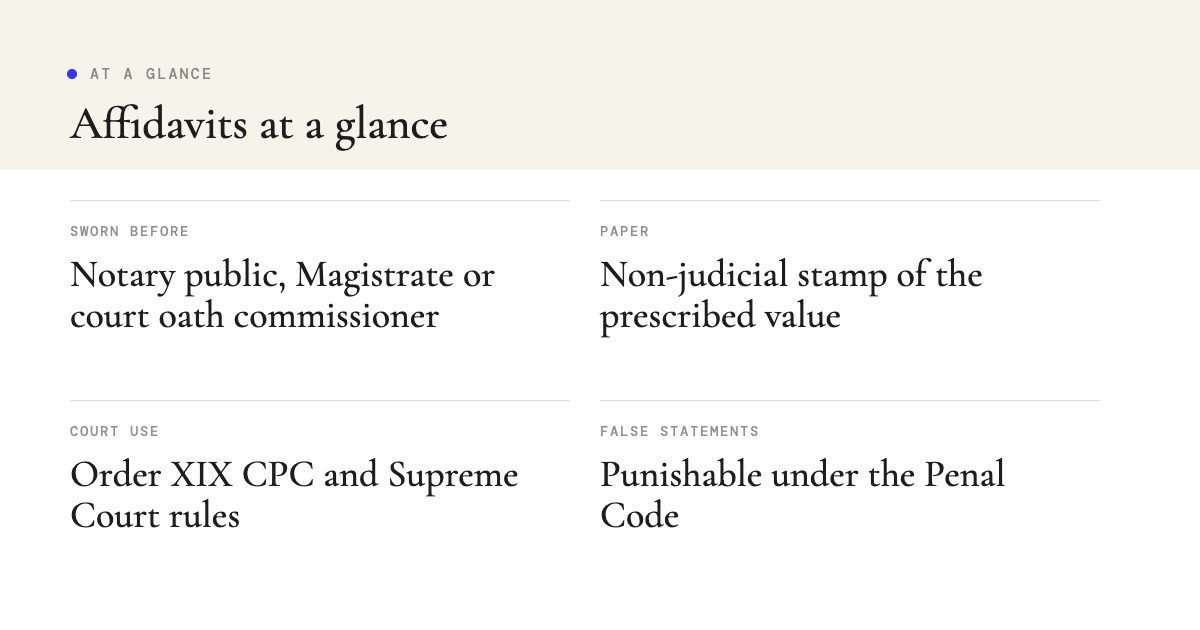
- An affidavit is a voluntary written statement of facts sworn or affirmed as true before an authorised officer.
- Administrative affidavits are usually sworn before a notary public; court affidavits before the court’s oath commissioner.
- Affidavits are printed on non-judicial stamp paper of the value prescribed under the Stamp Act and finance laws.
- An affidavit is a declaration, not proof by itself; it does not change official records such as an NID or birth registration.
- Knowingly making a false affidavit is an offence under the Penal Code.
What an affidavit in Bangladesh is
An affidavit is a statement in writing, made by a person called the deponent, who swears or affirms before an authorised officer that its contents are true to the best of their knowledge and belief. The officer verifies the deponent’s identity, administers the oath or affirmation, and signs and seals the document. Affidavits are used in two main settings: in court proceedings, to support applications or prove facts, and in administrative matters, to support applications to government offices, banks, educational institutions and foreign embassies.
The legal framework draws on the Oaths Act, the Notaries Ordinance 1961, Order XIX of the Code of Civil Procedure 1908, the rules of the Supreme Court, and the Stamp Act 1899. These are available on Laws of Bangladesh. Our team, described on our about page, drafts affidavits for personal, commercial and court use.
Who can attest an affidavit in Bangladesh
| Officer | Typical use |
|---|---|
| Notary public | Administrative declarations, name and date of birth affidavits, documents for use abroad |
| Magistrate | Certain declarations where the receiving authority requires a Magistrate |
| Oath commissioner of a court | Affidavits filed in civil and criminal proceedings |
| Supreme Court oath commissioner | Affidavits supporting writ petitions and applications in the High Court Division |
| Bangladesh missions abroad | Affidavits by expatriates for use in Bangladesh |
Always check which officer the receiving authority accepts. An affidavit sworn before the wrong officer may be rejected even if the content is correct.
Swearing an affidavit in Bangladesh step by step
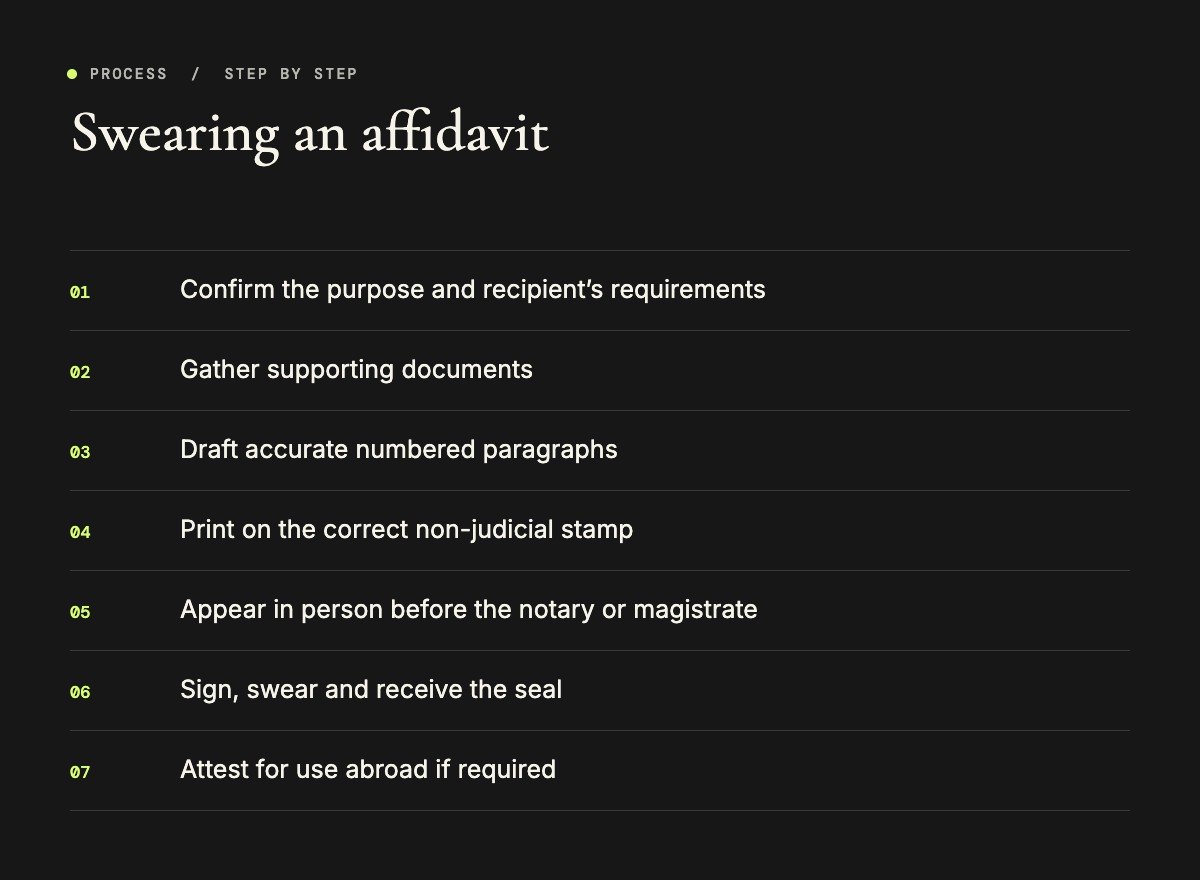
- Purpose. Confirm why the affidavit is needed and whether the recipient prescribes a format.
- Documents. Gather NID, birth registration, certificates and other proof of the facts stated.
- Draft. Write clear numbered paragraphs, one fact per paragraph, with a verification clause.
- Stamp. Print the affidavit on non-judicial stamp paper of the prescribed value from a licensed vendor.
- Appear. Attend in person before the notary, Magistrate or oath commissioner with original ID.
- Swear and seal. Swear or affirm, sign, and have the officer sign, seal and register the affidavit.
- Attest. For use abroad, obtain Ministry of Foreign Affairs attestation and any embassy legalisation required.
Check every name, date and number against your official documents before swearing. An affidavit that introduces a new spelling or date creates a fresh inconsistency and can make your original problem harder to fix.
Drafting an affidavit in Bangladesh
A standard affidavit begins with a title and the deponent’s full name, parents’ names, address, occupation, nationality and NID number. The body sets out the facts in numbered paragraphs, each limited to a single point. It should distinguish facts within the deponent’s personal knowledge from facts based on information or documents, stating the source of the latter. The affidavit ends with a verification declaring that the statements are true and nothing material has been concealed, followed by the deponent’s signature, date and place, and the officer’s attestation.
Court affidavits must follow the court’s rules strictly. In the High Court Division, for example, writ petitions are supported by an affidavit sworn by the petitioner or an authorised person, verifying which paragraphs are true to knowledge and which are based on records or advice.
Common types of affidavit in Bangladesh
Frequently used affidavits include declarations of one and the same person where names differ across documents, change of name after marriage or for other reasons, correction of date of birth, marital status or single status declarations, income and financial support declarations for visas or education abroad, declarations about lost documents, guardianship declarations, address declarations, and declarations of heirs. Businesses use affidavits for tender declarations, non-blacklisting statements and verification of facts in licence applications.
What an affidavit in Bangladesh cannot do
An affidavit is only a sworn declaration. It does not itself change official records. To correct a national identity card, the deponent must apply through the national identity card service; to correct birth registration, through the birth and death registration office; to correct educational certificates, through the relevant education board. In each case the affidavit may be a supporting document, but strong independent evidence, such as an SSC certificate, is usually decisive.
Similarly, an affidavit cannot create a marriage, transfer property or appoint an agent. Marriage requires compliance with personal law and registration; property transfers require registered deeds; and appointing an agent requires a power of attorney. See our guide to powers of attorney.
Stamp duty for an affidavit in Bangladesh
Affidavits are written on non-judicial stamp paper of the value fixed by the Stamp Act 1899 as amended by finance laws. Stamp values change from time to time, so check the current rate before buying. Buy stamps only from licensed vendors or authorised channels, because counterfeit stamps are a serious offence and invalidate the document. Notary fees and drafting charges are separate.
Using an affidavit in Bangladesh abroad
Foreign embassies, universities and immigration authorities usually require affidavits in English, sworn before a notary and then attested by the Ministry of Foreign Affairs, with some countries also requiring legalisation by their embassy in Dhaka. Requirements vary by country and purpose, so confirm them with the receiving authority. Attestation information is available from the Ministry of Foreign Affairs.
A false affidavit in Bangladesh
Because an affidavit is sworn, knowingly stating something false is giving false evidence under section 191 of the Penal Code, punishable under section 193 with imprisonment and fine. A benefit obtained by a false affidavit, such as a certificate or job, can be cancelled, and the deponent may face further proceedings for cheating or forgery. Only state facts you know or honestly believe to be true, and identify the source of facts you rely on.
Expatriates and affidavits
Bangladeshis living abroad can swear affidavits for use in Bangladesh before the consular officer at a Bangladesh embassy or high commission, or before a local notary followed by consular attestation. Requirements depend on the receiving office in Bangladesh. Where the purpose is to authorise someone to act on their behalf, for example to sell land or appear in a case, a power of attorney is needed instead, authenticated under the Power of Attorney Act 2012 and its Rules after arrival in Bangladesh.
Choosing a notary
Notaries are lawyers appointed by the government for defined areas. Check that the notary’s seal shows their appointment number and validity, and that the affidavit is entered in the notary’s register. Documents sealed by unauthorised persons are invalid and may be part of a fraud. Keep a note of the register number and date for later verification.
Identification and witnesses
If the officer does not know the deponent, an identifier, often a lawyer or acquaintance, confirms the deponent’s identity and signs the affidavit. Illiterate deponents give a thumb impression after the contents are read and explained to them, and this should be recorded on the affidavit. Anyone acting as an identifier should genuinely know the deponent, because false identification carries its own liability.
Affidavits in family matters
Affidavits are often used in family contexts, such as declarations that two adults are marrying of their own free will, declarations of guardianship, or statements supporting maintenance and custody applications. An affidavit cannot replace a registered marriage or a court order on custody, but it can provide supporting evidence. In family court proceedings, affidavits should be drafted carefully with legal advice, because statements made in them can be used in cross-examination.
Affidavits for students
Students commonly need affidavits to explain name or date discrepancies in certificates, to declare gaps in study, or to confirm financial sponsorship for overseas admission. Sponsorship affidavits should identify the sponsor and their relationship to the student, describe the sponsor’s income and assets, and attach bank solvency certificates, tax returns or salary certificates. Universities and embassies scrutinise these documents, so consistency with other documents is essential.
Business and tender affidavits
Companies use affidavits in public procurement, licensing and banking. A tender affidavit may declare that the bidder is not debarred, has no conflict of interest and that the information submitted is true. When a company is the deponent, the affidavit should be sworn by an authorised director or officer and refer to the board resolution authorising them. False declarations in tenders can lead to disqualification, debarment and criminal liability.
How long an affidavit in Bangladesh remains valid
An affidavit has no fixed legal expiry, because it speaks as at the date it is sworn. However, many institutions require affidavits sworn within the last few months, and an affidavit about circumstances that have since changed, such as marital status or income, will not be accepted. Swear the affidavit close to the time you will submit it.
Language and translation
Affidavits for domestic use can be in Bangla or English. Where a document must be used in a country with another language, a certified translation may be needed. If the deponent does not understand the language of the affidavit, the officer should explain its contents and record that this was done, so that the deponent cannot later claim they did not understand what they swore.
Keeping copies
Keep scanned and photocopied versions of every affidavit, note the notary’s register number, and obtain extra originals if several offices need them.
Frequently asked questions about affidavit in bangladesh
Where do I swear an affidavit?
Before a notary public, a Magistrate, or a court oath commissioner, depending on the purpose.
Must I appear in person?
Yes, the deponent must appear before the officer to swear or affirm.
What stamp is needed?
Non-judicial stamp paper of the value prescribed under current law.
Can an affidavit correct my NID?
No, it only supports an application to the NID authority.
How do I use an affidavit abroad?
Notarise it, then obtain Ministry of Foreign Affairs attestation and any embassy legalisation.
What if the affidavit is false?
It can be prosecuted as false evidence under the Penal Code.
How we can help
We draft every kind of affidavit in Bangladesh, check supporting documents, arrange notarisation and attestation, and prepare affidavits for court proceedings. Learn more about our practice and our guides to succession certificates and writ cases.
Primary sources: the Notaries Ordinance 1961, the Stamp Act 1899, the Code of Civil Procedure 1908 and the Penal Code 1860 on Laws of Bangladesh; attestation information from the Ministry of Foreign Affairs.
This article is general information about Bangladeshi law and practice as of October 2026 and is not legal advice. Take advice on your circumstances.

0 Comments