
For many families, buying a flat is the biggest investment of their lives. An apartment purchase in Bangladesh usually means buying from a developer who has built on land owned by others under a joint venture arrangement. Delayed handovers, title defects and unapproved floors are common problems, so buyers need to check the developer, the land, the approvals and the contract before paying.
- Developers must be registered under the Real Estate Development and Management Act 2010, which also regulates sale agreements and handover.
- Check the land title, the joint venture agreement between landowner and developer, and the registered power of attorney given to the developer.
- Confirm that the building plan is approved by RAJUK or the relevant authority and that the flat is within the approved floors.
- Pay through banking channels, keep receipts and ensure the deed is registered in your name with the proportionate land share.
- After handover, owners form an apartment owners association under the Apartment Ownership Act 2014.
How flat projects are structured
Most apartment projects in Dhaka and Chattogram are built under joint venture arrangements. A landowner agrees with a developer that the developer will construct a building at its cost, and in return the landowner receives an agreed share of flats and the developer sells the remaining flats to buyers. The landowner usually executes a registered power of attorney allowing the developer to sell its share of flats and the proportionate undivided land.
Understanding this structure is essential for a safe apartment purchase in Bangladesh, because the buyer's title depends on both the landowner's title and the validity of the developer's authority. Our real estate practice reviews these documents for buyers.
Apartment purchase in Bangladesh: checking the developer
The Real Estate Development and Management Act 2010 requires developers to be registered with the authority designated under the Act, which in Dhaka is RAJUK. Registered developers must follow rules on advertisements, agreements, construction quality and handover. Buyers should confirm registration, check membership of the Real Estate and Housing Association of Bangladesh, and look at the developer's track record of completed projects and any disputes.
Visiting completed buildings and speaking to existing owners provides valuable insight into quality, handover practices and after-sales service.
Apartment purchase in Bangladesh: land and title
| Document | What to check |
|---|---|
| Title deeds and chain of title | Landowner's ownership over the required period |
| Record of rights (khatian) and mutation | Landowner's name in the latest record |
| Land development tax receipts | Taxes paid up to date |
| Joint venture agreement | Allocation of flats and developer's obligations |
| Registered power of attorney | Developer's authority to sell the specific flat and land share |
| Encumbrance search | No mortgages, charges or pending cases |
Section 52A of the Registration Act 1908 requires the seller's name to appear in the latest record of rights before a sale deed can be registered. For an apartment purchase in Bangladesh, this means the landowner's title must be properly recorded. See our guide to land registration.
Approvals for an apartment purchase in Bangladesh
The building plan must be approved by RAJUK in Dhaka, the Chattogram Development Authority or the relevant local authority. Buyers should check that the number of floors built matches the approved plan, because flats on unapproved floors face demolition risk and cannot be safely registered. Other relevant permits include land use clearance, fire safety approval and environmental clearance for larger projects.
After completion, the developer should obtain an occupancy certificate. Buying in a building without proper approvals is one of the biggest risks in any apartment purchase in Bangladesh. Information on approvals is available from RAJUK.
The allotment agreement in an apartment purchase in Bangladesh
Before paying significant amounts, buyers sign an allotment or sale agreement with the developer. The 2010 Act and rules set requirements for such agreements, including description of the flat, price, payment schedule, handover date, specifications and consequences of delay. Read every clause, including penalties for late payment, the developer's right to cancel, and compensation for delayed handover.
The agreement should identify the flat precisely, with floor, unit number, size in square feet, parking space and the proportionate undivided land share. Common areas and facilities should be described.
Step by step
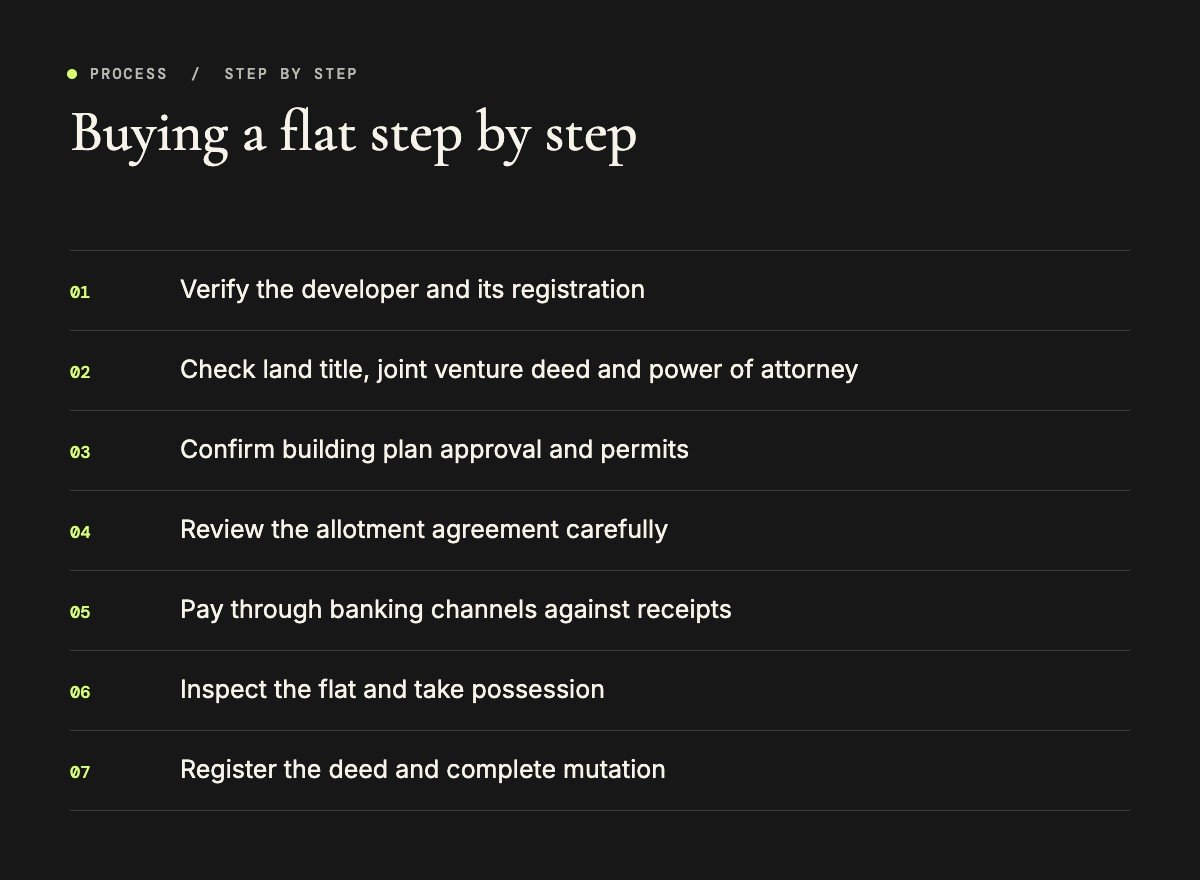
- Verify the developer. Check registration, track record and reputation.
- Check title. Review land documents, joint venture agreement and power of attorney.
- Confirm approvals. Inspect the approved plan and permits.
- Review the agreement. Negotiate unclear or unfair terms before signing.
- Pay safely. Use bank transfers or cheques and obtain receipts for every payment.
- Take possession. Inspect the flat, record defects and obtain handover documents.
- Register and mutate. Register the sale deed and complete mutation of the land share.
Never pay large amounts in cash or to an individual rather than the developer company. Cash payments are hard to prove in a dispute and may create tax and money laundering questions. Bank records are your best evidence.
Delayed handover after an apartment purchase in Bangladesh
Delay is the most common complaint. The 2010 Act provides for compensation where the developer fails to hand over the flat within the agreed time, subject to the agreement and force majeure. Buyers should keep records of all communications, payment receipts and notices. Where negotiation fails, remedies include complaints to the authority, civil suits for specific performance or compensation and, in some cases, criminal complaints for fraud.
Completing an apartment purchase in Bangladesh: registration and mutation
Once the flat is complete and paid for, the developer and landowner, often acting through the developer under the power of attorney, execute a registered sale deed transferring the flat and the proportionate undivided land to the buyer. Registration involves stamp duty, registration fees, local government tax and source tax on the transaction, which the buyer typically pays. Rates change through finance laws and notifications, so confirm current costs before registration.
After registration, the buyer should apply for mutation so that the land share is recorded in the buyer's name, and pay holding tax to the city corporation. See our guide to buying property in Bangladesh.
Apartment owners associations
The Apartment Ownership Act 2014 governs ownership of flats and common areas. Once flats are handed over, owners form an apartment owners association, which manages common areas such as stairs, lifts, roofs, generators and security, collects service charges and maintains the building. The developer should hand over documents, warranties and common facilities to the association.
Buyers should check what the association rules will be, how service charges are calculated and whether the developer has reserved any rights over the roof or common spaces. Disputes over common areas are frequent after an apartment purchase in Bangladesh, so clarity at the outset helps.
Buying a resale flat
Buying from an existing owner rather than a developer requires similar checks, plus verification of the seller's registered deed, mutation, holding tax and service charge payments, and any mortgage on the flat. Ask for a no-objection letter from the owners association confirming that dues are paid. If the flat is mortgaged to a bank, arrange redemption and release of the mortgage at registration.

Financing and home loans
Banks and finance companies offer home loans for apartment purchases, subject to Bangladesh Bank rules on loan-to-value ratios and borrower eligibility. Lenders conduct their own title and approval checks, which can provide an additional layer of comfort for buyers. The flat is usually mortgaged to the lender until the loan is repaid, and the mortgage must be registered.
Non-resident Bangladeshis can also buy flats and may obtain financing under special schemes, subject to foreign exchange rules on remittances and repayment.
Apartment purchase in Bangladesh for non-resident Bangladeshis
Many flats are bought by Bangladeshis living abroad. An apartment purchase in Bangladesh by a non-resident can be completed through a registered power of attorney given to a trusted relative or lawyer, executed abroad and authenticated in line with the Power of Attorney Act 2012 and its rules. Payments should come through formal banking channels so that the source of funds is documented and future sale proceeds can be repatriated where permitted.
Non-residents should be especially careful about developers' marketing abroad, verify every document independently and avoid paying large amounts before checking title and approvals. See our power of attorney guide.
Red flags to watch for
- The developer is unwilling to show the land documents or approved plan.
- Prices far below the market without a clear reason.
- Requests for cash payments or payments to individuals.
- Construction beyond the approved number of floors.
- Disputes between the landowner and the developer.
- Pending litigation or bank mortgages on the land.
If any of these appear, pause the apartment purchase in Bangladesh and take legal advice before paying further amounts.
Practical tips before you sign
Take time over an apartment purchase in Bangladesh. Visit the site at different times of day, check access roads, drainage and waterlogging during monsoon, and ask about utility connections for gas, electricity and water. Compare the specifications promised in the brochure with those in the agreement, because only the agreement is binding. Finally, ask a lawyer to review the agreement and title documents before you pay the booking money, as cancellation after payment can mean losing a significant deduction under the developer's terms.
Construction quality and defects
At handover, inspect the flat carefully with a checklist covering walls, floors, plumbing, electrical fittings, windows, doors, waterproofing and finishing specifications. Record defects in writing and ask the developer to fix them within a set time. Many agreements include a defect liability period during which the developer must repair faults. Structural safety is critical in an earthquake-prone country, so ask about compliance with the Bangladesh National Building Code and request copies of structural design approvals and soil test reports where available. An independent engineer's inspection is a worthwhile investment for a high-value flat.
Utility connections and holding tax
Confirm who is responsible for obtaining and paying for electricity, gas and water connections, and whether connection costs are included in the price. After handover, register the flat with the city corporation for holding tax and transfer utility accounts into your name. Keep receipts, as they are useful evidence of possession and are often required when selling later.
Frequently asked questions about apartment purchase in bangladesh
Which law protects flat buyers?
The Real Estate Development and Management Act 2010 and the Apartment Ownership Act 2014.
What should I check before booking?
Developer registration, land title, joint venture agreement, power of attorney and plan approval.
What if handover is delayed?
You may claim compensation under the agreement and the 2010 Act, and seek legal remedies.
Do I own land with my flat?
Yes, a proportionate undivided share of the land should be included in your deed.
Who pays registration costs?
Usually the buyer, unless the agreement provides otherwise.
Is mutation needed for a flat?
Yes, mutation of the land share is advisable to record your ownership.
How we can help
We support every apartment purchase in Bangladesh with title checks, agreement review, negotiation with developers, registration and dispute resolution. Learn more about our real estate practice and our construction team.
Buying a flat?
We check the paperwork before you pay.
Book a consultationReal estate practicePrimary sources: the Real Estate Development and Management Act 2010, Apartment Ownership Act 2014 and Registration Act 1908 on the Laws of Bangladesh portal; land records through the Ministry of Land.
This article is general information about Bangladeshi property law as of October 2026 and is not legal advice. Fees and tax rates change; confirm current costs before registration.




0 Comments