
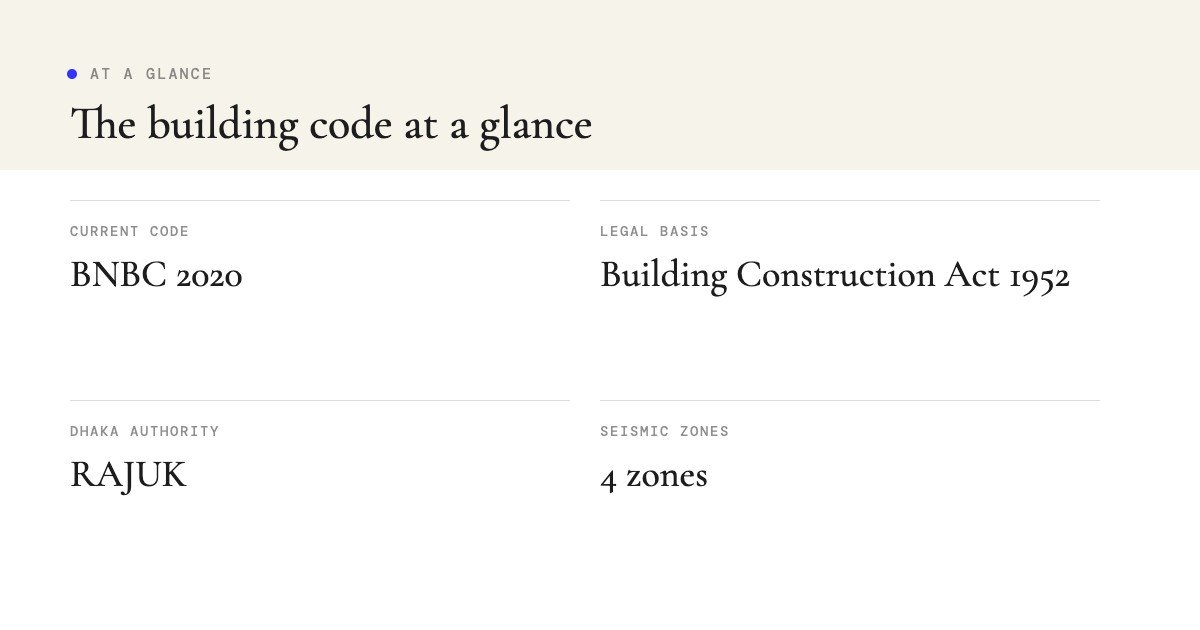
The Bangladesh National Building Code sets the minimum legal standards for how buildings are planned, designed, built and used. The current edition, BNBC 2020, was gazetted in 2021 and is binding through the Building Construction Act 1952. For developers, landowners, contractors and buyers, compliance is not optional: it decides whether a building gets its permits, its occupancy certificate and, in the worst case, whether it stays standing.

- BNBC 2020 replaced the 1993 code and is legally enforceable because the Building Construction Act 1952, as amended, makes compliance with the code mandatory.
- The code covers administration and enforcement, planning controls, fire protection, materials, structural design, construction safety, building services and change of use.
- In Dhaka, RAJUK applies the code together with its building construction rules and the Detailed Area Plan; other cities use their own development authorities and municipalities.
- BNBC 2020 updated seismic design, dividing the country into four seismic zones, and strengthened fire safety requirements after major factory and building disasters.
- Owners, designers, contractors and supervising engineers can all face liability when a building breaches the code.
What the Bangladesh National Building Code is
The Bangladesh National Building Code is a technical and regulatory document that prescribes minimum requirements for safety, health and amenity in buildings. The first code was prepared in 1993, and its compliance was made mandatory by amendments to the Building Construction Act 1952 in 2006. After a long revision process, the updated code, known as BNBC 2020, was published in the official gazette in February 2021.
BNBC 2020 is organised in three volumes and ten parts. They cover scope and definitions, administration and compliance, general building requirements and planning control, fire protection, building materials, structural design, construction practices and safety, building services, alteration and change of occupancy, and signs and outdoor displays. Each part can be relevant in a legal dispute, so lawyers and engineers often read it together.
Why the 2020 revision matters
The revision followed disasters such as the Rana Plaza collapse in 2013 and repeated building fires. The new Bangladesh National Building Code reflects modern engineering practice, updated wind and seismic data, accessibility for persons with disabilities, energy efficiency and stricter fire safety. Buildings designed under the 1993 code are not automatically unlawful, but new approvals and major alterations must meet BNBC 2020.
Legal status and enforcement
The Bangladesh National Building Code draws its force from the Building Construction Act 1952 and the rules made under it. Development authorities such as RAJUK in Dhaka, CDA in Chattogram, KDA in Khulna and RDA in Rajshahi, along with city corporations and municipalities, apply the code when they approve plans and inspect construction. The code also provides for a Bangladesh Building Regulatory Authority to oversee enforcement nationally; check the current status of that authority, because its establishment has been slower than planned.
Other laws sit alongside the code. The Fire Prevention and Extinguishing Act 2003 requires fire safety clearances, the Environment Conservation Act 1995 and the Environment Conservation Rules 2023 may require environmental clearance for large projects, and the Bangladesh Labour Act 2006 imposes workplace safety duties in factories. Our real estate and construction practice advises on how these rules fit together.
Planning controls: land use, DAP and FAR
Before any building design begins, the land must be suitable for the proposed use. In Dhaka, the Detailed Area Plan 2022–2035 assigns land use zones and density controls, and RAJUK's building construction rules set the floor area ratio (FAR), setbacks, ground coverage, height and parking. The DAP and its FAR provisions have been amended since 2022, so a developer should always check the version in force when applying.
The Bangladesh National Building Code adds general planning requirements such as access roads, open space, plot coverage and occupancy classification. Where a local rule and the code differ, the stricter requirement usually applies in practice, and authorities will not approve a plan that breaches either.
| Control | Main source | What it decides |
|---|---|---|
| Land use zone | DAP or local master plan | Whether residential, commercial or industrial use is allowed |
| Floor area ratio | RAJUK rules and DAP | Total buildable floor area on the plot |
| Setbacks and coverage | Local rules and BNBC | Space around the building and open area |
| Structural design | BNBC Part 6 | Loads, seismic and wind design, foundations |
| Fire protection | BNBC Part 4 and Fire Act 2003 | Exits, stairs, detection, suppression |
| Occupancy | BNBC and local authority | When and how the building can be used |
Approvals under the Bangladesh National Building Code
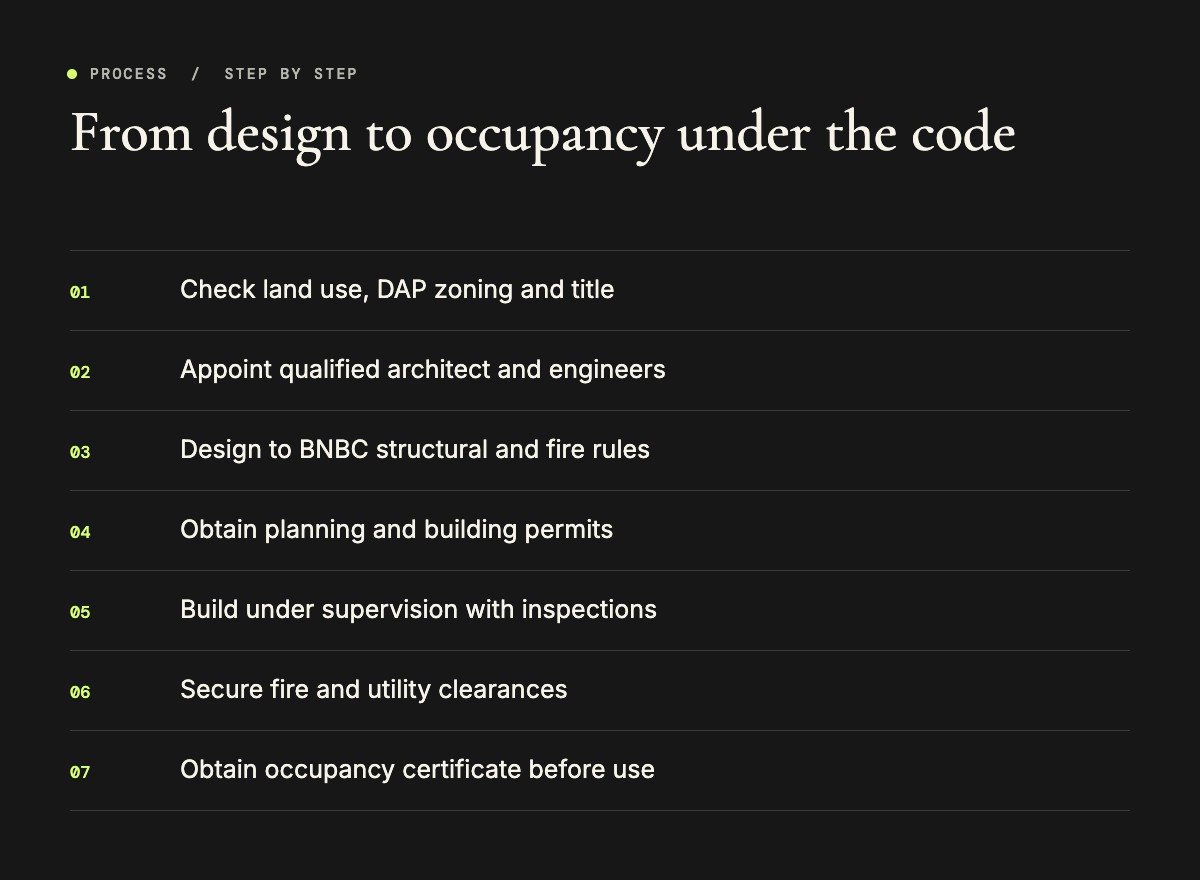
Obtaining approval for a building is a staged process. The details vary by authority, but in Dhaka a typical project moves through the following steps.
- Land use clearance. Confirm that the proposed use fits the DAP zone, and obtain land use clearance where required.
- Special project clearance. Large or high-rise buildings may need clearances from bodies such as the Civil Aviation Authority, fire service, environment department and traffic authority.
- Building permit. Submit architectural, structural and services drawings prepared by registered professionals, showing compliance with the Bangladesh National Building Code and local rules.
- Construction stage. Notify the authority when work begins, keep supervising engineers on site, and allow inspections at critical stages such as foundation and frame.
- Completion and occupancy. On completion, apply for the occupancy certificate. The building should not be occupied or sold for use until it is issued.
Many disputes arise because a developer builds beyond the approved plan, adds floors, or changes the use without approval. These breaches can lead to demolition orders, refusal of utility connections and claims by buyers.
Structural and seismic design
Part 6 of the Bangladesh National Building Code governs structural design. It sets dead, live, wind and earthquake loads, rules for concrete, steel and masonry design, and foundation requirements. BNBC 2020 divides Bangladesh into four seismic zones, with higher design forces in the north-east and other areas near active faults, and updated basic wind speeds for different districts.
Structural drawings must be prepared and signed by qualified engineers, and the design calculations should be retained. In a collapse or crack dispute, courts and inquiry committees examine whether the design and construction followed the code. Soil investigation reports are particularly important, because foundation failures on soft or filled land are common in fast-growing cities.
When buying an apartment or commercial space, ask for the approved plan, the structural design certificate and the occupancy certificate. A developer who cannot produce them is a warning sign, however attractive the price.
Fire safety requirements
Part 4 of the Bangladesh National Building Code sets fire protection standards based on occupancy and height. Requirements include protected escape stairs, exit widths and travel distances, fire doors, fire detection and alarm systems, sprinklers and hydrants for certain buildings, emergency lighting and fire lifts in high-rise buildings. The Fire Service and Civil Defence Department issues fire safety plan approvals and certificates under the Fire Prevention and Extinguishing Act 2003.
Commercial buildings, factories, hospitals, shopping centres and restaurants face particular scrutiny after deadly fires in recent years. Owners must also maintain fire systems after occupancy; a building that was compliant when completed can breach the law if alarms, extinguishers or exits are not maintained.
Construction safety on site
Part 7 of the code deals with construction practices and safety. It addresses excavation and shoring, scaffolding, protection of the public and neighbouring property, handling of materials, demolition and the safety of workers. Neighbouring owners often bring claims when excavation damages adjoining buildings, and the code's requirements on shoring and protection become central to those disputes.
Contractors should have a written site safety plan, competent supervision and insurance. Workplace accidents can also lead to liability under the Bangladesh Labour Act 2006 and inspection by the Department of Inspection for Factories and Establishments.
Building services, accessibility and energy
BNBC 2020 includes detailed requirements for electrical systems, plumbing, lifts, ventilation, air conditioning, gas installations and lightning protection. It also includes accessibility provisions to make buildings usable by persons with disabilities, such as ramps, accessible toilets and lifts, and energy efficiency measures for building envelopes and services. These provisions of the Bangladesh National Building Code are increasingly checked by authorities and by lenders and investors focused on ESG standards.
Alterations and change of use
Converting a residential building into offices, a school, a clinic or a restaurant changes its occupancy classification, and the Bangladesh National Building Code may then require different exits, fire systems, loads and services. Part 9 of the code and local rules require approval for significant alterations, additions and changes of use. Unapproved conversions are a common reason for sealing orders and fire service notices, particularly for restaurants and commercial premises in residential buildings.
Liability when the code is breached
Breaching the Bangladesh National Building Code can create several kinds of liability:
- Regulatory action. Authorities can refuse approval, stop work, seal buildings, order demolition of unauthorised parts and impose penalties under the Building Construction Act 1952.
- Criminal liability. Where breaches cause death or injury, owners, developers and engineers may face prosecution under the Penal Code and special laws.
- Contractual claims. Buyers can claim against developers under sale agreements and the Real Estate Development and Management Act 2010 for defects and deviations from approved plans.
- Professional liability. Architects and engineers who certify non-compliant designs risk disciplinary action and civil claims.
- Tort claims. Neighbours and third parties injured by unsafe construction can claim damages.
Our construction disputes practice handles defect claims, developer disputes and regulatory actions.
Developers, landowners and buyers
In joint venture developments, the landowner and developer should allocate responsibility for approvals and compliance with the Bangladesh National Building Code clearly in the development agreement. The agreement should require the developer to build strictly according to the approved plan, deliver the occupancy certificate and indemnify the landowner against regulatory penalties. Buyers should insist on clauses linking payment and handover to approvals and certificates.
Before signing, buyers can verify the approved plan with RAJUK or the local authority, compare it with the building, and check whether additional floors have been added. See our guide to buying a house in Bangladesh for the wider legal checks.
Practical compliance checklist
- Verify title, land use zone and FAR before buying land or signing a development agreement.
- Appoint registered architects and engineers and document their responsibilities.
- Commission a proper soil test and keep structural calculations.
- Obtain all permits and clearances before work starts.
- Build only according to the approved plan and seek approval for any change.
- Keep inspection records, test certificates for materials and site safety records.
- Obtain fire, utility and occupancy certificates before handover or use.
- Maintain fire and life safety systems throughout the building's life.
Factories and industrial buildings
Industrial buildings face some of the strictest scrutiny. After the Rana Plaza collapse and the Tazreen fire, structural, fire and electrical inspections of ready-made garment factories were carried out under national and buyer-led programmes, and the Department of Inspection for Factories and Establishments now requires factory layout and building approvals before licensing. A factory owner should be able to show that the building was designed for industrial loads under the Bangladesh National Building Code, that any additional floors were approved, and that fire exits, sprinklers and alarm systems match the occupancy.
Lenders and international buyers frequently ask for these documents during due diligence, and gaps can delay financing or orders.
Inspections, notices and how to respond
Authorities may inspect buildings during construction, on completion or after a complaint or incident. An inspection report can lead to a notice requiring rectification within a set period, a stop-work order, sealing of the premises or demolition of unauthorised portions.
When a notice arrives, the owner should immediately gather the approved plans, permits, structural certificates and fire documents, commission an independent engineer's assessment, and respond in writing within the deadline. In many cases a technical rectification plan, agreed with the authority, avoids sealing or demolition.
Where an order is unlawful or disproportionate, it may be challenged through an appeal under the relevant rules or, in suitable cases, a writ petition in the High Court Division. Professional advice on the Bangladesh National Building Code at this stage can save a building and significant money.
Insurance and risk allocation
Construction contracts should allocate the risk of non-compliance clearly. Common tools include warranties that the design and works comply with the Bangladesh National Building Code and all approvals, defects liability periods, performance security, contractor's all risks insurance and professional indemnity cover for designers. Owners should check that policies are actually in force and that exclusions do not remove cover for code breaches.
Frequently asked questions about bangladesh national building code
Is BNBC 2020 legally binding?
Yes. The Building Construction Act 1952, as amended, makes compliance with the national building code mandatory, and authorities apply BNBC 2020 to new approvals.
Does the code apply outside Dhaka?
Yes. It applies nationally, and local development authorities, city corporations and municipalities enforce it alongside their own rules.
Do old buildings need to comply with BNBC 2020?
Existing buildings approved under earlier rules are not automatically illegal, but major alterations, additions and changes of use must comply with the current code, and authorities can act on unsafe buildings.
Who is responsible for compliance?
The owner and developer carry primary responsibility, but architects, engineers and contractors also have duties, and all may face liability.
What is an occupancy certificate?
It is the authority's confirmation that the completed building matches the approval and can be used. Buildings should not be occupied without it.
What can a buyer do about illegal extra floors?
A buyer may have claims against the developer under the sale agreement and the Real Estate Development and Management Act 2010, and the authority may take action against the unauthorised floors.
How we can help
We advise developers, landowners, investors, buyers and contractors on the Bangladesh National Building Code: approvals strategy, development agreements, compliance reviews, regulatory notices, defect claims and construction disputes. Learn more about our real estate and construction practice.
Facing a building approval issue or defect dispute?
We review your approvals, contracts and site records and set out a clear plan to protect your investment.
Book a consultationReal estate practicePrimary sources: the Building Construction Act 1952, Fire Prevention and Extinguishing Act 2003 and Real Estate Development and Management Act 2010 on the Laws of Bangladesh portal; building approvals and the Detailed Area Plan from RAJUK; fire safety requirements from the Fire Service and Civil Defence Department.
This article is general information about Bangladeshi building regulation as of October 2026 and is not legal or engineering advice. Codes, DAP provisions and local rules change; confirm current requirements with the relevant authority and qualified professionals before acting.



0 Comments