
When parents separate or divorce, the hardest question is usually who will care for the children. Child custody in Bangladesh is decided under a combination of personal law, such as Muslim law’s rules on hizanat, and the Guardians and Wards Act 1890, with the Family Courts deciding disputes. Above all these rules sits one guiding principle developed by the Supreme Court: the welfare of the child.
- Custody (care of the child) and guardianship (legal authority over the child and property) are different concepts in Bangladeshi law.
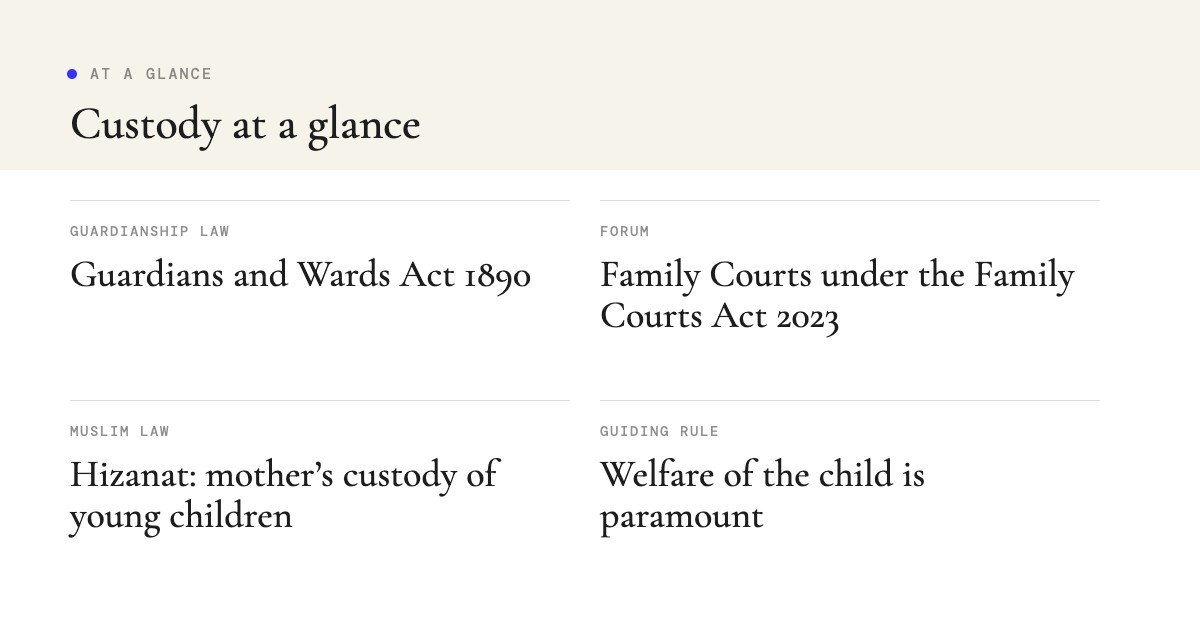
- Under traditional Hanafi Muslim law, the mother is entitled to custody of a son until age seven and a daughter until puberty, while the father is the natural guardian.
- The Appellate Division has held that the welfare of the child overrides these age rules where necessary.
- Custody and guardianship disputes are heard by the Family Courts, now governed by the Family Courts Act 2023.
- Courts can grant interim custody, visitation rights and orders preventing a child from being taken abroad.
Custody versus guardianship in child custody in Bangladesh
Custody, known as hizanat in Muslim law, refers to the physical care and upbringing of the child. Guardianship, or wilayat, refers to legal authority over the child’s person and property, including decisions on education, marriage and property. Under traditional Muslim law, the mother usually has the right to custody of young children, while the father remains the natural guardian. Understanding this distinction is essential in any dispute over child custody in Bangladesh, because a parent may have custody without being the legal guardian, or vice versa.
Our family law team, part of our broader practice described on our about page, advises parents on custody, guardianship and related issues.
The legal framework for child custody in Bangladesh
| Source | Role |
|---|---|
| Personal laws (Muslim, Hindu, Christian and others) | Define who is preferred as custodian and guardian |
| Guardians and Wards Act 1890 | Court’s power to appoint guardians and decide custody, applying the child’s welfare |
| Family Courts Act 2023 | Family Courts’ jurisdiction and procedure, replacing the 1985 Ordinance |
| Children Act 2013 | Child protection principles and juvenile justice |
| Case law of the Supreme Court | Welfare principle and interpretation of personal law rules |
Statutes are available on Laws of Bangladesh.
Hizanat and child custody in Bangladesh under Muslim law
Under the Hanafi school followed by most Muslims in Bangladesh, the mother is entitled to custody of her son until he reaches seven years and her daughter until she attains puberty. If the mother is unavailable or disqualified, custody passes to female relatives in a recognised order, such as the maternal grandmother. The mother may lose custody in certain circumstances, for example by remarriage to a person not related to the child within prohibited degrees, by neglect, or by conduct harmful to the child, although courts now examine such grounds in light of the child’s welfare rather than applying them mechanically.
The welfare principle in child custody in Bangladesh
In the landmark case of Abu Bakar Siddique v SMA Bakar (1986), the Appellate Division held that the rules of hizanat are not absolute and that the welfare of the child is the paramount consideration. The court allowed a mother to retain custody of a son beyond seven years because it was in his best interests. Since then, courts deciding child custody in Bangladesh consider the child’s age, sex, health, education, emotional bonds, the character and capacity of each parent, the stability of each home and, where the child is mature enough, the child’s own preference.
The Guardians and Wards Act 1890 also directs courts to consider the welfare of the minor, consistent with the personal law, when appointing guardians and making orders.
Seeking custody through the Family Court
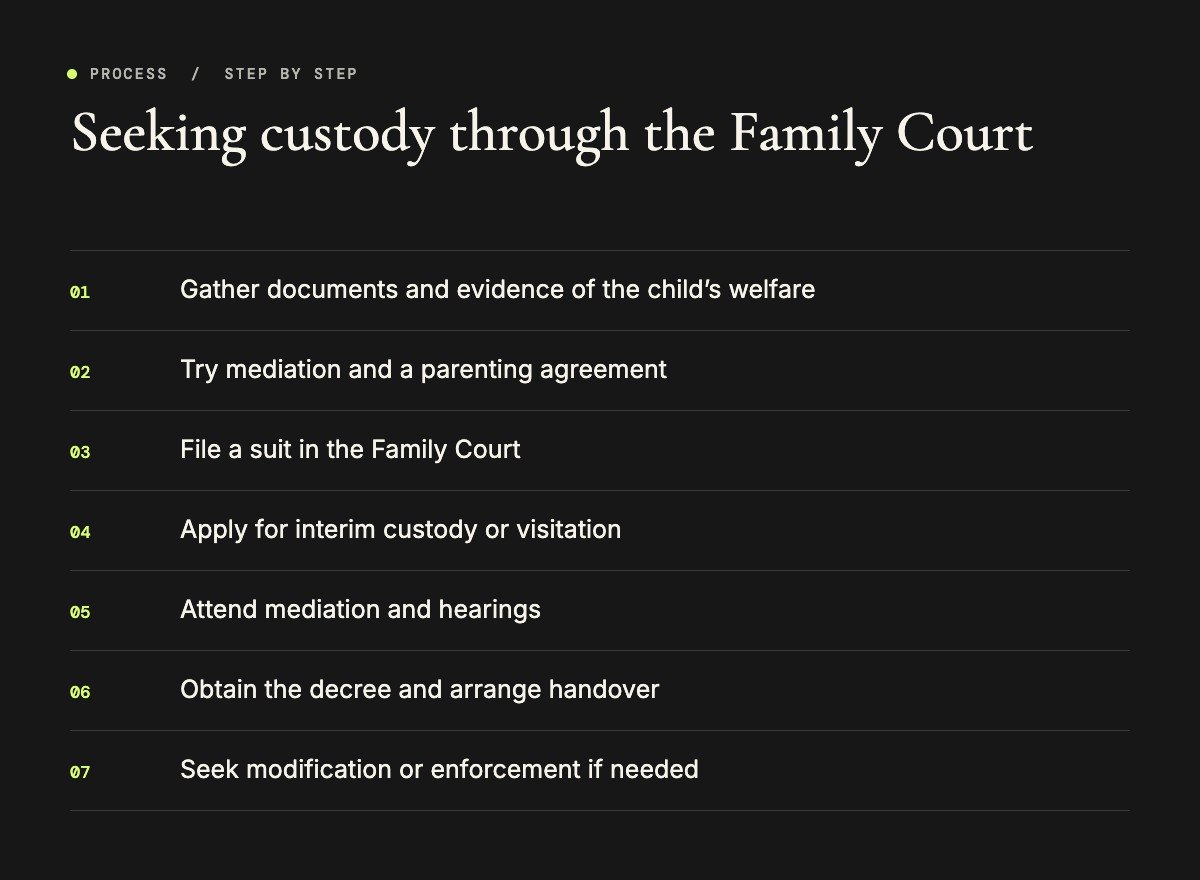
- Prepare. Collect birth certificates, school records, medical records and evidence about each parent’s care.
- Mediate. Explore a parenting agreement through mediation or counselling.
- File. Bring a suit for custody or guardianship in the Family Court with territorial jurisdiction.
- Interim relief. Apply for interim custody, visitation or orders preventing removal of the child.
- Hearings. Attend mediation sessions and the trial, presenting witnesses and documents.
- Decree. Obtain the custody decree and arrange orderly handover and visitation.
- Review. Seek modification if circumstances change or enforcement if the order is disobeyed.
Courts look unfavourably on parents who obstruct contact with the other parent without good reason. Facilitating reasonable visitation usually strengthens, rather than weakens, a parent’s case.
Custody under Hindu and Christian law
Hindu law as applied in Bangladesh treats the father as the natural guardian of a minor, followed by the mother, and courts also consider the child’s welfare when deciding custody. Christian parents are governed largely by the Guardians and Wards Act 1890 and the Divorce Act 1869, under which courts decide custody based on the child’s welfare. Because personal law codification for minority communities is limited, courts frequently rely on the welfare principle across communities when resolving disputes over child custody in Bangladesh.
Interim orders and visitation in child custody in Bangladesh
Custody cases can take months, so courts may grant interim custody to one parent and visitation to the other while the case is pending. Visitation orders set times, places and conditions, such as supervised visits where there are safety concerns. Courts can also make orders about contact during school holidays and religious festivals. A detailed and workable visitation schedule reduces conflict and helps the child maintain relationships with both parents.
Preventing removal from Bangladesh
Where one parent fears that the other will take the child abroad, the court can issue orders restraining removal, direct the deposit of the child’s passport and notify immigration authorities. Bangladesh is not a party to the Hague Convention on the Civil Aspects of International Child Abduction, so recovering a child taken abroad depends on the courts of the destination country and diplomatic channels. Cross-border child custody in Bangladesh therefore requires early, preventive action.
Maintenance of the child
Under Muslim law, the father is primarily responsible for maintaining his children regardless of who has custody, typically until sons reach majority and daughters marry. The Family Court can order child maintenance, including arrears, and enforce payment. The amount depends on the father’s means and the child’s needs, including education and healthcare. Custody and maintenance claims are often brought together.
Factors courts consider
In deciding child custody in Bangladesh, courts weigh a range of practical factors: who has been the primary caregiver, each parent’s ability to provide a safe and stable home, the child’s schooling and community ties, health needs, siblings, the moral and religious upbringing of the child, and any history of violence or neglect. A parent’s remarriage, financial position or employment is relevant only insofar as it affects the child’s welfare. Evidence from teachers, doctors and relatives can be influential.
Courts may also interview older children privately to understand their wishes without exposing them to parental pressure.
Mediation and parenting agreements
The Family Courts Act 2023, like the earlier ordinance, emphasises reconciliation and mediation before trial. Parents who agree on a parenting plan covering residence, visitation, education, holidays, travel and decision-making can ask the court to record it, giving it the force of a decree. Agreed solutions are usually faster, cheaper and less damaging for children than contested litigation, and they are easier to adjust as children grow.
Modification of custody orders
Custody orders are not permanent. Either parent can apply to modify an order if circumstances change significantly, for example if the custodial parent relocates, the child’s needs change, or there is evidence of harm. The court again applies the welfare principle. Keeping records of how arrangements are working, and any problems that arise, helps support or resist an application to change child custody in Bangladesh.
Domestic violence and child protection
Where there is domestic violence, the Domestic Violence (Prevention and Protection) Act 2010 allows protection orders, residence orders and custody orders for children as part of protective relief. Allegations of abuse are taken seriously and may lead to supervised visitation or denial of contact. The Children Act 2013 also provides child protection mechanisms. Safety must come first in any custody arrangement.
Non-resident parents and cross-border families
Many Bangladeshi families live across borders, with one parent working in the Middle East, Europe or North America. A parent abroad can bring or defend a custody case through a lawyer and an authenticated power of attorney, although personal appearance may be needed at key stages, and courts increasingly accept remote participation in some circumstances. Foreign custody orders are not automatically enforced in Bangladesh, so a parent relying on one may need to bring fresh proceedings, where the foreign order will be considered as evidence of what serves the child’s welfare.
Evidence and preparation
Strong preparation makes a real difference in disputes over child custody in Bangladesh. Useful evidence includes the child’s birth certificate, school attendance and results, medical records, photographs and messages showing involvement in the child’s life, records of financial support, and witness statements from relatives, neighbours or teachers. Parents should avoid involving children in the dispute, speaking negatively about the other parent, or posting about the case on social media, as these can harm their position.
Legal aid
Parents who cannot afford a lawyer can apply for government legal aid through the National Legal Aid Services Organisation and district legal aid offices, which provide advice, representation and mediation services in family matters. NGOs working on women’s and children’s rights also offer support. Access to legal help is particularly important for mothers seeking custody and maintenance.
Appeals
A parent dissatisfied with a Family Court decision on custody or guardianship can appeal to the District Judge’s court within the time allowed, and in some cases seek revision before the High Court Division. Interim orders may also be challenged. Because children’s circumstances change quickly, courts aim to resolve appeals promptly, but parties should comply with existing orders while an appeal is pending.
Frequently asked questions about child custody in bangladesh
Who gets custody of young children?
Under Muslim law the mother is generally preferred for young children, subject to the child’s welfare.
Does a mother lose custody after seven years?
Not automatically; courts can extend custody if it serves the child’s welfare.
Who is the legal guardian?
Under Muslim law the father is the natural guardian, but courts can appoint another guardian.
Which court hears custody cases?
The Family Court under the Family Courts Act 2023.
Can the other parent take the child abroad?
Courts can restrain removal of a child from Bangladesh without consent or permission.
Does the child’s preference matter?
Yes, especially for older children able to form an intelligent preference.
How we can help
We advise and represent parents in disputes over child custody in Bangladesh, guardianship applications, visitation arrangements and cross-border cases. Learn more about our practice, our mediation services and our guide to divorce under Muslim law.
Facing a custody dispute?
We put your child’s welfare and your rights at the centre.
Book a consultationAbout usPrimary sources: the Guardians and Wards Act 1890, the Family Courts Act 2023 and the Children Act 2013 on Laws of Bangladesh; case law from the Supreme Court of Bangladesh; legal aid from the National Legal Aid Services Organisation.
This article is general information about Bangladeshi family law as of October 2026 and is not legal advice. Custody decisions depend on the facts of each case.




0 Comments