
Ransomware, leaked customer databases and compromised payment systems now affect Bangladeshi banks, fintechs, hospitals, telecom operators and government agencies. An effective data breach response in Bangladesh combines fast technical containment with careful legal handling: preserving evidence, meeting sector reporting duties, communicating with affected people and managing liability under a cyber and data protection framework that changed significantly in 2025 and 2026.
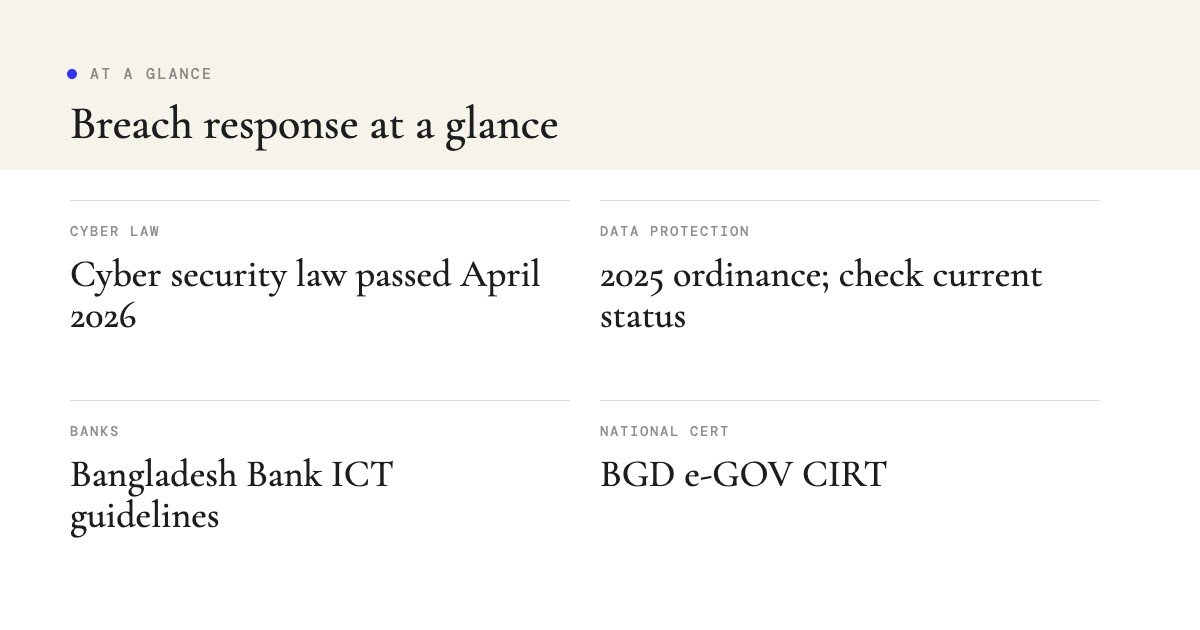
- Bangladesh's cyber security framework was overhauled in 2025 and 2026, with Parliament passing a new cyber security law in April 2026 to replace the 2025 ordinance.
- A Personal Data Protection Ordinance was made in 2025; organisations should confirm whether Parliament has re-enacted or amended it and which obligations are in force.
- Banks and financial institutions must report cyber incidents under Bangladesh Bank guidelines, and telecom operators face BTRC requirements.
- BGD e-GOV CIRT, the national computer incident response team, coordinates responses to significant incidents.
- Preparation, including an incident response plan and tested procedures, is the most effective way to limit harm.
Parliament passed the Personal Data Protection Act 2026 in April 2026, repealing the Personal Data Protection Ordinance 2025. References below to the Ordinance should be read in light of the 2026 Act.
Why breach response matters
A data breach can expose customers to fraud, disrupt operations, trigger regulatory action and damage trust for years. How an organisation responds in the first hours and days often matters more than the breach itself. A disciplined data breach response in Bangladesh limits harm, shows regulators that the organisation acted responsibly and reduces the risk of litigation.
Our data protection and privacy practice advises organisations on preparing for and responding to cyber incidents, working alongside technical forensic teams.
The legal framework for data breach response in Bangladesh
Bangladesh's cyber laws have changed rapidly. The Digital Security Act 2018 was replaced by the Cyber Security Act 2023, which was in turn replaced by the Cyber Security Ordinance 2025, and in April 2026 Parliament passed a new cyber security law. These laws define offences such as unauthorised access, data theft and damage to computer systems, and provide for critical information infrastructure protection.
The Personal Data Protection Ordinance 2025 introduced obligations on handling personal data. Its status after Parliament's April 2026 session should be confirmed before relying on specific provisions. Sector rules from Bangladesh Bank, BTRC and other regulators add incident reporting and security requirements, so a data breach response in Bangladesh must consider several overlapping regimes.

Sector rules for data breach response in Bangladesh
| Sector | Key requirements |
|---|---|
| Banks and financial institutions | Bangladesh Bank ICT security guidelines; incident reporting to the central bank; customer protection |
| Mobile financial services | Bangladesh Bank MFS rules and security requirements |
| Telecom operators | BTRC licence conditions and directives |
| Critical information infrastructure | Designation and obligations under cyber security law |
| Listed companies | Disclosure of price sensitive information to BSEC and stock exchanges where material |
Data breach response in Bangladesh: the first 72 hours
- Activate the team. Convene IT, security, legal, compliance, communications and senior management.
- Contain. Isolate affected systems, reset credentials and block malicious access.
- Preserve evidence. Keep logs, images and records for forensic analysis and possible prosecution.
- Assess scope. Identify what data, systems and individuals are affected.
- Check legal duties. Determine reporting obligations to regulators, partners and individuals.
- Notify. Make required notifications accurately and on time.
- Remediate and review. Fix vulnerabilities, restore services and update controls.
Involve legal counsel at the start of the investigation and structure forensic engagements through counsel where appropriate. This helps manage privilege and confidentiality and ensures that communications with regulators and customers are accurate and consistent.
Notifying regulators and individuals
Notification duties depend on the sector, the type of data and the applicable law. Banks must inform Bangladesh Bank of significant cyber incidents in line with its guidelines. Where personal data protection rules apply, they may require notification to the data protection authority and affected individuals within specified periods. Contracts with clients, partners and payment networks often contain their own notification deadlines.
Notifications should state what happened, what data was affected, what the organisation is doing and what individuals can do to protect themselves. Inaccurate early statements can create legal risk, so balance speed with accuracy in any data breach response in Bangladesh.
Reporting to law enforcement
Cyber attacks are criminal offences. Organisations can report to the police, including specialised cyber crime units, and coordinate with BGD e-GOV CIRT for technical support. Law enforcement involvement can help trace attackers and recover data, but organisations should consider how reporting interacts with confidentiality and ongoing investigations.
Ransomware
Ransomware attacks encrypt systems and often steal data for extortion. Decisions about whether to engage with attackers raise legal, ethical and sanctions issues, as payments to certain groups may breach foreign sanctions and fund further crime. Organisations should take legal advice, involve law enforcement and rely on tested backups wherever possible.
Liability after a data breach response in Bangladesh
Affected individuals and business partners may bring claims for losses caused by a breach, relying on contract, negligence or statutory rights under data protection law. Regulators may impose penalties for security failures. Directors may face scrutiny if they ignored known risks. Insurance, contractual limitations and evidence of reasonable security measures all affect exposure.
Preparing before a breach
The most successful data breach response in Bangladesh begins long before an incident. Organisations should map where personal and sensitive data is stored, classify systems by criticality, maintain offline backups, enforce multi-factor authentication and patch systems promptly. A written incident response plan should name team members, decision-makers, external advisers and contact details for regulators.
Tabletop exercises simulating ransomware or data leaks help teams practise decisions under pressure and reveal gaps in procedures. Regular staff training on phishing, which remains the most common entry point for attackers, reduces risk significantly.
Vendors and outsourcing
Many breaches originate at service providers, such as cloud hosts, payroll processors or software vendors. Contracts should require vendors to maintain adequate security, notify the organisation promptly of incidents, cooperate with investigations and allow audits. Data processing terms should define responsibilities clearly. When a vendor suffers a breach affecting your data, your data breach response in Bangladesh must coordinate closely with the vendor while meeting your own obligations.
Communications and reputation
Clear, honest communication helps maintain trust. Prepare holding statements in advance, designate a single spokesperson and coordinate messages to customers, employees, regulators and the media. Avoid speculation about causes or attribution before facts are established. A dedicated helpline or web page for affected individuals can reduce confusion and demonstrate responsibility.
Banks and fintechs
Financial institutions are frequent targets because of the value of payment data and the potential for direct theft. For banks, data breach response in Bangladesh involves Bangladesh Bank reporting, coordination with card schemes and payment networks, blocking compromised cards and accounts, and communicating with customers about fraud risks. The central bank expects banks to maintain security operations centres, conduct regular vulnerability assessments and test incident response plans.
Fintechs and payment service providers face similar expectations under their licences. A weak data breach response in Bangladesh can lead to restrictions on operations, licence conditions or penalties, and can affect relationships with partner banks.
Healthcare and sensitive data
Hospitals, diagnostic centres and health apps hold highly sensitive personal information. Leaks of medical records can cause serious harm and stigma. Health providers should limit access to records, encrypt data, keep audit logs and train staff. In any data breach response in Bangladesh involving health data, organisations should prioritise protecting affected patients, including offering guidance and support where appropriate.
Employee data and insider threats
Not all breaches come from outside. Employees may misuse access, take data when leaving or fall victim to social engineering. Access controls based on job roles, monitoring of unusual activity, and clear disciplinary policies help manage insider risk. When an insider breach occurs, the data breach response in Bangladesh should consider employment law processes alongside criminal reporting, and preserve evidence carefully for any proceedings.
Cross-border data and multinational groups
Bangladeshi subsidiaries of multinational groups may have to comply with notification laws in other countries, such as the EU GDPR, if data of foreign residents is affected or systems are shared. Group incident response plans should identify which entity leads, which laws apply and who communicates with which regulator. Coordinating global and local obligations avoids inconsistent statements and missed deadlines during a data breach response in Bangladesh.
After the incident
Once the immediate crisis is over, conduct a post-incident review covering root causes, the effectiveness of the response and improvements needed. Update policies, technical controls, vendor contracts and training. Report findings to the board, and document actions taken, because regulators and courts may later ask what the organisation learned and changed.
Cyber insurance
Cyber insurance policies can cover forensic investigation, legal advice, notification costs, business interruption and liability claims, subject to exclusions and conditions. Policies often require prompt notification to the insurer and use of approved vendors, so the incident response plan should include the insurer's contact details and requirements. Review cover annually, as policy terms change quickly in response to ransomware trends, and make sure the limits are realistic for the organisation's size and data holdings.
Board oversight
Cyber risk is now a board-level issue. Directors should receive regular reports on threats, controls, incidents and testing, approve the incident response plan and ensure adequate investment in security. Clear oversight protects directors personally, because regulators and courts increasingly expect boards to understand and manage cyber risk rather than leaving it entirely to IT teams. A short annual briefing by external experts can help non-technical directors ask the right questions.
Small and medium businesses
Smaller organisations often assume they are too small to be targeted, but automated attacks hit businesses of every size. Simple measures make a big difference: strong passwords with multi-factor authentication, regular software updates, offline backups, limiting administrator access and training staff to spot phishing. A one-page response checklist with key contacts, including a lawyer and an IT specialist, helps a small business act quickly when something goes wrong and avoid costly mistakes in the first hours.
Investing a little in preparation today is far cheaper than recovering from a serious incident tomorrow, both financially and in terms of customer trust.
Frequently asked questions about data breach response in bangladesh
Is breach notification mandatory in Bangladesh?
Sector rules, such as Bangladesh Bank guidelines, require reporting; personal data protection rules may add duties depending on their current status.
Who should we contact first?
Your incident response team and legal counsel, then regulators and law enforcement as required.
What is BGD e-GOV CIRT?
Bangladesh's national computer incident response team, which supports responses to significant incidents.
Should we pay a ransom?
Take legal advice; payments raise legal, sanctions and ethical concerns.
Can customers sue after a breach?
Yes, claims may be brought in contract, negligence or under data protection law.
How can we prepare?
Adopt an incident response plan, test it, keep backups and train staff.
How we can help
We guide organisations through data breach response in Bangladesh, from incident planning and regulatory notifications to investigations, claims and policy updates. Learn more about our data protection practice, our technology team and our financial services practice.
Facing a cyber incident?
We provide rapid legal support to contain risk and meet reporting duties.
Book a consultationData protection practicePrimary sources: cyber and data protection laws on the Laws of Bangladesh portal; ICT security guidelines from Bangladesh Bank; telecom directives from the BTRC.
This article is general information as of October 2026 and is not legal advice. Cyber and data protection laws are changing; confirm current obligations immediately when an incident occurs.




0 Comments