
Denmohor, or dower, is a Muslim wife’s legal right, not a gift that the husband may choose to pay. Yet many women never receive it, especially after divorce. Dower recovery in Bangladesh is handled by the Family Court, which can decree payment of unpaid dower together with maintenance. Understanding the difference between prompt and deferred dower, the limitation periods and the evidence needed makes recovery far more likely.
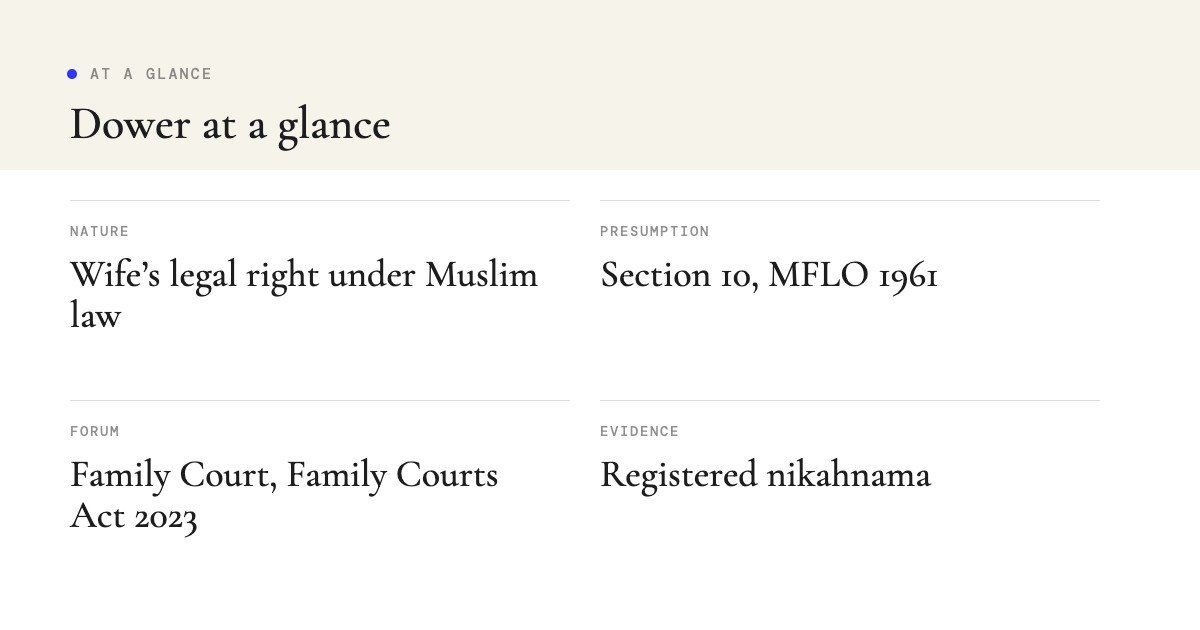
- Dower is a sum of money or property the husband must pay the wife under Muslim law as a consequence of marriage.
- Prompt dower is payable on demand; deferred dower becomes payable on divorce or death.
- Under section 10 of the Muslim Family Laws Ordinance 1961, if the nikahnama does not specify the mode of payment, the entire dower is presumed payable on demand.
- Claims are filed in the Family Court under the Family Courts Act 2023, which replaced the 1985 Ordinance.
- Limitation periods apply, so wives should demand payment in writing and file promptly.
What dower is
Dower, called mahr or denmohor, is an obligation imposed on the husband by Muslim law as a mark of respect for the wife. It belongs to the wife alone, and she can use it as she wishes. The amount is usually fixed in the nikahnama at the time of marriage, and it can be paid in cash, gold or other property.
Dower recovery in Bangladesh is therefore enforcement of a legal debt owed by the husband to the wife. It is not affected by who initiated the divorce, except in specific situations such as khula where the wife agrees to give up some or all of her dower. Our family law team, introduced on our about page, regularly acts in dower cases.
Prompt and deferred dower recovery in Bangladesh
| Type | When payable | Key point |
|---|---|---|
| Prompt (muajjal) | On demand at any time after marriage | Wife may refuse cohabitation until paid in some circumstances |
| Deferred (muwajjal) | On dissolution of marriage by divorce or death | Becomes immediately due on talaq or death of husband |
| Unspecified mode | Presumed payable on demand under section 10 MFLO | Protects wives where the nikahnama is silent |
Many nikahnamas divide dower into a prompt portion and a deferred portion. Payments already made, such as jewellery given at marriage and recorded as part of dower, are deducted from the total.
The Family Court and dower recovery in Bangladesh
The Family Courts Act 2023 replaced the Family Courts Ordinance 1985 and gives Family Courts exclusive jurisdiction over dissolution of marriage, restitution of conjugal rights, dower, maintenance, and guardianship and custody of children. A wife can combine claims for dower and maintenance in one suit, making dower recovery in Bangladesh more efficient.
Family Courts follow a simplified procedure, hold pre-trial and post-trial reconciliation sessions, and aim to resolve cases faster than ordinary civil courts. Court fees for family suits are nominal.
Evidence for dower recovery in Bangladesh
The registered nikahnama is the most important evidence, as it records the amount of dower, the prompt and deferred portions, and any amount paid at marriage. Marriage registration under the Muslim Marriages and Divorces (Registration) Act 1974 makes obtaining a certified copy straightforward. Other evidence includes witnesses to the marriage, the talaq notice and any written demands for payment.
Where the nikahnama records that dower was paid, for example through jewellery, the wife may need to show that the entry is false or that the jewellery was a gift rather than dower. Courts examine such entries carefully.
Limitation in dower recovery in Bangladesh
The Limitation Act 1908 sets time limits for dower suits. For prompt dower, time generally runs from when the dower is demanded and refused, or from when the marriage is dissolved by death or divorce. For deferred dower, time runs from the dissolution of the marriage. The periods are generally three years, so wives should not wait too long after divorce or demand before filing.
Delay is one of the main obstacles to dower recovery in Bangladesh, often because women hope for voluntary payment or reconciliation. A written demand creates a clear record and helps establish when time starts to run.
Step by step
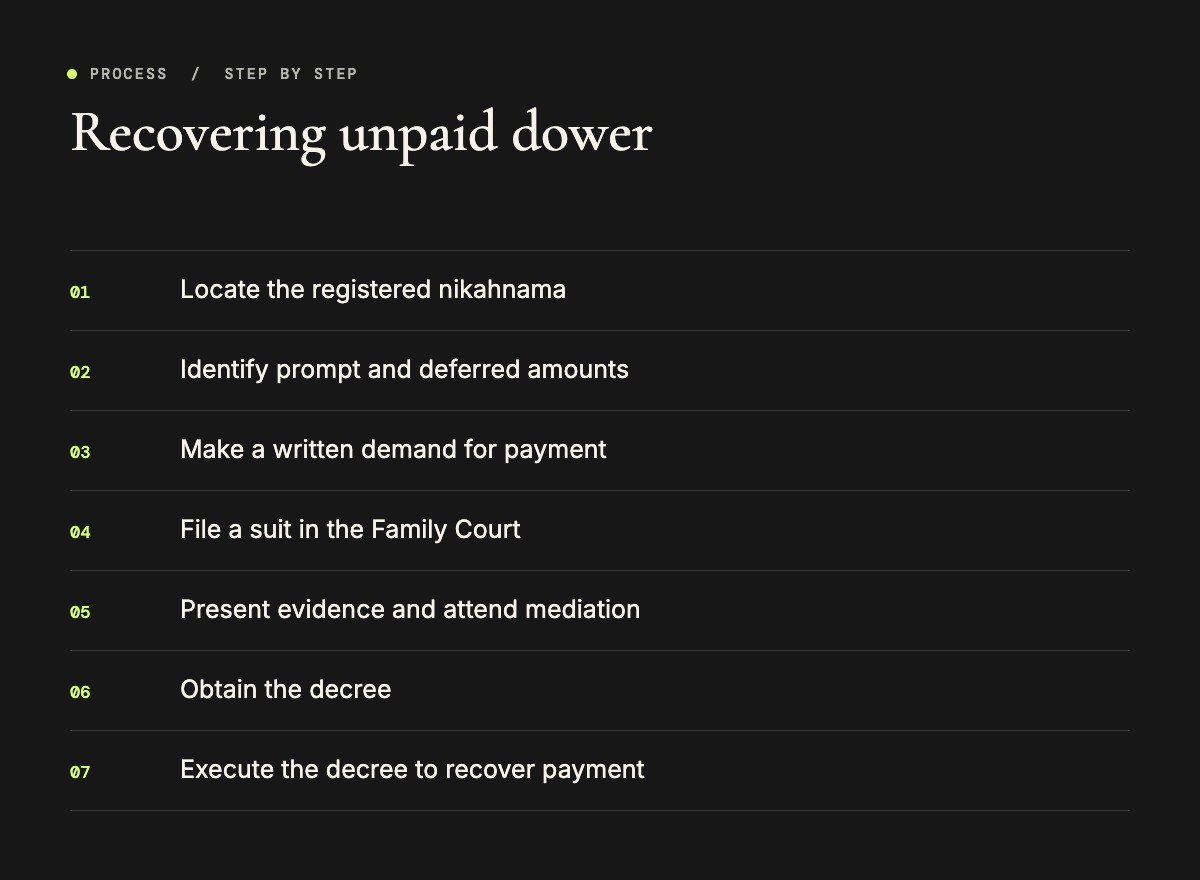
- Get the nikahnama. Obtain a certified copy from the marriage registrar.
- Calculate the claim. Identify prompt and deferred amounts and deduct any payments.
- Make a demand. Send a written legal notice demanding payment.
- File the suit. File in the Family Court with jurisdiction, often where the wife resides.
- Attend reconciliation. Participate in pre-trial reconciliation; settlement may be reached.
- Prove the claim. Present the nikahnama and evidence at trial.
- Execute the decree. Apply for execution if the husband does not pay.
A husband cannot escape dower by claiming the wife was disobedient or that she sought the divorce, unless she expressly relinquished dower, for example in a khula agreement. Read any settlement or khula document carefully before signing.
Execution and recovery
Once the Family Court decrees dower, the husband must pay as ordered, sometimes in instalments if the court allows. If he does not pay, the wife can apply for execution, and the court can attach and sell property or use other enforcement methods available under the Family Courts Act and the Code of Civil Procedure. Effective dower recovery in Bangladesh often depends on identifying the husband's assets, such as land, bank accounts or salary.
Where the husband lives abroad, enforcement can be harder, but assets in Bangladesh can still be attached, and settlements are often negotiated once a decree exists.
Dower recovery in Bangladesh after the husband's death
When a husband dies, unpaid dower, both prompt and deferred, becomes a debt payable from his estate before the heirs receive their shares. The widow can claim it from the estate and may, in some circumstances, retain possession of the husband's property until her dower is paid, a right recognised in Muslim law. Heirs who distribute the estate without paying dower may face claims. Dower recovery in Bangladesh against an estate often requires coordination with succession proceedings and land records.
Maintenance alongside dower
Wives usually claim maintenance together with dower. A husband must maintain his wife during the marriage, and after talaq during the iddat period. Children's maintenance is a separate obligation. The Family Court can order arrears of maintenance as well as future payments. Combining these claims in one suit saves time and costs.
Khula and relinquishment
In khula, the wife seeks divorce and may agree to return or give up her dower in exchange. Any relinquishment should be clear, voluntary and recorded in writing. Pressure on a wife to give up dower as a condition of divorce may be challenged. Before agreeing to relinquish, wives should take advice on whether a different route, such as dissolution under the Dissolution of Muslim Marriages Act 1939, would preserve their dower rights.
Disputes about the amount
Sometimes the amount recorded in the nikahnama is disputed, for example where the husband claims a lower figure was agreed or that the nikahnama was altered. Courts give strong weight to the registered nikahnama and the registrar's records. Where no amount was fixed, the wife may claim proper dower, assessed by reference to the dower of women of similar status in her family. Clear documentation at the time of marriage avoids most of these disputes and simplifies dower recovery in Bangladesh later.
Husbands living abroad
Many husbands work overseas. Family Courts can proceed where the husband has been properly served, including through substituted service or service at his Bangladeshi address. A decree can be executed against property in Bangladesh, and remittances or bank accounts may be attachable. Enforcing a Bangladeshi decree abroad depends on the law of the foreign country, which can be complex. Negotiated settlements, sometimes with instalment arrangements, are common once a husband abroad realises a decree has been obtained.
Practical tips for wives
- Keep a certified copy of the nikahnama safely.
- Record any dower payments received, with dates and amounts.
- Send a written demand before filing suit.
- File within limitation, especially after divorce.
- Seek free legal aid if you cannot afford a lawyer.
These steps make dower recovery in Bangladesh faster and more certain. The National Legal Aid Services Organisation can assign lawyers to eligible women in Family Court cases.
Appeals
A party dissatisfied with a Family Court decree can appeal to the District Judge's court within the time allowed by the Family Courts Act, and further remedies may lie to the High Court Division in limited circumstances. Appeals in dower cases often concern the validity of payments recorded in the nikahnama, the classification of dower as prompt or deferred, or the amount of maintenance awarded alongside it.
Pending appeal, the decree may still be executed unless the appellate court grants a stay, which may be conditional on depositing part of the decretal amount. Wives should therefore continue enforcement steps while an appeal is pending, unless a stay is granted.
Dower and other religious communities
Dower is a concept of Muslim law. Hindu, Christian and Buddhist marriages in Bangladesh do not involve dower in the same way, although women in those communities have other property rights, such as stridhan in Hindu law, and may claim maintenance under their personal laws and general statutes. Inter-faith couples married under the Special Marriage Act are governed by different rules.
Gifts, jewellery and dower
Disputes often arise over jewellery and gifts given at marriage. Gifts from the wife's family belong to her, and gifts from the husband's family may also become her property depending on the circumstances. Only items expressly given as dower count towards dower. Keeping photographs, receipts and lists of jewellery helps resolve these disputes.
Settlement through mediation
Family Courts encourage reconciliation and settlement. Many dower cases end with an agreed payment schedule, recorded by the court and enforceable as a decree. A settlement can provide faster payment than a contested trial, but the terms should be realistic and secured where possible, for example by post-dated cheques or a charge over property.
Frequently asked questions about dower recovery in bangladesh
Is dower payable if the wife initiates divorce?
Yes, unless she relinquished it, for example in a khula arrangement.
When is deferred dower payable?
On dissolution of the marriage by divorce or death.
What if the nikahnama does not say prompt or deferred?
Section 10 MFLO presumes the whole dower is payable on demand.
Which court hears dower claims?
The Family Court under the Family Courts Act 2023.
Is there a time limit?
Yes, generally three years from demand and refusal or from dissolution, depending on the type.
Can dower be claimed from a deceased husband's estate?
Yes, unpaid dower is a debt payable from the estate before distribution to heirs.
How we can help
We act for wives and husbands in dower recovery in Bangladesh, maintenance, divorce and custody matters in Family Courts and on appeal. Learn more on our about page, our guide to divorce under Muslim law and our guide to the Muslim Family Laws Ordinance.
Owed your denmohor?
We help you recover what the law guarantees.
Book a consultationAbout our chamberPrimary sources: the Muslim Family Laws Ordinance 1961, Family Courts Act 2023 and Limitation Act 1908 on the Laws of Bangladesh portal; free legal aid through the National Legal Aid Services Organisation.
This article is general information about Bangladeshi family law as of October 2026 and is not legal advice. Each case depends on its documents and facts.




0 Comments