
A flat handover dispute in Bangladesh usually starts the same way: the buyer has paid most of the price, the promised date has passed, and the developer keeps offering new dates, extra charges or a flat that does not match the agreement. The Real Estate Development and Management Act 2010 gives buyers real rights, and combined with contract, registration and court remedies, there is a clear path to possession, compensation or a refund.
- The Real Estate Development and Management Act 2010 requires developers to hand over flats on time, as agreed and in line with the approved plan, and makes many breaches offences.
- Disputes between buyers and developers under the Act are generally referred to arbitration first, before criminal or civil proceedings.
- A registered agreement for sale strengthens the buyer's position, because the Registration Act requires registration and the Specific Relief Act ties specific performance to it.
- Buyers can claim possession, delay compensation, refunds with compensation and correction of defects, depending on the facts.
- Documents decide most cases: keep the agreement, allotment letter, payment receipts, approved plan and every letter exchanged.
Why a flat handover dispute in Bangladesh is so common
Apartment development in Dhaka, Chattogram and other cities is often financed by buyers' instalments. When sales slow, costs rise or the developer falls out with the landowner, construction stalls and handover dates slip. Other problems include changes to the plan, smaller flats than promised, missing parking spaces, poor quality, unapproved extra floors and demands for extra payment before handover. Each of these can turn into a flat handover dispute in Bangladesh.
Joint venture structures add complexity. The landowner and developer share the flats under a development agreement, and disputes between them can block registration and possession for buyers even when the building is finished. Our real estate and construction practice regularly acts for buyers, landowners and developers in these situations.
The Real Estate Development and Management Act 2010
The Act regulates private developers and protects buyers. Key provisions require developers to register with the government authority, obtain approvals before advertising or selling, sell according to the approved plan, use a prescribed form of agreement setting out price, payment schedule, specifications and handover date, and hand over the flat with the agreed facilities on time. Developers must not change the plan without approval, and must register the transfer in favour of the buyer.
The Act also sets out obligations for buyers, such as paying instalments on time, and allows the developer to cancel an allotment for persistent default after notice, subject to refunding money as the Act and agreement provide. In any flat handover dispute in Bangladesh, the first legal question is which side failed to perform first.
Arbitration under the Act
The Act provides that disputes between developers, landowners and buyers arising under it are to be resolved through arbitration under the Arbitration Act 2001. In practice, this means a buyer should normally invoke arbitration, or at least attempt it, before filing other proceedings. The arbitration clause in the agreement usually sets out the procedure, and if the parties cannot agree on arbitrators, the court can appoint them under the Arbitration Act.
Common types of handover dispute
| Problem | Typical buyer remedy |
|---|---|
| Handover delayed beyond the agreed date | Delay compensation under the agreement, possession order, or refund with compensation |
| Developer demands extra money before handover | Challenge charges not in the agreement; deposit disputed sum under protest where advised |
| Flat smaller or different from agreement | Price adjustment, compensation or correction |
| Parking, common areas or facilities missing | Specific performance or compensation |
| Building deviates from approved plan | Complaint to authority, compensation, criminal complaint under the Act |
| Developer sells the same flat to another buyer | Criminal complaint for fraud, civil suit, injunction |
| Landowner and developer dispute blocks registration | Arbitration or suit joining both parties |
Documents to gather
Strong evidence makes a flat handover dispute in Bangladesh far easier to resolve. Buyers should collect:
- The allotment letter and agreement for sale, ideally registered.
- All payment receipts and bank records, including for parking and utility charges.
- The brochure and specifications promised at the time of sale.
- The approved building plan and permit numbers, which can be checked with RAJUK or the local authority.
- The development agreement and power of attorney between landowner and developer, if available.
- All correspondence, including emails, letters and messages about delays and extra charges.
- Photographs and an independent engineer's report if there are quality defects.
Registration of the sale agreement
Section 17A of the Registration Act 1908 requires agreements for the sale of immovable property to be registered, and section 21A of the Specific Relief Act 1877 limits specific performance of such agreements unless they are registered and, in a suit, the balance price is deposited in court. Many apartment agreements are not registered because buyers sign the developer's standard agreement at an early stage. An unregistered agreement does not mean the buyer has no remedy, since claims for refund, compensation and criminal remedies under the Real Estate Act remain, but it can weaken a claim for specific performance.
Buyers who have not yet registered the agreement should consider doing so. Where a flat handover dispute in Bangladesh is already underway, a lawyer should assess the effect of the agreement's status on the choice of remedy.
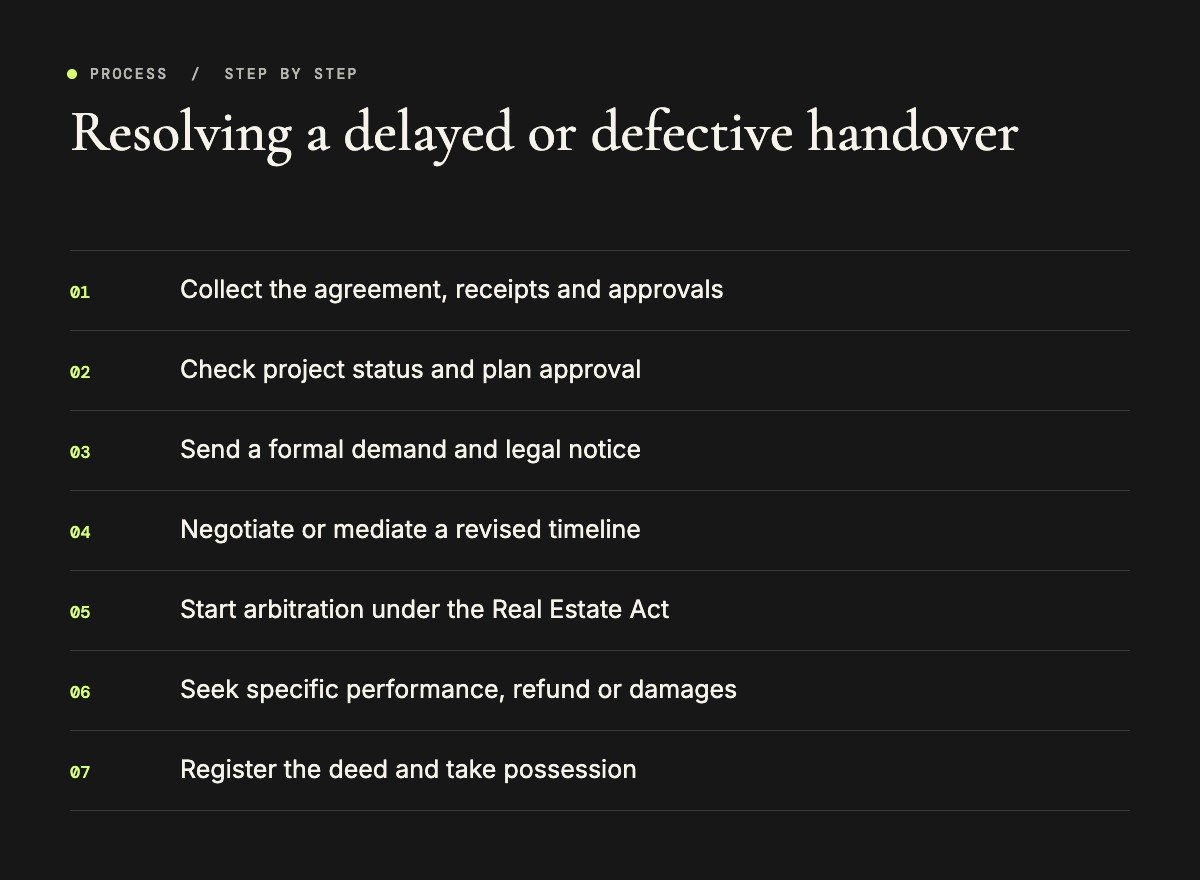
Steps to resolve a flat handover dispute in Bangladesh
- Review the agreement. Identify the handover date, grace periods, force majeure, delay compensation, extra charges and dispute resolution clauses.
- Check the project. Verify the approval, progress of construction and any disputes with the landowner or authorities.
- Write to the developer. Set out the breach and demand handover or a firm timetable with compensation.
- Send a legal notice. A lawyer's notice citing the agreement and the Real Estate Act often brings the developer to the table.
- Negotiate or mediate. REHAB, the developers' association, sometimes assists, and a written settlement with dates and penalties can be effective.
- Start arbitration. Invoke the arbitration clause or the Act's arbitration mechanism and appoint an arbitrator.
- Use court and criminal remedies where appropriate. Seek interim protection, specific performance, refund and damages, or file criminal complaints for offences under the Act or the Penal Code.
Delay compensation and refunds
Compensation is central to almost every flat handover dispute in Bangladesh. Most apartment agreements include a compensation clause for late handover, often expressed as a monthly amount or a percentage of money paid. Buyers should calculate the compensation due and claim it in writing. Where the agreement is silent or the amount is inadequate, a tribunal can consider damages under contract law, including rent paid elsewhere during the delay.
Where the project has stalled indefinitely, a refund may be the better remedy. The Act and the agreement may provide for refunds with compensation if the developer fails to hand over. A buyer considering a refund should assess the developer's financial strength, because a paper award is only as good as the ability to enforce it.
Do not stop paying instalments without advice. A buyer who stops paying while the developer is still performing may give the developer grounds to cancel the allotment. If there is a genuine dispute, structure any withholding carefully and in writing, or keep paying under protest.
Criminal remedies under the Act
Criminal law can also play a part in a flat handover dispute in Bangladesh. The Real Estate Development and Management Act 2010 makes several developer breaches offences, including selling without approval, deviating from the approved plan, failing to hand over as agreed and selling the same flat to more than one person. Penalties include fines and imprisonment, and the Penal Code provisions on cheating and criminal breach of trust may also apply. Criminal complaints can exert pressure, but they should be used responsibly and alongside the civil or arbitration claim, because a criminal conviction does not itself deliver the flat.
Disputes involving the landowner
In a joint venture project, the landowner may refuse to sign the deed for the buyer's flat because the developer has not delivered the landowner's share or has breached the development agreement. The buyer is caught between the two. In such a flat handover dispute in Bangladesh, the buyer usually needs to involve both the developer and the landowner, relying on the developer's power of attorney, the development agreement and the Real Estate Act's provisions on the landowner's obligations. Our guide to buying a house in Bangladesh explains how to check these documents before buying.
Handover, registration and after
Even after a flat handover dispute in Bangladesh is resolved, handover is not complete until the buyer has physical possession, a registered sale deed in their name, mutation of the undivided land share, utility connections and, ideally, the occupancy certificate for the building. Buyers should inspect the flat before accepting keys, record defects in writing and avoid signing a statement that the flat is satisfactory if it is not.
After handover, the flat owners' association takes over common areas under the Apartment Ownership Act 2014 and the building's management arrangements. Defects that appear after handover may still be claimed against the developer under the agreement's defects liability clause.

Interim relief while the dispute runs
Arbitration and court proceedings take time, and a developer in financial difficulty may try to sell unsold flats, mortgage the project or hand over flats to others in the meantime. Under section 7A of the Arbitration Act 2001, a court can grant interim measures before or during arbitration, such as injunctions restraining the sale or transfer of a particular flat, or orders preserving property. Civil courts can also grant temporary injunctions in a suit. In a serious flat handover dispute in Bangladesh, early interim relief can be the most valuable step, because it keeps the flat available for the buyer.
To obtain interim relief, the buyer must usually show a strong arguable case, a risk of irreparable harm and that the balance of convenience favours protection. A registered agreement, receipts and evidence of the developer's attempts to deal with the flat make this much easier.
Abandoned and stalled projects
Some projects stop altogether because the developer has run out of money or disappeared. In such cases, buyers often organise themselves into a group, appoint a committee and seek legal advice collectively. Options include negotiating with the landowner to bring in a new developer, completing the building with buyers' funds under a structured agreement, pursuing arbitration and criminal remedies against the original developer, and, where the developer is a company, considering winding-up or claims against directors for fraud.
A group approach reduces costs and gives buyers more leverage. It also helps avoid conflicting claims over the same building. Coordinated legal strategy is particularly important when a flat handover dispute in Bangladesh involves dozens of buyers and a landowner with competing interests. See our guide on winding up cases under company law for remedies against insolvent developer companies.
Bank loans and home financing
Buyers who have taken a home loan face an added pressure: instalments to the bank continue even while handover is delayed. Many lenders release funds to the developer in stages and hold a mortgage over the flat or the buyer's rights under the agreement. In a dispute, the buyer should keep the bank informed, check whether the loan agreement allows a moratorium or restructuring, and make sure any settlement with the developer protects the bank's security so that the bank cooperates. Lenders may also have their own leverage over the developer, which can help resolve a flat handover dispute in Bangladesh.
Choosing the right remedy
The right remedy depends on what the buyer really wants and on the developer's position. If the building is nearly finished and the developer is solvent, a negotiated handover with compensation is usually fastest. If the developer is refusing to perform or demanding unlawful charges, arbitration with interim protection is often the best route. If the project is abandoned, a refund claim combined with criminal and insolvency remedies may be more realistic. A lawyer experienced in each flat handover dispute in Bangladesh can weigh cost, time and the likelihood of actual recovery before the buyer commits to a path.
Preventing disputes before you buy
Many disputes can be avoided at the buying stage. Before paying a booking amount, check the developer's registration and track record, verify the plan approval and land title, read the development agreement between landowner and developer, and insist on a clear handover date, delay compensation and specifications in the agreement. Register the agreement for sale, pay only through banking channels and keep every receipt. These steps do not guarantee a smooth project, but they put the buyer in a far stronger position if a flat handover dispute in Bangladesh later arises.
Frequently asked questions about flat handover dispute in bangladesh
Which law protects apartment buyers?
The Real Estate Development and Management Act 2010, together with contract law, the Registration Act 1908, the Specific Relief Act 1877 and the Apartment Ownership Act 2014.
Do I have to go to arbitration first?
The Act provides for arbitration of disputes between developers, landowners and buyers, so arbitration is normally the first formal step, though interim court relief and criminal complaints may be available.
Can I get compensation for delay?
Yes, usually under the delay compensation clause in the agreement, and potentially damages for losses such as rent, depending on the facts.
Is an unregistered agreement useless?
No. It supports claims for refund and compensation, but it can limit specific performance because the law ties that remedy to registration.
Can the developer charge extra before handover?
Only charges allowed by the agreement. Unexplained or new charges can be challenged.
What if the developer sold my flat to someone else?
That can be an offence under the Act and the Penal Code, and you can seek injunctions and civil remedies to protect your rights.
How we can help
We act for buyers, landowners and developers in every type of flat handover dispute in Bangladesh: agreement reviews, legal notices, negotiation, arbitration, specific performance suits, refund claims, criminal complaints and registration. Learn more about our real estate and construction practice and our arbitration practice.
Waiting too long for your flat?
We review your agreement and payments, tell you which remedy is strongest and take action to get you possession or your money back.
Book a consultationReal estate practicePrimary sources: the Real Estate Development and Management Act 2010, Registration Act 1908, Specific Relief Act 1877, Arbitration Act 2001 and Apartment Ownership Act 2014 on the Laws of Bangladesh portal; building approvals from RAJUK.
This article is general information about Bangladeshi real estate law as of October 2026 and is not legal advice. The right remedy depends on your agreement and facts; take advice from a qualified lawyer before acting.


0 Comments