
Gratuity in Bangladesh is a lump-sum payment for long service, calculated on the worker's last wages and years of service. The Bangladesh Labour Act 2006 defines gratuity and links it to termination, retrenchment, discharge and resignation benefits, while many employers also run gratuity schemes under their own policies. Getting the calculation and timing right matters, because unpaid dues are one of the most common causes of labour disputes.
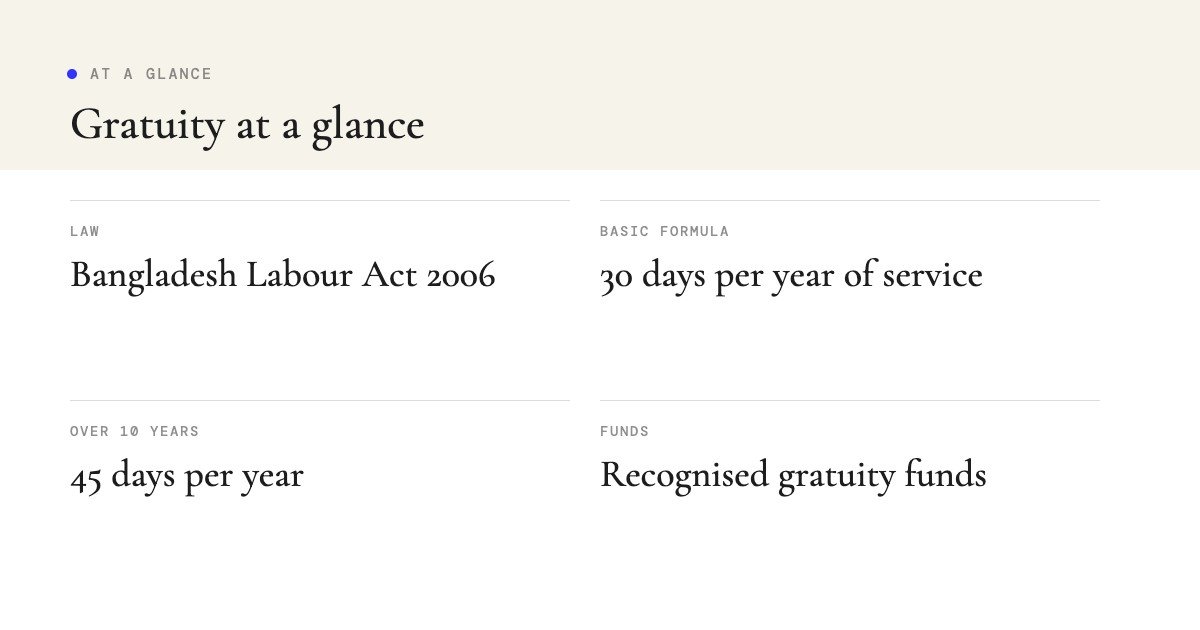
- The Labour Act 2006 defines gratuity as wages for at least 30 days for every completed year of service, or 45 days for each year where service exceeds ten years.
- Gratuity interacts with other terminal benefits, such as compensation on termination, retrenchment and resignation, and in several cases the worker receives the higher amount.
- Employers may provide more generous gratuity under contracts, service rules or recognised gratuity funds.
- Final dues must be paid within the period set by the Act after employment ends.
- Recognised gratuity funds approved by NBR receive favourable tax treatment.
What gratuity means in Bangladesh
Section 2 of the Bangladesh Labour Act 2006 defines gratuity as wages for at least 30 days for every completed year of service, or 45 days' wages for every completed year if the worker's service exceeds ten years, payable on separation in addition to other dues where the employer's rules or the Act so provide. Gratuity in Bangladesh is therefore a long-service benefit based on the last drawn wages. Many organisations, especially in the formal sector, also have written gratuity policies or funds that set their own, often higher, entitlements.
The Labour (Amendment) Act 2026 made around 90 changes to the Labour Act, including to provident fund and worker definitions, so employers should check whether any amendment affects their gratuity practices. Our employment and labour practice advises employers and employees on these rules.
Who is covered
The Labour Act applies to "workers" as defined, which generally covers employees doing skilled, unskilled, manual, technical, trade promotional or clerical work, but excludes those mainly employed in managerial or administrative roles. Managers and senior staff often have gratuity rights under their contracts or company policy instead. Government employees, and some sectors such as EPZs, follow separate rules. Determining whether someone is a worker is the first step in assessing gratuity in Bangladesh.
How gratuity is calculated
| Service length | Statutory formula | Example on monthly wage of Tk 30,000 |
|---|---|---|
| Each completed year up to 10 years | 30 days' wages per year | About Tk 30,000 per year of service |
| Each completed year where total service exceeds 10 years | 45 days' wages per year | About Tk 45,000 per year of service |
The calculation uses the last drawn wages as defined in the Act, and the definition of wages and treatment of allowances can affect the result. Some employers calculate on basic wage only under their policy, which may be challenged if it gives less than the law requires. Where an employer's policy is more generous, the policy applies. Disputes about gratuity in Bangladesh often arise from different views on the wage base.
Write down the wage base used for gratuity in the employment contract or policy, and apply it consistently. Inconsistent calculations across employees invite complaints and labour court cases.
When gratuity becomes payable
- Termination by the employer other than for misconduct, under the Act's termination provisions, together with notice or pay in lieu.
- Retrenchment, where the Act provides compensation or gratuity, whichever is higher.
- Discharge for physical or mental incapacity, with compensation or gratuity as the Act provides.
- Resignation, where workers with a minimum length of service receive compensation based on years of service, or gratuity if higher.
- Death of a worker in service, where the Act provides compensation to nominees or heirs.
- Retirement, under the Act's retirement provisions or company policy.
The exact entitlement depends on the provision under which employment ends, so it is important to identify the correct legal basis. Workers dismissed for proven misconduct may lose some benefits, though accrued provident fund contributions remain protected.
Gratuity and other terminal benefits
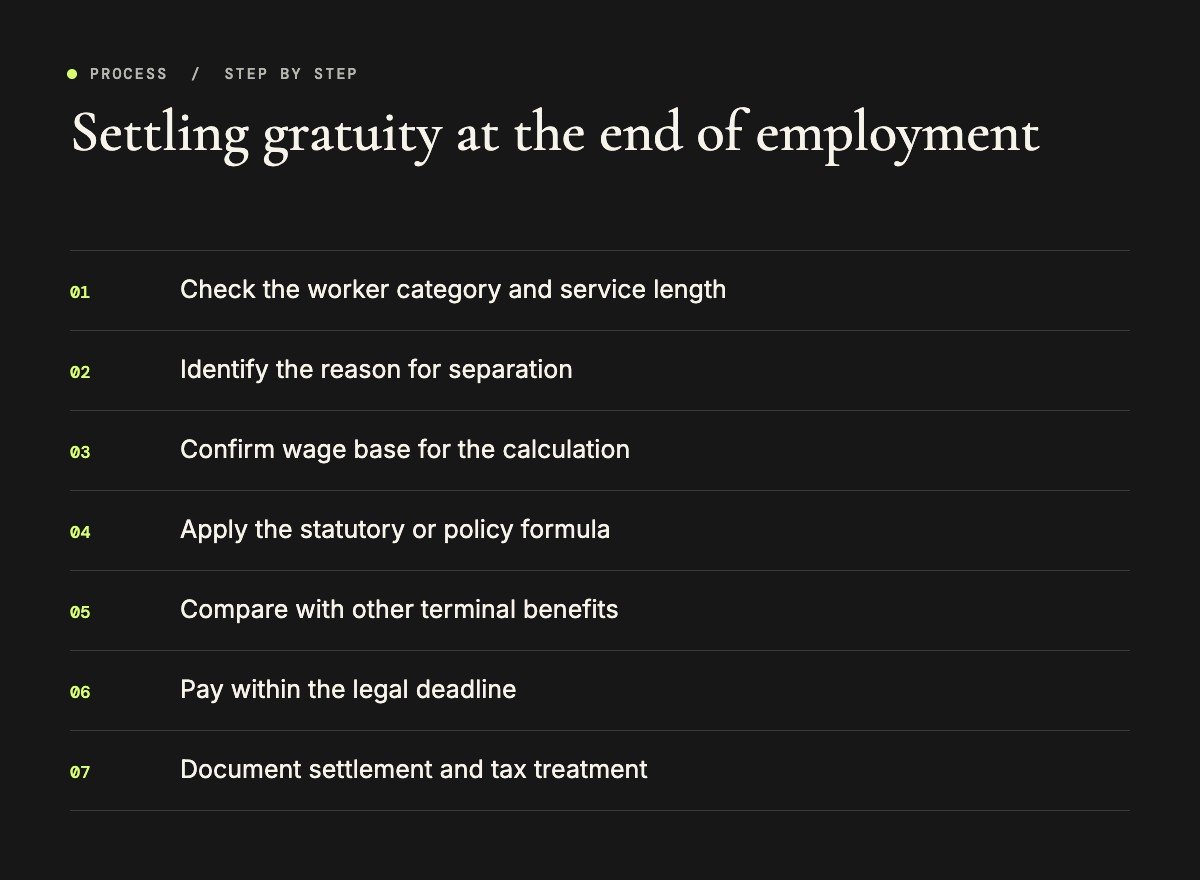
Gratuity in Bangladesh is rarely the only payment due. On separation, a worker may be entitled to several payments: notice pay, compensation for years of service, gratuity, unused earned leave encashment, unpaid wages and overtime, provident fund balance and participation fund dues where applicable. In several situations, the Act provides that the worker receives compensation or gratuity, whichever is higher, rather than both. Careful calculation of every element ensures that gratuity in Bangladesh is paid correctly within the full and final settlement.
Payment deadline
Timing is critical for gratuity in Bangladesh. The Labour Act requires employers to pay all dues, including gratuity, within a set period after the end of employment, and delays can lead to complaints to the labour inspectorate and claims in the Labour Court. Employers facing cash constraints should still pay statutory dues promptly, because delay can also trigger interest claims and reputational damage.
Gratuity funds and tax
Funding makes gratuity in Bangladesh easier to manage. Many employers establish gratuity funds managed by trustees, with contributions set aside each year. A gratuity fund recognised by NBR under the Income Tax Act 2023 enjoys tax benefits, including deductibility of employer contributions within limits and tax treatment of payments to employees under specified conditions. Unrecognised schemes do not receive these benefits. Employers should also account for gratuity liabilities in their financial statements under applicable accounting standards.
Gratuity versus provident fund
Gratuity and provident fund are different benefits. A provident fund is built from contributions by the worker and employer during employment and belongs to the worker, subject to vesting rules. Gratuity in Bangladesh is a lump sum paid by the employer at the end of service based on years worked and last wages. Some employers offer both. The Labour Act requires provident funds in certain establishments when workers demand them, and the 2026 amendments changed provident fund rules, so employers should review both schemes together.
Contract workers and outsourcing
Many businesses use contractual, casual or outsourced workers. Whether these workers are entitled to gratuity depends on their status under the Labour Act and their contracts. Long-serving "temporary" workers may in fact be permanent under the Act, with full benefits. Workers supplied by contractors are usually employees of the contractor, but the principal employer may face liability if the contractor fails to pay dues. Careful classification protects both workers and businesses from disputes over gratuity in Bangladesh.
Disputes and the Labour Court
A worker who does not receive gratuity or other dues can raise a grievance with the employer and then file a case in the Labour Court within the limitation period. The labour inspectorate can also take up complaints. Labour Courts can order payment with costs. In collective disputes, such as factory closures, the government may intervene to ensure payment of dues. Employers who calculate gratuity in Bangladesh transparently and pay on time rarely face such litigation.
Gratuity for company executives
Executives and managers who fall outside the Labour Act's definition of worker usually rely on contractual gratuity provisions. Their contracts should state clearly how gratuity is calculated, on which wage elements, whether it is capped, and whether it is payable on resignation, termination without cause or retirement. Senior employees should negotiate these terms at hiring, because gratuity in Bangladesh for executives depends almost entirely on the contract and company policy.
Closures, mergers and transfers
When a business closes, merges or transfers to a new owner, accrued gratuity becomes a major liability. In closures, workers are entitled to dues under the Act's closure provisions. In mergers and business transfers, continuity of service and transfer of accrued benefits should be addressed in transaction documents. Buyers conducting due diligence should quantify gratuity liabilities and confirm whether they are funded. Unfunded gratuity in Bangladesh can significantly affect the price of an acquisition.
Employer checklist
- Classify each employee correctly under the Labour Act.
- Adopt a written gratuity policy that meets or exceeds statutory requirements.
- Define the wage base and apply it consistently.
- Consider establishing a recognised gratuity fund.
- Provide for gratuity liabilities in accounts.
- Pay final dues, including gratuity in Bangladesh, within the legal deadline.
A worked example
Consider a factory worker with twelve completed years of service and a last monthly wage of Tk 24,000 who is terminated other than for misconduct. Because total service exceeds ten years, the statutory gratuity in Bangladesh is calculated at 45 days' wages for each completed year. Using a daily wage of Tk 800 (Tk 24,000 divided by 30), the gratuity is 45 days multiplied by Tk 800 multiplied by 12 years, or Tk 432,000. The worker would also be entitled to notice or pay in lieu, unpaid wages, leave encashment and provident fund dues, subject to the Act's rules on whether compensation or gratuity is paid where both could apply.
This simplified example shows why precise calculation matters.
Gratuity in sector-specific regimes
Some sectors have special rules. EPZ enterprises follow labour provisions applicable to export processing zones, and banks, insurers and other financial institutions often have detailed service rules with their own gratuity schemes. Government employees and employees of statutory bodies receive pension and gratuity under public service rules. When advising on gratuity in Bangladesh, it is essential to identify which regime applies before calculating.
Tips for employees
Employees should keep copies of appointment letters, service books, pay slips and any gratuity policy. On leaving, ask for a written calculation of all dues and check it against your records.
If you believe gratuity in Bangladesh has been miscalculated, raise the issue in writing promptly and seek advice before signing a full and final settlement, because signing may limit later claims. Free legal advice may be available through legal aid services and worker organisations. Knowing your rights on gratuity in Bangladesh is the best protection at the end of a long career, and it helps you plan your finances with confidence.
Families of deceased workers should also check whether a nominee was recorded, as this affects who receives the payment and how quickly it can be released.
Frequently asked questions about gratuity in bangladesh
How is gratuity calculated?
At least 30 days' wages for each completed year of service, or 45 days for each year where total service exceeds ten years.
Does a worker who resigns get gratuity?
Workers with the minimum service receive compensation on resignation based on years of service, or gratuity if higher.
Are managers entitled to gratuity?
Often under their contract or company policy, as they may not be "workers" under the Labour Act.
Can an employer pay less than the Act?
No. Policies can be more generous, but not less favourable than the statutory entitlement.
When must gratuity be paid?
Within the period set by the Labour Act after employment ends.
Is gratuity taxable?
Tax treatment depends on whether the fund is recognised and on limits under the Income Tax Act 2023.
How we can help
We advise employers and employees on gratuity in Bangladesh: policy drafting, recognised gratuity funds, calculation disputes, retrenchment and termination planning, and Labour Court claims. Learn more about our employment and labour practice.
Need help with gratuity or final settlements?
We calculate entitlements correctly and resolve disputes before they reach the Labour Court.
Book a consultationEmployment practicePrimary sources: the Bangladesh Labour Act 2006, Labour Rules 2015 and Income Tax Act 2023 on the Laws of Bangladesh portal; labour policy from the Ministry of Labour and Employment; inspections by DIFE.
This article is general information about Bangladeshi labour law as of October 2026 and is not legal advice. The 2026 amendments and company policies may affect entitlements; take advice on specific cases.


0 Comments