
For Hindu families in Bangladesh, succession to property is governed largely by uncodified personal law following the Dayabhaga school. Hindu inheritance in Bangladesh differs significantly from Muslim law and from codified Hindu law in India, particularly in the position of widows and daughters. Understanding the order of heirs, the nature of women’s estates and the procedures for transferring property helps families avoid disputes.

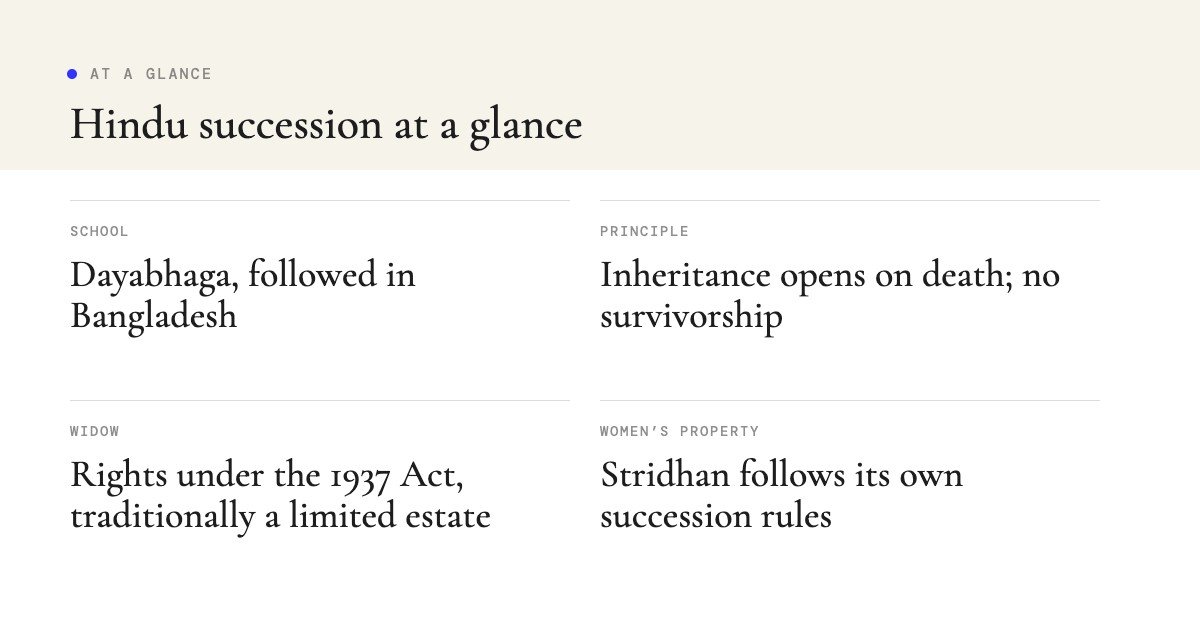
- Hindus in Bangladesh generally follow the Dayabhaga school of Hindu law for inheritance, which remains largely uncodified.
- Under Dayabhaga, a person’s property passes to heirs only on death, and there is no right of survivorship among coparceners.
- Heirs are ranked by their capacity to offer spiritual benefit (pinda), giving priority to sons, grandsons and great-grandsons.
- The Hindu Women’s Rights to Property Act 1937 gives widows rights in their husband’s property, traditionally as a limited estate.
- Daughters’ rights are limited and depend on their status, a subject of ongoing reform debate.
The Dayabhaga school and Hindu inheritance in Bangladesh
Classical Hindu law developed two main schools of inheritance: Mitakshara, followed in most of India before codification, and Dayabhaga, followed in Bengal. Under Dayabhaga, the father is the absolute owner of ancestral and self-acquired property during his lifetime, and sons acquire rights only on his death. There is no joint family coparcenary by birth as under Mitakshara, and no survivorship: when a co-owner dies, their share passes to their own heirs. These principles continue to shape Hindu inheritance in Bangladesh, as India’s Hindu Succession Act 1956 does not apply.
Our family and property team, part of the practice described on our about page, advises families on succession and partition.
Order of heirs in Hindu inheritance in Bangladesh
Dayabhaga ranks heirs according to the doctrine of spiritual benefit. Broadly, the sapindas, close relatives who can offer pinda to the deceased, come first, followed by sakulyas and then samanodakas. In practice, the main heirs are the son, grandson and great-grandson through the male line, then the widow, the daughter (subject to conditions), the daughter’s son, the father, the mother, brothers and their sons, and so on in a detailed order. A nearer heir excludes a more remote one.
| Category | Examples | General position |
|---|---|---|
| Male descendants | Son, son’s son, son’s son’s son | Take first, sharing equally per branch |
| Widow | Wife of the deceased | Rights under the 1937 Act, traditionally a limited estate |
| Daughters | Unmarried daughter, daughter with sons or capable of having sons | Limited rights, subject to status conditions |
| Daughter’s son | Grandson through a daughter | Inherits after daughters |
| Parents and collaterals | Father, mother, brothers and their sons | Inherit in the absence of nearer heirs |
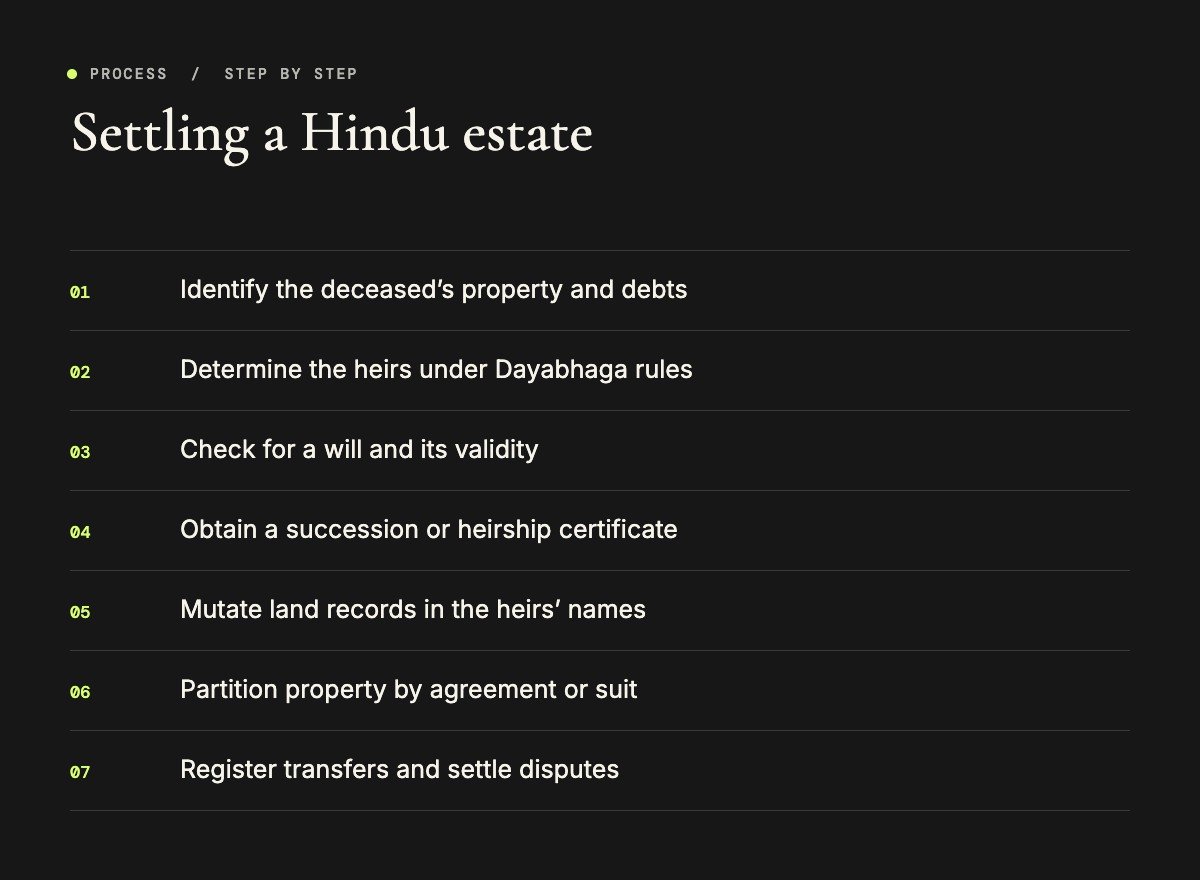
Settling a Hindu estate
- Inventory. Identify land, buildings, bank deposits, shares and debts.
- Identify heirs. Apply Dayabhaga rules to determine who inherits and in what shares.
- Check for a will. Hindus can make wills; check validity and probate requirements.
- Certificates. Obtain a succession certificate for debts and securities, or an heirship certificate from local authorities.
- Mutation. Update land records in the heirs’ names.
- Partition. Divide property by registered partition deed or partition suit.
- Transfers and disputes. Register any sale or gift and resolve disagreements early.
Many land disputes in Hindu families arise decades after a death because mutation and partition were never completed. Regularising records promptly protects every heir’s share.
Rights of widows in Hindu inheritance in Bangladesh
The Hindu Women’s Rights to Property Act 1937, which continues to apply in Bangladesh, gives a widow rights in her deceased husband’s property, including a share alongside sons in some cases.
Traditionally, the interest a widow takes is a limited estate, sometimes called a widow’s estate: she can enjoy the property and its income for life, but generally cannot sell or gift it except for legal necessity, such as maintenance or religious duties, or with the consent of the reversioners. On her death, the property passes to the next heirs of her husband, not her own heirs.
Courts have considered the scope of these restrictions in many cases, and the position of widows is central to debates on reforming Hindu inheritance in Bangladesh.
Rights of daughters in Hindu inheritance in Bangladesh
Under Dayabhaga as traditionally applied, a daughter inherits only in the absence of sons, grandsons, great-grandsons and the widow, and even then only certain daughters qualify: unmarried daughters and married daughters who have sons or are capable of having sons. Widowed or childless daughters may be excluded. Where daughters inherit, they also traditionally take a limited estate. These rules are widely criticised as discriminatory, and civil society groups and the Law Commission have recommended reform.
Stridhan in Hindu inheritance in Bangladesh
Stridhan is property belonging to a woman absolutely, such as gifts received before or at marriage, gifts from relatives, and property she earns or acquires herself. A woman has full power to dispose of her stridhan. On her death, it passes according to special rules that differ depending on the type of stridhan and whether her marriage was in an approved form, generally favouring daughters before sons in some cases. Distinguishing stridhan from property held as a limited estate is often key in disputes.
Wills and gifts
Hindus in Bangladesh can dispose of property by will, subject to the Succession Act 1925 and personal law, and wills may require probate depending on location and circumstances. Gifts during life must comply with the Transfer of Property Act 1882 and registration requirements for immovable property. Wills are frequently used to provide for daughters or widows beyond their limited rights under customary rules, but they can be challenged for lack of capacity, undue influence or improper execution, so careful drafting and witnessing are essential.
Partition after Hindu inheritance in Bangladesh
Inherited property is often held jointly by several heirs. Any co-owner can seek partition, either by agreement through a registered partition deed or by filing a partition suit under the Partition Act 1893 and civil procedure. Courts divide property according to each heir’s share and may order sale where physical division is impractical. Because Hindu inheritance in Bangladesh involves limited estates for women, partition deeds and court decrees must carefully identify the nature of each heir’s interest to avoid later challenges by reversioners.
Succession certificates and documentation
To collect bank deposits, shares and debts owed to the deceased, heirs usually need a succession certificate from the civil court under the Succession Act 1925. For land, heirs rely on heirship certificates issued by local government authorities and then apply for mutation. Banks and registry offices may ask for additional documents, such as death certificates and family trees. Consistent documentation across all institutions avoids delays and disputes.
Reform debates
There has been sustained debate about reforming Hindu personal law in Bangladesh, including proposals to give daughters equal inheritance rights, convert widows’ limited estates into absolute ownership, and codify the law. The Hindu Marriage Registration Act 2012 introduced optional marriage registration, but inheritance rules remain largely uncodified. Any reform would significantly change Hindu inheritance in Bangladesh, so families should follow developments and plan using wills and gifts where appropriate.
Debts of the deceased in Hindu inheritance in Bangladesh
Before heirs take their shares, the deceased’s debts and funeral expenses should be paid from the estate. Under Hindu law, heirs are generally liable for the deceased’s debts only to the extent of the property they inherit, not personally beyond that. The pious obligation of sons to pay their father’s debts, recognised in classical law, has limited practical relevance today. Creditors can pursue the estate through the courts, and heirs should identify liabilities early to avoid disputes after distribution.
Adoption and Hindu inheritance in Bangladesh
Adoption is recognised under Hindu law, and a validly adopted son generally takes the position of a natural-born son for inheritance purposes, inheriting from the adoptive family. The requirements for a valid adoption under traditional law are strict, including the capacity of the adopter and the giving and taking ceremony. Disputes over the validity of adoption sometimes arise when inheritance is at stake, so families should document adoptions carefully, including through registered deeds where possible.
Conversion and inheritance
Changes of religion can affect inheritance rights under personal law, and the Caste Disabilities Removal Act 1850 was historically relevant to protecting converts’ rights to property. The interaction between personal laws in mixed-religion families can be complex. Families in such situations should seek specific advice, as outcomes depend on the facts and the applicable law at the time of death.
Non-resident heirs
Many Hindu families have members living in India or elsewhere abroad. Non-resident heirs retain their rights under Hindu inheritance in Bangladesh, but practical issues arise in obtaining documents, mutation and partition, and in some cases restrictions linked to historic property laws. Heirs abroad should appoint attorneys under properly authenticated powers of attorney and keep records current to protect their interests.
Practical planning for families
Families can reduce uncertainty by documenting ownership clearly, keeping mutation records current, making wills that reflect their wishes within the law, and considering lifetime gifts to daughters or widows where appropriate. Discussing plans with family members and recording them in registered documents helps prevent disputes after death. Professional advice is valuable, because personal law rules are complex and the consequences of mistakes can last for generations.
Disputes and litigation
Inheritance disputes commonly involve questions of who qualifies as an heir, whether a daughter or widow took an absolute or limited estate, whether a sale by a limited owner was for legal necessity, the validity of wills and adoptions, and partition shares. Such disputes are heard in civil courts, often through declaratory and partition suits, and can take years. Mediation under the Code of Civil Procedure can help families reach practical solutions. Gathering title documents, family records and witness evidence early strengthens any claim.
Limitation periods apply to many claims, so heirs who believe their rights have been ignored should take advice without delay.
Courts generally expect parties to produce certified copies of khatians, deeds and mutation orders, so obtaining these from land offices and sub-registry offices should be one of the first steps in any dispute.
Frequently asked questions about hindu inheritance in bangladesh
Which school applies to Hindus in Bangladesh?
The Dayabhaga school.
Does the Indian Hindu Succession Act apply?
No, it does not apply in Bangladesh.
Do widows inherit?
Yes, under the Hindu Women’s Rights to Property Act 1937, traditionally as a limited estate.
Do daughters inherit?
Only in limited circumstances, depending on their status and the absence of preferred heirs.
Can a Hindu make a will?
Yes, subject to the Succession Act and personal law.
What is stridhan?
Property belonging to a woman, which follows special succession rules.
How we can help
We advise on Hindu inheritance in Bangladesh, succession certificates, partition, wills and property disputes. Learn more about our practice, our guide to succession certificates and our real estate team.
Dealing with a family estate?
We help heirs secure their rights and avoid disputes.
Book a consultationReal estatePrimary sources: the Hindu Women’s Rights to Property Act 1937, the Succession Act 1925 and the Partition Act 1893 on Laws of Bangladesh; land records from the Ministry of Land; case law from the Supreme Court of Bangladesh.
This article is general information about Hindu personal law in Bangladesh as of October 2026 and is not legal advice. Personal law is complex and fact-specific; take advice on your family’s situation.




0 Comments