
Women make up a large share of Bangladesh’s workforce, particularly in the garment sector, so clear rules on maternity leave in Bangladesh matter to millions of families and employers. The Bangladesh Labour Act 2006 provides paid maternity leave and protection from dismissal, and the Labour (Amendment) Act 2026 increased the entitlement to 120 days. Government employees have a separate, longer entitlement under service rules.

- The Labour (Amendment) Act 2026, in force from 10 April 2026, increased maternity benefit for workers from 112 days to 120 days.
- Reports describe the 120 days as 60 days before and 60 days after delivery; check the gazetted text for flexibility in timing.
- A worker must generally have worked for the employer for at least six months before the expected delivery to qualify for maternity benefit.
- Maternity benefit is paid at the worker's average wage, calculated under the Act, and must be paid on time.
- Government employees are entitled to six months' maternity leave with pay under government service rules.
The legal framework for maternity leave in Bangladesh
Maternity protection for private-sector workers is set out in Chapter IV of the Bangladesh Labour Act 2006, sections 45 to 50, supplemented by the Bangladesh Labour Rules 2015. The Labour (Amendment) Act 2026, which followed an amendment ordinance made in November 2025, made around ninety changes to the Act, including the increase in maternity benefit.
Maternity leave in Bangladesh for government employees is governed by separate rules issued by the Ministry of Public Administration, which provide six months' leave. Many private employers, especially multinational companies, also offer contractual benefits beyond the statutory minimum. Our employment and labour practice advises employers and employees on these rules.
How much maternity leave in Bangladesh
| Category | Entitlement |
|---|---|
| Private-sector workers under the Labour Act (before April 2026) | 16 weeks: 8 weeks before and 8 weeks after delivery |
| Private-sector workers after the 2026 amendment | 120 days, reported as 60 days before and 60 days after delivery |
| Government employees | Six months under government service rules |
| Contractual benefits | As set by employer policy, often more generous |
Because the amendment is recent, employers should update policies, payroll systems and employee handbooks to reflect the new period of maternity leave in Bangladesh, and check implementing rules or guidance as they are issued.
Who is eligible for maternity leave in Bangladesh
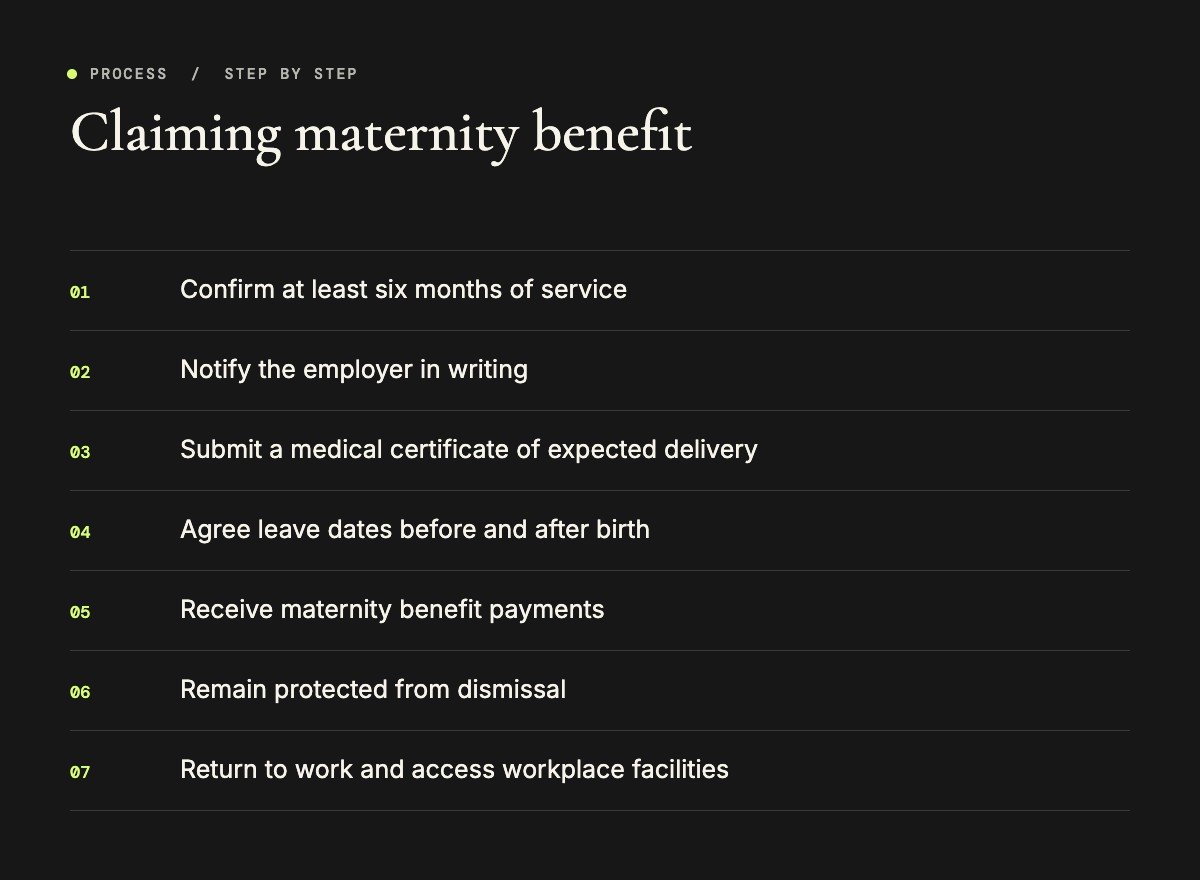
Under section 46 of the Labour Act, a woman worker is entitled to maternity benefit if she has worked under the employer for at least six months immediately preceding the date of her delivery. The Act has historically restricted maternity benefit, though not leave, for a woman who already has two or more surviving children at the time of delivery; employers should check whether the 2026 amendment changed this provision.
The Act covers workers as defined in the Labour Act, which generally excludes managerial and administrative staff. Senior employees outside the definition rely on their contracts and company policies, although many employers apply the same maternity leave in Bangladesh standards to all staff as good practice.
Notice and procedure
A pregnant worker may give notice to the employer, orally or in writing, that she expects to be confined within a stated period, and the employer may require a medical certificate. The employer then grants leave in accordance with the Act and pays maternity benefit as required.
Payment of maternity benefit is typically made in instalments for the periods before and after delivery, or as the Act and rules specify. Employers should keep records of notices, certificates and payments, because labour inspectors check maternity compliance during inspections.
Calculating maternity benefit
Maternity benefit is calculated on the basis of the worker's average daily, weekly or monthly wage, worked out by dividing her total wages earned during the three months preceding the notice by the number of days she actually worked during that period, as set out in the Act. The resulting daily rate is paid for the full maternity period.
Employers must not deduct maternity benefit payments from other entitlements, and late payment is an offence. Where a worker dies during the maternity period, the Act provides for payment to the nominated person or legal representative.
Protection from dismissal during maternity leave in Bangladesh
The Labour Act protects pregnant workers from dismissal or discharge in connection with pregnancy. An employer must not give notice of termination or dismiss a woman during the period of maternity leave, and termination shortly before delivery without sufficient cause may deprive her of maternity benefit and expose the employer to claims. Courts and labour authorities treat these protections seriously.
Employers who need to take disciplinary action against a pregnant worker should take legal advice and follow fair procedure, because any connection with pregnancy can make the action unlawful. See our guide to termination of employment.
Employer duties step by step
- Update policies. Reflect the 120-day entitlement in handbooks and contracts.
- Train managers. Explain rights and the prohibition on pregnancy-related dismissal.
- Accept notice. Record notices and medical certificates.
- Plan cover. Arrange temporary replacements without disadvantaging the worker.
- Pay on time. Calculate and pay maternity benefit according to the Act.
- Protect employment. Avoid termination during leave and keep the job available.
- Support return. Provide childcare facilities where required and flexible arrangements where possible.
Buyers in the garment sector audit maternity compliance closely. Keep a maternity register showing notices, leave dates and payments for each worker. Missing records are a common audit finding even where the worker was paid correctly.
Workplace facilities
The Labour Act requires establishments employing forty or more women workers to provide a suitable room for children under six years, often called a daycare or childcare room, with appropriate facilities. Employers should also avoid assigning pregnant workers to arduous or hazardous tasks that could harm their health during the period before delivery, as the Act restricts such work.
Good facilities support the successful return of mothers after maternity leave in Bangladesh, reducing turnover and improving productivity.
Miscarriage, stillbirth and complications
Workers who suffer miscarriage, stillbirth or pregnancy complications may need leave beyond or instead of standard maternity leave. The Labour Act's provisions on sick leave and the maternity chapter should be read together, and medical certificates obtained. Employers should handle these situations sensitively and, where the Act is unclear, consider granting leave as good practice.
Questions about how maternity leave in Bangladesh applies in these situations are common, so HR teams should prepare guidance in advance rather than deciding case by case under pressure.
Garment sector practice
The ready-made garment sector employs millions of women. International buyers' codes of conduct and certification schemes require full compliance with maternity rules, and many factories offer additional support such as health check-ups, nutrition allowances and flexible return arrangements. Non-compliance can lead to lost orders as well as legal penalties.
Factories should communicate the 2026 changes to workers and participation committees so that every worker understands her entitlement to maternity leave in Bangladesh.

Penalties for non-compliance
Failure to grant maternity leave or pay maternity benefit is an offence under the Labour Act, punishable by fines, and workers can bring claims before the Labour Court to recover unpaid benefits. Labour inspectors from the Department of Inspection for Factories and Establishments can issue notices and initiate proceedings. Repeated violations can damage an employer's reputation with buyers and regulators.
Maternity leave in Bangladesh for contract and temporary workers
Temporary, probationary and casual workers often ask whether they qualify. The key test under the Labour Act is the length of service with the employer before delivery. A worker on probation who has completed six months may qualify, while a short-term casual worker may not. Employers should avoid structuring contracts to deny maternity leave in Bangladesh, for example by terminating fixed-term contracts when a worker becomes pregnant, because labour courts may treat such conduct as an attempt to evade the Act.
Workers supplied through outsourcing contractors are employed by the contractor, which is responsible for maternity benefit. Principal employers should check that contractors comply, as buyers and auditors increasingly hold the principal accountable.
Returning to work
After maternity leave in Bangladesh ends, the worker is entitled to return to her job. Employers should plan a smooth return, consider breastfeeding breaks, provide the childcare room where required and, where practical, offer flexible hours for a transition period. Supportive return-to-work policies reduce resignations and help employers retain experienced staff.
Clear communication before leave starts, including expected return dates and contact preferences during leave, helps both sides plan.
Employer checklist
- Update the HR manual for the 120-day entitlement.
- Maintain a maternity register with notices and payments.
- Calculate benefit using the Act's formula and pay on time.
- Never terminate during leave or for reasons connected with pregnancy.
- Provide childcare facilities where forty or more women are employed.
Following this checklist keeps employers compliant and gives workers confidence that maternity leave in Bangladesh will be respected.
Health and safety during pregnancy
Employers have a general duty to protect workers' health and safety, and pregnancy raises specific risks. Heavy lifting, long periods of standing, exposure to chemicals, night shifts and excessive overtime may harm pregnant workers. The Labour Act restricts employing a woman in work that is arduous or requires long hours of standing, or that is likely to adversely affect her health, during the period before delivery.
A risk assessment for pregnant workers, adjustments to duties and access to rest areas and clean drinking water are practical steps that protect both the worker and the employer.
Factory medical officers or welfare officers can help monitor health and identify workers who need adjustments, and keeping a record of such adjustments demonstrates compliance during inspections and buyer audits.
Disputes and remedies
A worker denied leave or benefit can raise a grievance with the employer and, if unresolved, apply to the Labour Court. Labour inspectors can also intervene. Trade unions and participation committees often help resolve disputes early.
Early, respectful handling of complaints protects workers' rights and spares employers the cost and disruption of formal proceedings.
Frequently asked questions about maternity leave in bangladesh
How long is maternity leave in Bangladesh?
For private-sector workers, 120 days after the 2026 amendment; six months for government employees.
Who qualifies for maternity benefit?
Workers with at least six months' service with the employer before delivery.
Is maternity leave paid?
Yes, maternity benefit is paid at the average wage calculated under the Labour Act.
Can an employer dismiss a pregnant worker?
Dismissal connected with pregnancy and termination during maternity leave are prohibited.
Is there paternity leave?
There is no general statutory paternity leave for private-sector workers; some employers provide it by policy.
Do managers get maternity leave?
Managerial staff outside the Labour Act rely on contracts and policies, which often mirror the Act.
How we can help
We advise employers and employees on maternity leave in Bangladesh, policy updates after the 2026 amendment, disputes and labour inspections. Learn more about our employment and labour practice and our compliance team.
Updating your HR policies?
We align your policies with the latest Labour Act amendments.
Book a consultationEmployment practicePrimary sources: the Bangladesh Labour Act 2006 and amendments on the Laws of Bangladesh portal; inspection guidance from the Department of Inspection for Factories and Establishments; labour policy from the Ministry of Labour and Employment.
This article is general information about Bangladeshi labour law as of October 2026 and is not legal advice. Confirm details against the gazetted 2026 amendment and implementing rules.

0 Comments