
Private equity investment in Bangladesh has grown from a handful of development finance deals into a regular source of growth capital for manufacturers, healthcare groups, fintechs and consumer brands. The legal work decides whether investors get the protection and the exit they priced in, and whether founders keep the control they need to run the business.
- Most deals are minority growth investments into private limited companies, using new ordinary or preference shares, sometimes combined with a secondary purchase from founders.
- Investor rights must be written into the articles of association, not only the shareholders agreement, to bind the company and future shareholders.
- Foreign investors must bring funds through banking channels and keep encashment records to repatriate dividends and exit proceeds.
- Share pricing between residents and non-residents, and certain instruments, attract foreign exchange scrutiny under Bangladesh Bank rules.
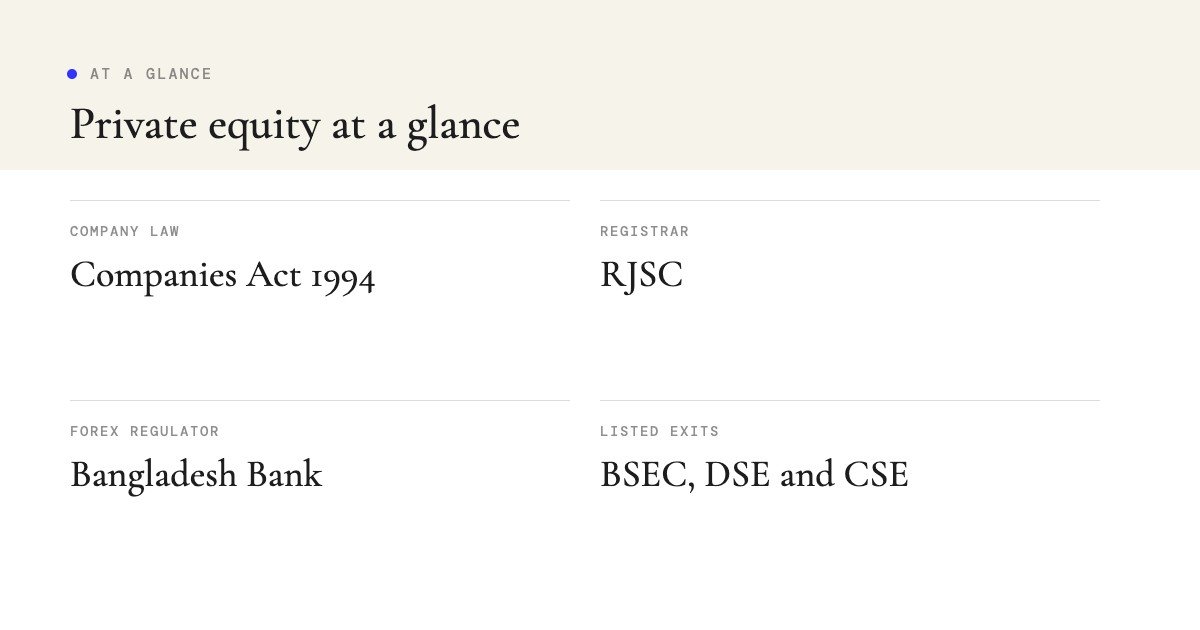
- Exit routes are trade sale, secondary sale to another fund, buy-back or put option, and IPO on the Dhaka or Chittagong stock exchanges.
Under the Invest Bangladesh Act 2026, effective 23 August 2026, the Bangladesh Investment Development Authority (BIDA), the Bangladesh Economic Zones Authority (BEZA) and the PPP Authority were merged into a single body, Invest Bangladesh. References below to BIDA, BEZA or the PPP Authority should be read as references to Invest Bangladesh. BEPZA continues as a separate authority.
The private equity investment in Bangladesh landscape
Investors in this market include international development finance institutions, regional private equity funds, local alternative investment funds regulated by the Bangladesh Securities and Exchange Commission (BSEC), family offices and corporate strategic investors. Targets are usually founder-led companies with strong local market positions and a need for capital to expand capacity, enter new markets or professionalise governance.
Private equity investment in Bangladesh tends to be minority investment. Founders rarely sell control, and investors accept that, relying on contractual protections and board representation instead. Leveraged buy-outs of the kind common in larger markets are uncommon, partly because acquisition finance for share purchases is limited locally and foreign borrowing is regulated.
Local alternative investment funds
BSEC regulates alternative investment funds, including private equity and venture capital funds, under its alternative investment rules. A locally registered fund has a fund manager, a trustee and a custodian approved by BSEC, and invests within the limits set by the rules and its constitutive documents. The rules have been amended over time, so check the current text on the BSEC website before structuring a local fund.
Deal structures for private equity investment in Bangladesh
The structure of private equity investment in Bangladesh is chosen to balance the investor's need for protection and return against the founders' desire for control and a fair valuation. These are the main options we see.
| Structure | How it works | Main considerations |
|---|---|---|
| Primary subscription of ordinary shares | Company issues new shares; cash goes to the company | Dilutes founders; simplest to implement |
| Preference shares | Shares with priority on dividends and return of capital | Terms must be set out in the articles; redemption rules apply |
| Secondary purchase | Investor buys existing shares from founders | Cash goes to sellers; capital gains tax and pricing scrutiny |
| Mixed primary and secondary | Combination of new shares and a founder sell-down | Common where founders want partial liquidity |
| Convertible instruments | Loans or preference shares that convert into ordinary shares | Foreign currency instruments face regulatory approval questions |
| Offshore holding investment | Investor buys into a foreign holding company of the Bangladeshi business | Easier enforcement and exit; tax and substance questions |
Preference shares
The Companies Act 1994 allows a company limited by shares to issue preference shares, including redeemable preference shares, if its articles permit. Redemption must generally be funded from distributable profits or from a fresh issue made for that purpose, with capital maintenance requirements protecting creditors. Investors use preference shares to secure a liquidation preference and a priority dividend, but the economic terms only work if the articles describe them precisely.
Convertible notes and foreign currency instruments
Convertible notes are widespread in start-up investing elsewhere, but a foreign currency convertible loan to a Bangladeshi company can be treated as foreign borrowing requiring approval. Many investors therefore prefer convertible or redeemable preference shares, or invest at an offshore holding level. The treatment of hybrid instruments under current Bangladesh Bank guidelines should be confirmed before signing.
Due diligence before private equity investment in Bangladesh
Due diligence for private equity investment in Bangladesh often uncovers issues that are easy to fix before closing and hard to fix after. Investors should cover corporate, regulatory, tax, employment, land and compliance matters.
- Corporate records. RJSC filings, share registers, allotment returns and whether earlier share transfers were properly documented and filed.
- Foreign investment history. Whether existing foreign shareholders brought in funds through banks, and whether BIDA registration matches.
- Licences. Trade licence, sector licences, environmental clearance, fire licence and factory approvals.
- Tax. Income tax, VAT and withholding compliance under the Income Tax Act 2023 and the VAT and Supplementary Duty Act 2012.
- Employment. Compliance with the Bangladesh Labour Act 2006, including worker participation fund obligations where they apply.
- Land and property. Title, mutation and lease documents for factories and offices.
- Anti-corruption and AML. Exposure to public contracts, political connections and money laundering risk.
In family-run companies we often find informal related-party arrangements: land owned by founders and used rent-free, group companies sharing staff, or loans from directors without documentation. These are rarely deal-breakers, but they should be regularised in the transaction documents, with clear pricing and terms, before the investor's money arrives.
Investor protections in the transaction documents
In private equity investment in Bangladesh, the core documents are an investment or share subscription agreement, a shareholders agreement and amended articles of association. Minority investors rely heavily on these contractual protections, because minority investors have limited statutory rights beyond those in the Companies Act 1994.
Economic protections
Typical terms include pre-emption rights on new issues, anti-dilution adjustment for down rounds, a liquidation preference on sale or winding up, and dividend policy commitments. Anti-dilution adjustments that require issuing new shares at a low or nil price should be checked against company law rules on share issues and against foreign exchange pricing rules where the investor is non-resident.
Control protections
Investors negotiate a board seat, often with an observer right, and a list of reserved matters requiring their consent: changes to the articles or capital, new borrowing above a threshold, acquisitions and disposals, related-party transactions, the annual budget and appointment of key managers. Information rights, including monthly management accounts and audited annual accounts, are standard.
Warranties, indemnities and founder covenants
Founders and the company give warranties about the business, backed by specific indemnities for known issues such as tax exposures. Founders usually accept lock-ins, non-compete and non-solicitation covenants. Enforceability of restrictive covenants under the Contract Act 1872 is limited, so covenants should be tied closely to the founders' status as shareholders and the sale of goodwill.
Our guide to company share transfer in Bangladesh explains how transfer restrictions in the articles work in practice.
Valuation and pricing in private equity investment in Bangladesh
Valuation disputes are a frequent source of delay in private equity investment in Bangladesh. Founders often anchor on revenue growth, while investors focus on audited earnings, cash conversion and governance risk. Because many Bangladeshi companies have historically kept accounts with tax in mind, the audited figures may understate the business, and investors may ask for a quality of earnings review before agreeing a price.
Where a non-resident investor is involved, pricing is not purely commercial. Foreign exchange rules generally expect that a non-resident does not acquire shares from a resident below fair value, or sell to a resident above it, and banks may ask for an independent valuation report when processing the remittance. Agree early which valuation method will be used and who will prepare it, so that the agreed price can actually be remitted.
Price adjustment mechanisms
Completion accounts and locked-box mechanisms are both used. Earn-outs are less common, partly because deferred payments to or from non-residents raise foreign exchange questions. Escrow arrangements with a local bank can secure warranty claims, but the escrow terms must be acceptable to the bank and consistent with foreign exchange rules.
Governance after closing
For many investors, the real value of private equity investment in Bangladesh comes after closing, through better governance. Investors typically push for an independent auditor of recognised standing, a functioning audit committee, written delegation of authority, related-party transaction policies and a compliance programme covering anti-corruption, labour and environmental standards. Development finance investors usually add environmental and social action plans tied to international performance standards.
The board should meet regularly, with proper notice, agendas and minutes, because investor directors carry the same statutory duties as other directors under the Companies Act 1994. Nominee directors owe their duties to the company, not to the fund that appointed them, and should be careful about information shared with the fund where confidentiality obligations apply. Directors and officers insurance is increasingly available and worth arranging.
Employee share schemes
Investors often want key managers incentivised through equity. Bangladeshi law does not have a detailed statutory framework for employee share options in private companies, so schemes are usually built through the articles, a board-approved plan and option agreements, with attention to tax treatment and to foreign exchange rules where the company is foreign-owned. Listed companies are subject to separate BSEC requirements.
Regulatory approvals and foreign exchange
For private equity investment in Bangladesh, a private company generally does not need regulatory approval simply to issue shares to a local investor, but the position changes with foreign investors, regulated sectors and listed targets.
For foreign private equity investment in Bangladesh, the investor remits the subscription price through a bank, which issues an encashment certificate. The company files the return of allotment with RJSC and updates its BIDA registration. Where a non-resident buys existing shares from a resident, or sells to one, the price and the transfer are subject to Bangladesh Bank foreign exchange rules, including requirements on fair valuation and, in some cases, prior permission. These requirements have been revised over time, so check the current Guidelines for Foreign Exchange Transactions.
Sector and listed company approvals
Banks, insurers, non-bank financial institutions, telecom operators and some other regulated businesses need sector regulator approval for changes in significant shareholding. Investment in a listed company triggers BSEC rules on disclosure, and acquisitions above prescribed thresholds trigger the takeover regulations. The Competition Act 2012 may also apply to some combinations, and the Bangladesh Competition Commission's merger control practice should be checked for larger deals.
Steps to complete private equity investment in Bangladesh
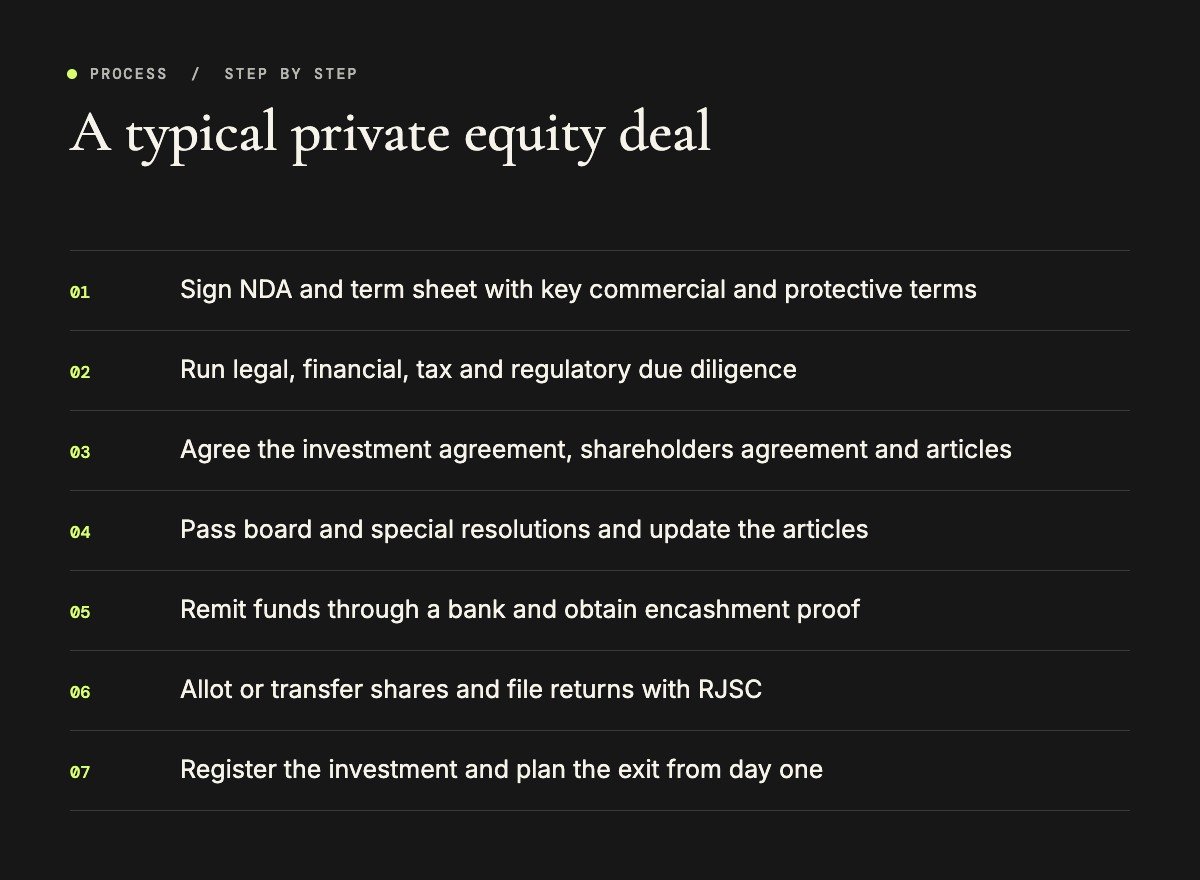
- Agree the term sheet. Settle valuation, instrument, board rights, reserved matters, exit rights and conditions in a short, mostly non-binding term sheet.
- Run due diligence. Investigate legal, financial, tax and regulatory matters and agree which issues must be fixed before closing.
- Negotiate documents. Finalise the subscription agreement, shareholders agreement and new articles of association.
- Obtain approvals. Pass board resolutions and the special resolution to adopt new articles, and obtain any sector or foreign exchange approvals.
- Fund the investment. Remit funds through a bank in Bangladesh and obtain the encashment certificate.
- Allot or transfer shares. Issue share certificates, update registers and file the return of allotment and amended articles with RJSC.
- Complete post-closing tasks. Amend BIDA registration, appoint investor directors, and deliver post-closing undertakings.
For how the board and special resolutions should be prepared, see our guide to board resolutions in Bangladesh.
Tax points in private equity investment in Bangladesh
For private equity investment in Bangladesh, tax affects returns at three points: dividends, exit gains and transaction costs. Dividends paid to shareholders are subject to withholding tax under the Income Tax Act 2023, with rates differing for residents and non-residents and potential relief under tax treaties. Gains on the sale of shares in a Bangladeshi company are generally taxable, and transfers of unlisted shares may require evidence of tax payment before the transfer is registered.
Gains on listed securities have their own regime, and indirect transfers through offshore holding companies may also be taxable in Bangladesh depending on the current law. Stamp duty applies to share transfer instruments under the Stamp Act 1899. All of these rules change through annual Finance Acts, so obtain current tax advice before fixing the structure.
Exit routes for private equity investment in Bangladesh
Exit planning for private equity investment in Bangladesh should begin at the term sheet. The realistic routes in this market are fewer than in larger economies, and each needs contractual support from day one.
Trade sale
Sale to a strategic buyer, often a regional or multinational group, is the most common successful exit. Drag-along rights let the investor require founders to sell on the same terms, and tag-along rights let the investor join any sale by founders. Both must be in the articles to be effective against the company.
Secondary sale to another investor
Funds often sell to a later-stage fund. The shareholders agreement should allow transfers to other financial investors without a right of first refusal applying, or with a fast and fair process if it does.
Buy-back and put options
Where no buyer emerges, investors rely on a put option requiring founders to buy their shares, or on a buy-back by the company. A company buy-back of its own shares is restricted under Bangladeshi company law, and redemption of preference shares must follow capital maintenance rules. A founder put option is a contractual promise and is only as good as the founders' ability to pay, so security and valuation mechanisms matter. Where the investor is foreign, the transfer price must also satisfy foreign exchange pricing rules.
IPO on the stock exchanges
Listing on the Dhaka Stock Exchange or Chittagong Stock Exchange, through an IPO approved by BSEC, is a possible exit for larger companies. Lock-in rules usually apply to pre-IPO shareholders, so the investor may not be able to sell immediately. The BSEC public issue rules set the eligibility and process, and the timeline from preparation to listing is long. We cover this route in our capital markets practice.
Repatriating exit proceeds requires a clear record from entry to exit: the original encashment certificate, RJSC filings for every transfer, tax clearance and a compliant valuation. Missing documents at entry are the most common reason exit proceeds get stuck.
Disputes and enforcement
Shareholder disputes in private equity investment in Bangladesh usually arise around exits: founders resisting a drag, or failing to honour a put. Investors commonly choose arbitration, often seated in Singapore or London for foreign investors, with English law governing the shareholders agreement. The articles, as the company's constitution, remain governed by Bangladeshi law. Foreign awards are enforceable in Bangladesh under the Arbitration Act 2001, as Bangladesh is a New York Convention state. Minority shareholders also have remedies in the company bench of the High Court Division for oppression and mismanagement under the Companies Act 1994.
Frequently asked questions about private equity investment in Bangladesh
Can a foreign fund own 100 percent of a Bangladeshi company?
In most sectors, yes. Some regulated or reserved sectors have ownership limits or need regulator approval, so check the sector rules before structuring the deal.
Are preference shares allowed for private equity investment in Bangladesh?
Yes, if the articles permit them. The rights attached must be set out clearly, and redemption must follow the Companies Act 1994 capital maintenance rules.
Do we need Bangladesh Bank approval to invest?
A simple subscription for new shares by a foreign investor, remitted through a bank, usually does not need prior approval. Share transfers between residents and non-residents and some instruments may, depending on current guidelines.
Can dividends and exit proceeds be repatriated?
Yes, through the company's bank, provided the investment was brought in through banking channels, taxes are paid and the documentation is complete.
Is a put option against founders enforceable?
It is a contractual obligation and can be enforced through arbitration or the courts, but its value depends on the founders' assets and on foreign exchange pricing rules where the investor is non-resident.
How we can help
We act for funds, development finance institutions, founders and companies on private equity investment in Bangladesh, from term sheet and due diligence to documents, approvals, closing and exit. Learn more about our private equity practice.
Raising or deploying private capital?
We structure the deal, draft the shareholders agreement and articles, and manage approvals so that your protections and exit rights hold up in Bangladesh.
Book a consultationPrivate equity practicePrimary sources: the Companies Act 1994 and Income Tax Act 2023 on the Laws of Bangladesh portal; fund and listing rules from BSEC; foreign exchange guidelines from Bangladesh Bank; company filings with RJSC.
This article is general information about Bangladeshi law as of 2026 and is not legal advice. Tax rates, foreign exchange rules and regulatory requirements change; confirm the current position with the relevant authority or a qualified lawyer before acting.


0 Comments