
The right to information act in Bangladesh gives every citizen a legal right to obtain information from public authorities and from private bodies that receive public funds. Used well, an RTI request can unlock files on land records, public projects, procurement, licences and service delivery, with firm deadlines and a route to complain if officials stay silent.
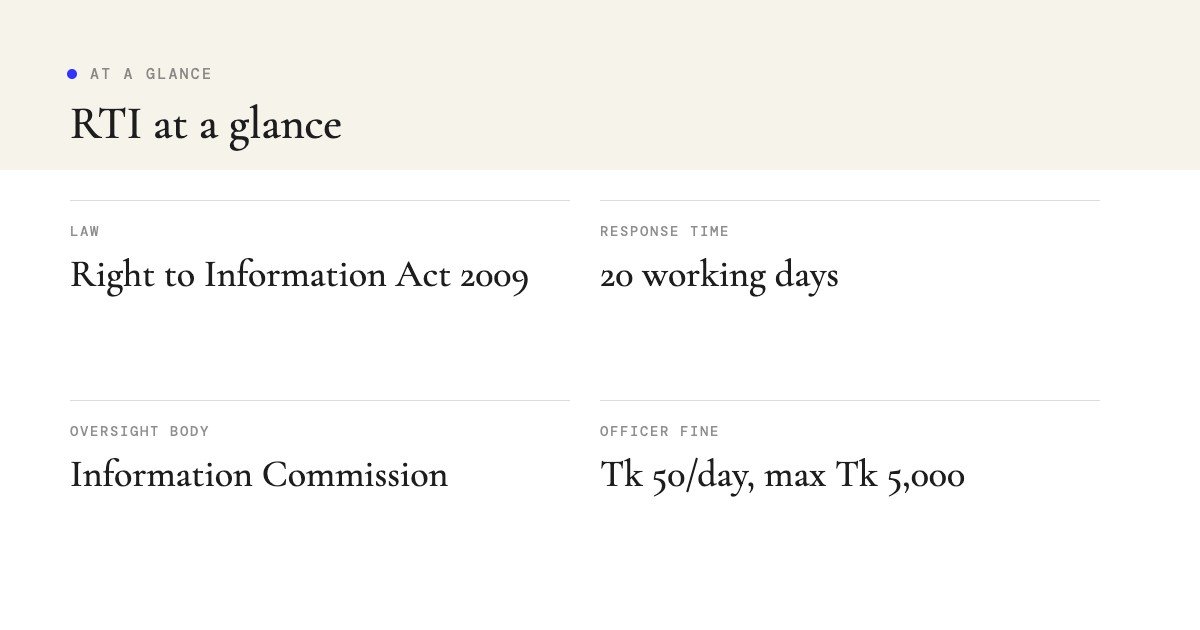
- The Right to Information Act 2009 gives citizens the right to request information held by public authorities and by organisations that receive government or foreign funding.
- The designated officer must provide the information within 20 working days, extendable to 30 working days where several units are involved, and within 24 hours where life or liberty is at stake.
- Section 7 lists categories of information that may be withheld, such as national security, ongoing investigations and commercial confidences, but the default is disclosure.
- A refused or ignored request can be appealed to the appellate authority and then taken to the Information Commission as a complaint.
- The Commission can fine officers Tk 50 per day up to Tk 5,000; a 2025 draft amendment proposed raising this fivefold, so check whether it has been enacted.
What the right to information act in Bangladesh does
Parliament passed the Right to Information Act in 2009 to promote transparency and accountability and to give practical effect to the constitutional freedoms of thought, conscience and expression. The Act recognises information as a right of citizens and places corresponding duties on authorities to disclose it, both on request and proactively.
The right to information act in Bangladesh applies to a wide range of bodies. "Authority" includes government ministries, divisions and offices, statutory bodies, local government institutions, and private organisations or NGOs that are run with government funds or with foreign funding. That breadth makes the Act useful well beyond government offices.
What counts as information
The Act defines information broadly. It includes records, documents, memos, files, correspondence, reports, contracts, data, decisions, minutes, maps, photographs, audio and video, and material in electronic form. It does not cover notes on files in some cases, and personal information about third parties may be protected, but most administrative records fall within its scope.
Who must provide information
Under the right to information act in Bangladesh, every authority must appoint a designated officer responsible for receiving and responding to requests at each office or unit. The officer's name and contact details should be displayed. If the designated officer is not available, an alternative officer is appointed. Authorities also have a duty to publish information proactively, such as their structure, functions, decision-making processes, budgets and the rules they apply.
The Information Commission, an independent statutory body, oversees implementation, hears complaints, issues directions and can impose fines on officers who fail to comply. Information about the Commission and the Act is published on government portals; the Act itself is available on the Laws of Bangladesh portal. In recent years, commentators have reported periods when the Commission lacked a full complement of commissioners, which affected the hearing of complaints; check its current status before filing.
How to make an RTI request
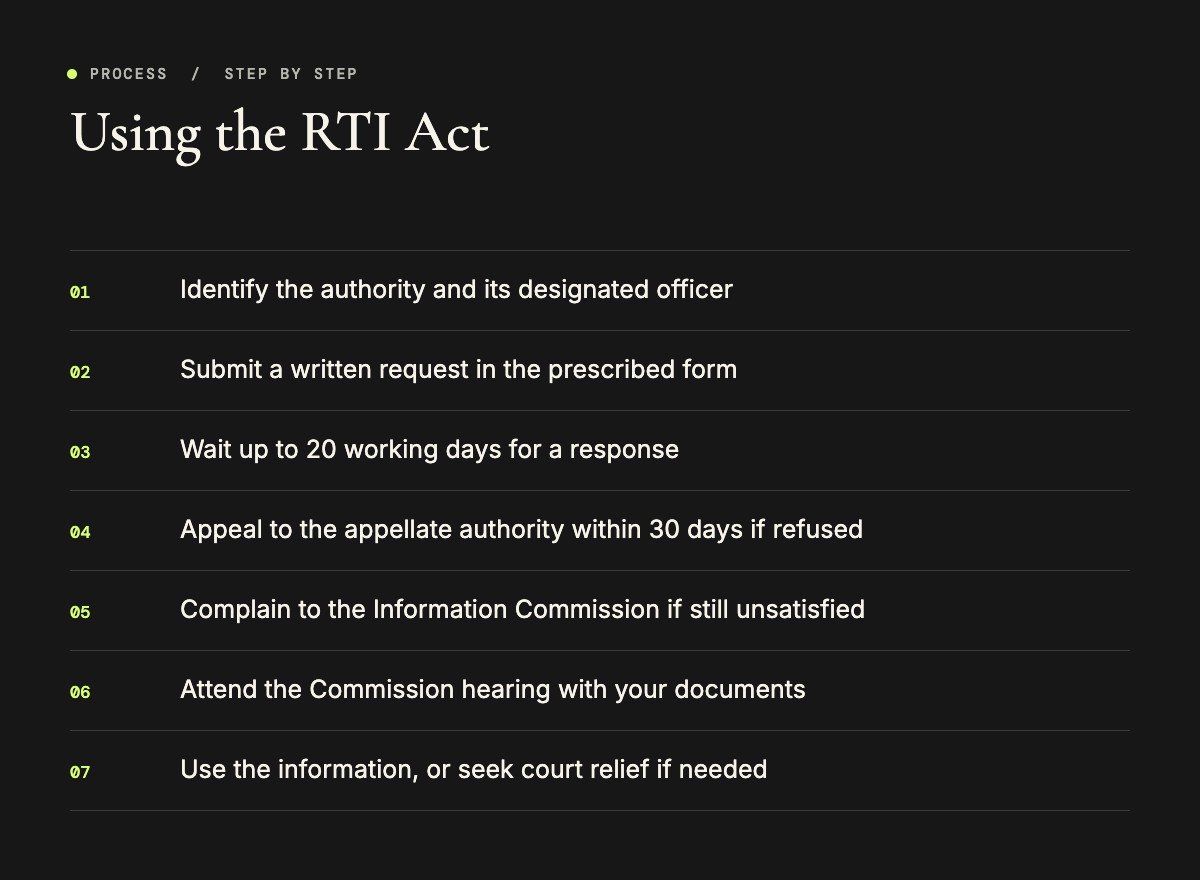
Using the right to information act in Bangladesh is straightforward, but precision helps. The steps below reflect the Act and the Right to Information (Information Related) Rules 2009.
- Identify the authority. Work out which office holds the information, for example the AC (Land) office for mutation records or the procuring entity for a tender.
- Find the designated officer. Check the office notice board or website for the designated officer's name and address.
- Write the request. Use the prescribed form, or a written application containing the same details: your name and address, the information sought, how you want it (inspection, copies, electronic) and contact details.
- Submit and keep proof. Submit by hand with an acknowledgement, by post with proof of posting, or by email where accepted. Keep a copy.
- Pay any fee. The officer may ask for the cost of providing the information, as set by the rules, before supplying it.
- Diarise deadlines. Note the 20 working day deadline and the appeal deadline that follows.
- Review the response. Check whether the information is complete and whether any refusal cites a valid exemption.
Tips for effective requests
- Ask for specific documents or data, with dates or reference numbers if you know them.
- Break large requests into parts, so one difficult item does not delay everything.
- Avoid asking questions that require opinions; ask for records instead.
- Write in clear Bengali or English, whichever the office handles most easily.
Deadlines under the right to information act in Bangladesh
Deadlines are the backbone of the right to information act in Bangladesh. Section 9 sets the time limits for providing information, and later sections set the timetable for appeals and complaints.
| Stage | Time limit |
|---|---|
| Response by designated officer | 20 working days from receipt |
| Where more than one unit or authority is involved | Up to 30 working days |
| Information concerning life or liberty | Preliminary information within 24 hours |
| Notice of refusal | Within 10 working days, with reasons |
| Appeal to appellate authority | Within 30 days of the deadline or decision |
| Decision on appeal | Within 15 days |
| Complaint to Information Commission | Within 30 days of the appeal decision or deadline |
If the designated officer does not respond in time, the request is treated as refused, which opens the appeal route. Keep a careful record of dates, because the Commission will ask for them.
Exemptions: when information can be withheld
Section 7 of the right to information act in Bangladesh lists categories of information that an authority is not obliged to disclose. They include information that would threaten security, integrity or sovereignty; affect foreign relations; reveal commercial or business secrets or intellectual property that would harm a third party's competitive position; impede law enforcement or an ongoing investigation; endanger a person's life or physical safety; invade personal privacy; reveal confidential information given in trust; relate to judicial proceedings where disclosure is prohibited; or disclose cabinet documents before decisions are taken.
Exemptions are to be applied narrowly. The officer must give reasons, and where only part of a document is exempt, the rest should usually be disclosed. Certain security and intelligence agencies are listed in the Act as largely outside its scope, although information about corruption and human rights violations in those agencies may still be requested.
Refusals often cite exemptions in general terms. In an appeal or complaint, ask the authority to identify which exemption applies to which part of the information and why disclosure would cause the specific harm. Generic refusals frequently do not survive scrutiny by the Commission.
Appeals and complaints
If you receive no response, an incomplete response or a refusal, the right to information act in Bangladesh gives two further steps. First, appeal to the appellate authority, usually the head of the office or the next higher authority, within 30 days. The appellate authority must decide within 15 days and may direct the officer to provide the information.
Second, if the appeal fails or is not decided, file a complaint with the Information Commission within 30 days. The Commission can summon parties, examine records, hold hearings and direct disclosure. It aims to decide complaints within 45 days, extendable to 75 days. The complaint should attach the original request, proof of submission, any response, the appeal and the appeal decision.
Penalties for officers
Where the Commission finds that an officer refused without reasonable cause, failed to respond, gave false or incomplete information, or obstructed access, it may impose a fine of Tk 50 per day of delay, up to Tk 5,000, and recommend departmental action. A draft amendment published in July 2025 proposed raising the fine to Tk 250 per day, up to Tk 25,000, and making it mandatory where withholding conceals corruption; check whether it has been passed.
Proactive disclosure under the right to information act in Bangladesh
The Act does not only respond to requests. Section 6 requires every authority to publish and keep updated information about its organisation, functions, duties, decision-making processes, rules and regulations, budgets, the services it provides and how to obtain them, and the particulars of its designated officers. The aim is that citizens should not need to file a request for basic information about how an office works.
In practice, proactive disclosure is uneven. Many ministries and directorates publish acts, rules, circulars and citizen charters on their websites, while smaller offices often display only basic notices. Before filing a request, check the authority's website and citizen charter. If information that should be published proactively is missing, that itself can be raised with the authority and, if necessary, with the Information Commission.
Citizen charters and service standards
Many offices publish citizen charters listing services, required documents, fees and time limits. These charters are useful evidence when service is delayed. Combined with an RTI request asking for the file movement record of your application, a charter can show clearly where a delay occurred and who is responsible.
Drafting an effective appeal or complaint
Appeals and complaints under the right to information act in Bangladesh succeed when they are clear and well documented. A good appeal sets out the date of the original request, what was asked for, what happened, and why the response is inadequate. It attaches copies of the request, proof of submission and any reply. It then asks for a specific remedy: disclosure of identified records within a set time.
Before the Information Commission, the requester should be ready to explain why the information is not covered by any exemption and why any partial disclosure is insufficient. The authority will be asked to justify its position. Where the authority claims the information does not exist, ask for a written statement of the search made. Commission decisions are binding on the authority, and failure to comply can lead to further action.
Practical uses for businesses and individuals
The Act is often associated with journalists and activists, but it has many practical uses for ordinary citizens and businesses:
- Land matters. Status of mutation applications, survey records, acquisition notices and compensation files.
- Procurement. Evaluation reports, award decisions and contract documents, subject to commercial confidentiality.
- Licences and permits. Reasons for delays, criteria applied and file movement records.
- Public services. Budgets and spending of local government institutions, hospitals and schools.
- Disputes with authorities. Records that may support a writ petition or civil claim.
Information obtained under the right to information act in Bangladesh can be used as evidence or as the basis for further action, such as a writ petition. Our guide to writ cases in Bangladesh explains how official inaction can be challenged.
A sample request structure
A simple, effective request might read: "Under the Right to Information Act 2009, I request certified copies of the following records held by your office: (1) the file movement register for mutation case number [number] from [date] to date; (2) the inspection report prepared in that case; and (3) any notice issued to me in connection with it. I would like to receive copies by post at the address below. I am willing to pay the cost of copies as set by the rules." Short, specific requests like this are easier to answer and harder to refuse.
RTI and NGOs
NGOs that receive foreign funding are "authorities" under the Act and must appoint designated officers and respond to requests. This surprises some organisations. NGOs registered with the NGO Affairs Bureau should prepare procedures for handling requests, decide what information they publish proactively and train staff on exemptions such as beneficiary privacy. Our guide to NGO registration covers related obligations.
Limits and practical challenges
Studies and commentary on the right to information act in Bangladesh have highlighted gaps between the law and practice: officers unaware of their duties, requests ignored, fines rarely imposed and proactive disclosure incomplete. The Information Commission's capacity has also been questioned, including periods with vacancies. These realities mean requesters should be persistent, keep records and use the appeal and complaint routes when needed.
At the same time, many offices now handle requests properly, and successful complaints have produced disclosure in land, education and public spending matters. A well-drafted request, followed by a timely appeal, has a reasonable chance of success.
Do not use RTI requests as a substitute for court disclosure in active litigation without advice. Information relating to matters before the courts may be withheld, and the court's own procedures may be the better route.
Frequently asked questions about right to information act in bangladesh
Who can make a request under the RTI Act?
Any citizen of Bangladesh. Organisations usually make requests through an individual representative.
How long does an authority have to respond?
20 working days, extendable to 30 working days where several units are involved, and 24 hours for preliminary information concerning life or liberty.
Do I have to explain why I want the information?
Generally no. The Act gives the right to information without requiring reasons, although stating the purpose can help the officer locate records.
What if my request is ignored?
Silence after the deadline is treated as refusal. Appeal to the appellate authority within 30 days and, if needed, complain to the Information Commission.
Can private companies be asked for information?
Only if they fall within the definition of authority, for example by being run with government funds. NGOs with foreign funding are covered.
What penalty can an officer face?
A fine of Tk 50 per day up to Tk 5,000 and a recommendation for departmental action. A 2025 draft proposed higher fines; check whether it has been enacted.
How we can help
We help individuals, businesses and NGOs use the right to information act in Bangladesh: drafting requests, appeals and complaints, representing clients before the Information Commission, and using disclosed information in writ and civil proceedings. Learn more about our public and administrative law practice.
Need information from a public authority?
We draft targeted requests and pursue appeals and complaints so that deadlines are met and refusals are properly challenged.
Book a consultationPublic law practicePrimary sources: the Right to Information Act 2009 and Right to Information (Information Related) Rules 2009 on the Laws of Bangladesh portal; writ jurisdiction of the Supreme Court of Bangladesh; Dhaka Tribune report on the proposed amendment (19 July 2025).
This article is general information about Bangladeshi law as of October 2026 and is not legal advice. Fees, forms and the status of proposed amendments may change; confirm current requirements with the authority, the Information Commission or a qualified lawyer before acting.

0 Comments