
The seat is the legal home of an arbitration. It decides which courts supervise the process, which law governs setting aside, and how easily the award can be enforced. For contracts with a Bangladeshi party, choosing the seat of arbitration in Bangladesh or abroad, typically Singapore or London, is one of the most consequential drafting decisions, yet it is often made at the last minute.
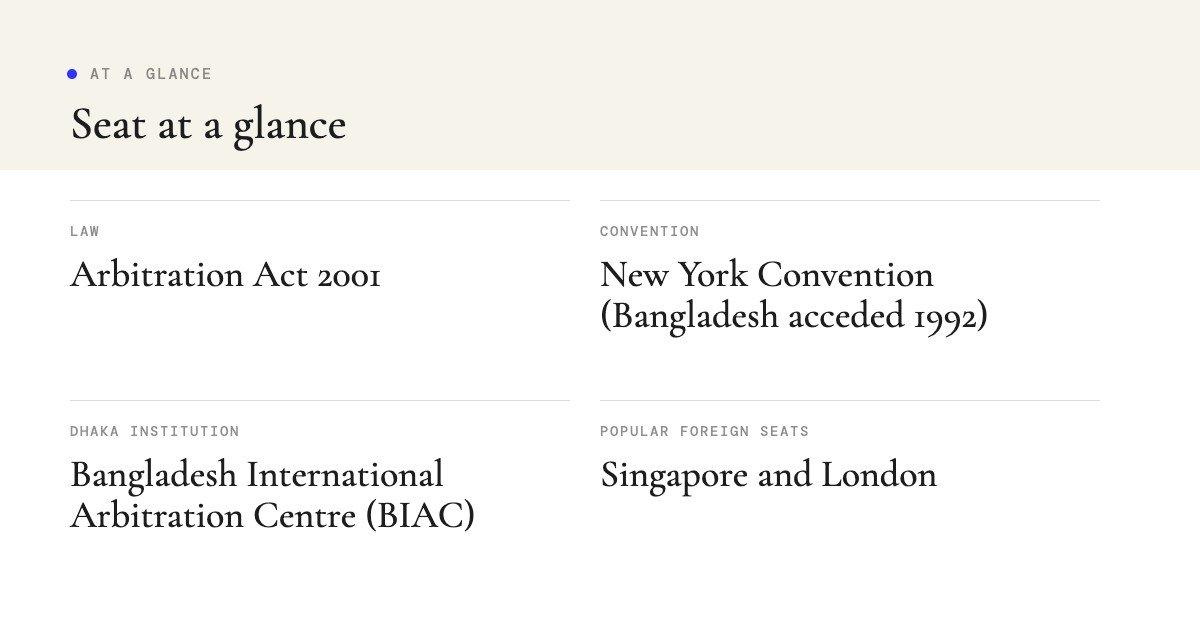
- The Arbitration Act 2001 governs arbitrations seated in Bangladesh and the enforcement of foreign awards.
- Choosing a seat of arbitration in Bangladesh means Bangladeshi courts supervise the arbitration and hear any application to set aside the award.
- Bangladeshi courts can grant certain interim measures in support of foreign-seated arbitrations, following amendments to the Act.
- Foreign awards from New York Convention countries, such as Singapore and the United Kingdom, are enforceable in Bangladesh subject to limited grounds of refusal.
- The best seat depends on enforcement needs, cost, neutrality and the parties’ bargaining power.
What the seat of arbitration in Bangladesh means
The seat is a legal concept, not just a physical venue. Hearings can take place anywhere, including online, while the seat remains fixed. The law of the seat, known as the lex arbitri, governs matters such as the validity of the arbitration agreement, the tribunal’s powers, court assistance and challenges to the award. A clear clause stating the seat of arbitration in Bangladesh or another country avoids arguments that the seat is wherever hearings happen to be held.
Our international arbitration practice advises on seat selection and represents clients in arbitrations seated in Dhaka, Singapore and London.
Choosing a seat of arbitration in Bangladesh: Dhaka
The Arbitration Act 2001 is based largely on the UNCITRAL Model Law. It gives parties autonomy to choose arbitrators and procedure, limits court intervention, and provides for enforcement of domestic awards as decrees of court. International commercial arbitrations seated in Bangladesh are supervised by the High Court Division for certain matters, while domestic arbitrations involve the District Judge’s court. Dhaka now has an institutional option in the Bangladesh International Arbitration Centre, which administers cases under its own rules.
The text of the Act is available on Laws of Bangladesh, and the Model Law on the UNCITRAL website.
Comparing a seat of arbitration in Bangladesh with Singapore and London
| Factor | Dhaka | Singapore | London |
|---|---|---|---|
| Cost | Lower fees and travel costs for local parties | Higher, but efficient | Higher |
| Court support | Available, but court timelines can be long | Highly supportive, arbitration-friendly courts | Highly experienced courts |
| Neutrality | Home ground for the Bangladeshi party | Neutral regional hub | Neutral, strong in shipping and finance |
| Enforcement in Bangladesh | As a domestic decree after setting-aside period | As a foreign award under the Act | As a foreign award under the Act |
| Institutions | BIAC | SIAC | LCIA, ICC |
Court intervention and setting aside
If the seat of arbitration in Bangladesh is chosen, an award can be challenged in Bangladeshi courts on limited grounds similar to those in the Model Law, such as incapacity, invalid agreement, lack of notice, excess of jurisdiction, improper composition of the tribunal, non-arbitrability and conflict with public policy. The Bangladeshi Act also includes grounds such as fraud or corruption affecting the award. Setting-aside proceedings and appeals can take time, which is an important practical consideration.
For foreign-seated awards, setting aside occurs only in the seat country. In Bangladesh, the award holder seeks enforcement, and the other side can resist only on the limited grounds in the Act that reflect the New York Convention.
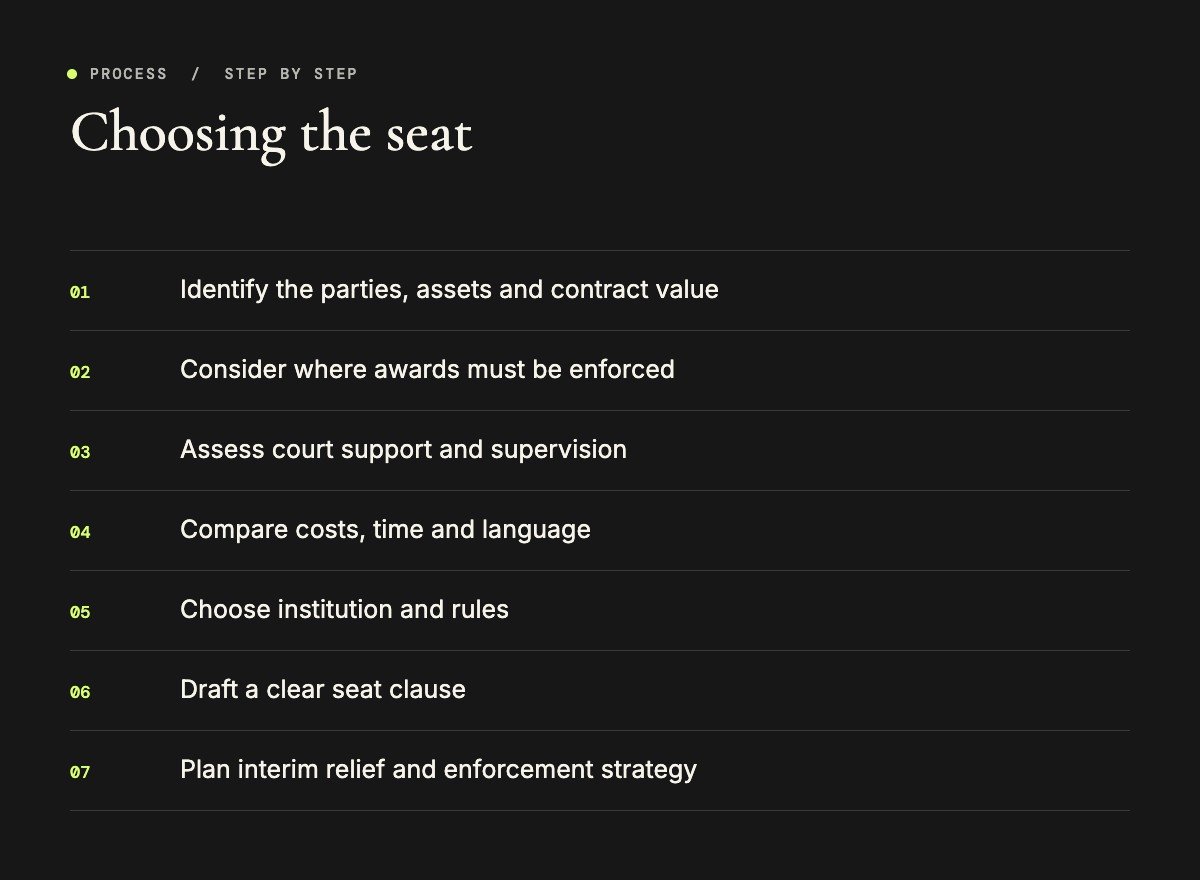
Choosing the seat step by step
- Map the deal. Identify parties, governing law, value and likely disputes.
- Locate assets. Consider where an award would need to be enforced.
- Assess courts. Weigh court support, speed and approach to arbitration.
- Compare costs. Factor in counsel, arbitrator and travel costs.
- Choose institution. Select BIAC, SIAC, LCIA, ICC or ad hoc arbitration.
- Draft the clause. Specify seat, rules, number of arbitrators, language and governing law.
- Plan interim relief. Decide how urgent relief and enforcement will work in practice.
Avoid clauses that mention a venue without naming the seat, or that name two cities. Ambiguity leads to satellite litigation about which courts have jurisdiction, adding months before the real dispute is heard.
Interim relief and foreign seats
Historically, a major concern for foreign-seated arbitrations was whether Bangladeshi courts could grant interim relief, such as injunctions preserving assets in Bangladesh. Amendments to the Arbitration Act allow courts to grant certain interim measures, and to enforce foreign awards, even where the seat is abroad. In practice, parties often combine an emergency arbitrator application under SIAC or ICC rules with an application to the Bangladeshi court where assets need to be frozen locally. Where a seat of arbitration in Bangladesh is chosen, the court’s interim powers apply directly.
Enforcement and the seat of arbitration in Bangladesh
If the Bangladeshi counterparty’s assets are mainly in Bangladesh, the award will need to be enforced there regardless of the seat. A Dhaka-seated award becomes enforceable as a decree once the setting-aside period has passed or a challenge fails, while a foreign award must go through recognition and enforcement proceedings, where defences such as public policy can be raised. Neither route is automatic, but foreign awards from respected seats often carry weight, and the grounds for refusing enforcement are narrow.
Where assets are spread across several countries, a neutral seat with strong Convention credentials, such as Singapore or London, may make enforcement abroad easier.
Cost, time and practicality
Arbitration in Singapore or London involves higher fees for counsel, arbitrators and venues, plus travel for witnesses. For smaller contracts, a seat of arbitration in Bangladesh with a capable tribunal and institutional administration may offer better value. Virtual hearings have narrowed the cost gap, because hearings can take place online regardless of the seat. Parties should balance cost against the advantages of neutrality and supportive courts.
Government and public sector contracts
Contracts with government bodies, state-owned enterprises and public utilities often involve negotiation over the seat. Bangladeshi public entities may prefer Dhaka, while foreign contractors and lenders often prefer Singapore or London. Large infrastructure and energy contracts, often on FIDIC or bespoke forms, frequently use foreign seats with ICC or SIAC rules, while smaller procurement contracts commonly specify arbitration in Bangladesh. Investors should also consider whether treaty protection offers an alternative forum against the state.
Drafting the clause on the seat of arbitration in Bangladesh
A sound clause states the seat, the institution and rules, the number of arbitrators, the language, and the governing law of the contract and ideally of the arbitration agreement. It may also address emergency arbitration, joinder and consolidation in multi-party projects, confidentiality and expedited procedures for smaller claims. Using the model clause of the chosen institution, adapted to the deal, reduces the risk of defects that could be exploited later.
Governing law and the seat
The governing law of the contract and the seat are separate choices. A contract governed by Bangladeshi law can have a Singapore seat, and an English law contract can be arbitrated in Dhaka. However, mismatches can create complexity, for example where Bangladeshi mandatory rules or public policy affect the dispute. The law governing the arbitration agreement itself may follow the seat or the main contract, and stating it expressly avoids uncertainty. When choosing a seat of arbitration in Bangladesh, parties should check that the chosen governing law and procedural rules fit together.
The Bangladesh International Arbitration Centre
BIAC, based in Dhaka, administers domestic and international arbitrations and mediations under its rules, maintains panels of arbitrators and provides hearing facilities. Its fee schedules are generally lower than those of major international institutions. For parties choosing a seat of arbitration in Bangladesh, institutional administration through BIAC can improve procedural discipline compared with ad hoc arbitration, including appointment of arbitrators where parties cannot agree and supervision of timelines.
Arbitrator selection
The seat influences the pool of arbitrators and counsel. Dhaka offers experienced retired judges, senior advocates and specialists familiar with Bangladeshi law and commercial practice, while Singapore and London offer international arbitrators with deep experience in cross-border disputes. Parties should consider whether the dispute requires technical expertise, such as engineering or finance, and whether arbitrators should be of neutral nationality. Institutional rules often address nationality of a sole arbitrator or presiding arbitrator.
Common mistakes
Frequent problems include pathological clauses naming non-existent institutions, clauses that refer disputes to arbitration and the courts at the same time, failure to name the seat, inconsistent dispute clauses in related contracts, and unrealistic time limits for appointing arbitrators. Each of these can lead to challenges in Bangladeshi courts that delay resolution. Reviewing every project document for consistency, especially in multi-contract projects, prevents disputes about the seat of arbitration in Bangladesh or elsewhere from overshadowing the merits.
Confidentiality and publicity
Arbitration is often chosen for confidentiality, but the degree of protection varies by seat and rules. Institutional rules such as those of SIAC and LCIA contain confidentiality provisions, and court proceedings related to the arbitration, such as setting-aside or enforcement applications, may become public. In Bangladesh, court files in arbitration-related proceedings are generally accessible, so parties concerned about publicity should include express confidentiality obligations in the clause and consider how court applications will be handled.
Practical recommendations
For high-value cross-border contracts with significant assets outside Bangladesh, a neutral seat such as Singapore or London, with institutional rules, is usually preferred. For mid-sized contracts where the counterparty’s assets are in Bangladesh and cost matters, Dhaka with BIAC administration can be efficient. In every case, the clause should be clear, consistent across related documents and supported by a plan for interim relief and enforcement. Taking advice at the drafting stage costs far less than litigating a defective clause later.
Where the parties cannot agree, a compromise such as a Singapore seat with hearings in Dhaka, or a Dhaka seat with an international institution and foreign presiding arbitrator, can balance cost, neutrality and enforcement concerns.
Whatever the compromise, record it precisely in the clause so that no court later has to guess what the parties intended.
Frequently asked questions about seat of arbitration in bangladesh
What law governs arbitration in Bangladesh?
The Arbitration Act 2001.
Is the seat the same as the venue?
No, the seat is the legal home; hearings can be held elsewhere.
Can Bangladeshi courts help a Singapore arbitration?
Certain interim measures are available from Bangladeshi courts in support of foreign-seated arbitrations.
Are Singapore and London awards enforceable?
Yes, as foreign awards under the New York Convention, subject to limited defences.
Is there an arbitration centre in Dhaka?
Yes, the Bangladesh International Arbitration Centre.
Can government contracts choose a foreign seat?
Often yes, but public procurement rules and negotiating positions may favour Dhaka.
How we can help
We advise on choosing the seat of arbitration in Bangladesh or abroad, draft arbitration clauses, and act in arbitrations and related court proceedings. See our international arbitration practice, our enforcement of awards team and our ICC and LCIA arbitration practice.
Drafting a dispute clause?
We help you choose a seat that works when it matters.
Book a consultationInternational arbitrationPrimary sources: the Arbitration Act 2001 on Laws of Bangladesh; the New York Convention; institutional rules from SIAC, LCIA and ICC.
This article is general information about Bangladeshi arbitration law as of October 2026 and is not legal advice. Seat choice depends on your contract and assets.




0 Comments