
Most commercial disputes end in a deal rather than a judgment. But a deal is only as good as its enforcement. A well-drafted settlement agreement in Bangladesh can be recorded as a court decree, converted into an arbitral award or enforced as a contract, and the route you choose decides how quickly you can act if the other side defaults.
- A settlement agreement in Bangladesh is a contract and is enforceable under the Contract Act 1872, but suing on it takes time.
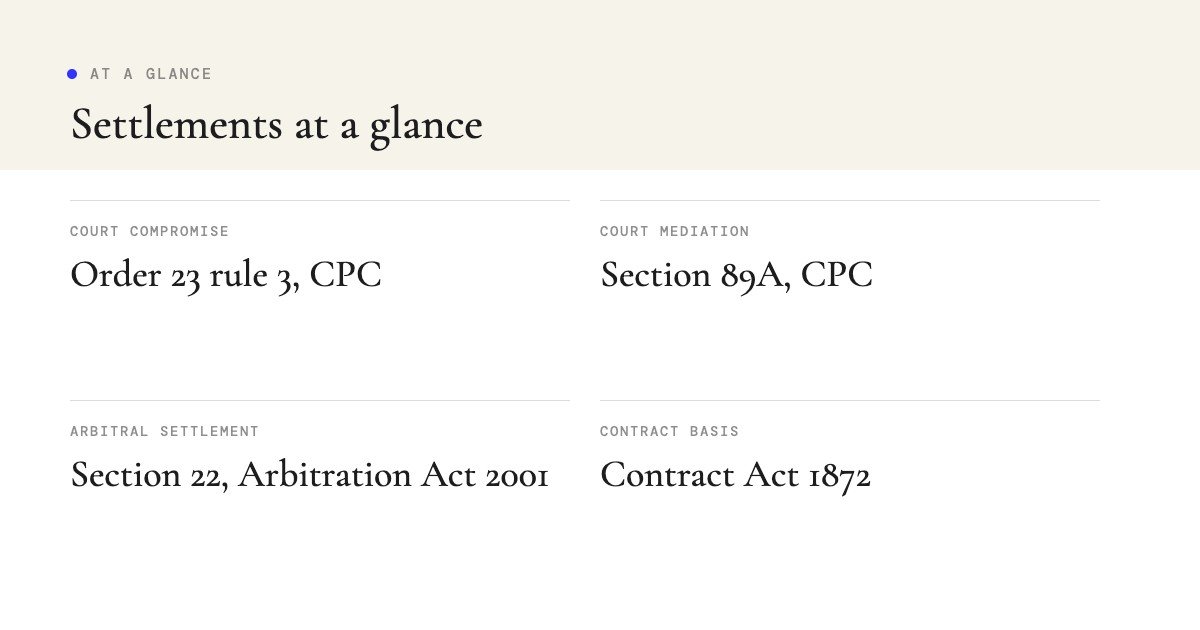
- If a suit is pending, recording a compromise under Order 23 rule 3 CPC produces a decree that can be executed directly.
- Settlements reached through court-annexed mediation under section 89A CPC are recorded and given effect by the court.
- In arbitration, section 22 of the Arbitration Act 2001 lets the tribunal record a settlement as an award on agreed terms.
- Payment schedules, default clauses, security and stamp duty all affect whether a settlement can be enforced smoothly.
Why the form of settlement matters
Parties often celebrate reaching agreement and then sign a short letter recording the terms. If the other side later fails to pay, that letter may only give a fresh cause of action, meaning a new suit and years of delay. The original dispute is gone, but the problem has simply changed shape.
Planning the form of a settlement agreement in Bangladesh at the outset avoids this trap. The right structure lets the innocent party move directly to execution or enforcement. Our mediation and ADR practice helps clients negotiate and document settlements with enforcement in mind.
Route one: compromise decree under Order 23 rule 3
Where a civil suit is pending, Order 23 rule 3 of the Code of Civil Procedure 1908 allows the court to record a lawful agreement or compromise that adjusts the suit wholly or partly, and to pass a decree in accordance with it. The compromise must be in writing and signed by the parties.
A compromise decree is executable like any other decree under Order 21. This is often the strongest form of settlement agreement in Bangladesh because the successful party can apply for execution, attachment and sale of property without proving the agreement again. The decree can also cover matters beyond the subject matter of the suit if they relate to the dispute, although careful drafting is needed.
Challenging a compromise decree is difficult. A party alleging fraud or that no lawful compromise was made must generally raise the issue before the court that recorded the compromise, rather than filing a separate suit.
Route two: mediation under section 89A CPC
Section 89A, introduced in 2003 and later strengthened, empowers the court after the filing of a written statement to mediate the dispute itself or refer the parties to their lawyers, a mediator or a mediator from the panel. Since amendments, mediation has become a mandatory step in many civil suits.
If mediation succeeds, the terms are reduced to writing, signed by the parties and their lawyers, and the court passes a decree in accordance with the compromise under Order 23. A settlement agreement in Bangladesh reached through court mediation is therefore enforceable as a decree. An important practical benefit is that court fees paid on the plaint may be refunded when a suit is settled through mediation under section 89A, subject to the rules.
Route three: award on agreed terms in arbitration
Section 22 of the Arbitration Act 2001 encourages settlement during arbitration. If the parties settle, the tribunal terminates the proceedings and, if requested by the parties and not objected to by the tribunal, records the settlement in the form of an arbitral award on agreed terms.
An award on agreed terms has the same status and effect as any other award on the substance of the dispute. It can be enforced under section 44 as a decree of the court for domestic awards, and foreign awards on agreed terms are enforceable under section 45. This route gives a settlement agreement in Bangladesh international portability through the New York Convention when the arbitration is seated abroad.
Route four: a stand-alone contract
Where no suit or arbitration is pending, the parties may simply sign a settlement agreement. It is enforceable as a contract under the Contract Act 1872, provided there is free consent, lawful consideration and a lawful object.
The weakness is that, on default, the innocent party must sue on the agreement. To strengthen a stand-alone settlement agreement in Bangladesh, parties often include an arbitration clause, take post-dated cheques that can trigger proceedings under section 138 of the Negotiable Instruments Act 1881, or obtain a bank guarantee or mortgage.
Comparing routes for a settlement agreement in Bangladesh
| Route | Enforcement on default | Best for |
|---|---|---|
| Compromise decree (Order 23 r 3) | Direct execution under Order 21 | Pending civil suits |
| Court mediation (s 89A) | Decree on compromise, possible fee refund | Suits referred to mediation |
| Award on agreed terms (s 22) | Enforced as an award; international portability | Pending arbitrations |
| Stand-alone contract | New suit or arbitration required | Pre-action settlements |
Drafting essentials
- Identify the parties correctly. Use full legal names, registration numbers and authorised signatories.
- Define the dispute settled. State which claims are released, including related claims and counterclaims.
- Set precise obligations. Specify amounts, dates, bank details and deliverables without ambiguity.
- Include default terms. Provide for acceleration of all instalments, interest and costs on default.
- Take security. Use guarantees, cheques, mortgages or escrow where risk exists.
- Address confidentiality. Agree what may be disclosed and to whom.
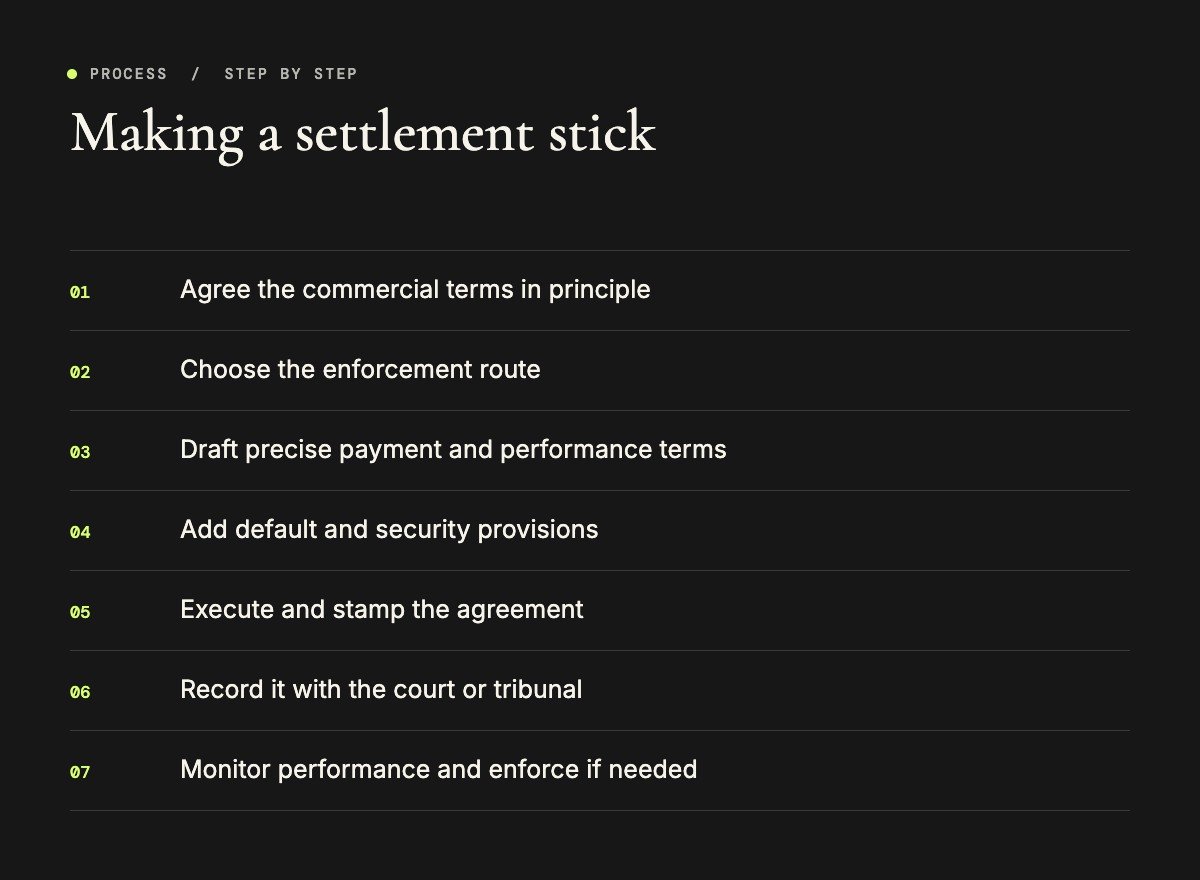
- Choose enforcement. Record the settlement with the court or tribunal, or include an arbitration clause.
An acceleration clause is the single most useful provision in an instalment settlement. Without it, a creditor may have to wait for each instalment to fall due before enforcing. With it, one missed payment makes the whole balance immediately enforceable.
Company approvals and authority
A settlement agreement in Bangladesh signed by a company should be backed by a board resolution authorising the settlement and naming the signatory. Banks, state-owned enterprises and regulated entities may need additional internal or regulatory approvals before settling.
Failing to obtain proper authority gives the other side an argument that the agreement does not bind the company. Our guide to board resolutions in Bangladesh explains the formalities.
Stamp duty and registration
Settlement documents may attract stamp duty under the Stamp Act 1899, depending on their nature. An agreement relating to immovable property, or one that creates or transfers rights in land, may need registration under the Registration Act 1908. Unstamped or insufficiently stamped documents may be inadmissible in evidence until duty and penalty are paid.
Checking stamp and registration requirements before signing ensures that the settlement agreement in Bangladesh can be relied on in court if needed.
Settlements in specialist forums
Several statutes provide their own settlement mechanisms. The Artha Rin Adalat Ain 2003 (Money Loan Courts Act) requires mediation in many bank recovery suits, and settlements there are given effect by the court. Family courts under the Family Courts Act 2023 hold pre-trial and post-trial reconciliation. Labour disputes may be settled through conciliation under the Bangladesh Labour Act 2006.
Each forum has its own procedural rules, so the documentation should follow the relevant statute.
Cross-border settlements
A cross-border settlement agreement in Bangladesh needs extra planning. Foreign parties settling with Bangladeshi counterparties should consider foreign exchange rules. Payments abroad under a settlement may need to comply with Bangladesh Bank requirements, and remittance of large sums can require supporting documents such as a court decree or arbitral award. Structuring the settlement as an award on agreed terms often makes remittance easier.
Tax deduction at source may also apply to certain payments, so the gross and net amounts should be clear in the agreement.
When settlements fail
If a party defaults under a compromise decree, the creditor applies for execution. If the settlement is a stand-alone contract, the creditor may sue for the settlement sum, or in some cases treat the breach as repudiation and revive the original claim, depending on how the agreement is drafted.
A carefully drafted settlement agreement in Bangladesh states clearly what happens on default: whether the original claim revives or whether the creditor's remedy lies only under the settlement.
Without prejudice negotiations
Negotiations leading to a settlement agreement in Bangladesh are usually conducted on a without prejudice basis. Section 23 of the Evidence Act 1872 provides that, in civil cases, an admission is not relevant if made on an express condition that evidence of it is not to be given, or in circumstances showing the parties agreed it should not be given. Marking correspondence clearly and keeping negotiation records separate protects each side if talks fail.
Once a settlement agreement in Bangladesh is signed, however, the final document itself can be produced to prove its terms, so the signed version should be complete and self-contained.
Releases and waivers
A well-drafted release clause defines exactly which claims are given up. Broad releases of "all claims" can catch matters the parties never discussed, such as unrelated invoices or employee claims. Narrow releases may leave the door open to fresh litigation.
Parties should list the proceedings to be withdrawn, the claims released and any claims expressly preserved. Getting this balance right is central to a durable settlement agreement in Bangladesh.
Settlement agreement in Bangladesh employment disputes
Employers often settle termination disputes by paying more than the statutory minimum in exchange for a release. Under the Bangladesh Labour Act 2006, workers cannot contract out of certain statutory rights, so a settlement agreement in Bangladesh with a worker should pay at least the statutory dues and record that they have been paid. Settlements with senior managers who are not workers under the Act give more flexibility. See our guide to termination of employment.
Checklist before signing
- Is the enforcement route decided and documented?
- Are all parties and signatories properly authorised?
- Are payment dates, amounts and accounts precise?
- Is there an acceleration clause and interest on default?
- Has stamp duty been checked and paid?
- Are withdrawals of pending cases scheduled?
Working through this checklist turns a settlement agreement in Bangladesh from a hopeful promise into a dependable outcome.
Frequently asked questions about settlement agreement in bangladesh
Is a settlement agreement legally binding in Bangladesh?
Yes, it is a contract under the Contract Act 1872 if the usual requirements are met.
How can I make a settlement directly enforceable?
Record it as a compromise decree under Order 23 rule 3 CPC or as an arbitral award on agreed terms.
Do court fees get refunded after mediation?
Section 89A provides for refund of court fees when a suit is settled through mediation, subject to the rules.
Can a compromise decree be challenged?
Only on limited grounds such as fraud, and generally before the court that recorded the compromise.
Do settlement agreements need stamp duty?
They may, depending on their nature; agreements involving land may also need registration.
Can a foreign party enforce a settlement?
Yes. An award on agreed terms is enforceable like any arbitral award, including foreign awards under section 45.
How we can help
We negotiate, draft and enforce settlement agreement in Bangladesh structures for local and international clients, from compromise decrees to awards on agreed terms. Learn more about our mediation and ADR practice, our commercial litigation team and our enforcement practice.
Close to a deal?
We make sure your settlement can be enforced if the other side defaults.
Book a consultationADR practicePrimary sources: the Code of Civil Procedure 1908, Arbitration Act 2001 and Contract Act 1872 on the Laws of Bangladesh portal; court information from the Supreme Court of Bangladesh.
This article is general information about Bangladeshi law as of October 2026 and is not legal advice. Specific settlements require tailored drafting.


0 Comments