
When a seller takes the advance (bayna) and then refuses to register the sale deed, the buyer’s main remedy is a specific performance suit in Bangladesh under the Specific Relief Act 1877. Since the 2004 amendments, the rules are strict: the agreement for sale must be registered, the buyer must deposit the unpaid balance in court when filing, and the suit must usually be filed within one year. Miss any of these and the court will not enforce the bargain.
- Specific performance is an equitable, discretionary remedy that compels a party to perform a contract rather than pay damages.
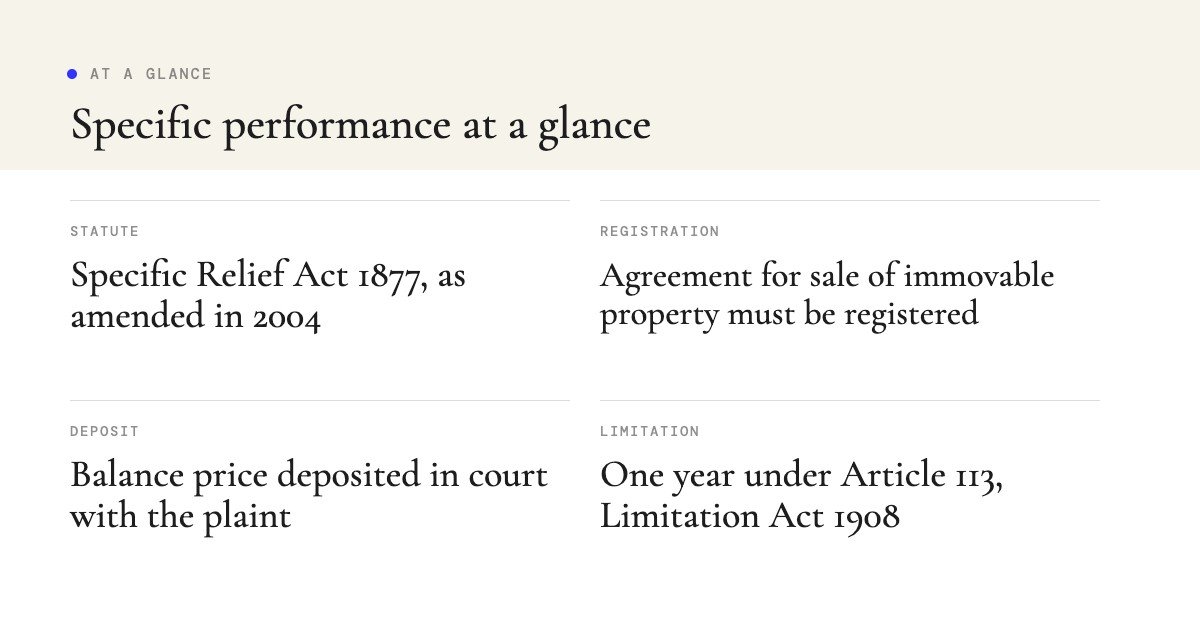
- Under section 21A of the Specific Relief Act, an unregistered agreement for sale of immovable property cannot be specifically enforced.
- The plaintiff must deposit the balance of the consideration money in court when filing the plaint.
- Article 113 of the Limitation Act gives one year from the date fixed for performance, or from notice of refusal where no date is fixed.
- A subsequent buyer with notice of the earlier agreement can be bound by the decree.
What a specific performance suit in Bangladesh is
Ordinarily, when a contract is broken the innocent party receives damages. Specific performance is different: the court orders the defaulting party to do what they promised. In Bangladesh the remedy is most often used in land transactions, where a buyer has signed a bainanama, paid an advance and is waiting for the seller to execute and register the sale deed. Land is treated as unique, so damages are usually considered inadequate, and courts are more willing to order performance.
The remedy is governed by Chapter II of the Specific Relief Act 1877. Section 12 sets out when specific performance may be granted, section 21 lists contracts that cannot be specifically enforced, and section 22 confirms that the relief is discretionary. The Act and its amendments are available on Laws of Bangladesh.
Our civil litigation team, described on our about page, regularly acts in land and contract disputes before the civil courts and the High Court Division.
The 2004 amendments behind every specific performance suit in Bangladesh
| Requirement | Provision | Effect |
|---|---|---|
| Registered agreement | Section 21A, Specific Relief Act; section 17A, Registration Act 1908 | Unregistered bainanama for immovable property cannot be enforced |
| Deposit of balance | Section 21A(1)(b) | Plaint must be accompanied by deposit of the unpaid consideration |
| Short limitation | Article 113, Limitation Act 1908 | One year from date fixed or from notice of refusal |
| Registration within time | Registration Act 1908 | Agreements must be presented for registration within the statutory period |
These reforms were designed to stop speculative claims based on backdated or forged agreements. In practice they mean that a buyer who did not register the bainanama is left with a claim for refund of the advance and damages rather than an order for the land itself, subject to arguments on agreements made before the amendments came into force.
When a specific performance suit in Bangladesh is available
The court will consider granting specific performance where the contract is valid and certain, the plaintiff has performed or is ready and willing to perform their part, damages would not be an adequate remedy, and the statutory pre-conditions are met. The plaintiff must plead and prove readiness and willingness throughout, from the date of the agreement to the date of the decree. Evidence such as bank statements showing funds, letters demanding registration and the deposit itself all support this.
Specific performance will usually be refused where the contract is too vague, where it requires continuous supervision, where it is for personal services, or where it would cause unfair hardship to the defendant that the plaintiff did not foresee. The court may also refuse relief where the plaintiff’s own conduct has been unfair, for example by long unexplained delay.
Filing a specific performance suit in Bangladesh step by step
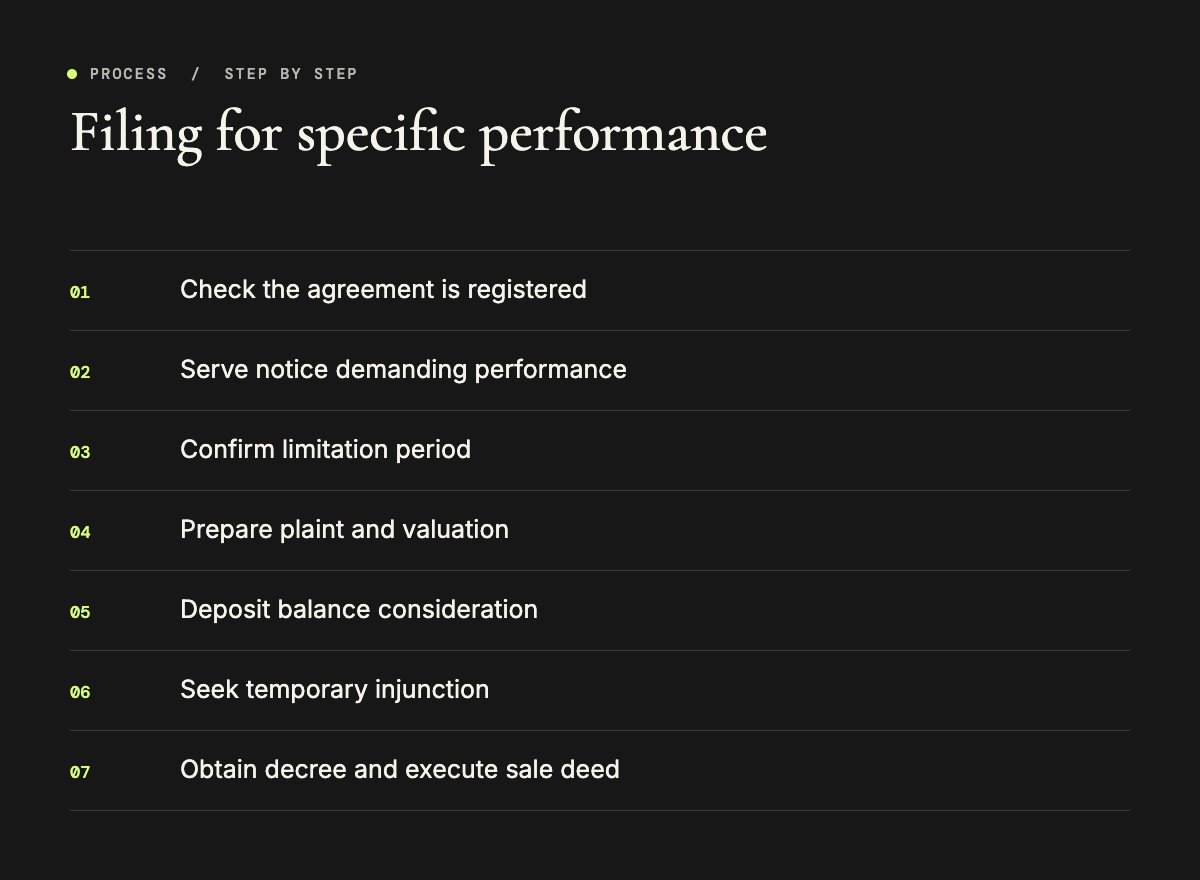
- Check registration. Confirm the agreement for sale was registered and obtain a certified copy.
- Serve notice. Send a legal notice demanding execution and registration of the sale deed by a fixed date.
- Limitation. Calculate the one-year period from the date fixed in the agreement or from the date of refusal.
- Plaint and valuation. Draft the plaint, value the suit and pay court fees.
- Deposit. Deposit the unpaid balance of the price in court with the plaint.
- Injunction. Apply for a temporary injunction restraining sale to anyone else.
- Decree and execution. On decree, have the deed executed by the defendant or, if they refuse, by the court.
Register an attachment of the suit property where possible and file for a temporary injunction on the first day. The biggest practical risk in these cases is that the seller transfers the land to a third party while the suit is pending.
Limitation and the specific performance suit in Bangladesh
Article 113 of the Limitation Act 1908, as amended, allows one year to sue for specific performance. Time runs from the date fixed for performance in the agreement, or, if no date was fixed, from the date the plaintiff had notice that performance was refused. Courts apply this strictly, and a plaint filed even a few days late will be rejected. Where the agreement fixes a date and the parties later extend it, the extension should be in writing and, ideally, signed by both sides, because oral extensions are difficult to prove.
The one-year period is much shorter than the three years that applied before 2004, and many buyers lose their remedy simply by waiting while negotiations drag on. If a seller is delaying, take advice early so that limitation is protected.
Court, valuation and fees for a specific performance suit in Bangladesh
A specific performance suit is filed in the civil court with pecuniary and territorial jurisdiction, normally the court of the Assistant Judge, Senior Assistant Judge or Joint District Judge where the land is situated, depending on the value of the suit. The suit is valued on the amount of consideration stated in the agreement, and ad valorem court fees are payable under the Court-fees Act 1870. A claim for a permanent injunction or for recovery of possession can be joined in the same suit.
Subsequent purchasers and the specific performance suit in Bangladesh
Section 27 of the Act allows specific performance to be enforced against the parties and anyone claiming under them by a title arising after the contract, except a transferee for value who paid in good faith without notice of the original contract. Registration of the agreement for sale is particularly important here, because a registered agreement is likely to be treated as giving notice to later buyers. Subsequent purchasers should be added as defendants, and the decree can direct them to join in the conveyance.
Buyers are therefore protected against a seller who tries to defeat the agreement by quickly selling to a relative or a friendly third party, provided the plaintiff acts promptly and joins those parties.
Common defences in a specific performance suit in Bangladesh
Defendants commonly argue that the agreement is unregistered, that the suit is time-barred, that the plaintiff was never ready and willing to pay, that the agreement was a loan transaction disguised as a sale, that the signature is forged, or that the plaintiff failed to deposit the balance. They may also argue that the seller had no clear title, for example because the land is under a family partition dispute or is khas land. Plaintiffs should anticipate these defences when drafting the plaint and collect documentary evidence early.
Forgery allegations often lead to handwriting expert examination, which can add months to the case. Keeping witnesses to the agreement available and preserving the original document is essential.
Alternative relief: refund and compensation
Where specific performance is refused, section 19 allows the court to award compensation in addition to or instead of performance. A plaintiff can also claim refund of the advance with interest, and the court may grant a lien on the property for the money paid. It is common to plead refund and compensation as an alternative prayer so that, if specific performance fails on a technical ground, the plaintiff still recovers their money in the same suit.
Executing a specific performance suit in Bangladesh decree
Once a decree is passed, the plaintiff must execute it under the Code of Civil Procedure 1908. If the defendant refuses to execute the sale deed, the court can execute and register it on the defendant’s behalf under Order XXI. The plaintiff then completes mutation of the land records and takes possession, with the court’s help if necessary. The deposited balance is paid out to the defendant on completion.
Evidence checklist
Before filing, gather the registered agreement for sale and its certified copy, receipts or bank records for the advance, the seller’s title documents including the khatian and mutation records, correspondence showing demands for registration, proof of funds to pay the balance and details of witnesses to the agreement. Obtain an up-to-date search of the land records to see whether the seller has already transferred or mortgaged the property.
Practical advice for buyers and sellers
Buyers should register the bainanama promptly, fix a clear date for completion and keep written records of every payment. Sellers who genuinely cannot complete, for example because of a title defect, should say so in writing early and offer refund, which reduces exposure to a specific performance suit in Bangladesh and to claims for compensation. Both sides should avoid informal side agreements that contradict the registered document.
Appeals
A party dissatisfied with the trial court’s decree can appeal to the District Judge or the High Court Division, depending on the valuation, and then seek revision or leave to appeal. Interim orders preserving the property can be sought at each stage, so the plaintiff’s protection continues while the appeal is heard.
Frequently asked questions about specific performance suit in bangladesh
Can I enforce an unregistered bainanama?
For immovable property, section 21A bars specific performance of an unregistered agreement for sale, though refund and compensation may still be claimed.
How long do I have to file?
Usually one year from the date fixed for performance or from notice of refusal under Article 113.
Must I deposit the full price?
The unpaid balance of the consideration must be deposited in court with the plaint.
What if the seller sold to someone else?
A subsequent buyer with notice can be bound by the decree and joined as a defendant.
Can I get an injunction?
Yes, a temporary injunction can restrain transfer while the suit is pending.
How long does the case take?
Contested suits often take several years at trial, with possible appeals.
How we can help
We bring and defend every kind of specific performance suit in Bangladesh, from drafting and registering agreements for sale to injunction applications, trial, appeal and execution. Learn more about our practice, our guides to types of civil cases and land registration.
Primary sources: the Specific Relief Act 1877, the Registration Act 1908, the Limitation Act 1908, the Court-fees Act 1870 and the Code of Civil Procedure 1908 on Laws of Bangladesh; land records via Ministry of Land.
This article is general information about Bangladeshi civil law as of October 2026 and is not legal advice. Take advice on your circumstances.




0 Comments