
A startup investment agreement in Bangladesh has to work under the Companies Act 1994 and Bangladesh Bank's foreign exchange rules, not just under Silicon Valley templates. Convertible notes and SAFEs are popular globally, but they do not map neatly onto Bangladeshi law, especially when the money comes from abroad. Founders and investors who understand these limits can close rounds faster and avoid problems at exit.
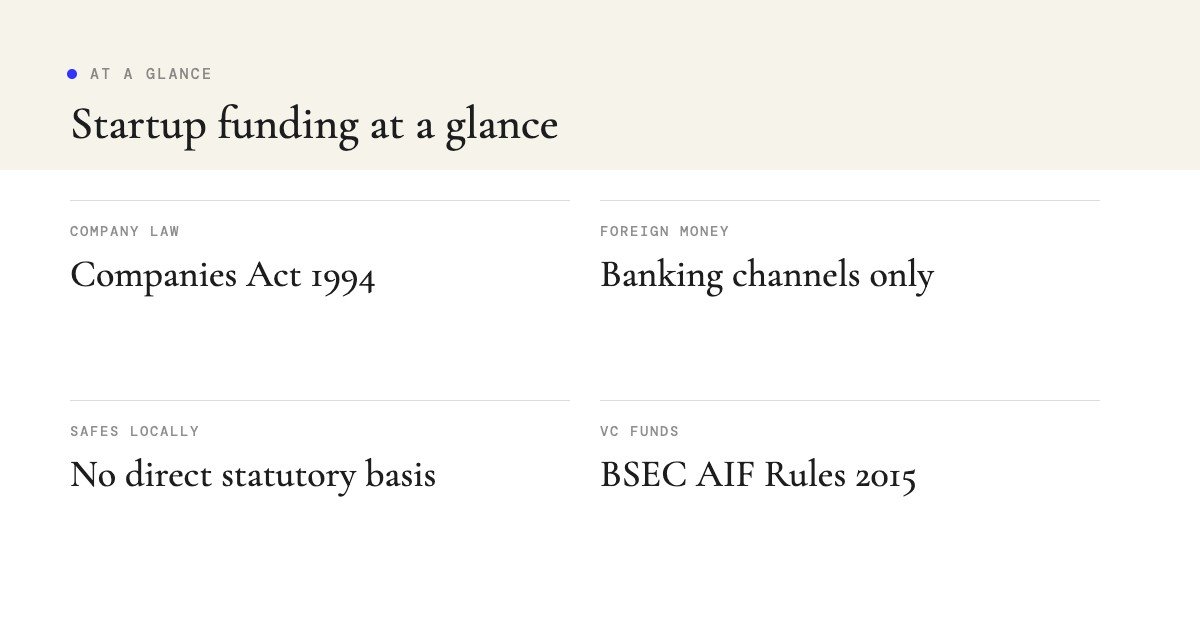
- Most local rounds use a share subscription agreement and a shareholders' agreement, with shares issued under the Companies Act 1994.
- SAFEs and convertible notes have no specific statutory basis in Bangladesh and raise foreign exchange questions when foreign investors fund a local company.
- Foreign investment must come through banking channels and be reported, so that dividends and exit proceeds can later be repatriated.
- Many venture-backed startups use a foreign holding company, often in Singapore or Delaware, with a Bangladeshi operating subsidiary.
- Investor protections, such as liquidation preferences, anti-dilution, vesting and drag and tag rights, must be drafted to be enforceable under Bangladeshi law.
The legal setting for startup funding
Bangladesh's startup ecosystem has grown with fintech, logistics, health and e-commerce ventures, supported by local angels, international venture funds and government initiatives such as Startup Bangladesh Limited and Bangladesh Bank's startup refinancing scheme. Yet the legal framework was not written for venture capital. A startup investment agreement in Bangladesh must fit company law, foreign exchange rules, tax and, for funds, BSEC regulation.
Our private equity and venture capital practice helps founders and investors structure rounds that close smoothly and hold up at exit.
Instruments compared
| Instrument | How it works locally | Key issue |
|---|---|---|
| Ordinary shares | Issued for cash at agreed price | Simple; investor rights must be contractual or in articles |
| Preference shares | Allowed if articles permit, with defined rights | Conversion and redemption terms need careful drafting |
| Convertible note | Debt converting to equity later | Foreign notes may be treated as foreign borrowing requiring compliance |
| SAFE | Right to future shares, not debt or equity | No direct legal category; foreign SAFEs into local companies are problematic |
| Holding company equity | Investment at offshore parent level | Avoids local constraints but needs outward investment and transfer pricing planning |
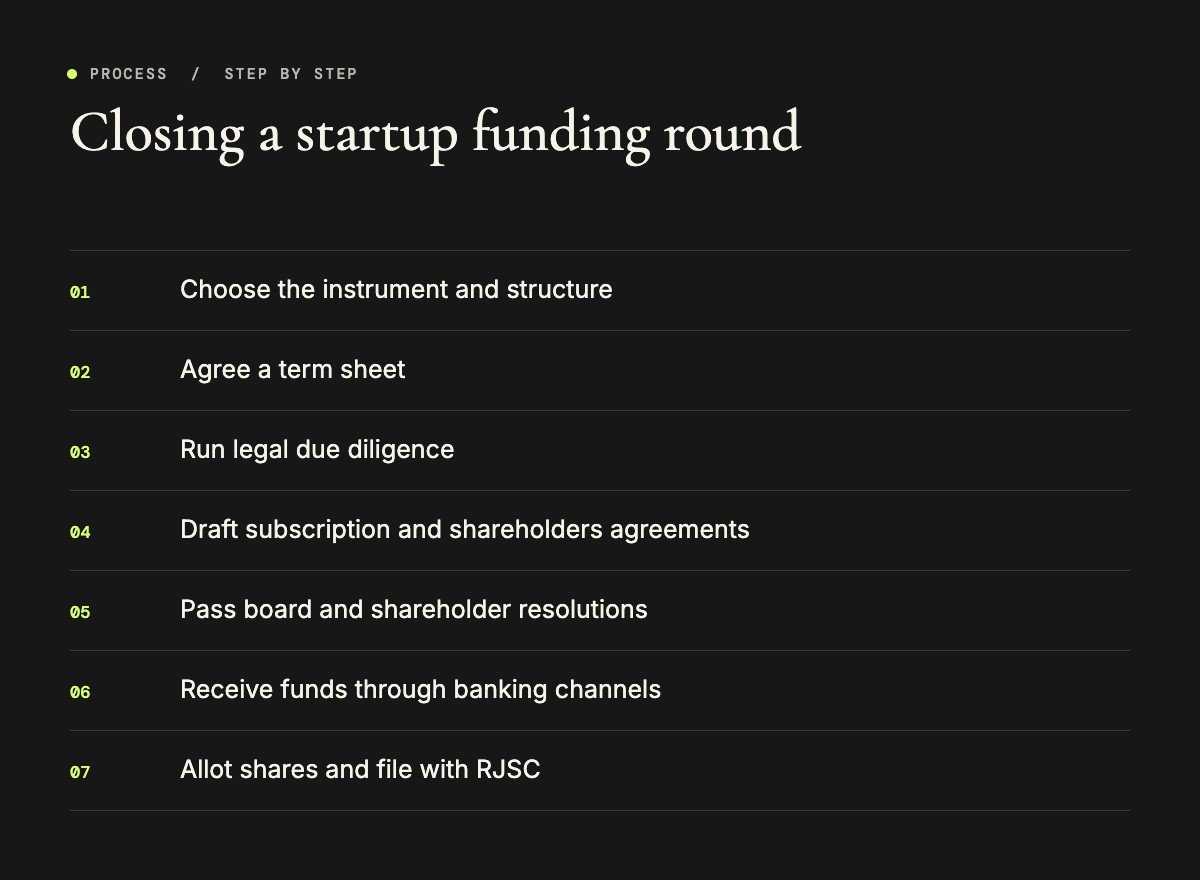
Share subscription and shareholders' agreements
A startup investment agreement in Bangladesh is usually two documents. A priced round involves The share subscription agreement sets the number and price of shares, conditions to closing, representations and warranties by the company and founders, and use of proceeds. The shareholders' agreement governs the relationship after closing: board composition, reserved matters requiring investor consent, information rights, pre-emption, transfer restrictions, drag-along and tag-along, founder vesting and exit provisions. A startup investment agreement in Bangladesh should also be reflected in amended articles of association, because courts and RJSC look first to the articles.
Put key investor rights in the articles as well as the shareholders' agreement. A right that appears only in a private contract may be hard to enforce against the company or a new shareholder, while a right in the articles binds everyone.
Convertible notes and SAFEs
Convertible instruments are a common question in any startup investment agreement in Bangladesh. Convertible notes are loans that convert into shares at a future round, often with a discount or valuation cap. When the lender is foreign, the note may be treated as foreign borrowing, subject to Bangladesh Bank rules on eligibility, interest ceilings, tenor and reporting. SAFEs, which give investors a right to future equity without being debt, have no defined place in Bangladeshi law, and banks may struggle to classify the inflow. For these reasons, foreign investors in a startup investment agreement in Bangladesh often prefer either a priced equity round in the local company or a SAFE at the level of an offshore holding company.
Local angels sometimes use convertible instruments with Bangladeshi startups. These can work as contracts, but conversion must eventually happen through a share allotment that complies with the Companies Act, and tax treatment should be checked.
Foreign exchange rules
Foreign exchange compliance is central to a startup investment agreement in Bangladesh. Foreign equity investment must come through banking channels, be converted at an authorised dealer bank and be reported, with shares issued at a price consistent with Bangladesh Bank requirements. This creates the record needed for future repatriation of dividends and exit proceeds. In March 2026, Bangladesh Bank consolidated the rules on share transfers and repatriation of sale proceeds for non-residents in unlisted companies, giving banks more autonomy. Bangladesh Bank also now allows startups to invest small amounts abroad under specific rules. A startup investment agreement in Bangladesh should include covenants requiring the company to complete all foreign exchange filings promptly.
The offshore holding structure
Structure shapes every startup investment agreement in Bangladesh. Many venture-backed Bangladeshi startups are owned by a Singapore or Delaware holding company that holds the local operating company. Investors invest in the holding company using familiar documents and instruments, and the holding company funds the local subsidiary through equity or loans. This "flip" structure simplifies fundraising and exits but creates its own issues: setting up the outward structure for Bangladeshi founders, transfer pricing, licensing of intellectual property, and ensuring the local company holds any required licences. Structuring early avoids costly restructuring later.
Key commercial terms
- Valuation and dilution. The headline term of any startup investment agreement in Bangladesh: Pre-money valuation, option pool and fully diluted capitalisation.
- Liquidation preference. Priority for investors on a sale or liquidation, which must be drafted carefully for local enforceability.
- Anti-dilution. Protection if later rounds are priced lower.
- Founder vesting. Founders' shares subject to buy-back if they leave early.
- Reserved matters. Major decisions requiring investor consent.
- Information rights. Regular financial and operational reporting.
Employee share options
ESOP terms often accompany a startup investment agreement in Bangladesh. ESOPs are widely used to attract talent, but Bangladeshi company law has no detailed ESOP regime for private companies. Options are typically granted by contract, with shares issued on exercise or held through a trust structure, and tax treatment must be considered. In offshore structures, ESOPs are usually granted at the holding company level. Clear plan rules and documentation avoid disputes with departing employees.
Legal due diligence on the startup
Before signing a startup investment agreement in Bangladesh, investors review the company's incorporation documents, share register and allotment filings, founder agreements, intellectual property ownership, key contracts, licences, employment arrangements, data protection practices and tax compliance. Common findings include shares issued without proper filings, code or brand owned by founders personally rather than the company, missing trade licences, and informal employment terms. Fixing these issues as conditions to closing protects both sides.
Founders can speed up a round by preparing a clean data room in advance, with corporate records, cap table, contracts and IP assignments ready for review.
Intellectual property and founder agreements
For technology startups, the core asset is often software, data or a brand. A startup investment agreement in Bangladesh should require founders and key developers to assign intellectual property to the company, and the company should register trademarks with the Department of Patents, Designs and Trademarks. Founder agreements should cover roles, vesting, non-compete and confidentiality obligations, keeping in mind that post-employment non-competes are limited by section 27 of the Contract Act 1872.
Sector licences and regulatory risk
Some startups operate in regulated sectors: fintech, health, education, transport and telecommunications. Investors will ask whether the business needs a licence from Bangladesh Bank, BTRC, DGHS or another regulator, or whether it operates through a licensed partner. Regulatory uncertainty affects valuation and may require specific warranties and indemnities in the startup investment agreement in Bangladesh. Building compliance into the business model from the start is the best way to reassure investors.
Exit planning
Investors plan for exit from the outset. Exit routes include trade sale to a strategic buyer, secondary sale to another investor, buy-back by the company or founders, and IPO on the stock exchange or SME platform. For local companies, the transfer of shares by foreign investors and repatriation of sale proceeds must comply with Bangladesh Bank rules, which were simplified in March 2026. Drag-along and tag-along clauses in the startup investment agreement in Bangladesh help ensure that an exit can actually be delivered when an attractive offer arrives.
Dispute resolution
Many investment agreements choose arbitration, often in Singapore or Dhaka, to resolve disputes between founders and investors. Foreign arbitral awards are enforceable in Bangladesh under the Arbitration Act 2001, and Bangladeshi courts can grant interim relief. Clear dispute resolution clauses, combined with escalation and deadlock mechanisms, reduce the risk that disagreements paralyse a young company.
Practical tips for founders
- Keep the cap table and RJSC filings accurate from day one.
- Assign all intellectual property to the company.
- Decide early whether a holding company structure is needed.
- Understand every investor right before agreeing to it.
- Make sure foreign funds arrive through proper banking channels.
- Take legal advice before signing any startup investment agreement in Bangladesh.
Tax points in a funding round
Tax rarely drives a seed round, but it matters. Share premium received by the company is generally capital, not income, though valuation and documentation should be robust. Founders selling secondary shares may face capital gains tax. Withholding tax applies to interest on convertible notes paid to non-residents. A startup investment agreement in Bangladesh should allocate responsibility for taxes arising from the transaction and require the company to remain compliant with income tax and VAT obligations.
Government and local funding sources
Local funding options include Startup Bangladesh Limited, the government-backed venture fund, Bangladesh Bank's startup refinancing scheme operated through banks, and BSEC-registered venture capital and private equity funds under the Alternative Investment Rules 2015. Each comes with its own eligibility criteria, documentation and reporting duties, which founders should reflect in their startup investment agreement in Bangladesh before accepting the money.
Frequently asked questions about startup investment agreement in bangladesh
Can a Bangladeshi startup issue a SAFE?
It can sign a contract, but SAFEs have no specific legal category, and foreign SAFEs into local companies raise foreign exchange issues. Many startups use SAFEs only at an offshore holding company.
Are convertible notes allowed?
Yes as contracts, but foreign convertible notes may be treated as foreign borrowing subject to Bangladesh Bank rules.
Do foreign investors need approval?
Equity investment generally does not need prior approval in most sectors, but funds must come through banking channels and be reported.
Should investor rights go in the articles?
Yes. Key rights should appear in both the shareholders' agreement and the articles of association.
Can a startup grant ESOPs?
Yes, usually by contract or through the holding company, with careful attention to tax and share issuance.
Why use a Singapore holding company?
It simplifies fundraising with international investors and familiar instruments, though it requires careful structuring.
How we can help
We advise founders, angels and venture funds on every startup investment agreement in Bangladesh: structuring, term sheets, due diligence, subscription and shareholders' agreements, foreign exchange compliance, offshore structures and ESOPs. Learn more about our private equity and venture capital practice and our technology and digital practice.
Raising your next round?
We structure the deal so money arrives quickly, investors are protected and your exit stays clean.
Book a consultationVenture capital practicePrimary sources: the Companies Act 1994 and Foreign Exchange Regulation Act 1947 on the Laws of Bangladesh portal; foreign exchange circulars of Bangladesh Bank; alternative investment fund rules of BSEC; company filings at RJSC.
This article is general information about Bangladeshi startup and venture law as of October 2026 and is not legal or tax advice. Foreign exchange rules and market practice change; take advice before structuring a round.


0 Comments