
The IPO process in Bangladesh turns a private company into a listed issuer whose shares trade on the Dhaka and Chittagong stock exchanges. It is regulated by the Bangladesh Securities and Exchange Commission (BSEC), takes months of preparation, and rewards companies that put their governance and accounts in order long before they file.

- BSEC's public issue rules govern eligibility, pricing, disclosure, subscription and allotment; the current rules should always be checked because they are revised from time to time.
- A private company must first convert to a public limited company under the Companies Act 1994 before offering shares to the public.
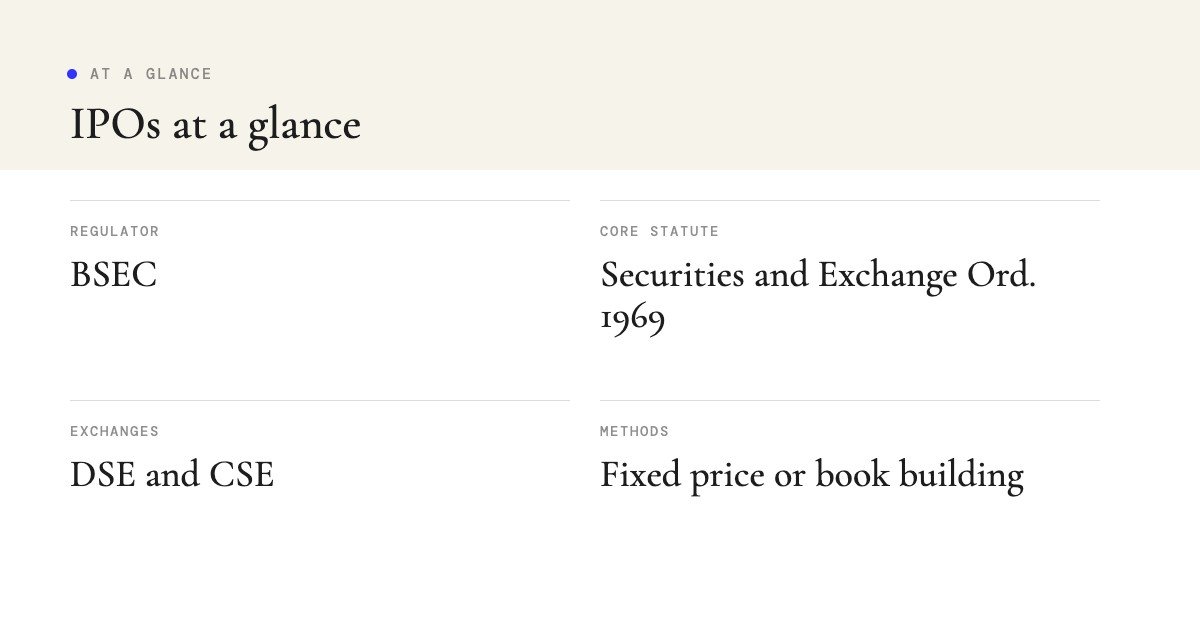
- Issuers choose between the fixed price method and the book building method, which uses bids from eligible investors to discover the price.
- The prospectus is a liability document: directors, the issue manager and experts can be held responsible for misstatements.
- Listing brings continuing obligations on disclosure, corporate governance, audit and use of IPO proceeds.
What the IPO process in Bangladesh involves
An initial public offering is the first sale of a company's shares to the general public. In Bangladesh it combines a regulatory approval from BSEC with listing approval from the stock exchanges, the Dhaka Stock Exchange (DSE) and the Chittagong Stock Exchange (CSE), and dematerialised settlement through the Central Depository Bangladesh Limited (CDBL).
The IPO process in Bangladesh is document-heavy. The company, its issue manager and its auditors prepare a prospectus that explains the business, risks, financial history, use of proceeds and valuation. BSEC reviews it, raises queries and, if satisfied, gives consent to the public issue. Subscription then opens, shares are allotted and trading begins.
Why companies go public
Listing gives access to long-term equity capital without bank debt, creates a market for shares that founders and early investors can eventually sell, raises the company's profile with customers and lenders, and can support employee share schemes. The trade-off is transparency, cost and regulatory scrutiny for as long as the company stays listed.
Legal framework for the IPO process in Bangladesh
Several layers of law apply. The core statutes are the Securities and Exchange Ordinance 1969 and the Bangladesh Securities and Exchange Commission Act 1993, which established BSEC. Under these, BSEC issues rules and notifications on public issues of securities, corporate governance and disclosure.
| Law or rule | What it governs |
|---|---|
| Securities and Exchange Ordinance 1969 | Core securities regulation, disclosure and liability |
| BSEC Act 1993 | Establishment and powers of the regulator |
| BSEC public issue rules | Eligibility, pricing methods, prospectus content, subscription and allotment |
| BSEC corporate governance code | Board composition, independent directors, committees and reporting |
| Companies Act 1994 | Conversion to public company, prospectus requirements, share capital |
| Depositories Act 1999 | Dematerialised holding and transfer through CDBL |
| DSE and CSE listing regulations | Listing conditions and continuing exchange obligations |
| Financial Reporting Act 2015 | Financial reporting standards and oversight of auditors |
BSEC has amended its public issue rules several times, and further reform of the capital market framework has been under discussion since 2024. Thresholds for paid-up capital, offer size, quota allocations and lock-in periods are especially prone to change. Treat any figure you read as a starting point and verify it against the current rules on the BSEC website.
Sector regulators also have a say. Banks, insurers, financial institutions and certain utilities need clearance from their primary regulator, such as Bangladesh Bank or the Insurance Development and Regulatory Authority, before offering shares to the public.
Eligibility and preparation before you file
BSEC's rules set eligibility conditions for an IPO on the main board, including minimum post-issue paid-up capital, a track record of commercial operations, profitability or other financial tests, and audited financial statements. A separate SME platform has lighter conditions for smaller companies. Because thresholds change, check the current numbers before planning the IPO process in Bangladesh around them.
Converting to a public limited company
Only a public company can offer shares to the public. A private company must convert under the Companies Act 1994 by special resolution, alter its articles to remove the private company restrictions, ensure it has at least the minimum number of directors and members for a public company, and file the changes with RJSC. Our guide on company formation in Bangladesh explains the RJSC filing system.
Governance clean-up
Investors and BSEC look closely at governance. Before filing, most issuers need to appoint independent directors, form audit and nomination and remuneration committees, adopt board policies, and resolve related-party arrangements with sponsors. Compliance with the BSEC corporate governance code is expected from listing onward, so building it in early saves rework. See our corporate governance practice for more.
Legal and financial house-keeping
- Regularise RJSC filings, share registers and past allotments.
- Confirm title to land and key assets, and record any mortgages.
- Renew licences, environmental clearance and tax registrations.
- Resolve or disclose material litigation and tax disputes.
- Ensure audited accounts comply with financial reporting standards and that the auditor is eligible under BSEC and FRC requirements.
The advisory team for an IPO
A Bangladeshi IPO is a team effort, and the choice of advisers affects both the timeline and the quality of the prospectus.
- Issue manager. A merchant bank registered with BSEC that prepares the prospectus, coordinates the application and liaises with the regulator. This is the central role in the IPO process in Bangladesh.
- Underwriters. Registered entities that commit to take up unsubscribed shares, where underwriting is required under the rules.
- Auditors. Prepare audited financial statements and certifications included in the prospectus.
- Valuer. Where required, values assets that support the offer price.
- Credit rating agency. Some issues, particularly book building, require a credit rating.
- Legal counsel. Conducts legal due diligence, drafts legal sections of the prospectus, reviews material contracts and advises on liability.
- Registrar to the issue. Handles applications, allotment and refunds alongside the exchanges and CDBL.
Fixed price and book building methods
BSEC's rules allow two pricing methods, and the choice shapes the whole IPO process in Bangladesh.
| Feature | Fixed price method | Book building method |
|---|---|---|
| How the price is set | Issuer and issue manager fix it, usually at or near face value, subject to BSEC review | Discovered through bids from eligible investors in a bidding process |
| Typical issuer | Smaller or newer companies | Larger companies seeking a premium to face value |
| Role of eligible investors | Subscribe at the fixed price within their quota | Bid during a roadshow and bidding period to set the cut-off price |
| Valuation scrutiny | Lower, since price is near face value | Higher; valuation reports and justifications are reviewed closely |
Eligible investors are institutional and other qualifying investors defined under BSEC rules, such as banks, mutual funds, insurers and merchant banks. The general public subscribes at the fixed price or at a price linked to the cut-off price, depending on the method. Quotas for eligible investors, general public and non-resident Bangladeshis are set by the rules and have changed over time.
The prospectus
The prospectus is the heart of the IPO process in Bangladesh. It must give investors the information they need to make an informed decision and must follow the content requirements in BSEC's rules.
What the prospectus covers
- Business description, history, products and markets.
- Risk factors and management's view of how they are mitigated.
- Audited financial statements, ratios and management discussion.
- Capital structure, sponsors, directors and their interests.
- Use of IPO proceeds with an implementation schedule.
- Valuation and justification of the offer price.
- Material contracts, litigation and related-party transactions.
- Lock-in arrangements for sponsors and pre-IPO shareholders.
Liability for the prospectus
Directors, the issuer, the issue manager and experts who consent to inclusion of their reports can face civil and regulatory liability for untrue or misleading statements, under both the Securities and Exchange Ordinance 1969 and the Companies Act 1994. BSEC has fined issuers and intermediaries for disclosure failures and has the power to cancel consent. Careful verification, with every material statement traced to a source document, is the best defence.
BSEC review and approval timeline
Once the application is filed with BSEC and the exchanges, the review typically involves several rounds of queries on financial statements, valuation, use of proceeds and risk disclosures. The exchanges also review the application and send their observations. For book building, eligible investor bidding happens after BSEC approves the bidding, and the final prospectus follows the cut-off price.
BSEC's rules set time limits for some stages of its review, but the overall elapsed time depends largely on how quickly the issuer answers queries. In practice, the IPO process in Bangladesh often takes many months from first filing to listing, and longer where the company is in a regulated sector or the market is volatile. A realistic plan allows six to twelve months of preparation before filing as well.
The most common cause of delay we see is financial statements going stale. If BSEC review drags past the date on which audited accounts must be refreshed, the prospectus has to be updated with new figures and re-reviewed. Plan the filing so that the audit cycle leaves enough headroom.
The IPO process in Bangladesh, step by step
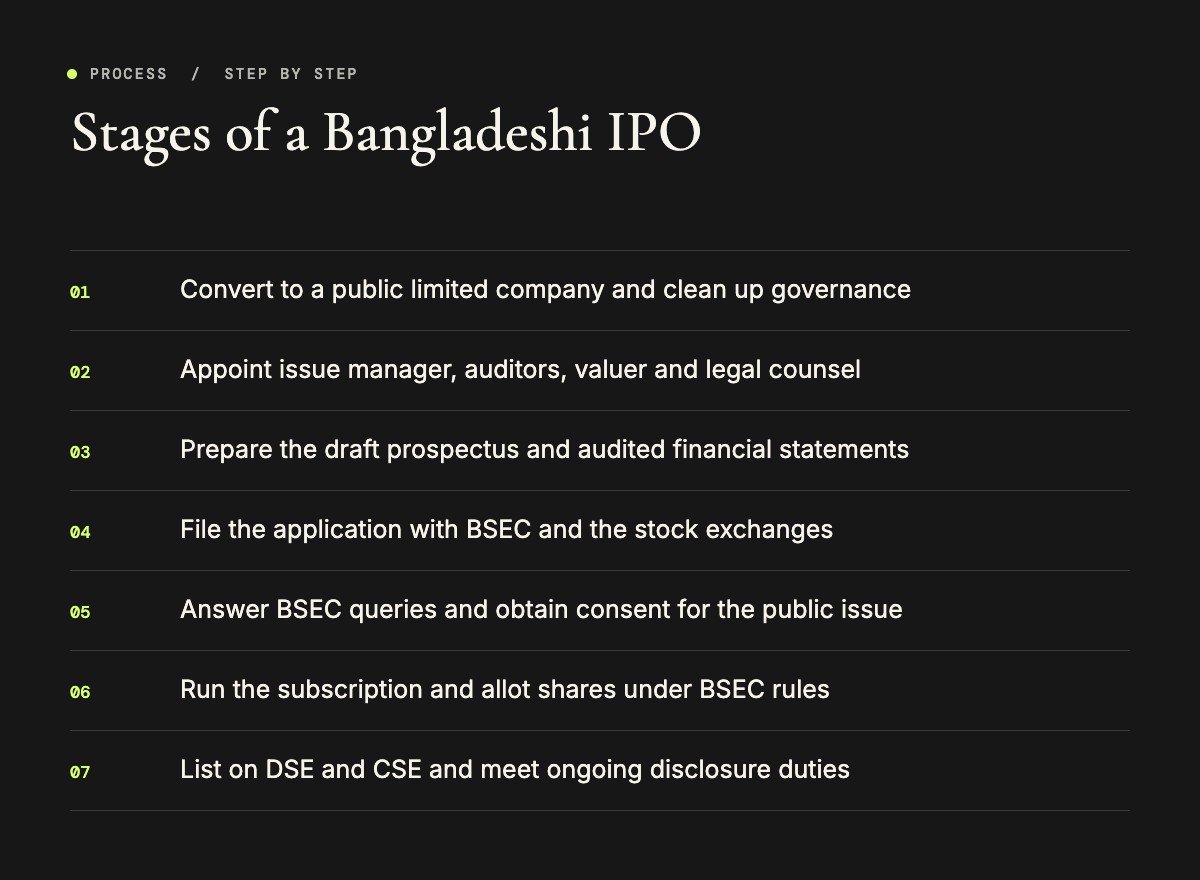
- Prepare the company. Convert to a public limited company, adopt governance structures, regularise records and complete audits.
- Appoint advisers. Engage an issue manager, underwriters where required, auditors, legal counsel and other experts.
- Draft the prospectus. Prepare the draft with supporting due diligence, valuation and auditor certifications.
- File the application. Submit to BSEC and the exchanges with the prescribed documents and fees under the current schedule.
- Obtain consent. Respond to queries and, for book building, run the eligible investor bidding to set the price; BSEC then issues its consent letter.
- Run the subscription. Publish the prospectus or abridged version, open subscription through the exchanges' electronic system, and allot shares under BSEC rules.
- List and trade. Credit shares to investors' BO accounts through CDBL, obtain listing approval and begin trading on DSE and CSE.
Subscription, allotment and listing
Subscriptions are now made electronically through stockbrokers and merchant bankers using investors' beneficiary owner (BO) accounts, which reduced the paper-based delays of earlier years. Where an issue is oversubscribed, allotment follows the method set out in the current BSEC rules, which has varied between lottery and pro rata allocation in different periods.
After allotment, shares are credited to investors' BO accounts through CDBL and the exchanges approve listing. Sponsors' and certain pre-IPO shareholders' shares are subject to lock-in periods set by the rules, which restrict selling for a fixed time after listing.
Obligations after listing
The IPO process in Bangladesh does not end on the first trading day. A listed company takes on continuing duties that its board must build into its annual calendar.
- Periodic reporting. Quarterly, half-yearly and annual financial statements within the deadlines set by BSEC and the exchanges.
- Price-sensitive information. Prompt disclosure of events that could affect the share price.
- Use of proceeds. Regular reporting on how IPO money has been used against the prospectus plan, with auditor certification.
- Corporate governance. Annual compliance reporting under the corporate governance code.
- Insider trading. Controls to prevent directors and staff dealing on unpublished information, which is prohibited under BSEC rules.
- Dividends and AGMs. Declaration and distribution of dividends and holding meetings within the time limits.
Failures can lead to fines, trading restrictions or a move to a weaker market category. Our BSEC regulatory work covers both listing and post-listing compliance.
Costs and budgeting for an IPO
Companies often underestimate the cost of going public, because much of it falls before any money is raised. A realistic budget for the IPO process in Bangladesh includes several categories, each of which should be agreed in engagement letters at the outset.
- Regulatory and exchange fees. Application, consent and listing fees payable to BSEC and the exchanges, plus CDBL charges. These are set by the current fee schedules and usually scale with issue size.
- Issue management and underwriting. Fees to the issue manager and underwriters, typically agreed as a percentage or fixed amount within any limits set by BSEC.
- Professional fees. Auditors, legal counsel, valuer and credit rating agency.
- Governance costs. Independent directors' fees, company secretary and compliance staff, and board training.
- Publication and roadshow. Printing, newspaper publication of the abridged prospectus and investor presentations.
IPO expenses must be disclosed in the prospectus, so a clear budget also feeds directly into the disclosure. Tax treatment of listing expenses and any reduced corporate tax rate for listed companies is set by the Income Tax Act 2023 and each year's Finance Act; check the current position with your tax adviser rather than assuming the benefit continues.
Alternatives to a full main board IPO
A full IPO is not the only way to raise equity or create liquidity. Depending on size and goals, a company may consider other routes before, or instead of, the IPO process in Bangladesh.
SME platform listing
Smaller companies can raise capital from qualified investors and list on the SME boards of DSE and CSE under BSEC's separate rules for small capital companies. Eligibility, disclosure and investor participation are lighter than on the main board, and a company can later migrate to the main board if it meets the conditions.
Private placement and pre-IPO rounds
Many issuers raise a pre-IPO placement from institutional or strategic investors to strengthen the balance sheet and support valuation. Private placements of a company's securities are themselves regulated, and BSEC consent or compliance with its rules may be required, especially when the company plans to list soon afterwards. Pre-IPO shares are generally subject to lock-in after listing.
Debt and hybrid instruments
Companies that need capital but are not ready for equity scrutiny can consider bonds, sukuk or preference shares, which also require BSEC approval when offered beyond a limited circle. Our debt capital markets team advises on these instruments.
Common mistakes in the IPO process in Bangladesh
- Starting governance too late. Appointing independent directors and committees only weeks before filing.
- Weak use-of-proceeds plans. Vague projects without quotations, approvals or timelines draw BSEC queries.
- Unresolved related-party dealings. Sponsor-owned premises and supply arrangements not on arm's-length terms.
- Aggressive valuation. Book building prices that cannot be justified against peers and fundamentals.
- Stale accounts. Audit timing that forces repeat review.
Frequently asked questions about IPO process in Bangladesh
How long does the IPO process in Bangladesh take?
Preparation often takes six to twelve months, and BSEC review and subscription can take several more months. Well-prepared issuers that respond quickly to queries move fastest.
Can a private limited company go public directly?
No. It must first convert to a public limited company under the Companies Act 1994 and meet BSEC eligibility rules before applying.
What is the difference between fixed price and book building?
Under fixed price, the issuer sets the price. Under book building, eligible investors bid and the cut-off price is discovered through that process, usually for larger issuers seeking a premium.
Is there a listing route for smaller companies?
Yes. The exchanges operate an SME platform with lighter eligibility conditions, governed by separate BSEC rules for qualified investor offers.
Can sponsors sell their shares after listing?
Only after the lock-in period set by BSEC rules expires, and subject to disclosure requirements and any minimum holding rules for sponsors and directors.
How we can help
We advise issuers, sponsors and issue managers through the IPO process in Bangladesh, from conversion and governance restructuring to legal due diligence, prospectus drafting and BSEC queries, and on compliance after listing. Learn more about our capital markets practice.
Considering a public listing?
We assess IPO readiness, prepare the company and its documents, and work with your issue manager through BSEC review to listing.
Book a consultationCapital markets practicePrimary sources: rules and notifications from the Bangladesh Securities and Exchange Commission; listing regulations of the Dhaka Stock Exchange and Chittagong Stock Exchange; statutes on the Laws of Bangladesh portal.
This article is general information about Bangladeshi law as of 2026 and is not legal advice. BSEC rules, thresholds and procedures change; confirm current requirements with BSEC, the exchanges or a qualified lawyer before acting.


0 Comments