
Winning abroad is only half the job. To turn a foreign arbitral award in Bangladesh into money, you must persuade a Dhaka court to enforce it under the Arbitration Act 2001 and the New York Convention, then execute it against assets that the debtor will often try to move or hide.
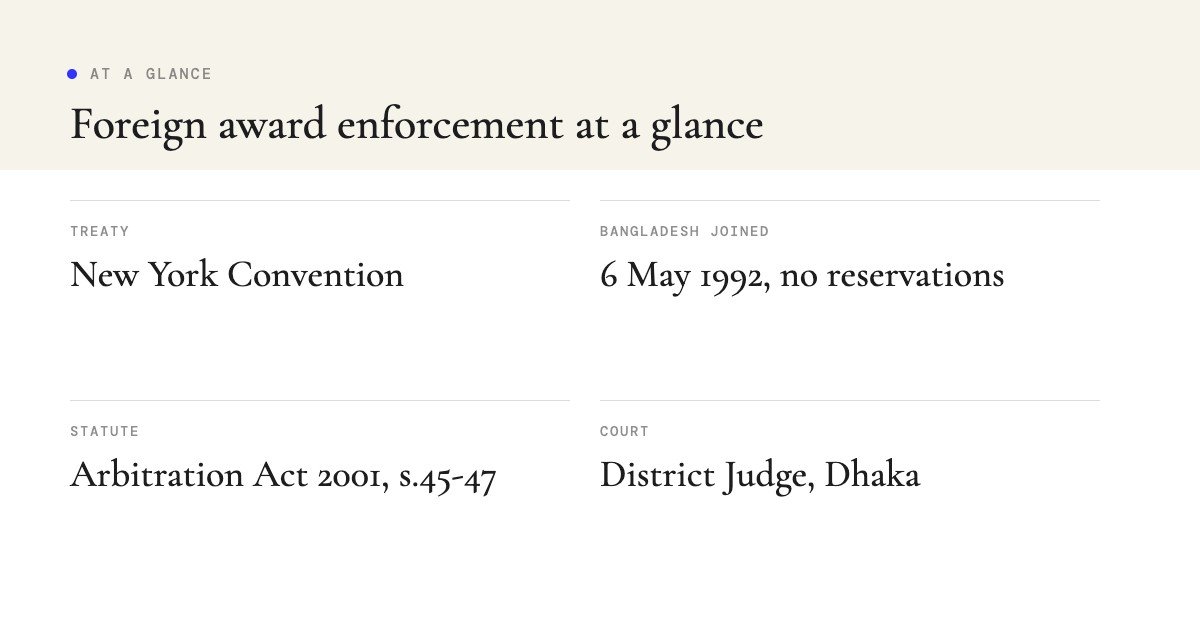
- Bangladesh acceded to the New York Convention on 6 May 1992 without reservations, and gives effect to it through sections 45 to 47 of the Arbitration Act 2001.
- Under section 45, a foreign award is enforced by the Court of the District Judge, Dhaka, by execution under the Code of Civil Procedure 1908 as if it were a decree of that court.
- Enforcement can be refused only on the limited grounds in section 46, which follow Article V of the Convention, including public policy.
- Courts do not re-hear the merits, but debtors use objections, appeals and stays to delay, so asset tracing and early interim relief matter.
- Recovered funds are remitted abroad through the banking system under foreign exchange rules, so plan the payment route early.
Why enforcing a foreign arbitral award in Bangladesh matters
Foreign investors, lenders, EPC contractors, shipowners and commodity traders routinely contract with Bangladeshi companies on terms that send disputes to ICC, SIAC, LCIA or London Maritime Arbitrators' Association arbitration. When the Bangladeshi party loses and does not pay, the creditor needs a Bangladeshi court order to enforce the foreign arbitral award in Bangladesh, because the debtor's factories, bank accounts, receivables and real estate are all in Bangladesh.
The good news is that the legal route is clear and pro-enforcement on paper. The challenge is practical: time, procedural objections and assets that disappear while the case is pending. A well-prepared application, filed fast and backed by intelligence about where the money is, changes the outcome.
Which awards count as foreign
The Arbitration Act 2001 applies mainly to arbitrations seated in Bangladesh. Section 3 provides that where the place of arbitration is outside Bangladesh, the Act does not apply except for sections 45 to 47, which deal with recognition and enforcement of foreign awards. An award made by a tribunal seated in Singapore, London, Paris, Dubai or Hong Kong is therefore treated as a foreign arbitral award in Bangladesh and enforced under those sections, regardless of the nationality of the parties.
The Act's foreign award regime is built on the New York Convention. If your award was made in a country that is not a Convention state, take advice before filing, because the section 45 route may not be available and you may need to sue on the award instead.
The legal framework: Convention, Act and Code
Three instruments work together whenever a creditor seeks to enforce a foreign arbitral award in Bangladesh.
| Instrument | What it does | Key provisions |
|---|---|---|
| New York Convention 1958 | Obliges Bangladesh to recognise and enforce awards made in other contracting states | Articles III to V |
| Arbitration Act 2001 | Domestic law giving effect to the Convention | Sections 3, 45, 46, 47 and 48 |
| Code of Civil Procedure 1908 | Machinery for executing the award as a decree | Section 51 and Order XXI |
| Foreign Exchange Regulation Act 1947 | Controls remittance of recovered funds out of Bangladesh | Remittance through authorised dealer banks |
Section 45: the core enforcement rule
Section 45(1)(a) makes a foreign award binding for all purposes between the parties, so it can also be relied on as a defence or set-off in Bangladeshi proceedings. Section 45(1)(b) provides that the award shall, on application by a party, be enforced by execution by the Court of the District Judge, Dhaka, under the Code of Civil Procedure in the same manner as if it were a decree of that court.
That single court for every foreign arbitral award in Bangladesh is a deliberate choice. It concentrates experience in Dhaka and avoids arguments about territorial jurisdiction. Where assets are located elsewhere in the country, the Dhaka court can transfer the decree for execution under the ordinary Code of Civil Procedure rules.
A note on the new commercial courts
The Commercial Court Ordinance 2026 created specialised commercial courts for a long list of business disputes. Section 45 continues to name the District Judge, Dhaka, and the Ordinance did not amend the Arbitration Act 2001. Some commentators expect enforcement applications to move to the commercial court in Dhaka over time. Until a clear statutory provision or practice direction settles this, file where section 45 directs and check the current position, including whether Parliament has re-enacted the Ordinance.
Documents you need to enforce a foreign arbitral award in Bangladesh
Section 45(2) requires the applicant to produce the original award or a duly authenticated copy, the original arbitration agreement or a duly certified copy, and evidence that the award is a foreign award. Section 45(3) adds that where any document is in a language other than English or Bangla, a translation into English certified in the prescribed manner must be filed.
In practice, when we enforce a foreign arbitral award in Bangladesh, we also file a copy of the request for arbitration and procedural orders showing that the debtor was notified, any correspondence showing the debtor participated, the tribunal's decision on costs, and an affidavit explaining the calculation of the sum claimed with interest to date. These are not strict legal requirements, but they answer the most common objections before they are raised.
Have the award and agreement notarised and legalised in the country of the seat, ideally through the Bangladesh mission there, before the originals leave the tribunal or the institution. Arranging authentication after the debtor has filed objections wastes weeks.
The enforcement process, step by step
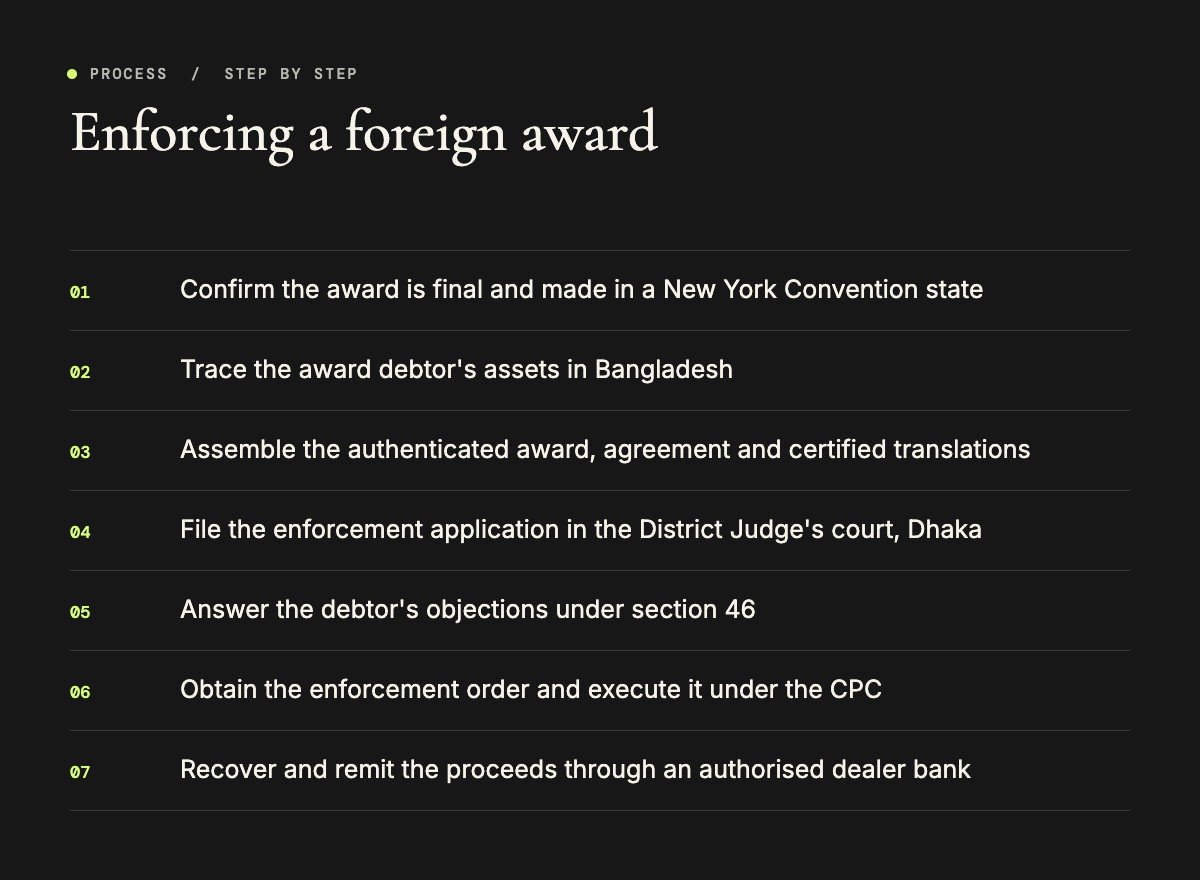
A typical application to enforce a foreign arbitral award in Bangladesh follows the sequence below. The timing depends heavily on the debtor's response and the court's list.
- Check the award. Confirm that it is final and binding, identify every award debtor by its correct Bangladeshi legal name, and check whether any set-aside proceedings are pending at the seat.
- Trace assets. Identify bank accounts, receivables from local customers, land, vehicles, shares and export proceeds. Public records at RJSC and land offices, and commercial intelligence, are the usual starting points.
- Prepare the papers. Collect the authenticated award and agreement, certified translations and supporting affidavit, and calculate interest and costs to the filing date.
- File the application. Present the enforcement application in the Court of the District Judge, Dhaka, paying the court fee required by the current schedule, and consider an application for attachment before judgment at the same time.
- Serve and respond. The court issues notice to the award debtor, who may file objections under section 46. Reply with evidence, not just argument.
- Obtain the order. If no ground for refusal is proved, the court allows enforcement and the award becomes executable as a decree.
- Execute and remit. Use Order XXI of the Code of Civil Procedure to attach accounts, garnish receivables or sell property, then remit the recovered sums abroad through an authorised dealer bank.
Grounds for refusing enforcement under section 46
A debtor resisting a foreign arbitral award in Bangladesh can succeed only by proving one of the grounds listed in section 46(1), which mirror Article V of the Convention. The burden is on the party resisting enforcement for the first group; the court may raise the last two on its own.
| Ground | What the debtor must show | How creditors usually answer |
|---|---|---|
| Incapacity | A party lacked capacity to make the agreement | Board approvals and authority documents |
| Invalid agreement | The arbitration agreement is invalid under its governing law | Signed contract, conduct in the arbitration |
| No proper notice | The debtor was not notified or could not present its case | Proof of service and participation |
| Excess of jurisdiction | The award deals with matters outside the submission | Terms of reference and pleadings |
| Irregular tribunal or procedure | Composition or procedure departed from the agreement or seat law | Institutional rules and procedural orders |
| Award not binding or set aside | Award suspended or annulled at the seat | Evidence of finality; security if stay sought |
| Not arbitrable | Subject matter cannot be arbitrated under Bangladeshi law | Commercial nature of the dispute |
| Public policy | Enforcement would conflict with the public policy of Bangladesh | Narrow interpretation in the case law |
How narrow is public policy?
Public policy is the ground most often pleaded and least often proved. The Appellate Division has described the concept narrowly, linking it to patent illegality that goes to the root of the matter or an outcome that shocks the conscience of the court, rather than simple errors of fact or law. A debtor that argues the tribunal misread the contract is asking for a review of the merits, which section 46 does not allow.
Pending challenges at the seat
If the debtor has applied to set aside the award at the seat, the Dhaka court may adjourn enforcement and, as under Article VI of the Convention, may order the debtor to provide suitable security. Creditors should press for security whenever an adjournment is sought, because it converts a delaying tactic into a protected position.
Appeals, delay tactics and interim protection
Under section 48 of the Arbitration Act 2001, an appeal lies to the High Court Division against certain orders of the District Judge, including orders on enforcement of foreign awards. Debtors resisting a foreign arbitral award in Bangladesh also file civil revisions and, occasionally, writ petitions. Each step can add months.
Protecting assets while the case runs
The extent to which section 7A of the Act supports interim relief for a foreign-seated arbitration has been contested, and High Court Division decisions have read it narrowly before the enforcement stage. Once an enforcement application is filed, creditors can seek attachment before judgment and temporary injunctions under the Code of Civil Procedure where there is evidence that the debtor is removing or disposing of assets.
Evidence is everything. A bare allegation that the debtor might move money rarely succeeds. Bank transfer patterns, asset sales to related companies or the closure of accounts after the award are the kind of facts courts act on.
Anti-arbitration injunctions: a lesson from history
Under the old Arbitration Act 1940, Bangladeshi courts sometimes restrained foreign arbitrations. In Saipem v Bangladesh, an ICSID tribunal held in 2009 that court orders revoking the authority of an ICC tribunal breached the Italy-Bangladesh investment treaty. The 2001 Act and later case law have moved the system decisively towards supporting arbitration, but the episode explains why careful creditors still structure contracts with seat, institution and investment treaty protection in mind.
Enforcing against state entities and state-owned companies
Many large awards in Bangladesh are against state-owned enterprises in power, gas, telecoms and aviation. The Arbitration Act 2001 has no provision allowing a state entity to plead sovereign immunity against enforcement of a foreign arbitral award in Bangladesh, and statutory corporations are generally treated as separate legal persons that can be sued and executed against.
Practical obstacles remain. Assets may be public property or held in accounts that require ministry approval to release, and payment often depends on budget allocation. Negotiated settlement backed by a court order is common, and the strength of the enforcement case is what brings the counterparty to the table. Where the counterparty is the Government itself, the Code of Civil Procedure contains special rules on executing decrees against the Government that delay execution.
Foreign award or foreign judgment: which is easier?
Creditors sometimes hold both a foreign judgment and an award, or can choose between litigation and arbitration when drafting. The comparison shows why a foreign arbitral award in Bangladesh is usually easier to enforce than a foreign judgment.
| Issue | Foreign arbitral award | Foreign court judgment |
|---|---|---|
| Legal basis | Arbitration Act 2001, sections 45 to 47 | Code of Civil Procedure, sections 13 and 44A |
| Countries covered | All New York Convention states | Direct execution only for notified reciprocating territories |
| Route | Enforcement application in Dhaka | Execution petition, or a fresh suit for non-reciprocating countries |
| Review of merits | No, only section 46 grounds | Conclusiveness tests under section 13 |
Few major trading partners are notified as reciprocating territories, so a judgment from London, Singapore or New York usually requires a fresh suit in Bangladesh in which the judgment is evidence. An award from the same city goes straight to enforcement.
Interest, currency and getting the money out
Awards are usually expressed in US dollars or another foreign currency, with post-award interest. Execution proceeds are realised in taka. The application should state how the sum is to be converted and ask the court to direct payment of the decretal amount with interest to the date of payment.
Remitting the proceeds abroad is a foreign exchange transaction. Funds pass through an authorised dealer bank under the Foreign Exchange Regulation Act 1947 and Bangladesh Bank's foreign exchange guidelines, and the bank will want the court order, the award and evidence of the creditor's identity. Discuss the route with the bank before the money is released, so that it does not sit in a court account for months.
Common mistakes when enforcing a foreign arbitral award in Bangladesh
- Waiting too long. The Act sets no special time limit, and the period under the Limitation Act 1908 has been argued in different ways. Treat enforcement as urgent and file promptly.
- Wrong debtor name. An award against a group name rather than the registered Bangladeshi company invites objections.
- Poor authentication. Unauthenticated copies and uncertified translations give the debtor an easy first objection.
- No asset plan. An enforcement order without a target asset is only paper.
- Ignoring security. Failing to ask for security when the debtor seeks an adjournment hands it free time.
Frequently asked questions about foreign arbitral award in Bangladesh
Which court enforces a foreign award?
Section 45 of the Arbitration Act 2001 names the Court of the District Judge, Dhaka. The award is enforced by execution under the Code of Civil Procedure as if it were a decree of that court. Check whether the new commercial courts have taken over this work before filing.
Will the court look again at the merits of the dispute?
No. Enforcement may be refused only on the grounds in section 46, such as lack of notice, excess of jurisdiction or conflict with public policy. An argument that the tribunal got the facts or law wrong is not a ground.
Can I enforce an award from a non-Convention country?
The section 45 regime is built on the New York Convention. For an award from a non-Convention state, take advice; you may need to sue on the award as a contract claim instead.
How long does enforcement take?
An unopposed application to enforce a foreign arbitral award in Bangladesh can move relatively quickly, but contested cases with appeals can run for a year or more. Early asset protection and a complete application are the best ways to shorten it.
Can a state-owned company claim immunity?
The Act contains no immunity defence at enforcement, and statutory corporations are generally separate legal persons. Practical issues around public assets and budget approvals still affect recovery.
How we can help
We act for creditors and debtors in proceedings to enforce or resist a foreign arbitral award in Bangladesh, from authentication and filing to asset tracing, attachment and remittance of proceeds. We also advise at the drafting stage on seat, institution and enforcement strategy. Learn more about our enforcement of awards practice, our work in international arbitration, and our guide to the arbitration process.
Holding an unpaid award against a Bangladeshi party?
We assess enforceability, trace assets and run the Dhaka enforcement application through to recovery.
Book a consultationEnforcement of awardsPrimary sources: the Arbitration Act 2001 and Code of Civil Procedure 1908 on the Laws of Bangladesh portal; contracting states and texts from the New York Convention site; the Model Law from UNCITRAL; judgments from the Supreme Court of Bangladesh.
This article is general information about Bangladeshi law as of 2026 and is not legal advice. Court procedures, fees and foreign exchange rules change; confirm the current position with a qualified lawyer before acting.




0 Comments