
A construction dispute in Bangladesh almost always turns on three questions: who caused the delay, who pays for the defects, and whether extra work was properly instructed. The answers depend less on the building than on the contract, the notices served and the records kept while the project was running.
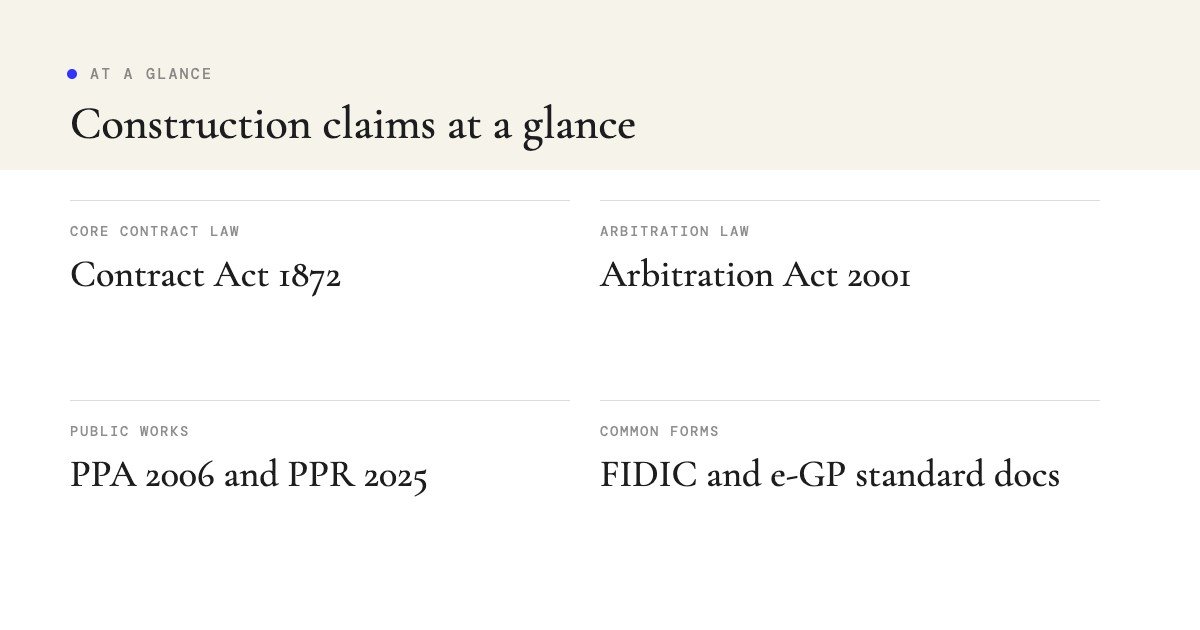
- A construction dispute in Bangladesh is usually decided under the Contract Act 1872, the contract form chosen (often FIDIC or a PPR standard document) and, if there is an arbitration clause, the Arbitration Act 2001.
- Notice clauses and time bars decide more claims than engineering arguments. Missing a 28-day notice under a FIDIC contract can cost a contractor its entire entitlement.
- Liquidated damages are recoverable only as reasonable compensation up to the agreed figure under section 74 of the Contract Act 1872, and an employer who causes delay may lose the right to deduct them.
- Public works are governed by the Public Procurement Act 2006 and the Public Procurement Rules 2025, which took effect on 28 September 2025.
- Commercial courts created by the Commercial Court Ordinance 2026 list construction and infrastructure contracts, including tenders, among the disputes they hear.
What a construction dispute in Bangladesh usually involves
Bangladesh has spent the last fifteen years building at scale: expressways, power plants, metro rail, ports, garment factories, hospitals and thousands of residential towers in Dhaka and Chattogram. Wherever there is that much concrete, there are claims. In our experience, nearly every construction dispute in Bangladesh falls into one of four families.
- Delay. The project finished late. The contractor wants more time and money; the employer wants liquidated damages.
- Defects. Work does not meet the specification, the drawings or the Bangladesh National Building Code 2020, and someone must pay to fix it.
- Variations. The scope changed, and the parties disagree on whether the change was instructed and what it is worth.
- Payment and security. Certificates are unpaid, retention is withheld, or a performance guarantee is called.
These families overlap. A late project usually produces a payment dispute, and an employer facing a delay claim often answers with a defects counterclaim. Good strategy treats them together from the first letter.
The legal framework for building and infrastructure claims
There is no single construction statute in Bangladesh. Claims are built from general contract law, the contract form, sector rules and the dispute resolution law the contract chooses. The table summarises the sources we rely on most often.
| Source | What it governs | Why it matters in a claim |
|---|---|---|
| Contract Act 1872 | Formation, breach, damages (s.73), liquidated damages (s.74), late performance (s.55), benefit of work done (s.70) | The default rules behind every private and public contract |
| Specific Relief Act 1877 | Injunctions and specific performance | Used to restrain guarantee calls or termination in narrow cases |
| Arbitration Act 2001 | Arbitration seated in Bangladesh, court support and enforcement of awards | Most large contracts send disputes to arbitration |
| Public Procurement Act 2006 and Rules 2025 | Tendering, award, contract administration for public bodies | Mandatory for government and statutory employers |
| Bangladesh National Building Code 2020 | Structural, fire and safety standards | The benchmark for whether work is defective |
| Real Estate Development and Management Act 2010 | Developer, land-owner and flat-buyer obligations | Requires an attempt at arbitration before most suits |
| Limitation Act 1908 | Time limits for suits | Generally three years from breach for an unregistered contract |
| Commercial Court Ordinance 2026 | Specialised commercial courts and appeal benches | New first-instance forum for construction contract suits |
Standard contract forms
Donor-funded and many large private projects use FIDIC forms, either the 1999 suite or the 2017 second editions (Red, Yellow and Silver Books). Domestic public works usually use the standard tender documents issued under the procurement rules through the e-GP system. Smaller private projects often run on short, bespoke contracts that are silent on the points that matter most, which is where the Contract Act fills the gaps.
The 2025 procurement reforms
The Public Procurement Rules 2025 and the Public Procurement (Amendment) Ordinance 2025 took effect on 28 September 2025, replacing the 2008 Rules. The Bangladesh Public Procurement Authority (BPPA), which succeeded the Central Procurement Technical Unit, administers the regime. The new Rules include provisions on contract price revision for changes in taxes and law. The amendment was made by ordinance, so check whether Parliament has since re-enacted it before relying on a specific provision.
Delay claims: extension of time and liquidated damages
Delay is the most common and most expensive issue in any construction dispute in Bangladesh. The contractor's claim is usually for an extension of time (EOT), which protects it from liquidated damages, and for prolongation costs, which compensate it for the extra time on site.
Proving entitlement to more time
To win an EOT, the contractor must show that a qualifying event occurred (for example late site possession, late drawings, employer variations, unforeseeable ground conditions, or a force majeure event), that it gave notice in time, and that the event actually delayed completion. The last point needs a programme analysis, usually comparing the baseline programme with what really happened on the critical path.
Employers commonly answer with concurrency: the contractor was also late for its own reasons. Contract wording matters here. Some forms give time but not money for concurrent delay; others are silent, leaving the tribunal to apportion responsibility on the evidence.
Liquidated damages under section 74
Most contracts fix a daily or weekly rate of liquidated damages for late completion, capped at a percentage of the contract price. Under section 74 of the Contract Act 1872, the innocent party is entitled to reasonable compensation not exceeding the amount named, whether or not actual loss is proved. Bangladeshi courts, following the same statutory text as India, treat the stated figure as a ceiling rather than an automatic entitlement.
Two points often decide the outcome. First, an employer that caused part of the delay and failed to grant an EOT may be unable to rely on the completion date at all, so the right to deduct liquidated damages falls away. Second, section 55 of the Contract Act provides that if a promisee accepts late performance, it cannot claim compensation for the delay unless it gives notice of that intention when accepting. Employers who take over a building without reserving their rights in writing risk losing the claim.
When an employer takes over works that are late, the taking-over letter should expressly reserve the right to liquidated damages. When a contractor receives that letter, it should check whether its pending EOT applications have been decided, because an undecided application is often its best defence.
Defects claims: workmanship, design and the building code
In a defects-based construction dispute in Bangladesh, the question is whether the work matches what was promised. The benchmark is the contract specification and drawings, then the Bangladesh National Building Code 2020 and any approvals from RAJUK or the relevant development authority. Fire safety defects are increasingly common after inspections by the Fire Service and Civil Defence.
The defects liability period
Most contracts give the contractor a defects liability or notification period, often twelve months from taking over, during which it must return and repair defects notified to it. The employer usually holds retention money or a retention guarantee as security. The period limits the contractor's duty to return, but it does not normally extinguish the employer's right to sue for breach for defects discovered later, subject to the Limitation Act.
Design responsibility
Who designed the defective element decides who pays. Under a FIDIC Red Book the employer usually provides the design, so a design flaw is the employer's risk. Under Yellow Book or EPC terms the contractor designs and is typically bound by a fitness for purpose obligation, which is stricter than reasonable skill and care. Our guide to EPC and O&M contracts covers how that risk is allocated.
Variation claims: changed scope and extra payment
A variation is a change to the work instructed under the contract. In a construction dispute in Bangladesh about variations, the usual arguments are whether a change was instructed at all, whether it was really extra work or already within scope, and how it should be valued.
Written instructions and oral changes
Most standard forms require variations to be instructed in writing by the engineer or employer's representative. On Bangladeshi sites, many instructions are given orally at site meetings or by phone. A contractor that does the work without confirming the instruction in writing risks having no contractual claim.
Where the contract route fails, section 70 of the Contract Act 1872 may help: a person who lawfully does something for another, not intending to do so gratuitously, and the other enjoys the benefit, must compensate or restore it. Tribunals apply this cautiously where a detailed contract exists, so it is a fallback, not a strategy.
Valuing the change
Contracts usually value variations using bill of quantities rates, then pro-rata rates, then a fair valuation of cost plus margin. Disputes arise over indirect costs, the knock-on effect on the programme and price escalation. Public contracts also have internal approval thresholds for variation orders under the procurement rules, and work instructed without the required approval can be difficult to recover.
Payment, guarantees and interim relief
Unpaid interim certificates are often the trigger for a wider construction dispute in Bangladesh. Check the contract for the payment period, the right to interest on late payment, and the right to suspend or slow work after notice. Suspension without following the contract procedure can itself become a breach.
Calling performance guarantees
In almost every construction dispute in Bangladesh the contractor has given a performance security and an advance payment guarantee, usually as unconditional bank guarantees. Bangladeshi courts generally treat them as independent of the underlying contract and will restrain payment only in narrow cases, typically established fraud or a risk of irretrievable injustice. A contractor seeking an injunction must move fast and with strong evidence; a dispute about the merits of the call is rarely enough.
Interim measures in arbitration
Where the contract has an arbitration clause and the seat is in Bangladesh, the court can grant interim measures under section 7A of the Arbitration Act 2001, and the tribunal itself can order interim measures under section 21. For a foreign-seated arbitration, court support in Bangladesh is much more limited, which is a reason to think carefully about the seat at the drafting stage.
How to build a strong claim, step by step
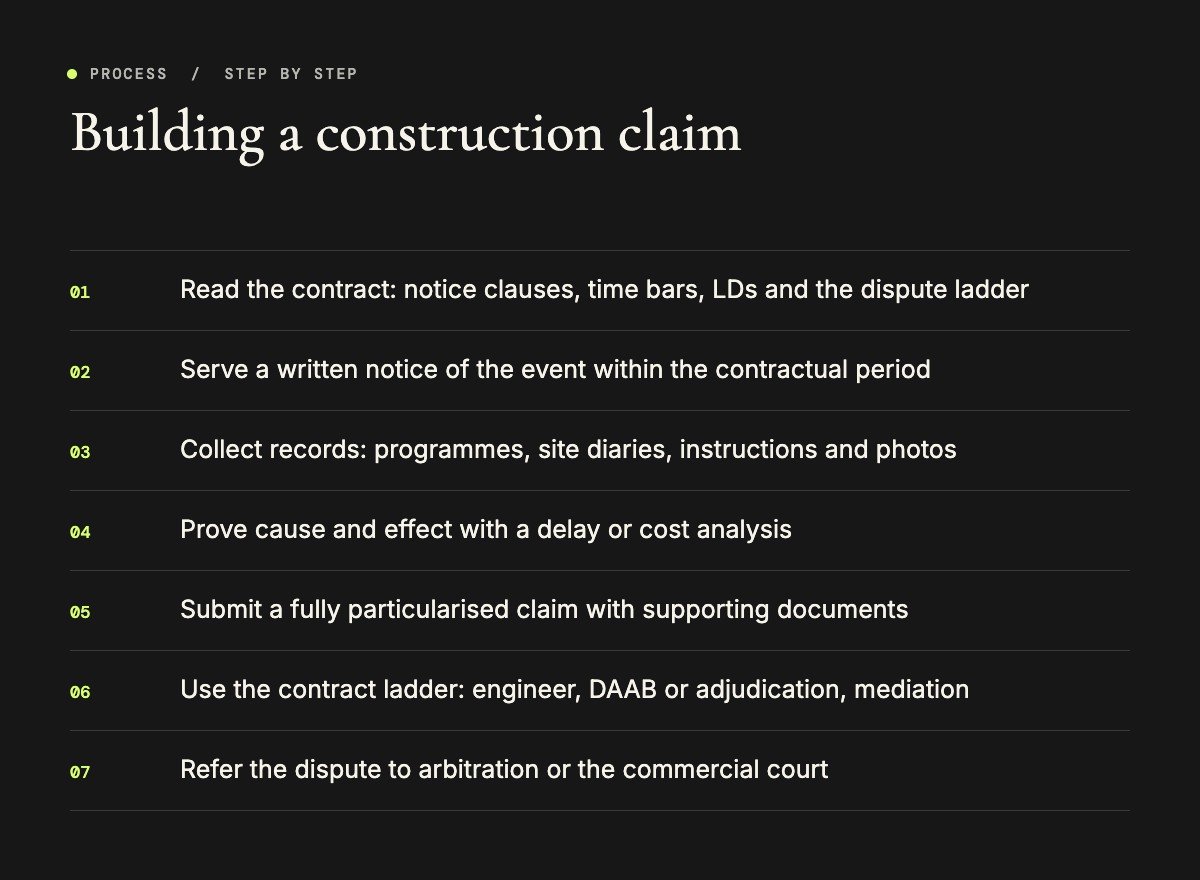
Whether you are the contractor or the employer, the process of preparing a claim in a construction dispute in Bangladesh is the same. The steps below reflect what tribunals expect to see.
- Read the contract first. Identify the notice clauses, time bars, liquidated damages provisions, variation procedure and the dispute resolution ladder before writing anything.
- Serve notice on time. Give written notice of the event within the contractual period, describing it and stating that you intend to claim. Under FIDIC that is generally 28 days from when you became aware of it.
- Gather contemporaneous records. Baseline and updated programmes, site diaries, meeting minutes, instructions, correspondence, photos, labour and plant records, and invoices.
- Prove cause and effect. Link each event to the delay or cost with a programme analysis and a quantum calculation. Assertions without analysis rarely succeed.
- Submit a particularised claim. Set out the contractual basis, facts, analysis and amount, with documents attached, within any period the contract fixes for detailed claims.
- Climb the dispute ladder. Use the engineer's determination, a dispute board or adjudication, and negotiation or mediation, as the contract requires. Skipping a mandatory step can delay or defeat a later reference.
- Refer the dispute. Start arbitration or a suit within the contractual and statutory time limits, with the claim file ready.
Where to resolve a construction dispute in Bangladesh
The forum for a construction dispute in Bangladesh is usually decided by the contract. If there is a valid arbitration clause, a party sued in court can apply under section 10 of the Arbitration Act 2001, before filing its written statement, for the suit to be stayed and the parties referred to arbitration. The court must refer unless the agreement is void, inoperative or the matter is not capable of arbitration.
| Forum | When it applies | Main advantage | Main drawback |
|---|---|---|---|
| Dispute board or adjudication | FIDIC and many EPC contracts | Fast, expert, keeps the project moving | Decision can be challenged later |
| Mediation | By agreement, or court-referred under the Code of Civil Procedure | Cheap and confidential | No binding result without settlement |
| Domestic arbitration | Arbitration clause with a Bangladesh seat | Expert tribunal, private, award enforceable as a decree | Costs and possible court challenges |
| International arbitration | Foreign contractor, foreign seat or institution | Neutral forum, New York Convention enforcement | Higher cost, limited local court support |
| Commercial court | No arbitration clause, construction or tender contract | Specialist judges and a 90-day trial target | New system, practice still developing |
The new commercial courts
The Commercial Court Ordinance 2026, published in the gazette at the start of January 2026, provides for district-level commercial courts and commercial appellate benches in the High Court Division. Construction and infrastructure contracts, including tenders, are among the listed commercial disputes, and trials are meant to finish within 90 days of the final hearing date. Because the courts are new and the law was made by ordinance, confirm whether Parliament has re-enacted it and whether a commercial court sits in your district before filing.
Arbitration after the award
An award made in Bangladesh can be challenged under section 42 of the Arbitration Act 2001 within 60 days of receipt, on the limited grounds in section 43. Domestic awards go to the District Judge; awards in an international commercial arbitration seated in Bangladesh go to the High Court Division. If no challenge succeeds, the award is enforced as a decree under section 44. Our guide to the arbitration process explains each stage of an arbitrated construction dispute in Bangladesh.
Public works: claims against government employers
A construction dispute in Bangladesh with a ministry, department or statutory body follows the same contract principles, but with extra layers. Payment depends on budget releases, variations need internal approvals, and officials are often reluctant to settle without an award or judgment that protects them from audit objections.
Tender disputes before contract award follow the complaint and review procedure under the Public Procurement Act 2006, which has strict short deadlines. Once a contract is signed, disputes go through the contract's own ladder, which in public contracts usually ends in arbitration under the Arbitration Act 2001. Writ petitions in the High Court Division are rarely available for purely contractual claims, although they remain possible where a public body acts unlawfully in the tender process.
Government employers frequently deduct liquidated damages or forfeit securities at final account stage. Respond in writing within the contract period, dispute the deduction expressly and keep the claim alive; silence is easily treated as acceptance.
Developers, land-owners and flat buyers
Residential projects generate a distinct kind of construction dispute in Bangladesh: delayed handover, missing common facilities, changes to approved plans, and conflicts between land-owners and developers over sharing arrangements. The Real Estate Development and Management Act 2010 regulates these relationships and requires the parties to try arbitration before going to court on most matters, with criminal prosecution available for certain offences.
Land-owner and developer agreements should be registered and should state clearly the handover schedule, the sharing ratio, the consequences of delay and the arbitration route. For buyers, see our guide to buying a house in Bangladesh.
Common mistakes that weaken a construction dispute in Bangladesh
- Late or vague notices. A letter saying "we reserve our rights" is not a notice of claim under most forms.
- Working on oral instructions. Always confirm instructions in writing within a day or two.
- No updated programme. Without a programme, proving critical delay is extremely difficult.
- Ignoring the dispute ladder. Jumping to arbitration before the required determination or board decision invites a jurisdiction objection.
- Destroying evidence. Remedial work done before inspection can make a defect impossible to prove.
Frequently asked questions about construction dispute in Bangladesh
Can an employer deduct liquidated damages without proving loss?
Section 74 of the Contract Act 1872 allows reasonable compensation up to the agreed amount without strict proof of loss, but the figure is a ceiling. If the employer caused delay or failed to decide extension requests, the deduction may be challenged entirely.
What happens if the contractor missed the notice deadline?
Under contracts with a strict time bar, such as FIDIC, a late notice can defeat the claim. Arguments based on waiver, the employer's own conduct or the prevention principle are sometimes available, so take advice before abandoning the claim.
Is arbitration compulsory for construction contracts?
Only if the contract contains an arbitration clause, or the parties later agree to arbitrate. Without one, a construction dispute in Bangladesh goes to the civil courts, now increasingly the commercial courts.
Can I stop a bank from paying out a performance guarantee?
Only in narrow cases. Courts treat unconditional guarantees as independent obligations and usually intervene only where there is clear fraud or a risk of irretrievable injustice.
How long do I have to bring a claim?
Check the contract first, because it may impose shorter time bars. The Limitation Act 1908 generally allows three years from breach for a suit on an unregistered contract, but the correct starting point depends on the facts.
How we can help
We advise contractors, employers, developers and consultants on every kind of construction dispute in Bangladesh, from drafting notices during the project to running arbitrations and court proceedings. We also review contracts before signature so that the notice, time bar and dispute provisions work for you. Learn more about our construction disputes practice.
Facing a delay, defect or variation claim?
We review your contract, notices and records, assess the strength of the claim and plan the fastest route to recovery.
Book a consultationConstruction disputesPrimary sources: the Contract Act 1872, Arbitration Act 2001 and Public Procurement Act 2006 on the Laws of Bangladesh portal; procurement guidance from the Bangladesh Public Procurement Authority; standard contract forms from FIDIC; judgments from the Supreme Court of Bangladesh.
This article is general information about Bangladeshi law as of 2026 and is not legal advice. Contract forms, procurement rules and court procedures change; confirm the current position and your contract's terms with a qualified lawyer before acting.

0 Comments