
An Appellate Division leave to appeal is the only way most High Court Division judgments can be taken to Bangladesh's final court. There is no automatic right of appeal: you must persuade the Appellate Division that your case raises a point worth hearing, within a strict time limit and in a tightly drafted petition.
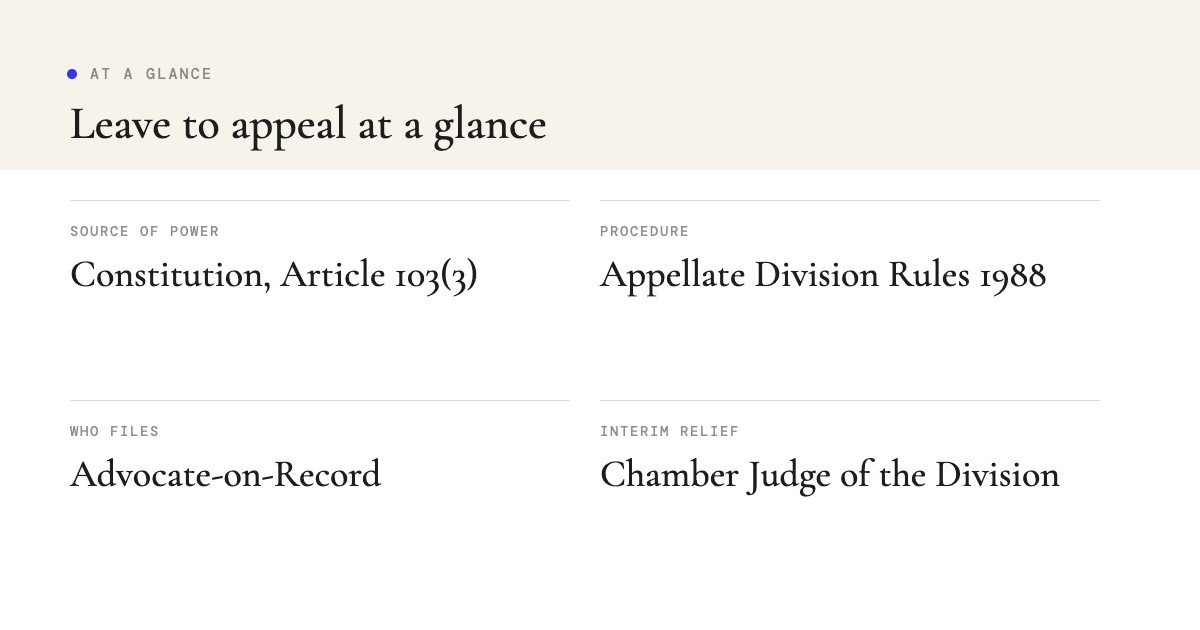
- Under Article 103(3) of the Constitution, an appeal from the High Court Division lies only with the leave of the Appellate Division, except in the limited cases listed in Article 103(2).
- A civil petition for leave to appeal (CPLA, usually numbered "C.P.") is governed by the Supreme Court of Bangladesh (Appellate Division) Rules 1988 and must be filed within the period those rules set, which is short.
- Leave is granted for substantial questions of law, conflicts with binding precedent and serious miscarriages of justice, not to re-argue facts already found twice.
- Filing a leave petition does not stay the High Court Division judgment; a stay must be sought separately, usually before the Chamber Judge.
- If leave is refused, the only remaining route is a narrow review under Article 105.
What an Appellate Division leave to appeal is
The Supreme Court of Bangladesh has two divisions. The High Court Division hears writ petitions, high-value first appeals, revisions, company matters and many statutory appeals. The Appellate Division is the final court; under Article 111 its decisions bind every court below, so access to it is deliberately limited. Article 103 of the Constitution sets the rules. A small number of cases go up as of right. Everything else needs permission, and that permission is what lawyers mean by an Appellate Division leave to appeal.
In practice, the leave stage is where most cases end. If the court decides the case does not deserve a full hearing, the petition is dismissed and the High Court Division judgment stands.
Appeal as of right compared with appeal by leave
Article 103(2) lists the cases in which an appeal lies to the Appellate Division as of right. They are cases where the High Court Division certifies that the case involves a substantial question of law as to the interpretation of the Constitution; cases where it has confirmed a sentence of death or imprisonment for life, or imposed such a sentence; cases where it has punished a person for contempt of that division; and other cases for which an Act of Parliament provides.
Article 103(3) covers everything else. An appeal from a judgment, decree, order or sentence of the High Court Division in any other case lies only if the Appellate Division grants leave. That covers the great majority of civil, commercial, writ and criminal matters.
Which decisions are usually challenged
The most common subjects of an Appellate Division leave to appeal are High Court Division judgments in writ petitions under Article 102, civil revisions under section 115 of the Code of Civil Procedure 1908, first appeals from decrees of district courts, company matters, tax references and appeals, and criminal appeals and revisions. Interlocutory orders, such as an injunction or a stay granted in a writ petition, can also be challenged, although the court is slower to interfere with orders that do not finally decide the case.
If you are new to the court system, our guide to the structure of the Supreme Court of Bangladesh explains how the two divisions fit together.
The law and rules behind a leave petition
Every Appellate Division leave to appeal rests on four layers of law. First, the Constitution: Articles 103 (appellate jurisdiction), 104 (complete justice), 105 (review) and 107 (rule-making). Second, the Supreme Court of Bangladesh (Appellate Division) Rules 1988, which set the form of petitions, the documents, the time limits and the Chamber Judge's powers.
Third, the Limitation Act 1908 still governs how time is computed. Fourth, practice directions issued by the Chief Justice and the Registrar General cover cause lists, mentioning and filing formats. They change more often than the Rules, so check the Supreme Court website before you file. The filings themselves have their own labels:
| Filing | Common label | Purpose |
|---|---|---|
| Civil Petition for Leave to Appeal | CPLA or C.P. | Asks permission to appeal a civil, writ or commercial judgment of the High Court Division |
| Civil Miscellaneous Petition | C.M.P. | Interim applications, most often for a stay of the judgment or order pending the leave petition |
| Civil Appeal | C.A. | The full appeal that is registered once leave has been granted |
| Civil Review Petition | C.R.P. | Asks the Appellate Division to review its own judgment or order under Article 105 |
| Criminal Petition for Leave to Appeal | Crl.P. | The criminal counterpart of the CPLA |
| Jail Petition | Jail P. | A petition sent through the prison authorities by a convicted person in custody |
This article focuses on the civil side, which covers most business, property, banking and administrative disputes.
Time limits for an Appellate Division leave to appeal
Time is the first thing to check. Under the Appellate Division Rules 1988, a civil petition for leave to appeal must be filed within sixty days of the judgment or order complained of. Under section 12 of the Limitation Act 1908, the time properly spent obtaining a certified copy of the judgment is excluded when the period is calculated. Criminal leave petitions have their own period under the Rules, so confirm it separately; never assume the civil period applies.
The exclusion only helps if the copy was applied for promptly, so apply on the day the judgment is pronounced or signed.
Condonation of delay
A petition filed out of time must be accompanied by an application to condone the delay, supported by an affidavit. The court expects a day-by-day explanation of the period of delay and evidence of diligence. Vague reasons such as "the file was misplaced" or "the client was abroad" rarely succeed on their own.
Government bodies sometimes receive more latitude, but even the state must give a genuine explanation. For a private party, an unexplained delay of a few weeks can end an Appellate Division leave to appeal before the merits are reached.
Diarise the deadline from the date of the judgment, not the date you receive the certified copy, and work backwards. If the copy is delayed, file an application for the copy, keep the receipt and the delivery date on record, and be ready to prove both. Those two dates are what the court will look at.
Grounds that persuade the court to grant leave
The Appellate Division is not a third court of fact. By the time a case reaches it, the facts have usually been examined twice. An Appellate Division leave to appeal succeeds when the petition shows something more than disagreement with those findings. The grounds that most often work are these:
- A substantial question of law. A real, arguable point on the meaning of a statute, the Constitution or a contract clause that affects the outcome.
- Conflict with binding precedent. The High Court Division failed to follow, or misapplied, an earlier decision of the Appellate Division, which binds it under Article 111.
- Conflicting High Court Division decisions. Different benches have taken different views, and the Appellate Division needs to settle the law.
- Misreading or non-consideration of material evidence. Not a different view of the evidence, but a clear failure to consider evidence that would have changed the result.
- Jurisdictional error. The High Court Division acted without jurisdiction or exceeded it, for example by deciding disputed facts in a writ petition.
- Breach of natural justice. A party was not heard, or the decision was made on material the party never saw.
- Public importance. The point will affect many cases, a whole sector or the public at large.
Concurrent findings of fact
Where the trial court and the first appellate court have reached the same findings of fact, the Appellate Division will rarely disturb them. A leave petition that simply re-argues the evidence is almost certain to be dismissed. If your real complaint is factual, frame it as a legal error: misreading of a document, reliance on inadmissible evidence, or a finding that no reasonable court could have reached on the record.
How to file an Appellate Division leave to appeal
The procedure is formal, and the Registry will return papers that do not comply with the Rules. The sequence below is the one we follow on a typical civil petition.
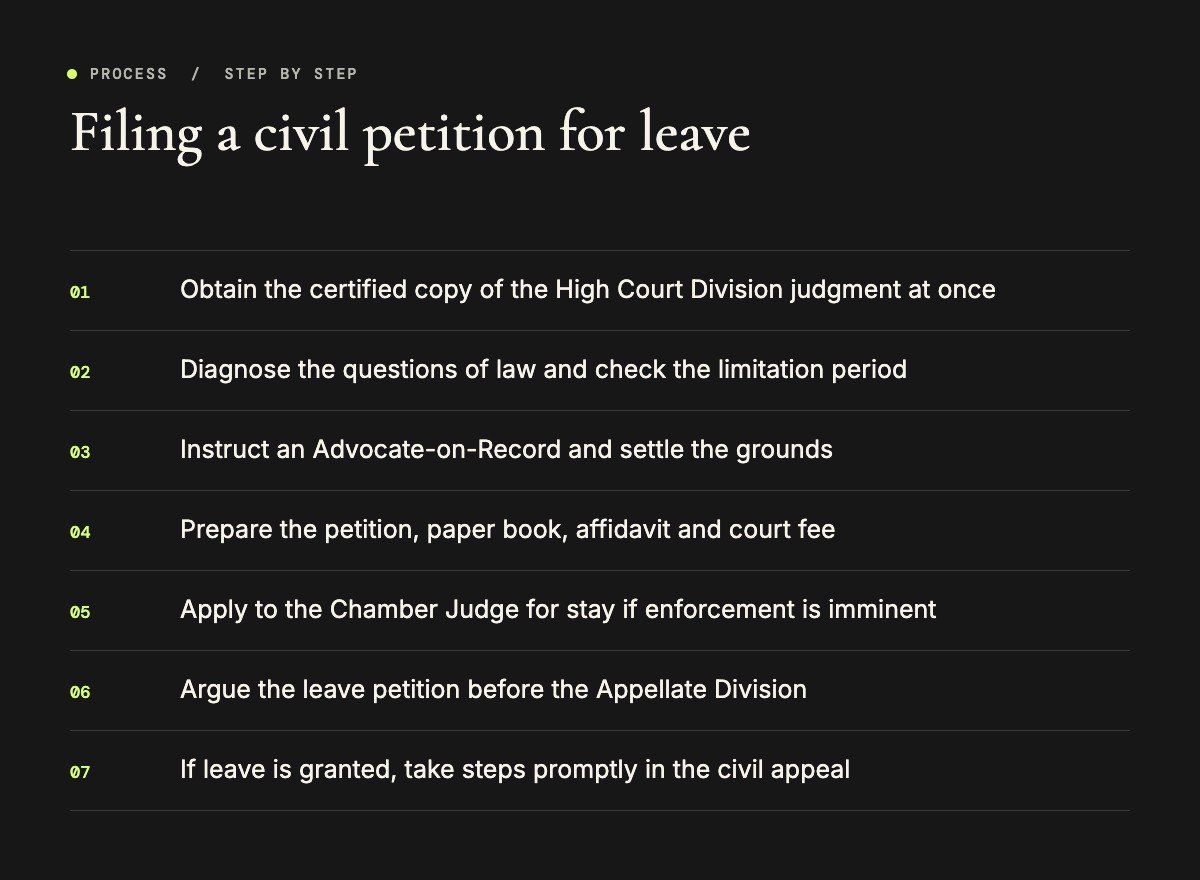
- Secure the certified copy. Apply for the certified copy of the High Court Division judgment and order immediately, and collect copies of the lower court judgments and key record documents.
- Diagnose the case. Identify the questions of law, check the limitation date, and decide frankly whether the case meets the threshold for leave. Some cases are better settled than appealed.
- Instruct an Advocate-on-Record. Only an Advocate-on-Record of the Appellate Division can file papers there. Senior advocates and other counsel may argue the case, but filing runs through the Advocate-on-Record.
- Draft the petition and grounds. Set out the facts concisely, the judgments below, and the grounds framed as short, numbered questions of law.
- Prepare the paper book. Compile the certified copy, lower court judgments, pleadings and documents relied on, an affidavit verifying the petition, the vakalatnama and the court fee.
- Seek a stay if needed. If the judgment can be enforced before the petition is heard, file a civil miscellaneous petition for stay and mention it before the Chamber Judge.
- Argue the leave petition. When the petition appears in the cause list, counsel makes focused submissions on why leave should be granted. The respondent may appear and oppose.
A late stay application can mean the judgment is executed before the court looks at the Appellate Division leave to appeal at all.
Drafting the petition and paper book
An Appellate Division leave to appeal is read quickly by judges with very large cause lists. The drafting should make the case for leave obvious within the first two pages.
Keep the facts to what the court needs to understand the legal point, and identify each judgment below by court, case number and date. Every paragraph of an Appellate Division leave to appeal should earn its place.
Framing the grounds
Each ground should be a short question of law the court can answer. For example: "Whether the High Court Division erred in law in holding that a writ petition was maintainable where the dispute arose from a commercial contract with a statutory body." Put the strongest ground first. Five well-chosen grounds are more persuasive than twenty overlapping ones.
The supporting documents
The Registry checks that the petition carries what the Rules require: typically the certified copy of the impugned judgment, the judgments below, relevant pleadings and documents, an affidavit and the vakalatnama. Translations may be needed where the petition is in English. Court fees follow the Court-fees Act 1870 schedule; your Advocate-on-Record will confirm the current amount.
The same discipline applies to writ matters. If the judgment you are challenging came out of a writ petition, our guide to writs and writ cases in Bangladesh explains the principles the Appellate Division will apply.
Stay and interim relief pending leave
Filing an Appellate Division leave to appeal does not suspend the High Court Division judgment. If that judgment orders the release of goods, the cancellation of a licence, the payment of money or the demolition of a structure, it can be acted on while the petition waits for a hearing. Interim protection must be sought separately.
The usual route is a civil miscellaneous petition for stay, filed alongside the Appellate Division leave to appeal and placed before the Chamber Judge. The Chamber Judge can grant an interim stay, refuse it, direct that the status quo be maintained, or send the matter to the full bench for hearing. Orders are sometimes made on conditions, such as depositing a sum or furnishing security.
Until a stay is granted, the High Court Division judgment must be obeyed. Ignoring it because a leave petition has been filed can expose a party, and in a company's case its officers, to contempt proceedings. If compliance is impossible or would cause irreparable loss, move for a stay immediately and keep evidence of that urgency.
What the court weighs
On a stay application the court considers whether the leave petition raises an arguable point, where the balance of convenience lies, and whether refusing the stay would make the eventual appeal pointless. Show what will happen, concretely and with documents, if the judgment is enforced now.
What happens at the leave hearing
An Appellate Division leave to appeal is heard in open court on the regular cause list, and hearings are short. Counsel is expected to go straight to the point of law, not to read the petition aloud. The respondent's lawyer may appear and oppose leave.
There are several possible outcomes. The court may grant leave on some or all grounds, dismiss the petition, or dispose of it with observations or directions without granting leave. The last option is common where the court sees a narrow error it can correct quickly, for example by sending the case back to the High Court Division for a fresh hearing.
Where leave is granted only on certain grounds, the appeal is normally confined to them, so a strong point buried inside a weak ground can be lost.
After leave is granted: the civil appeal
Once leave is granted, the petition becomes a civil appeal and is given a new number. The appellant must then take the steps required by the Rules within the time they set, including preparing and filing the paper books and any statement of the case. An appeal in which these steps are not taken can be dismissed for default.
At the final hearing, the court considers the appeal on the grounds on which leave was granted. Under Article 104, the Appellate Division may issue any direction, order, decree or writ necessary for doing complete justice in a pending case. That power is used sparingly, but it allows the court to shape a practical remedy where a strict reading of the law would leave an injustice in place.
A stay granted at the leave stage often continues until the appeal is decided, but check each order: some stays are expressly limited in time.
Review under Article 105
Article 105 lets the Appellate Division review its own judgments and orders. A civil review petition, filed within the short period fixed by the Rules, is the last step once leave is refused or an appeal is dismissed. Review is not a second appeal: the petitioner must show an error apparent on the face of the record. Re-arguing rejected points will not succeed, which is why the effort should go into getting the Appellate Division leave to appeal right first time.
Timeframes, backlog and costs in 2026
The Appellate Division carries a heavy caseload. According to Supreme Court figures reported by The Financial Express in September 2026, the division began 2026 with 41,551 pending cases, received 9,139 new filings between January and August, disposed of 11,136, and had 39,554 cases pending on 31 August 2026. That disposal rate is well above the average of earlier years, but it still means many petitions wait months before they are heard.
For anyone pursuing an Appellate Division leave to appeal, the figures mean the stay application, not the leave hearing, is often the decisive moment. Urgent matters can be mentioned for early listing, but counsel needs a clear reason. Costs depend on the size of the record, the number of hearings and whether senior counsel is briefed; we estimate in writing after reading the judgment.
Commercial cases after the 2026 ordinance
The Commercial Court Ordinance 2026 created district commercial courts and commercial appellate benches in the High Court Division. Their judgments are, in principle, challenged in the Appellate Division in the ordinary way. Whether Parliament has re-enacted the ordinance in the same form was not confirmed at the time of writing, so check the current text.
Common mistakes in an Appellate Division leave to appeal
These are the errors we see most often when we are instructed after a petition has already been filed or a deadline has nearly passed:
- Late certified copy application. Waiting weeks to apply for the copy, which then eats into the limitation period.
- Re-arguing facts. Grounds that ask the court to reweigh evidence instead of identifying a legal error.
- Too many grounds. Twenty overlapping grounds that hide the one point that could win leave.
- No stay application. Assuming that filing the petition protects the client, then facing enforcement or contempt.
- Incomplete paper book. Missing judgments, translations or annexures, which delays listing.
- Neglecting the appeal after leave. Failing to take steps in time after leave is granted, so the appeal is dismissed for default.
Frequently asked questions about appellate division leave to appeal
Can every High Court Division judgment be appealed?
Only the cases listed in Article 103(2) go to the Appellate Division as of right. All other judgments, decrees, orders and sentences of the High Court Division can be challenged only with leave under Article 103(3).
How long do I have to file a civil petition for leave to appeal?
The Appellate Division Rules 1988 allow sixty days from the judgment or order, and the time properly spent obtaining the certified copy is excluded under the Limitation Act 1908. Late petitions need an application for condonation of delay with a full explanation.
Does filing an Appellate Division leave to appeal stop enforcement?
No. The High Court Division judgment remains enforceable until a stay is granted. Apply for a stay, usually before the Chamber Judge, as soon as the petition is ready.
Can I file the petition myself?
Filing in the Appellate Division is done through an Advocate-on-Record. A party may be represented by other counsel at the hearing, but the papers are filed by the Advocate-on-Record.
What if leave is refused?
The High Court Division judgment becomes final, subject only to a review petition under Article 105. Review is limited to errors apparent on the record and similar narrow grounds; it is not a rehearing.
How we can help
We advise on whether a High Court Division judgment can realistically be challenged, prepare and file petitions through an Advocate-on-Record, seek urgent stays before the Chamber Judge, and oppose leave petitions for respondents. For a candid view on your Appellate Division leave to appeal, see our Supreme Court of Bangladesh practice, and for underlying business disputes our commercial litigation team.
Facing a deadline to challenge a judgment?
Send us the High Court Division judgment and we will tell you whether there is a point worth taking to the Appellate Division, what the deadline is, and whether you need a stay now.
Book a consultationSupreme Court practicePrimary sources: the Constitution of the People's Republic of Bangladesh (Articles 103 to 105, 107 and 111), the Limitation Act 1908 and the Code of Civil Procedure 1908 on the Laws of Bangladesh portal; the Supreme Court of Bangladesh (Appellate Division) Rules 1988, cause lists and practice notices on the Supreme Court of Bangladesh website; caseload figures as reported by The Financial Express, September 2026.
This article is general information about Bangladeshi law as of 2026 and is not legal advice. Time limits, rules and practice directions change; confirm the current position with an Advocate-on-Record or a qualified lawyer before acting.


0 Comments