
An environmental clearance certificate in Bangladesh is the permit that lets an industrial unit or project operate lawfully from an environmental point of view. Since March 2023, the Environment Conservation Rules 2023 decide which category your project falls into, what studies you need and how long the certificate lasts.
- Section 12 of the Environment Conservation Act 1995 prohibits establishing an industrial unit or project without an environmental clearance certificate from the Department of Environment (DOE).
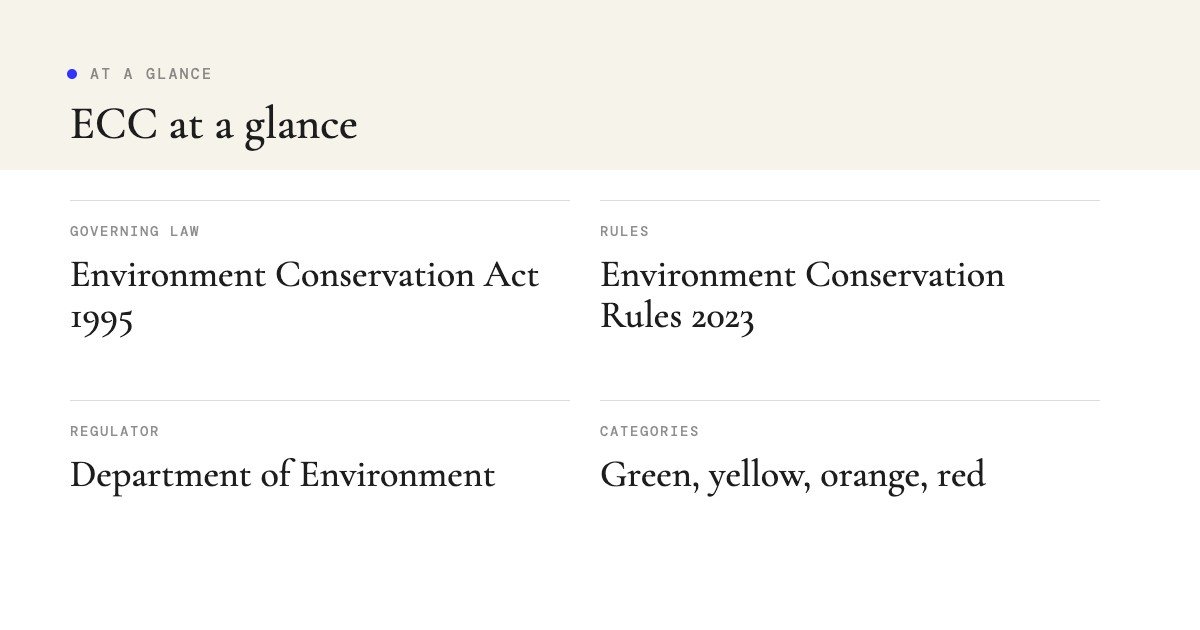
- The Environment Conservation Rules 2023 (SRO 53, 5 March 2023) replaced the 1997 Rules and classify projects as green, yellow, orange or red according to their environmental risk.
- Higher categories need location (site) clearance first, and orange and red projects need an initial environmental examination or a full environmental impact assessment.
- Practitioner summaries of the 2023 Rules report ECC validity of five years for green, two years for yellow and one year for orange and red projects; confirm against the current text.
- Operating without a valid ECC can lead to penalties, environmental compensation orders and disconnection of utilities.
What an environmental clearance certificate in Bangladesh is
The Department of Environment, under the Ministry of Environment, Forest and Climate Change, regulates pollution and environmental impact in Bangladesh. Its main licensing tool is the environmental clearance certificate, usually called the ECC. Section 12 of the Environment Conservation Act 1995 provides that no industrial unit or project may be established or undertaken without obtaining one in the manner prescribed by the rules.
In practice, an environmental clearance certificate in Bangladesh is required not only for factories but also for many infrastructure, commercial, residential, healthcare and service projects listed in the schedules to the Rules. Banks ask for it before financing, Invest Bangladesh (formerly BIDA) and zone authorities expect it, and buyers in export industries check it as part of compliance audits.
The 2023 Rules
The Environment Conservation Rules 2023 were published as SRO 53 on 5 March 2023 and replaced the Environment Conservation Rules 1997. They updated the categories, introduced a structured two-step process of location clearance followed by ECC for higher-risk projects, revised standards for air, water, noise and effluent, and moved applications online. Our earlier guide on how to get an environment licence covers the background.
The four categories
For an environmental clearance certificate in Bangladesh, the category decides almost everything about your application. The schedules to the Rules list industries and projects under each colour. If your activity is not listed, the DOE decides the category, usually by analogy to similar activities.
| Category | Risk level | Location clearance | Study required | Examples |
|---|---|---|---|---|
| Green | Low | Generally not required | Basic information and undertaking | Small assembly, some service units |
| Yellow | Moderate | Required | Process description and pollution control plan | Light manufacturing, some food processing |
| Orange | Substantial | Required | Initial environmental examination (IEE) and management plan | Larger manufacturing, some textile processes |
| Red | High | Required | Full environmental impact assessment (EIA) and management plan | Dyeing and washing, tanneries, chemicals, power plants, major infrastructure |
The examples above are indicative only; always check the current schedule, because the 2023 Rules moved some activities between categories compared with the 1997 Rules.
Category disputes are common. A garment factory with only cutting and sewing may be in a lower category, but adding washing or dyeing moves it up, often to red. Describe your actual processes precisely in the application, including future expansions, so the certificate matches what you will really do.
Location clearance: the first step for higher categories
For yellow, orange and red projects, the 2023 Rules require a location clearance certificate before construction or installation. The DOE checks that the site is suitable: land use, distance from residential areas, schools and hospitals, proximity to rivers, wetlands and protected areas, and any environmentally critical area restrictions.
Location clearance is usually granted with conditions, such as completing the IEE or EIA within a set period, installing an effluent treatment plant before trial production, or keeping buffer zones. Construction should not start until location clearance is in hand. Starting early is one of the most common reasons an environmental clearance certificate in Bangladesh is delayed or refused.
Choosing a site
Industrial parks, economic zones and export processing zones are often easier, because the zone has already considered environmental suitability and may provide shared infrastructure such as central effluent treatment. Projects outside zones need more careful site due diligence, including land records and any restrictions under local planning rules.
IEE and EIA requirements
Orange projects generally require an initial environmental examination, and red projects a full environmental impact assessment. Both lead to an environmental management plan setting out mitigation and monitoring commitments.
- Scope. The study describes the project, baseline environment, likely impacts on air, water, soil, noise, ecology and communities, and alternatives considered.
- Terms of reference. For EIA, the DOE usually approves terms of reference before the full study.
- Consultation. Stakeholder and community consultation is expected for larger projects, especially red category.
- Management plan. The environmental management plan sets out pollution control, monitoring parameters, responsibilities and budgets.
- Consultants. Studies are prepared by environmental consultants; the project owner remains responsible for accuracy.
Lender-financed projects may also need to meet international standards, such as the IFC Performance Standards, alongside the domestic environmental clearance certificate in Bangladesh. Plan the studies so that one baseline survey serves both purposes.
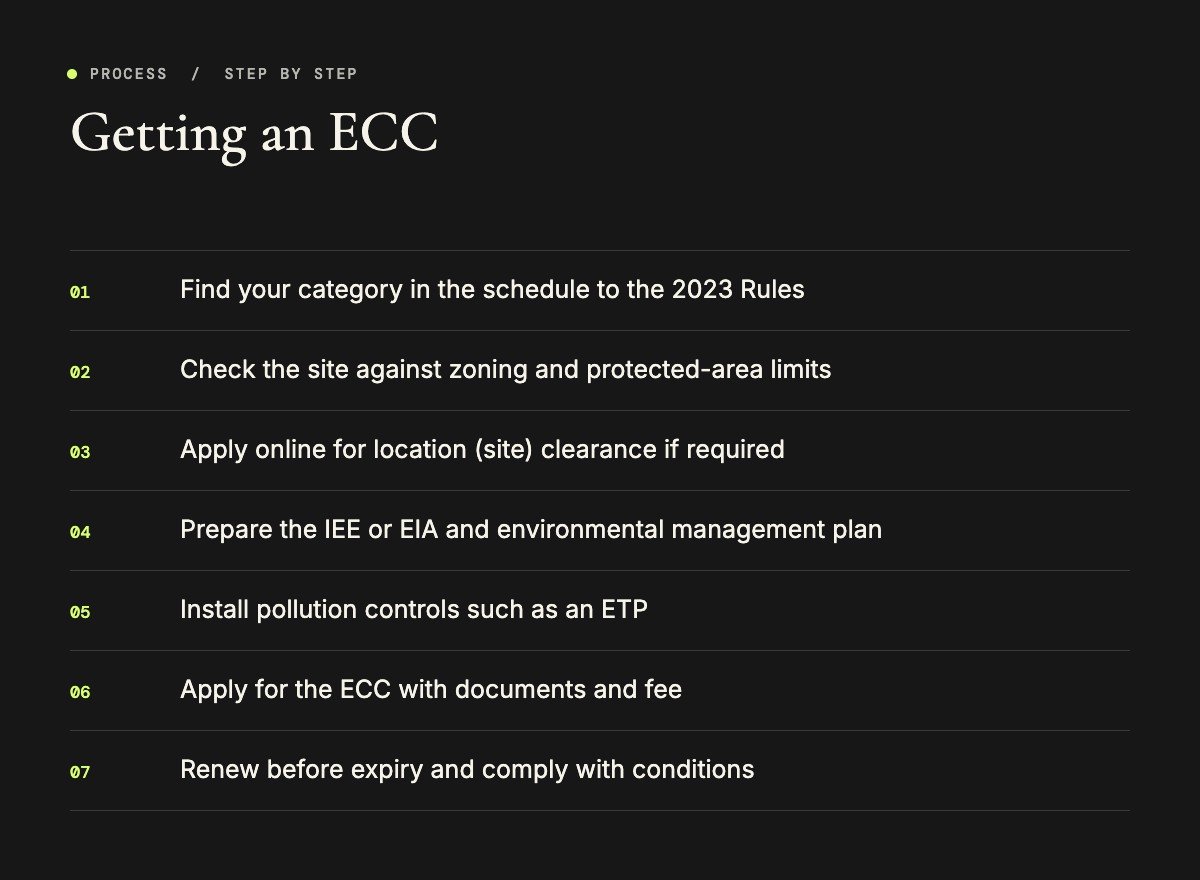
Step-by-step process
The process for an environmental clearance certificate in Bangladesh varies by category, but the following sequence is typical for a yellow, orange or red project.
- Confirm the category. Match your processes to the schedule and, if unclear, seek DOE guidance before committing to a site.
- Site due diligence. Check land use, setbacks, flood risk and protected-area restrictions.
- Apply for location clearance. Submit the online application with land documents, layout, process description and the required fee.
- Prepare studies. Commission the IEE or EIA and environmental management plan, following any approved terms of reference.
- Install controls. Build the effluent treatment plant, air pollution controls and waste handling facilities described in the plan.
- Apply for the ECC. Submit the application with studies, trade licence, incorporation documents, NOCs and evidence of pollution controls; the DOE usually inspects the site.
- Comply and renew. Meet the certificate conditions, submit monitoring reports and apply for renewal before expiry.
Online applications
Applications are made through the DOE's online system, linked from the Department of Environment website. The system issues an application number, tracks queries and allows upload of documents. Fees are set by the Rules and are paid as directed by the DOE; check the current schedule when applying.
Documents commonly required
| Document | Purpose |
|---|---|
| Application form and fee proof | Formal application under the Rules |
| Trade licence and incorporation documents | Identity and legal status of the applicant |
| Land ownership or lease documents | Right to use the site |
| Site layout and location map | Assessment of surroundings and setbacks |
| Process flow and raw material list | Assessment of pollution sources |
| IEE or EIA and management plan | Required for orange and red projects |
| ETP design and pollution control details | Evidence of mitigation |
| Local authority and other NOCs | Fire, building and utility approvals where relevant |
Inconsistencies between documents are the main source of DOE queries. The process description, layout and management plan should tell the same story about the same project.
Validity and renewal
Validity depends on category. Practitioner summaries of the 2023 Rules report that an ECC is valid for five years for green projects, two years for yellow and one year for orange and red. Renewal applications should be made before expiry, commonly at least thirty days in advance, with updated monitoring data and evidence that conditions have been met.
A lapsed environmental clearance certificate in Bangladesh is treated as no certificate. Banks, buyers and inspectors may treat operating with an expired ECC as a serious compliance failure, so renewal dates should sit in the company's compliance calendar alongside the trade licence, fire licence and factory licence.
Changes and expansions
Increasing capacity, adding new processes or moving production lines may require amendment of the ECC or a new application, especially if the change moves the project into a higher category. Inform the DOE before the change rather than after an inspection reveals it.
Effluent treatment, monitoring and reporting
For many industries, the effluent treatment plant is the heart of compliance. The 2023 Rules set discharge standards for industrial effluent and require units that generate liquid waste to treat it before discharge. The design capacity of the ETP should match the maximum water use of the factory, not average use, and the plant should be operated by trained staff with daily logs of flow, chemical dosing and power consumption.
Conditions attached to an environmental clearance certificate in Bangladesh usually require periodic testing of effluent, air emissions or noise by recognised laboratories, and submission of results to the DOE. Some large units are required to install online monitoring equipment. Keep the test reports, maintenance records and sludge disposal records on file, because inspectors ask for them and because they are the best evidence of good faith if a breach is alleged.
Solid and hazardous waste
Solid waste, sludge from the ETP, chemical containers and hazardous waste must be stored and disposed of in line with the Rules and any specific waste management rules in force. Disposal through unlicensed contractors can make the generator liable. Contracts with waste handlers should require proof of lawful disposal.
Common mistakes in ECC applications
From our experience assisting clients with an environmental clearance certificate in Bangladesh, the same mistakes cause most delays and refusals:
- Wrong category. Applying under a lower category than the actual processes justify.
- Construction before location clearance. Building first and seeking clearance later.
- Generic studies. Copying an IEE or EIA from another project without site-specific data.
- Undersized ETP. Treatment capacity that does not match water use or effluent characteristics.
- Missing land documents. Unclear title or lease records for the site.
- Late renewal. Allowing the certificate to lapse while operations continue.
Each of these can be avoided with early planning. A short pre-application review that checks category, site, documents and pollution control design usually saves months later and gives the project a far smoother path to an environmental clearance certificate in Bangladesh.
Penalties and enforcement
The Environment Conservation Act 1995 gives the DOE strong enforcement tools. Operating without an ECC, breaching its conditions or exceeding discharge standards can lead to:
- Directions to stop operations or take corrective measures.
- Environmental compensation orders based on the damage caused.
- Disconnection of electricity, gas and water to the unit.
- Prosecution under the Act, with fines and imprisonment for serious or repeated offences.
- Refusal or cancellation of the certificate and other licences that depend on it.
Enforcement in recent years has focused on effluent discharge from textile, dyeing and tannery units, brick kilns and river pollution. Mobile courts and DOE enforcement drives are used regularly. A unit with a valid environmental clearance certificate in Bangladesh but a non-functioning effluent treatment plant remains exposed.
Running the ETP only when inspectors visit is a known practice that the DOE actively targets, including through online monitoring of some large polluters. Electricity and chemical consumption records are compared with production. Operate pollution controls continuously and keep logs.
Appeals and disputes
If the DOE refuses an application or imposes conditions you consider unreasonable, the Act and Rules provide for appeal to the appellate authority within a set period. Practitioner guides describe a thirty-day window from receipt of the decision. Prepare the appeal with technical evidence, such as revised designs or independent test results, rather than legal argument alone.
Disputes over environmental compensation or enforcement orders can also reach the Environment Court and Environment Appellate Court under the Environment Court Act 2010, or the High Court Division in writ proceedings. Our environment and ESG practice handles both regulatory appeals and court proceedings.
Environmental clearance certificate in Bangladesh for investors and lenders
For investors acquiring a factory or project, the environmental clearance certificate in Bangladesh is a key due diligence item. Check that the certificate is valid, matches the current processes and capacity, and that monitoring reports have been filed. Ask for recent DOE inspection reports and any notices or compensation orders.
Lenders typically make a valid ECC a condition precedent to disbursement and a continuing covenant. They may also require compliance with international environmental and social standards and regular reporting. Sustainability-linked finance and green bonds add further reporting duties. Coordinate these requirements early, because the same data feeds all of them.
Buyers and supply chains
Export buyers, particularly in garments and leather, run supplier audits that include environmental clearance and wastewater testing. A missing or expired certificate can lead to suspension of orders even before the DOE acts.
Frequently asked questions about environmental clearance certificate in bangladesh
Which law requires an ECC?
Section 12 of the Environment Conservation Act 1995, with procedure in the Environment Conservation Rules 2023, which replaced the 1997 Rules from March 2023.
Does a green category project need location clearance?
Generally no. Green projects apply directly for the ECC, while yellow, orange and red projects need location clearance first under the 2023 Rules.
How long is an ECC valid?
Practitioner summaries of the 2023 Rules report five years for green, two years for yellow and one year for orange and red. Confirm the current text and renew before expiry.
Can we start construction before getting clearance?
For yellow, orange and red projects, construction should not begin before location clearance. Starting early risks refusal, penalties and costly redesign.
What happens if we operate without an ECC?
The DOE can order closure, impose environmental compensation, disconnect utilities and prosecute under the Environment Conservation Act 1995.
Is an ECC needed inside an export processing zone?
Environmental requirements still apply inside zones, often coordinated with the zone authority. Check the zone's procedure and the DOE's current requirements for your category.
How we can help
We advise manufacturers, developers, investors and lenders on the environmental clearance certificate in Bangladesh: category analysis, site and location clearance, coordinating IEE and EIA consultants, applications and renewals, DOE enforcement and appeals. Learn more about our regulatory compliance practice.
Planning a new project or expansion?
We map your category, timeline and documents under the 2023 Rules and manage the DOE process to approval.
Book a consultationRegulatory compliancePrimary sources: the Environment Conservation Act 1995, Environment Conservation Rules 2023 (SRO 53, 5 March 2023) and Environment Court Act 2010 on the Laws of Bangladesh portal; application procedures of the Department of Environment; UNEP LEAP legislative database entry for SRO 53.
This article is general information about Bangladeshi environmental law as of October 2026 and is not legal advice. Categories, validity periods, fees and standards are set by the Rules and DOE notifications and may change; confirm current requirements with the DOE or a qualified lawyer before acting.




0 Comments