
A construction delay claim in Bangladesh arises when a project finishes late and the parties argue about who should bear the cost. The contractor seeks more time and money; the employer seeks liquidated damages. Who wins usually depends less on the law than on notices, programmes and records kept while the project was running.
- Extension of time protects the contractor from delay damages; prolongation costs compensate it for extra time-related costs caused by employer risk events.
- Most contracts, including FIDIC forms, require notice of a delay event within a short period, commonly 28 days; late notice can defeat or weaken the claim.
- Under section 74 of the Contract Act 1872, liquidated damages are capped at the stated sum and the employer recovers reasonable compensation up to that cap.
- Delay must be shown to affect completion, usually through critical path analysis supported by contemporaneous programmes.
- Public works also follow the Public Procurement Act 2006 and the Public Procurement Rules 2025, which govern time extensions and approvals.
What a construction delay claim in Bangladesh involves
Construction projects in Bangladesh face many sources of delay: land acquisition and site handover, utility relocation, design changes, late approvals, monsoon rains and flooding, supply chain disruption, currency and import restrictions, labour unrest and political events. When delay happens, two questions follow. Is the contractor entitled to more time? And is anyone entitled to more money?
A construction delay claim in Bangladesh answers those questions through the contract first and the general law second. The contract will usually list events that entitle the contractor to an extension of time, and some of those events also entitle it to additional cost. Where the contractor is responsible, the employer may deduct liquidated damages for late completion.
The two sides of every delay claim
| Claim | Who claims | What must be shown |
|---|---|---|
| Extension of time | Contractor | A qualifying event, notice and an effect on completion |
| Prolongation costs | Contractor | An employer risk event that caused compensable delay, and the resulting costs |
| Disruption costs | Contractor | Loss of productivity caused by employer events, even without overall delay |
| Liquidated damages | Employer | Late completion not excused by an extension of time |
| General damages | Either party | Breach and loss under sections 73 and 74 of the Contract Act |
The legal framework
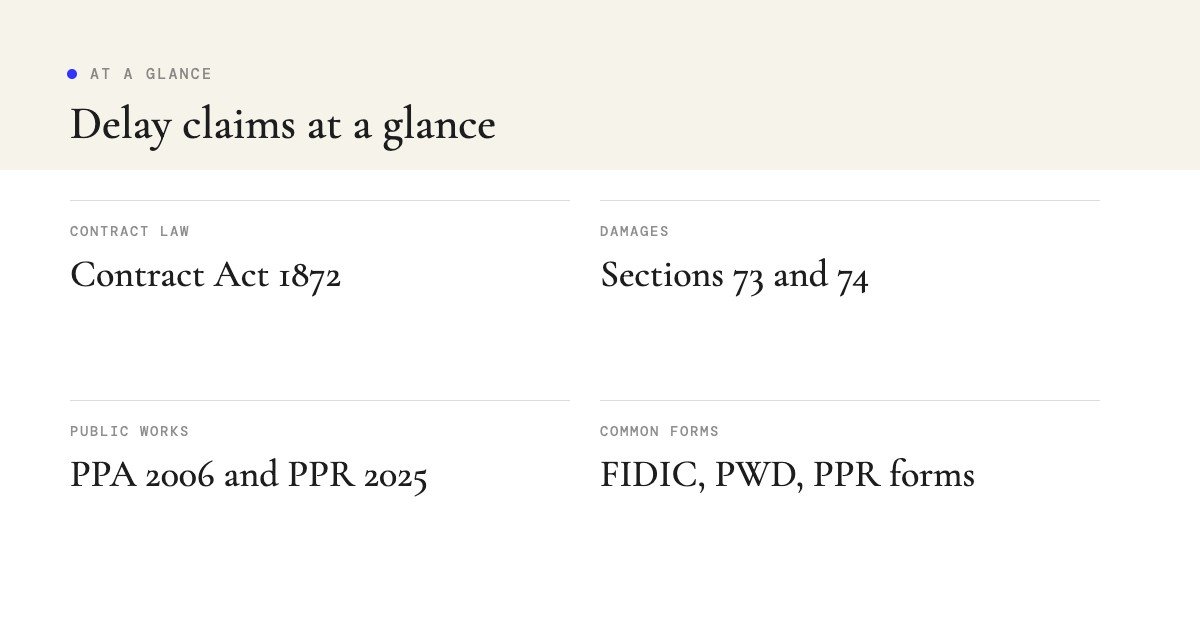
Construction contracts in Bangladesh are governed by the Contract Act 1872. Section 73 provides compensation for loss caused by breach that naturally arose in the usual course of things or that the parties knew was likely to result. Section 74 governs stipulated sums for breach, allowing reasonable compensation not exceeding the stated amount. Section 55 deals with failure to perform at a fixed time and the effect of accepting late performance.
Public works add a further layer. Procurement by government bodies is governed by the Public Procurement Act 2006 and the Public Procurement Rules 2025, in force since 28 September 2025. Standard contract forms used by public works agencies set out procedures for time extensions, variations and liquidated damages, and extensions often require approval at specified levels. Private projects commonly use FIDIC forms or bespoke contracts. Statutes are on the Laws of Bangladesh portal.
Extension of time: entitlement
In a construction delay claim in Bangladesh, an extension of time moves the completion date. It protects the contractor from liquidated damages for the period extended and, under many contracts, preserves the employer's right to damages by keeping a valid completion date in place. Without an extension mechanism, an employer who causes delay may lose the right to liquidated damages altogether, because time becomes "at large".
FIDIC contracts list grounds for extension, including variations, exceptionally adverse climatic conditions, unforeseeable shortages caused by epidemic or government action, and delay caused by the employer or its other contractors. Bangladeshi public works forms have their own lists. A construction delay claim in Bangladesh must link each delay event to a specific clause.
Common delay events in Bangladesh
- Late site possession. Unresolved land acquisition or encroachment.
- Utility relocation. Gas, power, water and telecom lines that must be moved by other agencies.
- Design changes and late drawings. Variations instructed during construction.
- Approvals. Delayed environmental clearance, building permits or customs release of imported plant.
- Weather and floods. Exceptional rainfall, flooding or cyclones beyond normal seasonal patterns.
- Political events and force majeure. Strikes, curfews or government restrictions.
Notices: the first hurdle
Under FIDIC, the contractor must give notice describing the event within 28 days after becoming aware of it, and then submit a fully detailed claim within a further period. Public works forms in Bangladesh also require timely written requests for extension. The 2017 FIDIC editions apply similar time bars to employer claims.
Under Bangladeshi law, section 28 of the Contract Act 1872 makes void agreements that absolutely restrict a party from enforcing its rights or limit the time to do so. There is an argument that strict notice time bars are vulnerable, but the point is unsettled. A construction delay claim in Bangladesh should never rely on that argument. Serve notices on time, every time, and keep proof of delivery.
Appoint one person on site responsible for contractual notices and keep a notice register. Many strong delay claims in Bangladesh have been weakened because notices were sent informally by email to the wrong person or never sent at all.
Proving delay: programmes and analysis
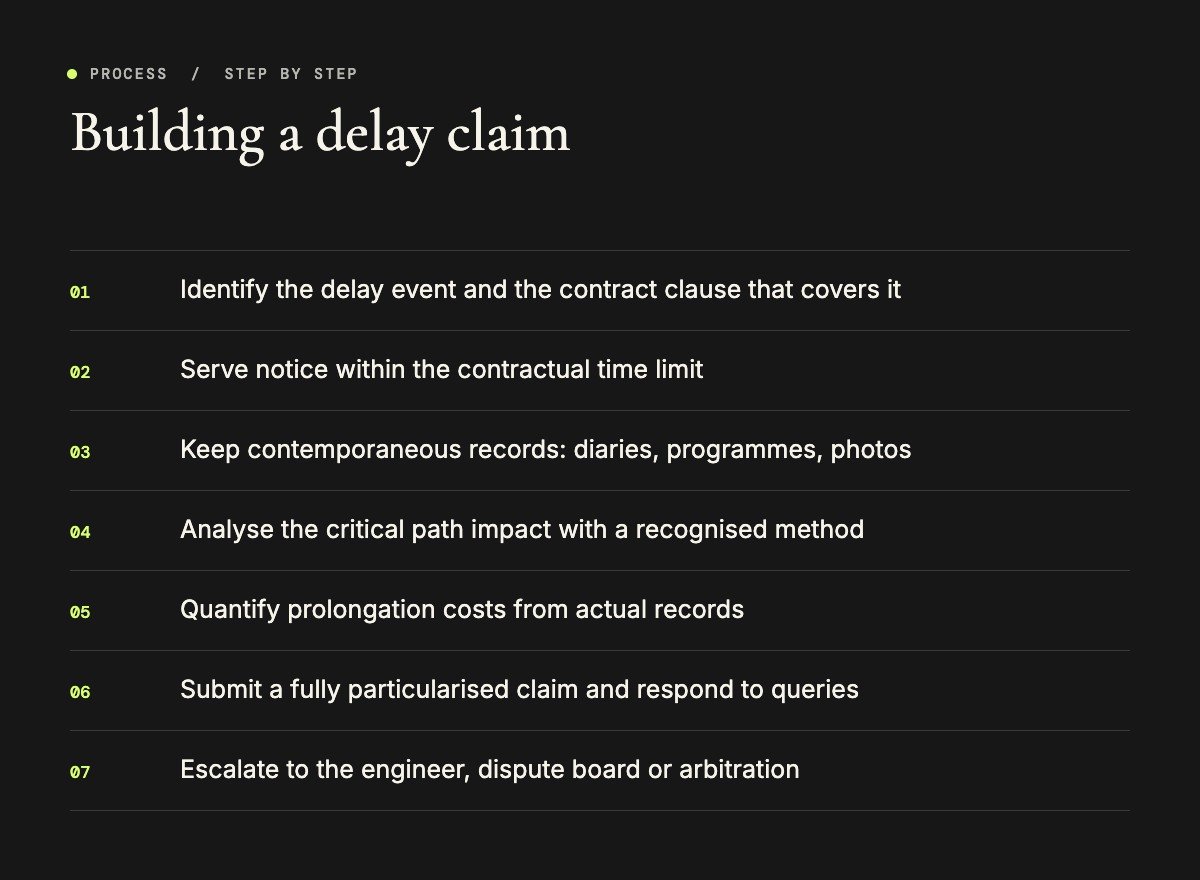
In a construction delay claim in Bangladesh, it is not enough to show that an event happened. The contractor must show that it delayed completion. That means showing that the event affected the critical path, the sequence of activities that determines the completion date. Delay to non-critical activities, which can be absorbed by float, does not usually justify an extension.
Delay analysis uses recognised methods, often described in the Society of Construction Law Delay and Disruption Protocol. Common methods include impacted as-planned analysis, time impact analysis, windows analysis and as-planned versus as-built comparison. The choice depends on the records available and the stage of the project. Tribunals prefer methods based on contemporaneous updated programmes.
- Baseline programme. Agree an accepted baseline programme at the start, with logic links and resources.
- Regular updates. Update the programme monthly with actual progress and submit it to the engineer.
- Event identification. Record each delay event with dates, causes and affected activities.
- Impact analysis. Model the effect of the event on the updated programme at the time it occurred.
- Concurrency review. Identify any contractor delays running at the same time.
- Entitlement statement. State the extension sought and the clause relied on.
- Supporting evidence. Attach diaries, correspondence, photographs and instructions.
Concurrent delay
Where employer and contractor delays occur at the same time and both affect completion, the treatment depends on the contract and the law. Many tribunals grant the contractor an extension of time but no prolongation costs for the concurrent period. Some contracts address concurrency expressly. In a construction delay claim in Bangladesh, the contract wording on concurrency deserves careful reading.
Prolongation and disruption costs
Where a construction delay claim in Bangladesh arises from an employer risk event that carries cost entitlement, the contractor may recover prolongation costs: the extra time-related costs of staying on site longer. These typically include site staff and supervision, site facilities and utilities, equipment hire, insurance and bond extension costs, and a share of head office overheads.
Costs must be proven from actual records, such as payroll, invoices and equipment logs, not estimated from tender rates where actual data exists. Head office overhead claims are often contested and may be calculated using formulae such as Hudson or Emden, or better, from actual overhead records. Disruption, meaning loss of productivity, is harder to prove and usually requires comparison of productive and disrupted periods.
| Cost head | Typical evidence |
|---|---|
| Site staff and supervision | Payroll records and staffing schedules |
| Site facilities | Rental invoices, utility bills |
| Equipment | Hire invoices, equipment logs and idle time records |
| Bonds and insurance | Bank and insurer charges for extensions |
| Head office overheads | Audited accounts and overhead analysis |
| Financing costs | Bank statements and loan agreements, where recoverable |
Liquidated damages and section 74
In any construction delay claim in Bangladesh, the contract usually sets a daily or weekly rate of liquidated damages for late completion, capped at a percentage of the contract price. Under section 74 of the Contract Act 1872, the employer is entitled to reasonable compensation not exceeding the stated sum, whether or not actual damage is proved. Courts in Bangladesh have generally treated the stated amount as a ceiling rather than an automatic entitlement.
Employers should therefore set liquidated damages at a genuine pre-estimate of likely loss and keep evidence of the loss caused by delay. Contractors facing deductions should check whether extensions of time were properly assessed, whether the employer caused delay, and whether the deduction followed the contract's procedure. Our guide to the FIDIC contract in Bangladesh explains related clauses.
In public contracts, deductions for delay are often made automatically from running bills. Contractors should object in writing at each deduction and pursue extensions promptly, because waiting until final account stage makes recovery harder.
Public works: extensions and approvals
For public projects, a construction delay claim in Bangladesh must navigate both the contract and procurement rules. Extensions of time and variations may require approval from the procuring entity at specified levels, and in larger projects from higher authorities. Delays in approving extensions are themselves common, leaving contractors exposed to deductions while decisions are pending.
Contractors should submit extension requests with complete supporting documents, follow up in writing and escalate through the contractual dispute procedure if decisions are not made within the contractual or regulatory time. Debarment and performance security issues may arise if delays escalate into termination, so legal advice is important at an early stage. Our EPC and O&M contracts practice advises on public works contracts.
Construction delay claim in Bangladesh: subcontractors and suppliers
Delay flows down the contractual chain. A main contractor who receives an extension from the employer will want to pass on delay costs caused by subcontractors and recover from them, while subcontractors delayed by the main contractor will claim in turn. Back-to-back drafting matters: notice periods in subcontracts should be shorter than in the main contract, so the main contractor can comply with its own notice obligations.
Supplier delays, particularly for imported plant and materials, are a frequent cause of a construction delay claim in Bangladesh. Letters of credit, customs clearance and port congestion can each add weeks. Contracts should allocate these risks clearly and require suppliers to give early warning. Where delay is caused by government import restrictions or foreign exchange shortages, the contract's change-in-law or force majeure provisions may apply.
Force majeure and exceptional events
Floods, cyclones, pandemics, political unrest and nationwide shutdowns have all affected projects in Bangladesh. Whether they justify extension or cost depends on the contract's force majeure or exceptional events clause, the notice given and proof that the event actually affected the works. Section 56 of the Contract Act on frustration applies only in extreme cases where performance becomes impossible and the contract does not already allocate the risk.
Employers: managing delay claims
Employers can reduce exposure to a construction delay claim in Bangladesh by making sure the site is available, approvals are obtained on time and design information is issued promptly. Engineers should respond to extension requests within the contractual time, giving reasons, rather than ignoring them. An unanswered request can later be used to argue that the employer waived its rights or that time became at large.
Employers should also keep their own records and programmes, rather than relying on the contractor's, and should obtain independent delay advice early when claims begin to accumulate. A fair assessment of extensions during the project often prevents a far larger dispute at the end.
Resolving delay disputes
For a construction delay claim in Bangladesh, most contracts provide a tiered process: determination by the engineer, referral to a dispute board, amicable settlement and then arbitration. Domestic disputes often go to arbitration seated in Dhaka under the Arbitration Act 2001, while international projects may use ICC or SIAC arbitration. Court litigation is less common but arises where contracts lack arbitration clauses or for interim relief, such as restraining a call on a performance guarantee.
Delay disputes are evidence-heavy. Independent delay and quantum experts are often appointed. Early mediation can save substantial cost where the main disagreement is about numbers rather than principle. Our construction disputes practice handles these claims for contractors and employers.
Records that win delay claims
- Signed baseline and monthly updated programmes.
- Daily site diaries recording labour, equipment, weather and events.
- Engineer's instructions, drawings register and variation orders.
- Correspondence and minutes of progress meetings.
- Dated photographs and drone surveys of progress.
- Cost records: payroll, invoices, equipment logs.
- Notice register showing dates and delivery of each notice.
Every construction delay claim in Bangladesh is ultimately built from these records. Projects that keep them well rarely lose a valid claim; projects that do not often lose claims they should have won.
Frequently asked questions about construction delay claim in bangladesh
What is the difference between extension of time and prolongation costs?
Extension of time moves the completion date and protects against liquidated damages. Prolongation costs compensate the contractor for extra time-related costs where the employer is responsible for the delay.
How soon must I give notice of a delay?
Under FIDIC, within 28 days after becoming aware of the event. Other forms have their own limits. Late notice can defeat or weaken the claim, so act promptly.
Can an employer deduct the full liquidated damages?
Under section 74 of the Contract Act 1872, the employer is entitled to reasonable compensation up to the stated sum. A genuine pre-estimate supported by evidence strengthens the employer's position.
What is concurrent delay?
Delay caused by both parties at the same time that affects completion. Treatment depends on the contract, but commonly the contractor receives time but not money for the concurrent period.
Do public projects follow different rules?
Yes. The Public Procurement Act 2006, Public Procurement Rules 2025 and the agency's standard contract govern extensions, variations and approvals.
How we can help
We advise contractors, employers and consultants on every construction delay claim in Bangladesh: notices and records, extension of time submissions, prolongation and disruption costs, liquidated damages, dispute boards, mediation and arbitration. Learn more about our construction disputes practice.
Project running late?
We help you protect your entitlement with timely notices and strong evidence, and resolve disputes before they escalate.
Book a consultationConstruction disputesPrimary sources: the Contract Act 1872, Public Procurement Act 2006 and Arbitration Act 2001 on the Laws of Bangladesh portal; standard tender documents of the Bangladesh Public Procurement Authority; contract forms of FIDIC.
This article is general information about Bangladeshi construction law as of October 2026 and is not legal advice. Delay entitlements depend on the specific contract and facts; take advice on your project documents before acting.



0 Comments