
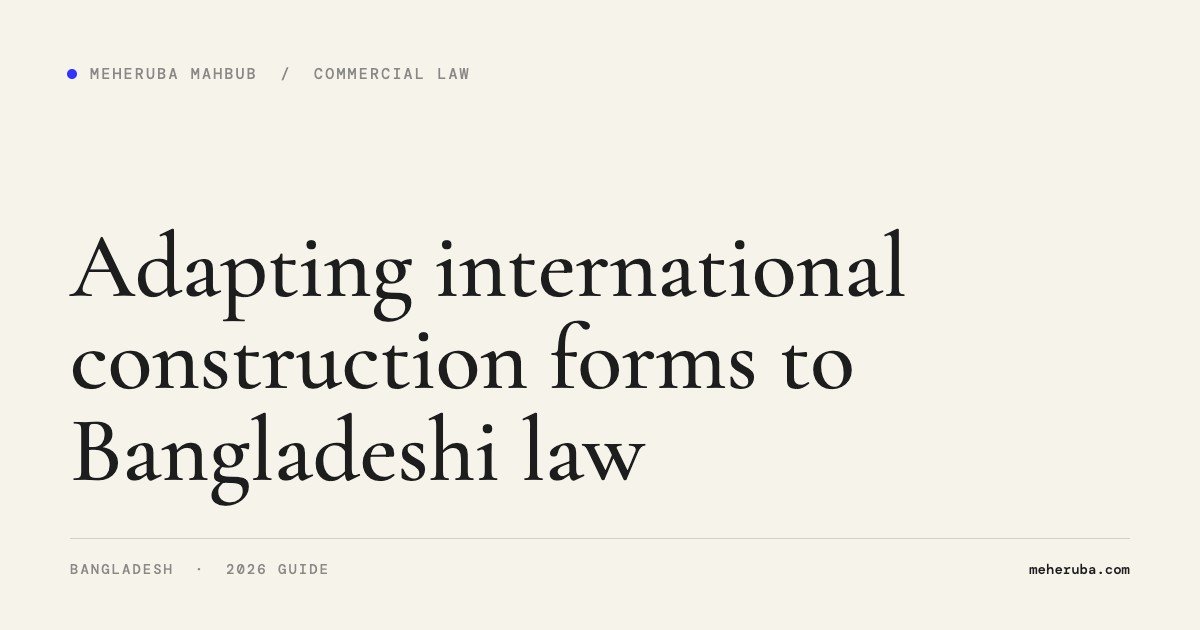
A FIDIC contract in Bangladesh gives employers, contractors and lenders a familiar, internationally tested framework for building roads, power plants, factories and ports. But FIDIC forms are written to work under many legal systems, and the particular conditions must be adapted carefully to Bangladeshi contract, procurement, tax and arbitration law.
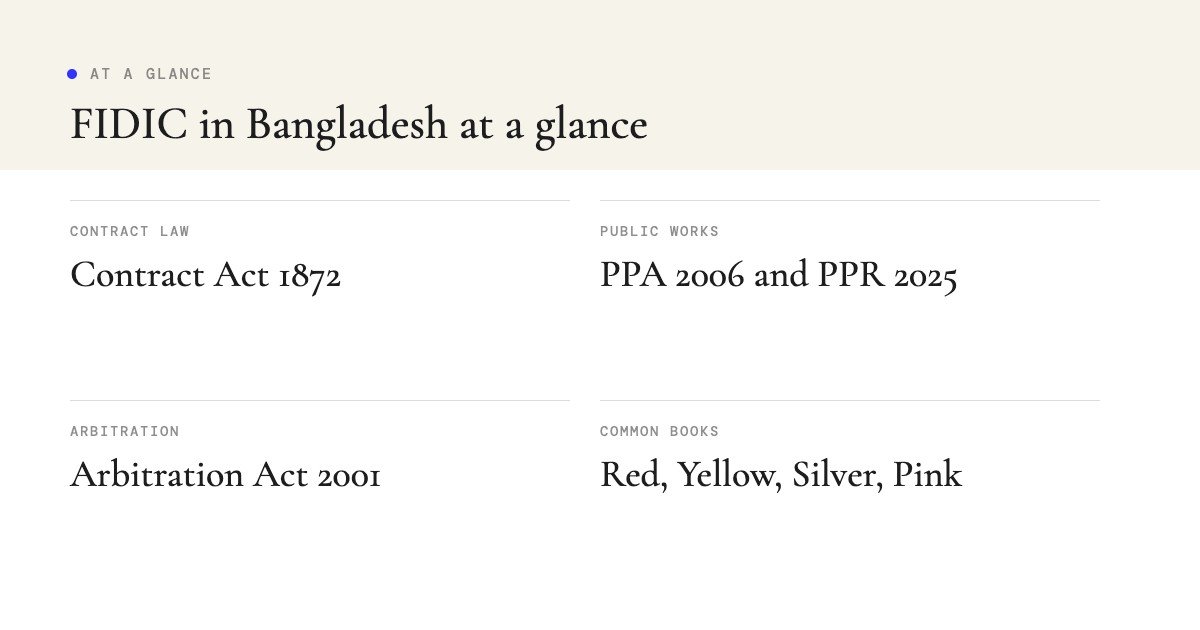
- FIDIC forms are widely used in Bangladesh, especially on donor-funded and large private projects; the Red, Yellow, Silver and Pink (MDB) books are the most common.
- Governing law is usually Bangladeshi law, so FIDIC terms operate subject to the Contract Act 1872, including its rules on penalties and time limits.
- Public works also follow the Public Procurement Act 2006 and the Public Procurement Rules 2025, in force since 28 September 2025, and standard tender documents from the Bangladesh Public Procurement Authority.
- Time-bar clauses, delay damages and advance payment guarantees need careful drafting to be enforceable locally.
- Disputes typically go to a dispute avoidance and adjudication board, then arbitration under the Arbitration Act 2001 or a foreign seat.
Why a FIDIC contract in Bangladesh is so common
FIDIC, the International Federation of Consulting Engineers, publishes standard forms of construction contract used around the world. In Bangladesh, they are a fixture of major infrastructure. Projects financed by the World Bank, the Asian Development Bank, JICA and other development partners usually require a FIDIC-based form, and many private power, industrial and real estate developers use FIDIC to reassure foreign contractors and lenders.
The attraction is predictability. Contractors know how a FIDIC contract in Bangladesh allocates risk, how claims are made, and how disputes are resolved. Lenders know what security and step-in rights to expect. That familiarity reduces pricing risk and speeds up negotiation, provided the local adaptations are done properly.
The main FIDIC books
| Book | Typical use | Who designs | Risk profile |
|---|---|---|---|
| Red Book (Construction) | Civil works designed by the employer | Employer | Balanced; measurement and payment by quantities |
| Yellow Book (Plant and Design-Build) | Electrical and mechanical plant, design-build works | Contractor | Contractor carries design risk |
| Silver Book (EPC/Turnkey) | Power plants and process facilities with fixed price | Contractor | Most risk on contractor |
| Pink Book (MDB Harmonised) | Projects funded by multilateral development banks | Employer | Red Book adapted to lender rules |
| Green Book (Short Form) | Smaller, simpler works | Either | Simplified |
FIDIC published second editions of the Red, Yellow and Silver books in 2017, with amendments reprinted in 2022. Many Bangladeshi projects still use the 1999 editions or the MDB edition because lenders or standard tender documents require them. Check which edition the tender documents mandate before drafting.
Bangladeshi law governs the FIDIC contract in Bangladesh
A FIDIC contract in Bangladesh is almost always governed by Bangladeshi law, particularly where the employer is a public body. The general conditions then take effect within the Contract Act 1872 and the rest of Bangladeshi law. Where they conflict with a mandatory rule, the local rule wins.
That matters most for four areas: liquidated damages, contractual time limits, termination and limitation periods. Each is discussed below. The particular conditions are the place to bridge the gap between FIDIC's international wording and local law.
Other laws that apply on site
- Bangladesh National Building Code 2020 and local building rules, such as RAJUK requirements in Dhaka.
- Environment Conservation Act 1995 and the Environment Conservation Rules 2023, for environmental clearance.
- Bangladesh Labour Act 2006, as amended in 2026, for workers' safety, wages and site conditions.
- Income Tax Act 2023 and VAT and Supplementary Duty Act 2012, for deductions at source from contractor payments.
- Foreign exchange rules of Bangladesh Bank for payments in foreign currency to foreign contractors.
Public procurement and FIDIC forms
For public works, the procurement regime shapes a FIDIC contract in Bangladesh before any negotiation starts. The Public Procurement Act 2006 governs procurement by government bodies, and the Public Procurement Rules 2025 came into force on 28 September 2025, replacing the 2008 Rules. Parliament passed the Public Procurement (Amendment) Act in April 2026, carrying forward an amendment ordinance. The new Rules include debarment of up to two years for misconduct, with a Debarment Review Board.
The Bangladesh Public Procurement Authority (formerly the CPTU) publishes standard tender documents, and much procurement runs through the e-GP portal. Standard documents for large works are based on FIDIC conditions with Bangladesh-specific particular conditions. Where a development partner funds the project, its procurement rules and harmonised conditions may apply instead of, or alongside, the national rules.
In public procurement, bidders usually cannot negotiate the general conditions, and deviations can make a bid non-responsive. Raise concerns through formal pre-bid clarification requests. In private projects, by contrast, the particular conditions of a FIDIC contract in Bangladesh are fully negotiable.
Drafting particular conditions for Bangladesh
The particular conditions are where a FIDIC contract in Bangladesh becomes a Bangladeshi contract. The following points deserve attention in almost every project.
Taxes and deductions at source
Employers in Bangladesh are generally required to deduct income tax and VAT at source from payments to contractors and suppliers, at rates set by the Income Tax Act 2023, the VAT and Supplementary Duty Act 2012 and the annual Finance Act. The contract should state whether the contract price includes these taxes, how deductions appear in payment certificates and who bears changes in rates. Foreign contractors also need clarity on permanent establishment and treaty relief.
Currency and payment
Where part of the price is in foreign currency, the contract should specify the currencies, exchange rate mechanism and the employer's obligations to obtain any approvals needed for payment abroad. Since 2022 the Taka has depreciated significantly, so currency allocation has become a major pricing issue.
Permits and approvals
Identify which party obtains each permit: environmental clearance, building approvals, import permits for plant, work permits for foreign staff and utility connections. Foreign personnel need work permits from Invest Bangladesh (formerly BIDA) or BEPZA, depending on the project location. Delays in permits are a common source of claims.
Language and notices
English is normally the contract language. Specify addresses for notices, accepted electronic communication and how notices are proved. Strict notice provisions are only useful if both sides can show when a notice was received.
Time bars and the Contract Act
FIDIC's claims clause requires the contractor to give notice of a claim within 28 days of becoming aware of the event, failing which the claim may be lost. The 2017 editions extend similar time bars to the employer. These clauses are the most litigated part of any FIDIC contract in Bangladesh.
Under Bangladeshi law, section 28 of the Contract Act 1872 makes void an agreement that absolutely restricts a party from enforcing its rights by legal proceedings, or limits the time within which it may do so. Bangladesh has not adopted the amendment India made to its equivalent section in 1997. There is therefore a respectable argument that a strict condition-precedent time bar is vulnerable, although contractual notice requirements that operate within the contract machinery may be treated differently. The point is not settled.
The practical answer is not to rely on the argument. Contractors should give notices on time, every time. Employers who want time bars to bite should draft them clearly as part of the claims procedure and apply them consistently.
Delay damages and section 74
FIDIC provides for delay damages at a daily rate up to a cap. Under section 74 of the Contract Act 1872, where a contract names a sum to be paid on breach, the injured party is entitled to reasonable compensation not exceeding that sum, whether or not actual loss is proved. Bangladeshi courts have generally treated the stated sum as a ceiling rather than an automatic entitlement.
In a FIDIC contract in Bangladesh, delay damages should therefore be set at a genuine pre-estimate of loss and supported by a short record of how the figure was calculated. Employers should keep evidence of the losses caused by delay, such as financing costs, lost revenue and supervision costs, in case the contractor challenges the deduction.
Performance security and advance payment guarantees
Performance securities and advance payment guarantees are usually on-demand bank guarantees issued by Bangladeshi or foreign banks. Bangladeshi courts generally treat unconditional guarantees as independent of the underlying contract, intervening only in narrow circumstances such as established fraud or irretrievable injustice. Contractors seeking to stop a call usually face a difficult burden, so the time to negotiate the call conditions is before signing.
Variations, claims and the Engineer
The Engineer, or the Employer's Representative under the Silver Book, administers the contract: issuing instructions, certifying payments, valuing variations and making determinations on claims. On public projects in Bangladesh, the Engineer is often a consulting firm appointed by the employer, sometimes a joint venture of foreign and local consultants.
The 2017 editions require the Engineer to act neutrally when making determinations and to follow strict time limits. Whatever the edition, a well-run FIDIC contract in Bangladesh depends on good records: daily site diaries, instructions in writing, contemporaneous programmes and photographs.
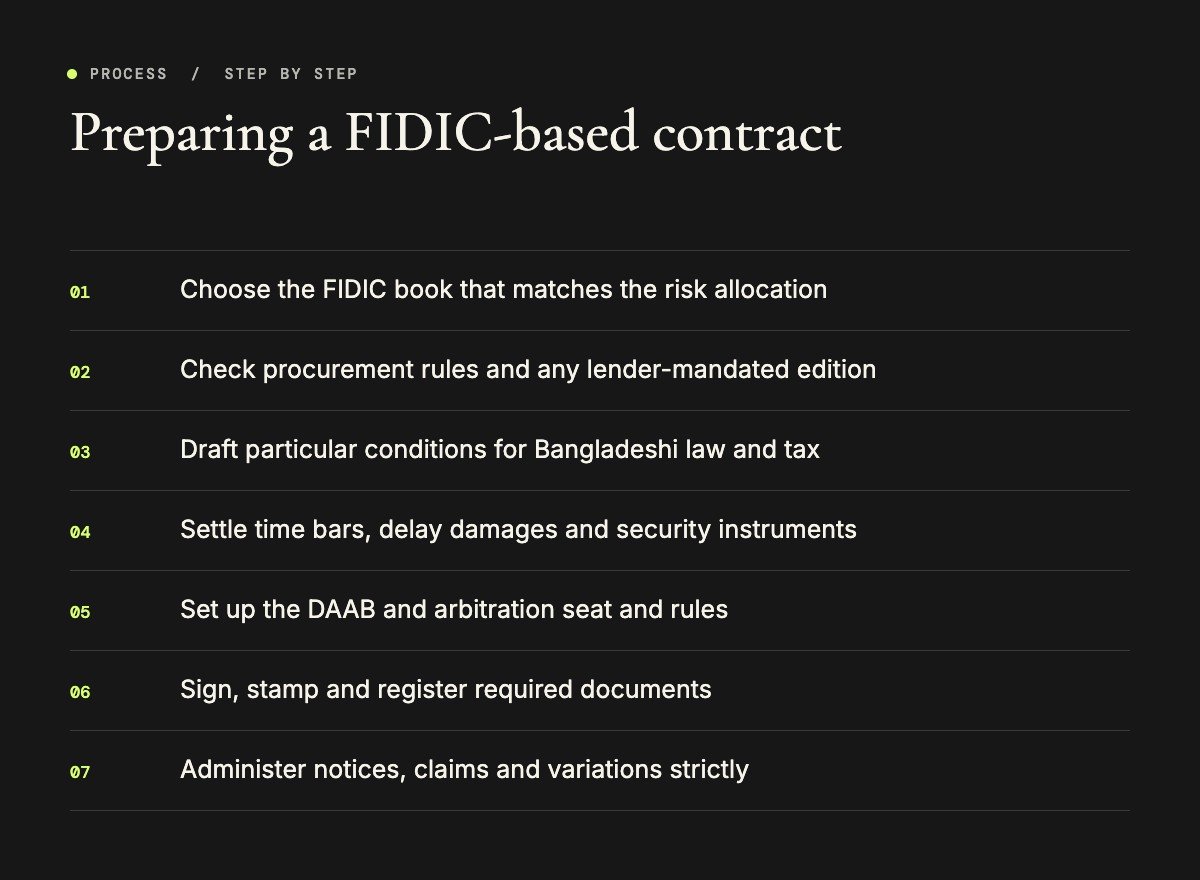
- Identify the event. Record the date the contractor became aware of the event and its likely impact.
- Give notice. Serve the notice of claim within the contractual period, citing the clause.
- Keep records. Maintain contemporaneous records of cost and time impact and allow the Engineer to inspect them.
- Submit the fully detailed claim. Provide the claim with supporting particulars within the period set by the edition.
- Engineer's determination. The Engineer consults the parties and determines the claim within the time limit.
- Notice of dissatisfaction. A party that disagrees serves a notice of dissatisfaction within the contractual period.
- Refer to the DAAB. The dispute goes to the dispute board, and then, if unresolved, to arbitration.
Dispute boards and arbitration
FIDIC contracts provide for a dispute adjudication board (1999 editions) or a dispute avoidance and adjudication board (2017 editions). On large projects in Bangladesh, standing boards are increasingly used, particularly on lender-funded projects. On smaller contracts, ad hoc boards are appointed only when a dispute arises, which saves cost but loses the avoidance function.
After the board, disputes go to arbitration. Where both parties are Bangladeshi or the employer is a public body, arbitration seated in Dhaka under the Arbitration Act 2001 is common. Foreign contractors often prefer ICC or SIAC arbitration seated in Singapore or another neutral seat. ICC Rules 2026 apply to arbitrations under agreements concluded from 1 June 2026, according to ICC announcements, so check which rules version the clause selects.
Enforcing board decisions and awards
Enforcing a dispute board decision before arbitration can be difficult in any jurisdiction, and Bangladesh is no exception. Parties should draft the obligation to comply with board decisions clearly and consider interim relief from the court under section 7A of the Arbitration Act 2001. Awards under a FIDIC contract in Bangladesh made abroad are enforced locally under the Arbitration Act 2001, which gives effect to the New York Convention. Our guide to the arbitration process in Bangladesh explains the local procedure.
Insurance, defects and handover
FIDIC requires the contractor to insure the works, equipment and third-party liability in the joint names of the parties, on terms set in the contract data. In a FIDIC contract in Bangladesh, insurance must usually be placed with insurers licensed by the Insurance Development and Regulatory Authority, and reinsurance abroad follows local rules. Confirm early that the market can provide the cover the contract specifies, especially for large plant and marine transit.
Taking-over marks the move from construction to operation. The employer issues a taking-over certificate when the works pass the tests on completion, and the defects notification period then begins. Retention money is often released in two stages, half at taking-over and half at the end of the defects period, sometimes replaced by a retention guarantee.
Latent defects and limitation
After the performance certificate, liability for latent defects continues under the general law, subject to the Limitation Act 1908. Employers in a FIDIC contract in Bangladesh should keep as-built drawings, test records and operation manuals, because proving a latent defect years later depends on them.
Termination and suspension
FIDIC gives both parties rights to suspend and terminate for defined defaults, and the employer a right to terminate for convenience. In a FIDIC contract in Bangladesh, termination must be exercised strictly in accordance with the notice procedure, because a defective termination can itself be a repudiatory breach.
Public employers sometimes terminate and then forfeit performance security and blacklist or debar the contractor under procurement rules. Contractors should be aware that debarment under the Public Procurement Rules 2025 is a separate administrative process with its own review mechanism, and should respond to show-cause notices promptly and in writing.
Termination for convenience by a public employer, followed by re-tendering the same works, invites challenge. Employers should document the genuine reasons and pay the compensation the contract provides; contractors should keep evidence of costs incurred and demobilisation.
Practical tips for foreign contractors
Foreign contractors entering their first FIDIC contract in Bangladesh often underestimate the local administrative load. From our experience, the following steps reduce risk:
- Choose the right local vehicle. Decide early between a branch office, a project office or a local company, and register with Invest Bangladesh where needed. See our guide to legal requirements for a new business.
- Plan for tax deductions. Model income tax and VAT deductions at source into cash flow, and claim treaty relief where available.
- Secure local partners carefully. Joint venture and subcontract agreements should flow down FIDIC obligations and notice periods.
- Keep the notice discipline. Appoint one person responsible for contractual notices and maintain a register.
- Understand the site. Land acquisition, utility relocation and monsoon conditions are frequent causes of delay; price and programme for them.
Our construction disputes team also advises contractors mid-project when claims start to build up.
Frequently asked questions about fidic contract in bangladesh
Which FIDIC book is used most in Bangladesh?
The Red Book and its MDB Harmonised (Pink Book) version are common on donor-funded civil works; the Yellow and Silver books are common for power and industrial plant. The tender documents usually decide.
Can a FIDIC contract be governed by English law if the project is in Bangladesh?
In private projects, parties can choose a foreign governing law, but mandatory Bangladeshi rules on permits, labour, tax and land still apply. Public employers almost always require Bangladeshi law.
Are FIDIC 28-day time bars enforceable in Bangladesh?
Not certainly. Section 28 of the Contract Act 1872 provides an argument against strict time bars, but the point is unsettled. Contractors should always give notices on time.
Will courts award the full delay damages in the contract?
Under section 74 of the Contract Act 1872, the stated sum is a ceiling; the employer is entitled to reasonable compensation up to it. A genuine pre-estimate with evidence improves the employer's position.
Where are FIDIC disputes in Bangladesh resolved?
Usually through a dispute board and then arbitration, either in Dhaka under the Arbitration Act 2001 or under ICC or SIAC rules at a foreign seat.
Do the Public Procurement Rules 2025 apply to private projects?
No. They apply to procurement by public bodies. Private projects are governed by contract and general law.
How we can help
We advise employers, contractors, consultants and lenders on every FIDIC contract in Bangladesh: choosing the book, drafting particular conditions, bid clarifications, claims and variations, dispute boards and arbitration. Learn more about our EPC and O&M contracts practice.
Negotiating or administering a FIDIC contract?
We adapt FIDIC terms to Bangladeshi law and help you manage notices, claims and disputes before they become costly.
Book a consultationEPC contracts practicePrimary sources: the Contract Act 1872, Public Procurement Act 2006 and Arbitration Act 2001 on the Laws of Bangladesh portal; standard tender documents of the Bangladesh Public Procurement Authority; contract forms published by FIDIC; arbitration rules of the ICC.
This article is general information about Bangladeshi law as of October 2026 and is not legal advice. Procurement rules, tax deductions and FIDIC editions change; confirm the current position with the procuring entity, the relevant authority or a qualified lawyer before acting.

0 Comments