
A franchise agreement in Bangladesh lets a foreign or local brand expand through local operators without owning every outlet. Bangladesh has no dedicated franchise statute, so the agreement itself, backed by contract, trademark, foreign exchange, tax and competition law, does all the legal work. Getting those pieces right decides whether royalties can be remitted, the brand is protected and the relationship can be ended cleanly if it fails.
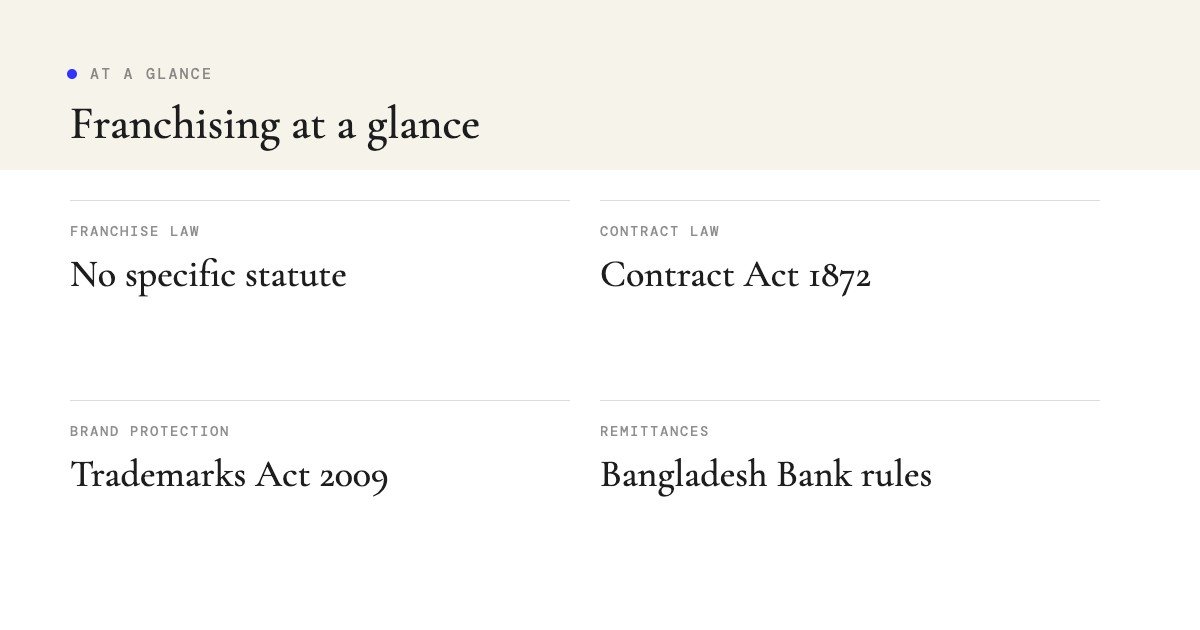
- There is no franchise-specific law; franchising is governed by the Contract Act 1872 and related laws on trademarks, foreign exchange, tax and competition.
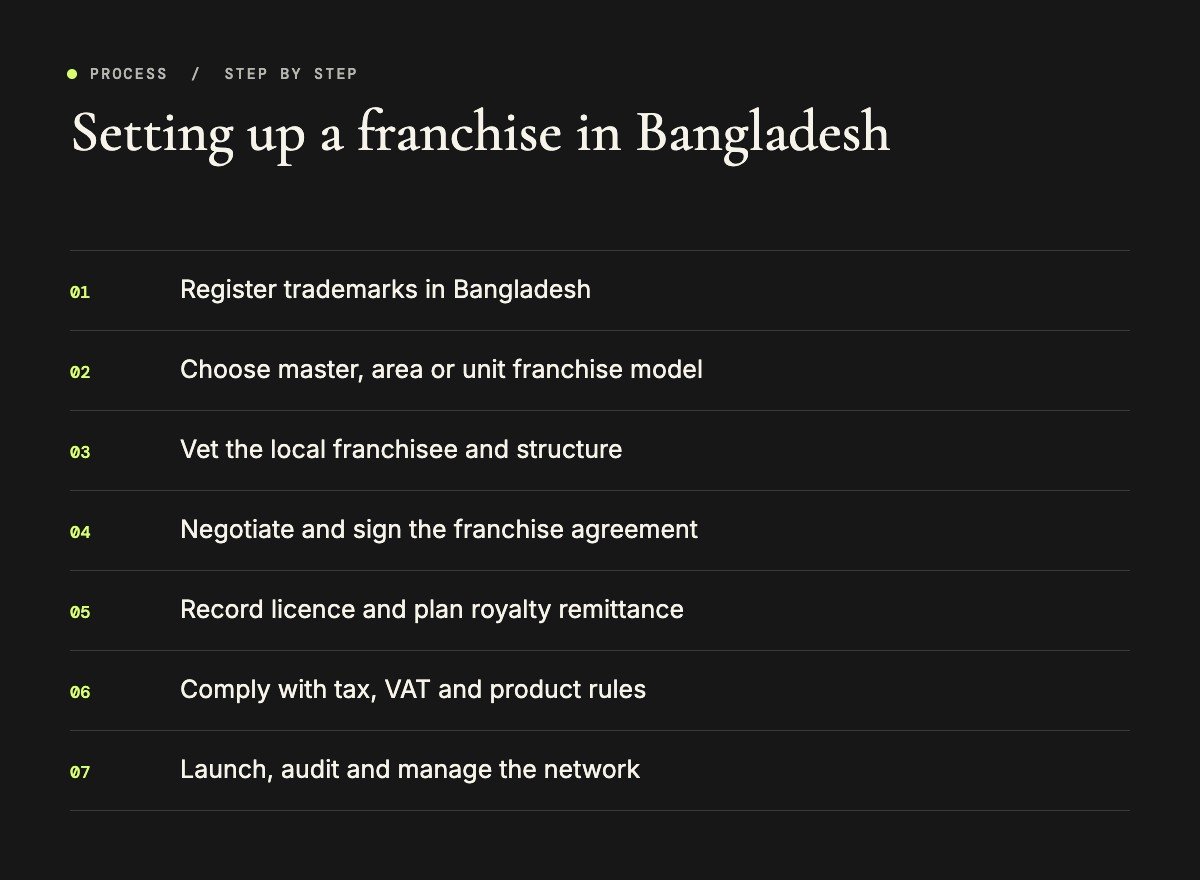
- Register trademarks in Bangladesh before signing, because an unregistered brand is hard to protect against copycats and former franchisees.
- Royalties and fees paid abroad must comply with Bangladesh Bank foreign exchange rules, and remittances beyond set limits may need approval.
- Withholding tax and VAT apply to franchise fees and royalties, and the agreement should say who bears them.
- Termination, de-branding and non-compete clauses must be drafted carefully to be enforceable under the Contract Act.
How franchising works in Bangladesh
Franchising is now common in Bangladesh's food, retail, education, fitness, beauty and hospitality sectors. International fast food and coffee chains, fashion brands and education providers operate through local franchisees, and successful local brands are franchising across districts. A franchise agreement in Bangladesh typically grants the franchisee the right to use the brand, trade secrets, operating systems and supply chain in a defined territory, in return for an initial fee and ongoing royalties.
Because there is no specific franchise law, there is no mandatory disclosure document, registration of franchises or cooling-off period, unlike in some other countries. This gives parties freedom, but it also means the written agreement carries the full burden of defining rights and protecting both sides. Our consumer and retail practice advises brands and franchisees on these structures.
Franchise models
| Model | How it works | Best for |
|---|---|---|
| Master franchise | One local company receives exclusive rights for the whole country and may sub-franchise | Foreign brands entering a new market |
| Area development | The developer commits to open a set number of outlets in a territory | Rapid roll-out with one strong partner |
| Unit franchise | Each outlet is franchised separately | Local brands and established networks |
| Joint venture franchise | Brand owner takes equity in the local operator | Brands wanting control and a share of profits |
The choice of model affects control, tax, remittances and risk. A master franchise agreement in Bangladesh is the most common route for foreign brands, because the master franchisee handles local licences, property, staffing and supply chain.
Protecting the brand: trademarks
Trademark protection is the foundation of any franchise. Bangladesh's Trademarks Act 2009 provides for registration with the Department of Patents, Designs and Trademarks. Registration takes time, so brand owners should file applications well before entering the market. Without registration, a brand owner must rely on passing off claims, which are harder and slower to prove.
The franchise agreement should grant a licence to use the marks, not an assignment, and should require the franchisee to use the marks only as instructed. Recording the licence or registered user with the trademark office, where applicable, helps evidence the authorised use. Our guide to trademark registration in Bangladesh explains the process.
Trade secrets and know-how
Recipes, operating manuals, supplier lists and software are protected mainly by contract. Confidentiality clauses, restricted access, staff confidentiality undertakings and return of materials on termination are essential, since Bangladesh has no separate trade secrets statute.
Key clauses in a franchise agreement in Bangladesh
- Grant and territory. Scope of rights, exclusivity, territory and online sales.
- Term and renewal. Initial term, renewal conditions and renewal fees.
- Fees. Initial franchise fee, royalties, marketing contributions and their calculation and payment dates.
- Development obligations. Number of outlets and timelines for master and area franchisees.
- Standards and training. Operating manual, quality standards, training and audits.
- Supply. Approved suppliers, imported ingredients or goods and pricing.
- Intellectual property. Licence terms, improvements, domain names and social media accounts.
- Reporting and audit. Sales reports, point-of-sale access and audit rights.
- Termination. Grounds, cure periods, step-in rights and post-termination duties.
- Dispute resolution. Governing law, arbitration seat and rules, and interim relief.
Royalties and foreign exchange
For foreign franchisors under a franchise agreement in Bangladesh, getting money out of the country is a central issue. Payments of franchise fees, royalties and technical fees to non-residents are governed by the Foreign Exchange Regulation Act 1947 and Bangladesh Bank's Guidelines for Foreign Exchange Transactions. Banks can remit such fees within limits set by the rules, typically linked to a percentage of sales or project cost, with supporting documents such as the agreement, invoices and tax certificates. Remittances above those limits, or for unusual arrangements, may need approval, historically through BIDA and now through Invest Bangladesh (formerly BIDA) or Bangladesh Bank as the rules provide.
A franchise agreement in Bangladesh should therefore define royalties in a way that fits the remittance rules, require the franchisee to obtain any approvals, and deal with what happens if remittances are delayed or blocked. Brand owners should also consider currency risk, since the taka has depreciated significantly against the dollar in recent years.
Before signing, ask the franchisee's bank to confirm the documents it will need for royalty remittances. A royalty clause that looks good on paper but cannot be remitted under Bangladesh Bank rules is a common and expensive mistake.
Tax and VAT
Royalties and franchise fees paid to non-residents are subject to withholding tax under the Income Tax Act 2023, at the rate set for non-resident payments unless a double taxation treaty reduces it. Bangladesh has treaties with many countries, and treaty benefits require proper documentation. Franchise and royalty payments are also subject to VAT under the VAT and Supplementary Duty Act 2012, with the local franchisee usually accounting for VAT on imported services through reverse charge.
The agreement should specify whether payments are gross or net of tax, which party bears VAT and how tax certificates will be provided so the franchisor can claim credit at home. Local franchisors and franchisees also need to account for VAT on domestic franchise fees.
Regulatory licences for the business
Under a franchise agreement in Bangladesh, the franchisee needs the ordinary licences for the business it runs: trade licence, tax and VAT registration, BSTI and food safety requirements for food businesses under the Bangladesh Food Safety Authority, import registration for imported goods, and sector licences for education or health. The franchisor should require the franchisee to obtain and maintain all licences and to indemnify the franchisor against regulatory breaches.
Competition law
The Competition Act 2012 prohibits anti-competitive agreements and abuse of dominance, and the Bangladesh Competition Commission enforces it. Franchise agreements often contain vertical restrictions such as resale price recommendations, exclusive supply and territorial protection. Most ordinary franchise restrictions that protect the brand are acceptable, but resale price fixing and restrictions that go beyond what is needed to protect the system can raise concerns. A franchise agreement in Bangladesh should keep restrictions proportionate and justified by brand protection.
Termination and post-termination
Termination is where a franchise agreement in Bangladesh is most tested. Termination clauses should specify the grounds, such as non-payment, breach of standards, insolvency or change of control, and give cure periods where appropriate. Under the Contract Act 1872, a party may terminate for fundamental breach, but disputes often arise about whether a breach was serious enough. Clear drafting reduces this risk.
After termination, the franchisee must stop using the marks, de-brand outlets, return manuals and confidential information, and transfer domain names and social media accounts. Section 27 of the Contract Act makes agreements in restraint of trade void, subject to limited exceptions, so post-termination non-compete clauses must be narrow and tied to the protection of goodwill and confidential information. Brand owners should rely on confidentiality and trademark rights rather than broad non-competes alone.
Disputes and enforcement
Disputes under a franchise agreement in Bangladesh are often international. Many agreements choose foreign law and arbitration in Singapore, London or Dubai. Foreign arbitral awards are enforceable in Bangladesh under the Arbitration Act 2001, as Bangladesh is a party to the New York Convention. Interim relief, such as injunctions to stop use of marks, can be sought from Bangladeshi courts in support of arbitration. Our international arbitration practice advises on dispute resolution clauses and enforcement.
Choosing and vetting the franchisee
The success of a franchise agreement in Bangladesh depends more on the franchisee than on the contract. Brand owners should assess the franchisee's financial strength, retail or hospitality experience, access to prime property, management team and reputation. Due diligence should include company records from RJSC, tax compliance, litigation searches, bank references and the backgrounds of key shareholders. For a master franchise, the franchisor should also review the franchisee's plan for sub-franchising and how it will control quality across the country.
The franchisee's corporate structure matters too. Many franchisors require the franchisee to set up a dedicated company for the brand, so that the business can be audited, transferred or stepped into without disturbing the franchisee's other activities. Change of control clauses then protect the franchisor if the shares are sold to an unsuitable owner.
Property and outlet leases
Outlet leases are often the largest fixed cost in a franchise system. Franchisors usually require approval of locations and lease terms, and some require the right to take over the lease if the franchise ends. Under Bangladeshi law, leases of immovable property for more than one year should be registered, and the Premises Rent Control Act 1991 governs some landlord and tenant matters. Aligning the lease term with the franchise term, and including a step-in or assignment right in favour of the franchisor, protects the brand's presence in key locations when a franchise agreement in Bangladesh is terminated.
Supply chain and imports
Many brands require franchisees to buy ingredients, equipment or merchandise from approved suppliers, some of them abroad. Imports must comply with the Import Policy Order, customs duties, BSTI standards and food safety rules, and payments for imports go through letters of credit or other permitted banking channels. Price clauses should deal with currency movements and import duty changes. Where the franchisor or its affiliates profit from supplies, this should be disclosed and justified to avoid disputes. A practical franchise agreement in Bangladesh allows local sourcing of approved substitutes where imports become impossible or too costly.
Marketing funds and digital channels
Most franchise systems require contributions to a marketing fund, often a percentage of sales, used for national advertising. The agreement should explain how the fund is managed, reported and spent. Online channels deserve particular care. Food delivery platforms, e-commerce sites, social media pages and customer data are valuable assets, and the agreement should state who owns accounts, domain names and data, and how they transfer on termination. Data handling should also respect Bangladesh's developing data protection and cyber security laws. Leaving these points vague is one of the most frequent sources of conflict under a franchise agreement in Bangladesh.
Local brands franchising at home
Bangladeshi restaurant, bakery, salon, pharmacy and education brands increasingly franchise within the country. For these franchisors, the foreign exchange issues fall away, but the other legal issues remain: trademark registration, a clear operating manual, fee structures that comply with VAT, and termination clauses that work. A well-drafted franchise agreement in Bangladesh helps a local brand grow quickly while keeping control of quality, and positions it for later expansion abroad or for investment from private equity.
Negotiation tips for both sides
Franchisors usually start with a global template, but a franchise agreement in Bangladesh often needs local changes to work. Franchisees should negotiate realistic development schedules, cure periods before termination, fair renewal terms, local sourcing flexibility and protection against arbitrary changes to the operating manual. Franchisors should insist on clear audit rights, prompt reporting, robust brand standards and effective remedies for non-payment. Both sides benefit from a dispute escalation process that encourages senior management discussion before arbitration.
It is also worth agreeing how the parties will handle events outside their control, such as political unrest, import restrictions, currency shortages or pandemics. A tailored force majeure and hardship clause, with temporary fee relief or extended timelines, can keep the relationship alive through difficult periods instead of pushing it into termination. Thinking through these scenarios at the start is what separates a durable franchise agreement in Bangladesh from one that collapses at the first crisis.
Transfers, exits and succession
Franchisees may want to sell their business, bring in investors or pass the franchise to family members. The agreement should set out when transfers are allowed, the franchisor's approval rights and any right of first refusal, transfer fees and training requirements for the new owner. For individual franchisees, succession on death or incapacity should be addressed so the outlet can continue without disruption. Clear exit rules protect the value both parties have built in the brand.
Frequently asked questions about franchise agreement in bangladesh
Is there a franchise law in Bangladesh?
No. Franchising is governed by the Contract Act 1872 together with trademark, foreign exchange, tax and competition laws.
Do franchise agreements need registration?
There is no franchise registration, but trademark licences may be recorded and approvals may be needed for royalty remittances above set limits.
Can royalties be sent abroad?
Yes, through banks under Bangladesh Bank foreign exchange rules, within limits and with documents, and with approval where required.
What tax applies to royalties?
Withholding tax under the Income Tax Act 2023, subject to treaties, and VAT on imported services.
Are non-compete clauses enforceable?
Section 27 of the Contract Act limits restraints of trade, so post-termination non-competes should be narrow and linked to protecting goodwill and confidential information.
Can a foreign arbitration award be enforced?
Yes. Bangladesh is a New York Convention party, and foreign awards are enforceable under the Arbitration Act 2001.
How we can help
We advise international brands, local franchisors and franchisees on every franchise agreement in Bangladesh: market entry structuring, trademark protection, drafting and negotiation, royalty remittance and tax, competition law, termination and disputes. Learn more about our consumer and retail practice and our intellectual property practice.
Bringing a brand to Bangladesh or franchising your own?
We structure the deal, protect your brand and draft an agreement that works with Bangladesh's tax and foreign exchange rules.
Book a consultationConsumer and retail practicePrimary sources: the Contract Act 1872, Trademarks Act 2009, Competition Act 2012 and Foreign Exchange Regulation Act 1947 on the Laws of Bangladesh portal; foreign exchange guidelines of Bangladesh Bank; trademark registration at the Department of Patents, Designs and Trademarks; competition enforcement by the Bangladesh Competition Commission.
This article is general information about Bangladeshi franchise law as of October 2026 and is not legal or tax advice. Foreign exchange limits, tax rates and approval procedures change; confirm the current position with your bank, tax adviser or a qualified lawyer before acting.


0 Comments