
An agro processing business in Bangladesh turns rice, fruit, vegetables, spices, fish, dairy, tea and jute into products for local shops and export markets. The opportunity is large, but so is the licensing list: company registration, food safety, BSTI standards, environmental clearance, factory approvals, tax incentives and export documentation. This guide sets out the legal path from idea to a licensed, export-ready factory.

- Most investors use a private limited company registered with RJSC, followed by a trade licence, tax and VAT registration.
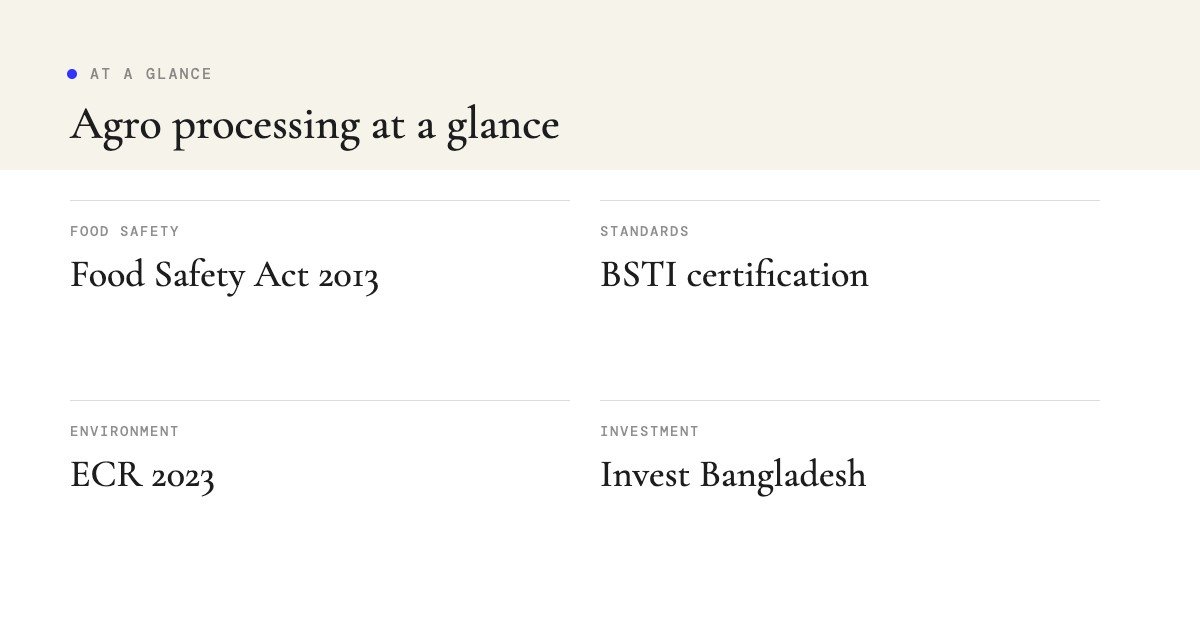
- Food businesses must comply with the Food Safety Act 2013 and the Bangladesh Food Safety Authority, and many products need BSTI certification before sale.
- Processing plants generally need environmental clearance under the Environment Conservation Rules 2023 and factory approvals from DIFE.
- Agro processing has historically enjoyed tax and export incentives, but rates and conditions change with each budget and with LDC graduation.
- Exports need phytosanitary or health certificates, and often halal and buyer-specific certifications.
Why the agro processing business in Bangladesh is growing
Bangladesh is a major producer of rice, potatoes, vegetables, fruit, fish and spices, with a large domestic market and a growing diaspora demand abroad. Processing reduces post-harvest losses, adds value for farmers and creates exports beyond garments. Products range from flour, edible oil, spices and snacks to juices, frozen fish, dairy, bakery and ready meals. Government policy has long promoted the agro processing business in Bangladesh through incentives, industrial zones and export support.
At the same time, consumers and regulators are more demanding about food safety, adulteration and labelling, and export buyers impose strict standards. A sound legal foundation is essential. Our agriculture and food practice advises processors, investors and exporters across the sector.
Choosing the business structure
The first legal decision for an agro processing business in Bangladesh is its structure. Small processors may start as sole proprietorships or partnerships, but a private limited company is usually best for growth, bank finance and foreign investment. Registration is with the Registrar of Joint Stock Companies and Firms (RJSC), and the company then obtains a trade licence from the city corporation or local authority, an e-TIN and VAT registration (BIN). Our guide to private limited company registration explains the process.
Foreign investors can own up to 100 percent of most agro processing ventures. Investment is registered with Invest Bangladesh (formerly BIDA), or with BEPZA or the economic zones authority if the plant is in an EPZ or economic zone. Capital must come through banking channels so that profits and exit proceeds can later be repatriated.

Licences for an agro processing business in Bangladesh
| Licence or approval | Authority | Purpose |
|---|---|---|
| Company incorporation | RJSC | Legal entity |
| Trade licence | City corporation or municipality | Permission to trade locally |
| TIN and VAT registration | NBR | Tax compliance |
| Environmental clearance | Department of Environment | Pollution control |
| Factory licence and layout approval | DIFE | Worker safety and factory standards |
| Fire safety certificate | Fire Service and Civil Defence | Fire protection |
| Food business registration | Bangladesh Food Safety Authority | Food safety compliance |
| Product certification | BSTI | Mandatory standards for listed products |
| Import and export registration | Office of the Chief Controller of Imports and Exports | Trade in raw materials and products |
Not every licence applies to every business, and sector rules add more. Dairy, fisheries and meat processing, for example, involve the Department of Livestock Services or Department of Fisheries.
Food safety and BSTI standards
The Food Safety Act 2013 established the Bangladesh Food Safety Authority to regulate food safety across the supply chain. Food businesses must follow hygiene requirements, avoid harmful additives and adulteration, label products correctly and cooperate with inspections. Selling unsafe or adulterated food is an offence with serious penalties, and mobile courts regularly fine processors and shops.
BSTI administers mandatory certification for a list of products, including many processed foods such as flour, edible oil, biscuits, juices, spices and bottled water. A product on the mandatory list cannot be sold without a BSTI certification mark licence, which requires testing and factory inspection. For any agro processing business in Bangladesh, checking the current mandatory list before launch is essential.
Labelling
Labels should show the product name, ingredients, net weight, manufacturing and expiry dates, batch number, price where required, manufacturer details, BSTI mark where applicable and nutritional or allergen information required by rules. Misleading claims can breach food safety and consumer protection laws.
Environmental and factory compliance
Under the Environment Conservation Rules 2023, industries are classified by environmental impact, and many food processing plants require site and environmental clearance from the Department of Environment, with effluent treatment where wastewater is generated. Fish, meat, dairy, starch and sugar processing can produce heavy effluent loads and attract scrutiny. Clearance must be renewed, and operating without it can lead to fines and closure.
Factories also need DIFE approval of the layout and a factory licence, and must comply with the Bangladesh Labour Act 2006 on wages, hours, safety and welfare, as amended in 2026. Seasonal and contract workers, common in agro processing, should be engaged in line with the Act.
Locate the plant where environmental clearance is realistic. A site in an approved industrial area, BSCIC estate or economic zone usually gets utilities and clearances more easily than agricultural or residential land, which may also need land use conversion.
Tax and export incentives
Agro processing has long been a priority sector. Over the years, investors have benefited from tax holidays, reduced corporate tax rates for certain agro processing income, reduced duties on capital machinery, and export cash incentives for processed agricultural products. These incentives are set by the Income Tax Act 2023, customs and VAT rules and annual budget measures, and they change frequently.
LDC graduation also affects export subsidies, as cash incentives are being reduced to comply with trade rules. An agro processing business in Bangladesh should therefore model its returns using current rates confirmed with tax advisers each year, rather than relying on past incentives. Economic zones and hi-tech parks offer their own packages of fiscal benefits.
Sourcing from farmers
Reliable raw material supply is critical for every agro processing business in Bangladesh. Processors often use contract farming, providing seeds, technical support or advances to farmers in return for agreed volumes at agreed quality and price. These arrangements are governed by the Contract Act 1872 and should be written clearly, in Bangla, covering quality standards, pricing formulas, delivery, rejection, advances and dispute resolution. Fair, transparent contracts reduce side-selling and disputes, and support certification schemes that buyers increasingly require.
Exporting processed food
Exports require registration with the Office of the Chief Controller of Imports and Exports (export registration certificate), compliance with the Export Policy, and product-specific certificates. Plant products need phytosanitary certificates from the Department of Agricultural Extension under the Plant Quarantine Act 2011, and fish and animal products need health certificates from the relevant departments. Halal certification is important for Middle Eastern and Southeast Asian markets.
Destination countries impose their own rules, such as maximum residue limits, labelling and importer registration, and some require certification such as HACCP, ISO 22000 or BRCGS. An agro processing business in Bangladesh aiming at export should build these standards into its plant design from the start. Export proceeds must be repatriated within the period set by Bangladesh Bank.
Financing the business
An agro processing business in Bangladesh can access bank loans, Bangladesh Bank refinance schemes for agriculture and SMEs, green finance for energy-efficient equipment and equity from local or foreign investors. Lenders will review licences, environmental compliance and offtake contracts, so getting the legal basics right helps secure finance. Our banking and finance practice advises on project and working capital financing.
Land, site selection and utilities
Site selection shapes almost every later approval. Agricultural land cannot simply be used for a factory; conversion of land use may require permission from the district administration, and the Agricultural Land Protection policies discourage industrial use of fertile farmland. Buying land also requires careful title checks, mutation records and verification of land development tax payments. Many investors in an agro processing business in Bangladesh therefore prefer plots in BSCIC industrial estates, economic zones or established industrial areas, where land use is already industrial and utilities are planned.
Reliable power, gas and water are critical for processing, cold storage and drying. Utility connections require applications to the relevant distribution company and can take time, so they should be planned alongside construction. Captive generation, solar installations and water treatment may need separate approvals. Our guide to land registration in Bangladesh covers title and registration checks.
Cold chain, storage and logistics
Fruits, vegetables, fish and dairy depend on a cold chain from farm to factory to market. Cold storage facilities need their own licences and must meet safety and environmental standards, including the safe handling of refrigerants such as ammonia. Warehouses for food must meet hygiene requirements under food safety rules. For exporters, links to ports and airports, inland container depots and reefer container availability shape costs and quality. Logistics contracts should allocate responsibility for temperature failures and spoilage clearly, because these are a frequent source of disputes for an agro processing business in Bangladesh.
Brands, trademarks and packaging
A recognisable brand is often the most valuable asset of a food company. Register trademarks for brand names and logos with the Department of Patents, Designs and Trademarks before launch, and consider registering distinctive packaging designs as industrial designs. Packaging must also comply with food contact material standards, labelling rules and any plastic packaging restrictions, such as the ban on polythene shopping bags under the Environment Conservation Act. Counterfeit and look-alike products are common in the local market, and registered rights make enforcement against them far more effective.
Geographical indications are another opportunity. Bangladesh has registered several products as GIs, such as certain varieties of rice, mango and textiles, under the Geographical Indication of Goods (Registration and Protection) Act 2013. Processors using GI-registered raw materials can use this status in marketing, subject to the rules for authorised users.
Distribution and retail contracts
Domestic sales usually run through distributors, wholesalers, supermarket chains and, increasingly, e-commerce platforms. Distribution agreements should set out territory, exclusivity, pricing, credit terms, returns of expired goods, marketing support and termination. Supermarket listing agreements often include listing fees, promotional contributions and strict delivery terms. Clear contracts reduce payment disputes, which are one of the biggest cash-flow risks for an agro processing business in Bangladesh, and they support recovery through cheque dishonour proceedings or civil suits when buyers fail to pay.
Quality systems and recalls
Regulators and buyers expect documented quality systems: supplier approval, raw material testing, process controls, traceability by batch, laboratory testing of finished products and complaint handling. A recall plan should explain how the company will identify affected batches, notify regulators and customers, and withdraw products quickly. Under the Food Safety Act 2013, authorities can order recalls and seize unsafe food, and a well-run recall can protect both consumers and the brand. Investing in these systems early makes an agro processing business in Bangladesh more resilient and more attractive to export buyers and investors.
Common legal mistakes to avoid
- Starting production before environmental clearance, BSTI certification or food safety registration is in place.
- Buying agricultural land without checking whether industrial use and conversion are permitted.
- Relying on old tax holidays or export incentives without confirming current rates.
- Using informal arrangements with farmers that cannot be enforced when prices move.
- Launching a brand without trademark registration, inviting copycats.
- Receiving foreign investment informally, which later blocks remittance of dividends.
Each of these mistakes is common, and each can be costly to fix later. A short legal review at the planning stage helps an agro processing business in Bangladesh avoid them.
A sample roadmap
A typical new plant follows a sequence: feasibility study and site selection; company formation and investment registration; land acquisition or lease; environmental site clearance; building design and approvals; machinery import; construction; utility connections; factory licence and fire certificate; environmental clearance for operation; food safety registration and BSTI licences; trial production; and then commercial launch and export registration. Many steps can run in parallel with good planning, and experienced advisers can shorten the overall timeline considerably. Treating the roadmap as a single project, with one person responsible for every licence and deadline, is the best way to bring an agro processing business in Bangladesh to market on time and on budget.
Halal and organic certification
Halal certification is issued in Bangladesh by bodies including BSTI and the Islamic Foundation, and importing countries may require certification recognised by their own authorities. Organic claims require certification from an accredited body under recognised standards, and labelling a product as organic without certification can breach consumer protection and food safety rules. Both certifications require supply chain controls and records, so they should be planned when designing sourcing and production.
Frequently asked questions about agro processing business in bangladesh
What licences does a food processing plant need?
Typically company registration, trade licence, tax and VAT registration, environmental clearance, DIFE factory licence, fire certificate, food safety compliance and BSTI certification for listed products.
Can foreigners own an agro processing company?
Yes, generally up to 100 percent, with investment registered with Invest Bangladesh or the relevant zone authority.
Is BSTI certification always required?
Only for products on BSTI's mandatory certification list, which includes many processed foods. Check the current list.
Are there tax incentives?
Agro processing has had tax and export incentives, but they change with budgets and LDC graduation. Confirm current rates before investing.
What documents are needed to export food?
An export registration certificate, commercial documents, phytosanitary or health certificates and often halal and buyer certifications.
Do I need environmental clearance?
Most processing plants do under the Environment Conservation Rules 2023, especially those generating wastewater.
How we can help
We advise investors and processors on every legal aspect of an agro processing business in Bangladesh: structuring and foreign investment, licensing, food safety and BSTI compliance, environmental clearance, contract farming, export documentation, incentives and finance. Learn more about our agriculture and food practice.
Planning a food processing plant or export venture?
We map every licence, prepare your applications and structure contracts that protect your supply and your brand.
Book a consultationAgriculture and food practicePrimary sources: the Food Safety Act 2013, Environment Conservation Act 1995 and Plant Quarantine Act 2011 on the Laws of Bangladesh portal; food safety rules from the Bangladesh Food Safety Authority; product certification from BSTI; environmental clearance from the Department of Environment.
This article is general information about Bangladeshi agro processing regulation as of October 2026 and is not legal or tax advice. Incentives, mandatory product lists and licensing rules change; confirm the current position with the relevant authority or a qualified lawyer before acting.




0 Comments