
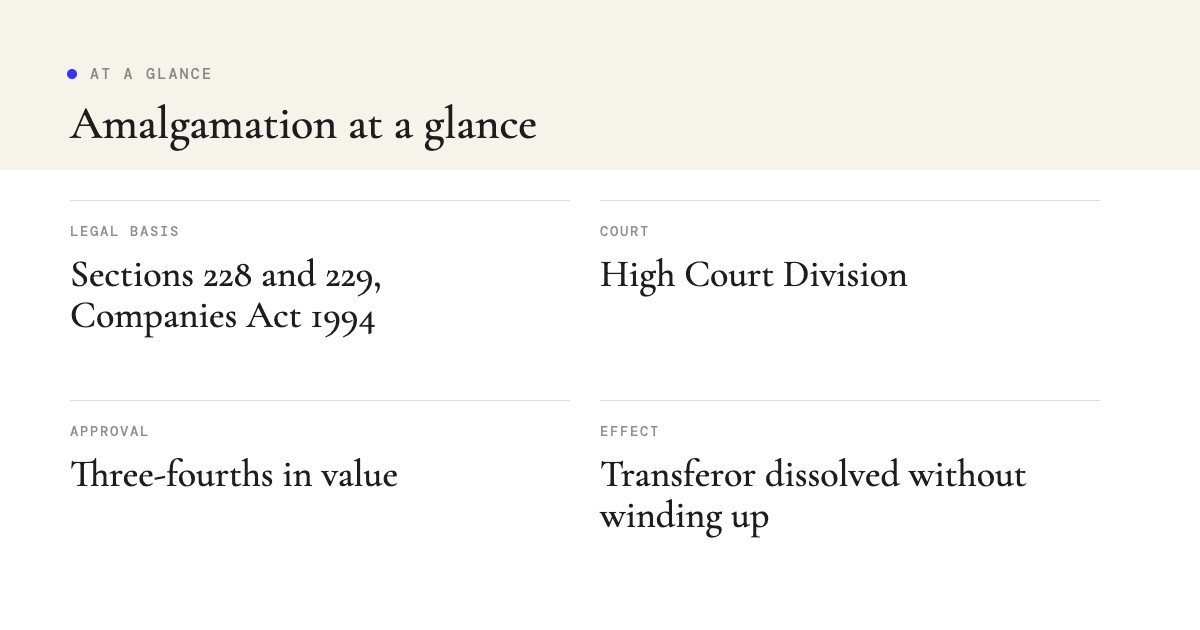
Company amalgamation in Bangladesh is usually carried out through a scheme of arrangement sanctioned by the High Court Division under sections 228 and 229 of the Companies Act 1994. The court process allows one or more companies to transfer their entire business, assets and liabilities to another company and then dissolve without winding up. Groups use amalgamations to simplify structures, combine operations, absorb subsidiaries or complete acquisitions.
- Amalgamations are implemented through a court-sanctioned scheme under sections 228 and 229 of the Companies Act 1994.
- The scheme must be approved by a majority in number representing three-fourths in value of the shareholders or creditors, or each class, at court-ordered meetings.
- Once sanctioned, the court can order transfer of assets and liabilities and dissolution of the transferor company without winding up.
- The sanction order must be filed with RJSC, and licences, contracts, land records and employees need to be moved across in practice.
- Tax, stamp duty, sector regulators and competition law must all be planned before the application is filed.
What company amalgamation in Bangladesh involves
An amalgamation combines two or more companies into one. In the most common form, a transferor company merges into an existing transferee company, which issues shares to the transferor's shareholders. Alternatively, two companies may merge into a new company. The legal mechanism for company amalgamation in Bangladesh is a scheme of compromise or arrangement under section 228, combined with the court's power under section 229 to facilitate reconstruction and amalgamation by transferring the undertaking and dissolving the transferor.
Amalgamation differs from a share acquisition, where the buyer purchases shares and both companies continue to exist, and from an asset purchase, where specific assets are transferred by contract. Our mergers and acquisitions practice advises on choosing the right structure.
When to use an amalgamation
| Purpose | Why amalgamation helps |
|---|---|
| Group simplification | Removes dormant or duplicate subsidiaries and reduces compliance costs |
| Combining operations | Brings related businesses into one entity for efficiency and financing |
| Post-acquisition integration | Merges an acquired target into the buyer's local company |
| Listing preparation | Consolidates businesses before an IPO |
| Restructuring | Combines weak and strong entities as part of a turnaround |
The legal framework
Section 228 allows a company to propose a compromise or arrangement with its members or creditors. The court may order meetings, and if the required majority approves, the court may sanction the scheme, making it binding on all members or creditors of that class. Section 229 gives the court additional powers when the scheme involves reconstruction or amalgamation, including transferring the property and liabilities of the transferor company, allotting shares, continuing legal proceedings, dissolving the transferor without winding up and making provisions for dissenting persons. The Company Bench of the High Court Division hears these matters.
Sector laws add requirements. Bank amalgamations involve the Bank Company Act 1991 and Bangladesh Bank approval, finance companies the Finance Company Act 2023, insurers IDRA, and listed companies BSEC and the stock exchanges. Company amalgamation in Bangladesh in regulated sectors therefore needs parallel regulatory approvals.
Step-by-step process
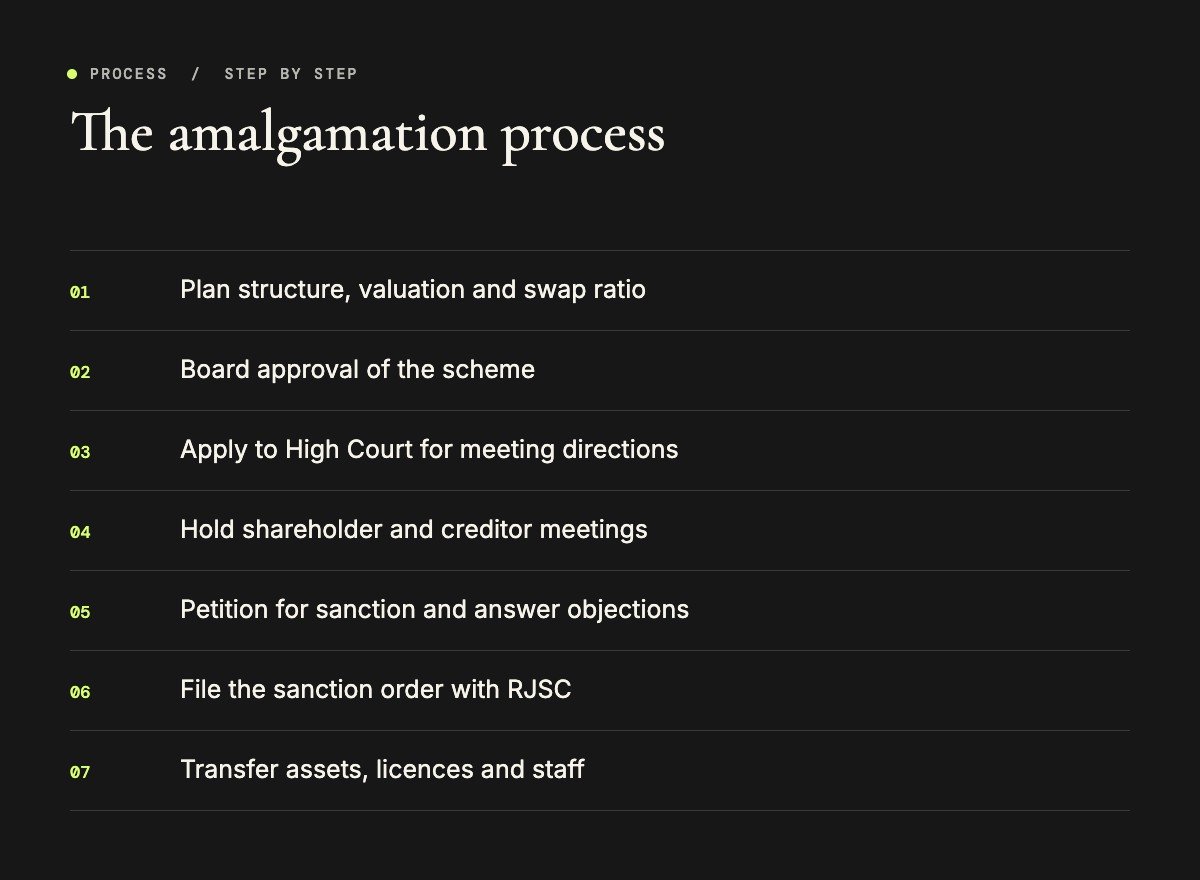
- Planning. Decide structure, conduct due diligence, value the companies and fix the share exchange ratio.
- Board approvals. The boards of both companies approve the scheme and authorise the application.
- First motion. Apply to the High Court Division for directions to convene meetings of members and, where needed, creditors, or for dispensation where appropriate.
- Meetings. Hold meetings as directed, with notices, explanatory statements and chairpersons appointed by the court; obtain the statutory majority.
- Second motion. Petition for sanction, report the meeting results and respond to objections from shareholders, creditors or regulators.
- Sanction order. The court sanctions the scheme and makes orders under section 229.
- Implementation. File the certified order with RJSC within the prescribed time, issue shares, transfer assets, update records and notify counterparties.
Shareholder and creditor protection
The statutory majority, a majority in number holding three-fourths in value of those present and voting, protects minority interests while allowing the scheme to bind dissenters. The court will check that the meetings were properly held, that the explanatory statement fairly disclosed material facts, and that the scheme is fair and reasonable. Creditors may object if the scheme prejudices their claims. In company amalgamation in Bangladesh, the court can refuse sanction where the scheme is unfair, oppressive or designed to evade liabilities.
An independent valuation report supporting the swap ratio is often decisive. It answers minority shareholder objections and gives the court confidence that the scheme is fair.
Tax considerations
Amalgamations can trigger tax questions, including capital gains on transfer of assets or shares, carry-forward of losses and depreciation, and treatment of the transferor's tax liabilities. The Income Tax Act 2023 contains provisions dealing with amalgamation and conditions for tax-neutral treatment, and VAT registration and liabilities must be transferred. Early engagement with tax advisers and, where needed, NBR prevents surprises. Tax planning is a core part of company amalgamation in Bangladesh.
Stamp duty and registration of property
Property transfers deserve special attention in company amalgamation in Bangladesh. Where the transferor owns land or buildings, the transfer under the court order may attract stamp duty and registration requirements, and land records must be mutated in the transferee's name. The treatment of stamp duty on court-sanctioned transfers has been a subject of practice and case law, so it should be assessed specifically. Vehicles, intellectual property and other registered assets also need updating with the relevant authorities.
Licences, contracts and employees
Practical transfer issues arise in every company amalgamation in Bangladesh. Not every licence transfers automatically. Trade licences, factory licences, environmental clearances, import registration certificates and sector licences may need fresh applications or approvals. Contracts may contain change of control or assignment clauses requiring consent. Employees transfer under the scheme, but their service continuity, benefits and gratuity should be addressed in line with the Bangladesh Labour Act 2006. Careful implementation planning makes company amalgamation in Bangladesh work in practice, not just on paper.
Competition law
Competition law may also apply to company amalgamation in Bangladesh. The Competition Act 2012 addresses combinations that may substantially lessen competition, and the Bangladesh Competition Commission has powers to review them. Parties to large amalgamations should assess whether a filing or clearance is required under current rules and guidance before completion.
Documents for the court application
A well-prepared application speeds up company amalgamation in Bangladesh. The court file usually includes the scheme of amalgamation, board resolutions of each company, the memorandum and articles, the latest audited financial statements, a valuation report supporting the share exchange ratio, lists of shareholders and creditors, a draft explanatory statement and notices for meetings, and affidavits verifying the facts. Where a regulator's approval or no-objection is required, it should be obtained or applied for in parallel and placed before the court.
Dispensing with meetings
In some cases, such as the merger of a wholly owned subsidiary into its parent, or where all shareholders have consented in writing, applicants ask the court to dispense with shareholder meetings. Creditor meetings may also be dispensed with if creditors are not affected or consent. Courts consider these requests on the facts. Dispensation can shorten the timeline for company amalgamation in Bangladesh considerably, but it should be supported by clear evidence of consent and absence of prejudice.
Cross-border amalgamations
The Companies Act 1994 was designed for mergers of companies registered in Bangladesh. A direct merger between a Bangladeshi company and a foreign company is not straightforward under the Act, so cross-border groups usually achieve similar results through share acquisitions, asset transfers or local holding company structures. Foreign shareholders receiving shares in the transferee company must comply with foreign exchange reporting rules. Planning these points early avoids obstacles in company amalgamation in Bangladesh involving foreign parents.
Bank and financial sector mergers
Bangladesh Bank has encouraged the consolidation of weak banks and finance companies, and new resolution legislation for banks has been introduced. Mergers in this sector involve the regulator closely, including approval of the scheme, protection of depositors, treatment of non-performing loans and governance of the merged entity. Shareholders and creditors of weak institutions may have limited bargaining power. Anyone considering a financial sector merger should treat regulatory strategy as the central workstream.
Common pitfalls
- Undervaluing the time needed for regulatory approvals and court listings.
- Ignoring contracts with change of control or anti-assignment clauses.
- Failing to plan the transfer of land titles and licences after sanction.
- Overlooking employee benefits and gratuity liabilities.
- Weak valuation evidence that invites shareholder objections.
- Missing the deadline for filing the sanction order with RJSC.
Avoiding these pitfalls keeps company amalgamation in Bangladesh on schedule and limits post-merger disputes.
Timeline and costs
A straightforward intra-group company amalgamation in Bangladesh, with dispensation of meetings and no regulatory issues, can often be completed within a few months of filing. Contested schemes, mergers of listed companies or transactions requiring sector approvals take longer. Costs include court fees, legal and valuation fees, advertisement of notices in newspapers, meeting expenses, stamp duty and registration costs, and post-merger filing and licensing costs. A realistic budget and timetable at the outset helps boards manage expectations.
After the merger
Integration continues after the court order. The transferee company should update its registers, notify banks and customers, consolidate accounts, transfer bank accounts and facilities, and close the transferor's tax and VAT registrations once liabilities are settled. The first audited accounts after a company amalgamation in Bangladesh should reflect the merger correctly under applicable accounting standards, and auditors should be engaged early.
Demergers and other reconstructions
The tools used for company amalgamation in Bangladesh serve other purposes too. Sections 228 and 229 also support demergers, where part of a company's business is transferred to another company, and other reconstructions such as reorganising share capital or rights between classes of shareholders. The same court process, meetings and sanction apply. Groups sometimes combine an amalgamation with a demerger to reorganise several businesses at once. Careful drafting of the scheme ensures that each asset, liability and employee ends up in the intended company, and that creditors of each business remain protected.
Frequently asked questions about company amalgamation in bangladesh
Which court approves amalgamations?
The Company Bench of the High Court Division, under sections 228 and 229 of the Companies Act 1994.
What majority is needed?
A majority in number representing three-fourths in value of those voting at each court-ordered meeting.
Does the transferor company need to be wound up?
No. The court can dissolve it without winding up as part of the sanction.
Do licences transfer automatically?
Not always. Many licences and registrations need fresh approvals or updates after the merger.
Is the merger taxable?
It depends on the structure and whether conditions for tax-neutral treatment under the Income Tax Act 2023 are met.
How long does it take?
Typically several months, depending on court schedules, objections and regulatory approvals.
How we can help
We advise groups, investors and regulated entities on company amalgamation in Bangladesh: structuring, scheme documents, High Court applications, meetings, regulatory approvals, tax and implementation. Learn more about our mergers and acquisitions practice and our corporate practice.
Planning a merger or group restructuring?
We design the scheme, manage the court process and make sure the merged company is ready to operate from day one.
Book a consultationM&A practicePrimary sources: the Companies Act 1994, Income Tax Act 2023, Competition Act 2012 and Bank Company Act 1991 on the Laws of Bangladesh portal; company filings at RJSC; court information from the Supreme Court of Bangladesh.
This article is general information about Bangladeshi corporate law as of October 2026 and is not legal or tax advice. Court practice, tax rules and regulatory requirements change; take advice before structuring a merger.


0 Comments