
The Artha Rin Adalat is Bangladesh's special money loan court, created to speed up recovery of loans by banks and financial institutions. Under the Artha Rin Adalat Ain 2003, lenders file suits against borrowers, mortgagors and guarantors, the court pushes parties toward settlement, and decrees are enforced through auction and other measures. For lenders, it is the main recovery tool; for borrowers and guarantors, understanding the process is essential to protect assets and negotiate.
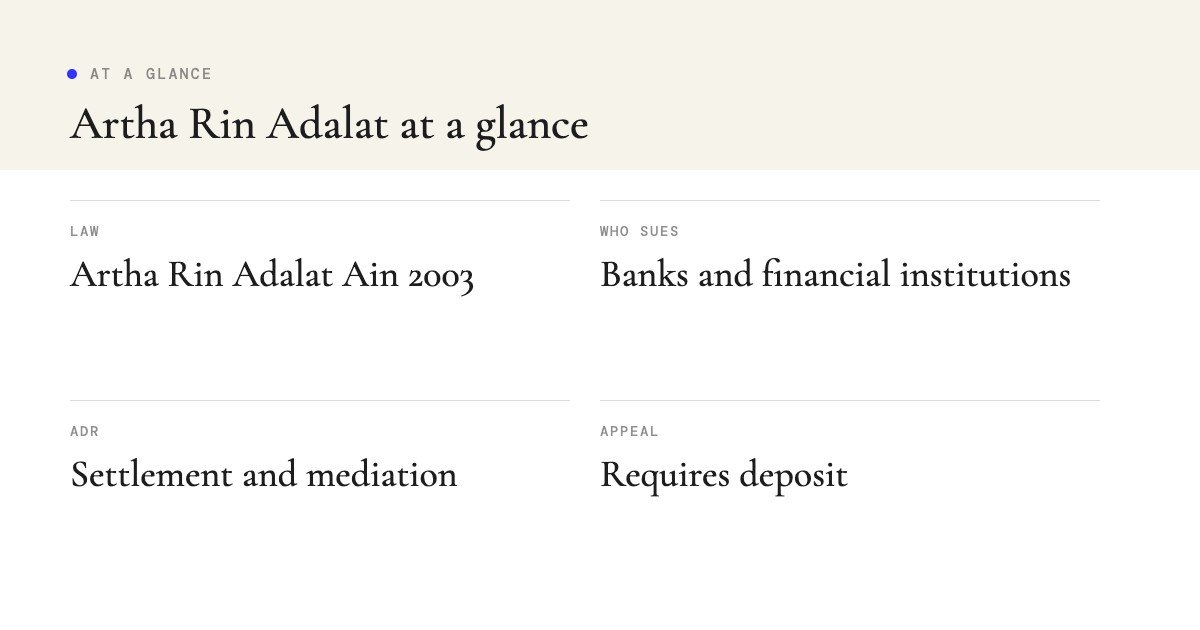
- The Artha Rin Adalat Ain 2003 gives special money loan courts exclusive jurisdiction over recovery claims by financial institutions.
- Lenders must generally try to realise pledged or hypothecated security before filing, and must file with supporting documents.
- The Ain provides for settlement conferences and mediation, and many cases resolve through rescheduling or compromise.
- Decrees are executed by auction of mortgaged property, transfer of title to the lender if auction fails, and civil detention in some cases.
- Appeals and revisions require a substantial deposit of the decretal amount, which strongly affects borrowers' strategy.
What the Artha Rin Adalat is
Before 1990, banks recovered loans through ordinary civil courts, and cases took many years. The Artha Rin Adalat was created to give lenders a faster, specialised forum, and the current law is the Artha Rin Adalat Ain 2003. Joint District Judges are designated as Artha Rin Adalat judges, and the courts sit in districts across Bangladesh, with several in Dhaka and Chattogram.
Only financial institutions, including banks, finance companies and certain specialised lenders, can sue in the Artha Rin Adalat. Defendants include borrowers, mortgagors, guarantors and others liable for the loan. Our banking and finance practice acts for both lenders and borrowers in these courts.
Before filing: notices and security
Before suing, a lender should review the facility documents, classification status, demand notices and security. Under the Ain, where the lender holds pledged or hypothecated movable property, it is generally expected to sell that security and adjust the proceeds before filing, and to show the result in the plaint. Mortgaged immovable property may, in some cases, be sold under section 12 of the Ain after notice, without a court decree. Proper pre-suit steps reduce later objections by defendants in the Artha Rin Adalat.
Borrowers should respond to demand notices in writing and keep records of payments and discussions. Many disputes in the money loan court turn on interest calculations, unauthorised charges and the value obtained when security was sold.
Filing the suit
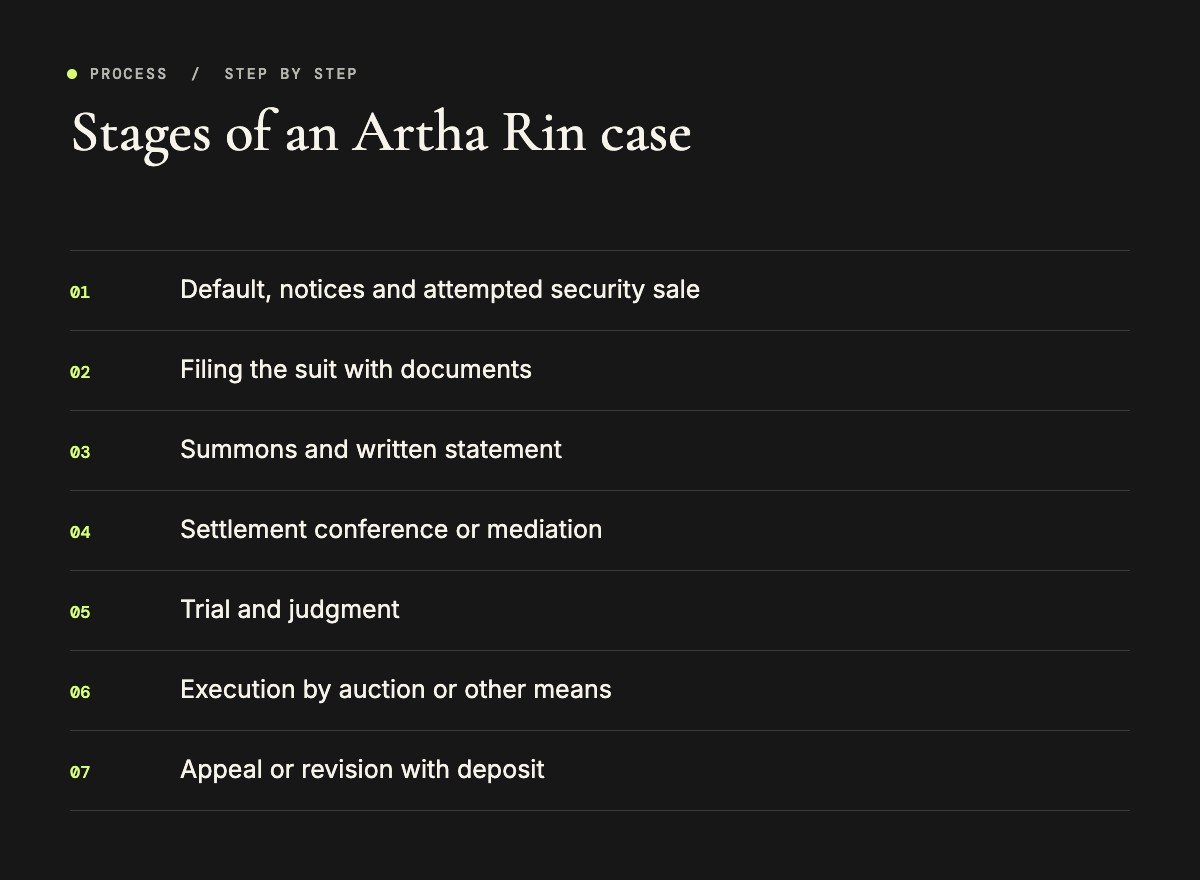
The plaint must state the loan details, the amount claimed with a breakdown of principal, interest and charges, the security held and any sale proceeds adjusted, and be supported by the facility documents, statements of account and notices. Court fees are payable on the claim. The Artha Rin Adalat then issues summons to defendants, often with publication in newspapers if personal service fails.
Written statement and the defendant's position
Defendants must file a written statement within the time allowed. Typical defences include incorrect calculation of interest, charging penal interest beyond agreed or permitted rates, failure to adjust payments or sale proceeds, invalid or incomplete security documents, limitation, and guarantees that were discharged or never validly given. Defendants who fail to appear risk an ex parte decree, which can be costly to set aside.
| Stage | Key action for lenders | Key action for defendants |
|---|---|---|
| Pre-suit | Notices, security sale, account reconciliation | Respond, negotiate, check calculations |
| Filing and summons | Complete documents and correct parties | Appear and file written statement on time |
| Settlement | Consider rescheduling options | Propose realistic payment plan |
| Trial | Prove documents and accounts | Challenge interest and charges |
| Execution | Auction, title transfer, detention | Seek time, settlement or lawful objections |
Settlement conference and mediation
The Ain emphasises alternative dispute resolution. After the written statement, the Artha Rin Adalat can refer the case to a settlement conference or mediation, where the parties, with their lawyers, try to agree on payment, rescheduling or compromise. Bangladesh Bank policies on rescheduling and one-time exits influence what banks can offer. Settlements are recorded and enforceable. A large proportion of money loan disputes are resolved at this stage, saving time for both sides.
Trial and decree
If settlement fails, the case proceeds to trial. The lender proves the documents and statements of account, and the defendant presents its defences. The Ain sets timelines for disposal, though in practice delays occur. The court passes a decree for the amount it finds due, including interest as allowed, and costs. Decrees against guarantors are typically joint and several with the borrower.
Execution of decrees
After a decree, the lender files execution proceedings in the Artha Rin Adalat. The court can order auction of mortgaged or attached property. If an auction fails to attract a suitable bid, the Ain allows the court to transfer ownership of the property to the decree-holder lender. The court may also order civil detention of judgment debtors in certain circumstances, and banking rules impose further consequences on wilful defaulters, including restrictions on new credit and on holding certain positions.
Appeals, revisions and deposits
A judgment debtor who wishes to appeal against a decree of the Artha Rin Adalat must deposit a percentage of the decretal amount before the appeal can be heard, and the Ain specifies the appellate forum based on the amount involved. Similar deposit requirements apply to revisions and have been applied by courts to writ petitions challenging Artha Rin proceedings. These deposit rules are designed to prevent delay tactics and mean that defendants must assess the strength of their case carefully before appealing.
Interest, penal charges and calculations
Disputes over the amount claimed are at the heart of many loan cases. Lenders must apply interest in line with the facility agreement and Bangladesh Bank rules, which have changed over time. Lending rates moved to a market-based system after the SMART reference rate was abolished on 8 May 2024, but historical rate caps and rules on penal interest and charges may still matter for older periods. Borrowers should obtain complete statements of account and, where amounts are large, ask an independent accountant to reconcile them. Errors in compounding, unauthorised fees and failure to credit payments or sale proceeds are common and can reduce the decretal amount significantly.
Guarantors and third-party mortgagors
Family members and directors often sign guarantees or mortgage their own property to secure a company's loans. They become defendants and can lose their property if the borrower defaults. Guarantors can sometimes argue that their guarantee was discharged, for example by a variation of the loan terms without their consent or by the lender's release of other security, though facility documents often contain clauses waiving such defences. A guarantor who pays the debt may claim against the borrower. Anyone asked to guarantee a loan should understand that the money loan court treats guarantees seriously.
Rescheduling and one-time exit
Bangladesh Bank periodically issues policies allowing banks to reschedule classified loans on payment of a down payment, or to offer one-time exit settlements on agreed terms. Borrowers who are genuinely unable to pay on the original terms should explore these options early, ideally before a suit is filed or at the settlement stage. A rescheduling agreement usually requires withdrawal or compromise of pending suits and creates a new repayment schedule; defaulting on the rescheduled loan can make future relief much harder.
Criminal and parallel proceedings
Lenders sometimes pursue parallel remedies, such as cheque dishonour cases under section 138 of the Negotiable Instruments Act 1881 for bounced repayment cheques, or complaints alleging fraud. Borrowers may face travel restrictions in serious default cases. These parallel proceedings can create pressure to settle. Defendants should coordinate their response across all forums to avoid inconsistent positions. See our guide to cheque dishonour remedies.
Practical tips for borrowers
- Never ignore summons or notices; appear and file a written statement on time.
- Obtain full statements of account and check every calculation.
- Gather evidence of payments, security sales and correspondence.
- Explore rescheduling or settlement early, with realistic proposals.
- Assess the deposit requirement before planning any appeal.
Practical tips for lenders
- Keep facility, security and account documents complete and organised.
- Follow pre-suit steps on security realisation carefully.
- Name all liable parties, including guarantors and mortgagors.
- Use settlement and mediation strategically to recover faster.
- Move promptly to execution after decree and track debtor assets.
Writ petitions and constitutional challenges
Defendants sometimes file writ petitions in the High Court Division challenging auction notices, execution steps or the constitutionality of particular provisions. Courts have generally upheld the special procedures of the money loan court, including deposit requirements, and have been cautious about interfering with recovery proceedings. A writ may succeed where there is a clear jurisdictional error or a breach of mandatory procedure, but it is not a route to delay legitimate recovery. Legal advice on the merits is essential before filing.
Defaulting companies and insolvency
When a corporate borrower is insolvent, lenders may consider winding-up proceedings in the High Court Division as well as recovery suits. Insolvency changes priorities among creditors, and secured lenders generally rely on their security. Borrowers in financial distress should consider whether a negotiated restructuring with all lenders is possible, possibly with Bangladesh Bank's policy support, rather than facing multiple separate suits. Coordinated strategy usually produces better outcomes for everyone involved.
Time limits
Recovery suits are subject to limitation rules, and the Ain contains its own provisions on timelines for disposal and execution. Lenders should not delay filing after default, and borrowers should check whether a claim may be out of time. Acknowledgements of debt and part payments can extend limitation periods, so correspondence should be handled carefully.
Choosing a lawyer
Experience in the Artha Rin Adalat matters, because procedure, deposit rules and settlement practice are specialised. Choose counsel who can read facility documents and accounts, negotiate with banks and, where needed, take matters to the High Court Division.
Frequently asked questions about artha rin adalat
Who can sue in the Artha Rin Adalat?
Banks and financial institutions covered by the Artha Rin Adalat Ain 2003.
Can guarantors be sued?
Yes. Guarantors and mortgagors can be made defendants and held jointly liable with the borrower.
Is mediation available?
Yes. The Ain provides for settlement conferences and mediation, and many cases settle.
What happens if mortgaged property does not sell at auction?
The court can transfer ownership of the property to the lender under the Ain.
Can I appeal without paying?
No. An appeal requires a deposit of a portion of the decretal amount as specified in the Ain.
What if I miss the hearing?
The court may pass an ex parte decree, which is difficult and costly to set aside.
How we can help
We represent banks, finance companies, borrowers and guarantors in the Artha Rin Adalat: pre-suit strategy, filing and defending suits, settlement and rescheduling negotiations, execution, appeals and related writs. Learn more about our banking and finance practice and our restructuring and insolvency practice.
Facing or filing a money loan case?
We review the facility, accounts and security, and pursue the fastest route to recovery or a fair settlement.
Book a consultationBanking and finance practicePrimary sources: the Artha Rin Adalat Ain 2003, Code of Civil Procedure 1908 and Bank Company Act 1991 on the Laws of Bangladesh portal; rescheduling and classification policies of Bangladesh Bank.
This article is general information about Bangladeshi loan recovery law as of October 2026 and is not legal advice. Deposit percentages, timelines and Bangladesh Bank policies change; confirm the current position with a qualified lawyer before acting.



0 Comments