
Understanding director duties in Bangladesh is essential for anyone who sits on a company board, whether of a family business, a foreign subsidiary or a listed company. The Companies Act 1994, the articles of association, general fiduciary principles and, for listed companies, the BSEC Corporate Governance Code all shape what directors must do. Directors who ignore these duties can face personal liability for company debts, taxes, regulatory fines and even criminal charges.
- Directors owe duties to the company, including to act in good faith in its interests, use powers for proper purposes, exercise care and skill, and avoid conflicts of interest.
- The Companies Act 1994 adds specific obligations on disclosure of interests, loans to directors, accounts, meetings and filings with RJSC.
- Listed company directors must also follow the BSEC Corporate Governance Code 2018, including rules on independent directors and board committees.
- Directors can be personally liable in certain cases, including fraudulent trading, misfeasance, unpaid taxes and personal guarantees of company loans.
- Good records, regular board meetings and timely filings are the best protection for directors.
Sources of director duties in Bangladesh
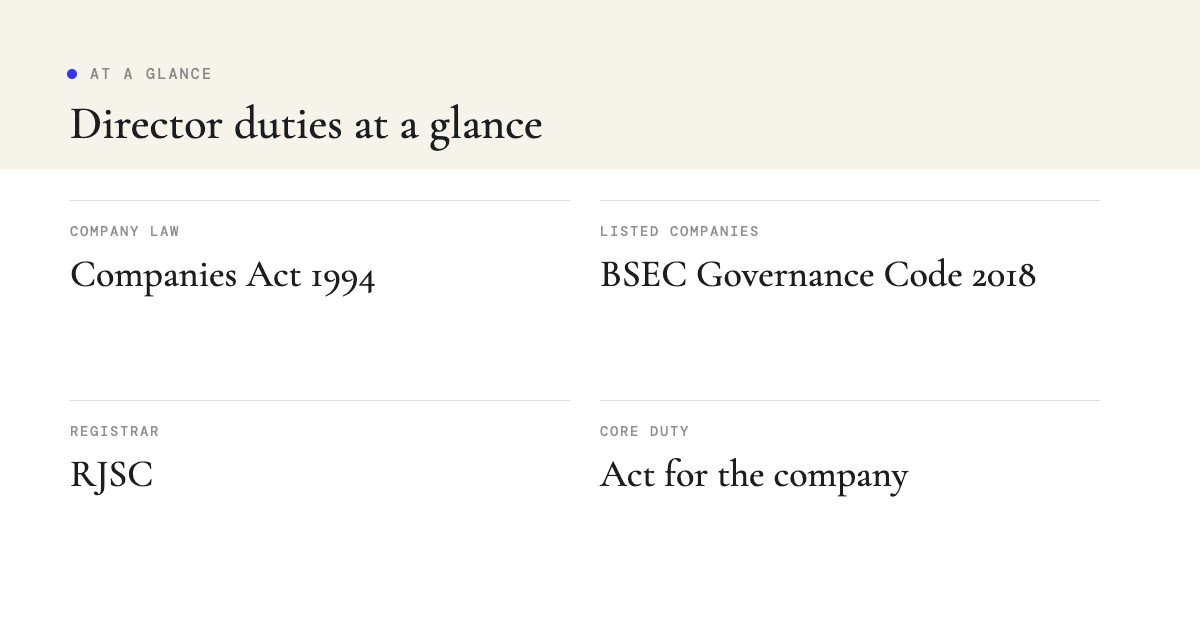
Director duties in Bangladesh come from several sources. The Companies Act 1994 sets statutory requirements on appointment, disqualification, meetings, accounts, disclosures and filings. The company's memorandum and articles of association define the board's powers and procedures. General principles of fiduciary duty, developed in common law and applied by Bangladeshi courts, require loyalty and care. Sector regulators, such as Bangladesh Bank for banks and BSEC for listed companies, impose additional rules.
For foreign investors appointing nominee directors to Bangladeshi subsidiaries, these duties apply in full. A nominee director must still act in the interests of the Bangladeshi company, not only the parent. Our corporate practice advises boards and individual directors on their obligations.
Core fiduciary duties
| Duty | What it means in practice |
|---|---|
| Act in good faith for the company | Decisions must aim at the company's interests, not personal or third-party benefit |
| Use powers for proper purposes | Powers, such as issuing shares, must not be used to entrench control or defeat shareholders |
| Exercise reasonable care and skill | Directors must be informed, attend meetings and ask questions |
| Avoid conflicts of interest | Disclose interests and do not profit secretly from the position |
| Do not make secret profits | Opportunities belonging to the company must not be diverted |
| Act within the constitution | Follow the memorandum, articles and shareholder resolutions |
Statutory duties under the Companies Act 1994
The Companies Act imposes specific obligations that form part of director duties in Bangladesh:
- Disclosure of interest. A director interested in a contract or arrangement with the company must disclose the nature of the interest to the board and generally may not vote on it.
- Loans to directors. The Act restricts companies from making loans to directors or giving guarantees for them without required approvals.
- Accounts and audit. Directors must keep proper books of account, prepare annual financial statements, lay them before the annual general meeting and appoint auditors.
- Meetings. Board meetings must be held as required, and the annual general meeting must be held within the statutory time.
- Filings. Annual returns, changes in directors, charges and other events must be filed with RJSC within prescribed periods.
- Registers. Registers of members, directors, charges and interests must be maintained.
Failure to comply can lead to fines on the company and every officer in default, and persistent breaches can affect a director's reputation and eligibility.
Minute every significant decision, including the information considered and any conflicts declared. In a dispute or investigation, well-kept minutes are often the strongest evidence that directors acted properly.
Listed companies and the Corporate Governance Code
Directors of companies listed on the Dhaka and Chittagong Stock Exchanges must comply with the BSEC Corporate Governance Code 2018. It requires a minimum proportion of independent directors, separation of the chair and chief executive roles, audit and nomination and remuneration committees, qualified company secretaries and chief financial officers, and detailed disclosures in the annual report. BSEC also imposes minimum shareholding requirements for sponsors and directors and rules on trading in the company's shares. Director duties in Bangladesh are therefore heavier for listed companies, and breaches can lead to BSEC penalties.
Banks and financial institutions
Director duties in Bangladesh are especially strict in finance. Directors of banks are subject to the Bank Company Act 1991 and Bangladesh Bank rules, including limits on family members on boards, restrictions on loans to directors and their related companies, and fit and proper requirements. Finance company directors face similar rules under the Finance Company Act 2023. Bangladesh Bank can remove directors and has done so in several cases of governance failure.
Personal liability of directors
A company is a separate legal person, so directors are not normally liable for its debts. However, director duties in Bangladesh carry real personal exposure in several situations:
- Personal guarantees. Directors who guarantee company loans are personally liable, and banks pursue guarantors in the Artha Rin Adalat.
- Fraudulent trading and misfeasance. In winding up, directors who carried on business to defraud creditors or misapplied company property can be ordered to contribute.
- Tax. Tax law can make directors liable for certain unpaid company taxes in specified circumstances.
- Defaulter status. Directors of companies classified as wilful defaulters may face restrictions under banking rules.
- Criminal liability. Offences committed by a company may be attributed to directors who consented or connived, under various statutes.
- Cheque dishonour. Signatories of dishonoured company cheques can face proceedings under the Negotiable Instruments Act 1881.
Disqualification and removal
Eligibility is the starting point of director duties in Bangladesh. The Companies Act sets out grounds on which a person is disqualified from being a director, such as being of unsound mind, an undischarged insolvent or failing to hold qualification shares where required. Shareholders can remove directors by resolution following the Act and articles. Regulators can remove directors in regulated sectors. A director who wishes to resign should do so in writing and ensure the change is filed with RJSC, otherwise they may continue to appear as a director in official records.
Duties when the company is in financial difficulty
When a company approaches insolvency, the interests of creditors become increasingly important. Directors should monitor cash flow closely, avoid taking on new debts the company cannot repay, avoid preferring certain creditors or related parties, and seek professional advice early. Continuing to trade while knowing the company cannot pay its debts, or moving assets out of reach of creditors, can expose directors to claims for fraudulent trading or misfeasance in a later winding up. Director duties in Bangladesh therefore require extra care during financial stress, and well-documented decisions to restructure, raise funds or seek a negotiated settlement with creditors provide important protection.
See our guide to winding up cases under company law for how insolvency proceedings work.
Employment, safety and environmental responsibilities
Directors are also responsible for ensuring that the company complies with laws that protect workers and the public. Under the Bangladesh Labour Act 2006, as amended in 2026, the owner and managers of an establishment can face penalties for unpaid wages, unsafe conditions and other breaches. Environmental law, fire safety rules and building regulations impose further duties, and serious accidents can lead to criminal investigations of those in control. A board that receives regular reports on safety, labour and environmental compliance is far better placed to show it met director duties in Bangladesh if something goes wrong.
Anti-corruption and money laundering
Compliance with integrity laws is part of director duties in Bangladesh. Directors should ensure that the company has policies against bribery and money laundering. The Money Laundering Prevention Act 2012 can apply to companies and their officers, and anti-corruption laws penalise bribery of public officials. Foreign-owned companies may also be subject to their home country's anti-bribery laws, such as the UK Bribery Act or the US Foreign Corrupt Practices Act. Approving payments without proper documentation, or ignoring red flags, can create personal exposure for directors.
Directors' and officers' insurance and indemnities
Insurance can support, but not replace, director duties in Bangladesh. Directors' and officers' liability insurance is increasingly available in Bangladesh and can cover defence costs and certain liabilities arising from claims against directors. The Companies Act limits the extent to which a company can exempt or indemnify directors against liability for negligence or breach of duty, so indemnities in the articles or service agreements should be reviewed carefully. Insurance does not cover fraud or deliberate wrongdoing, and it is no substitute for actually complying with director duties in Bangladesh.
Practical checklist for new directors
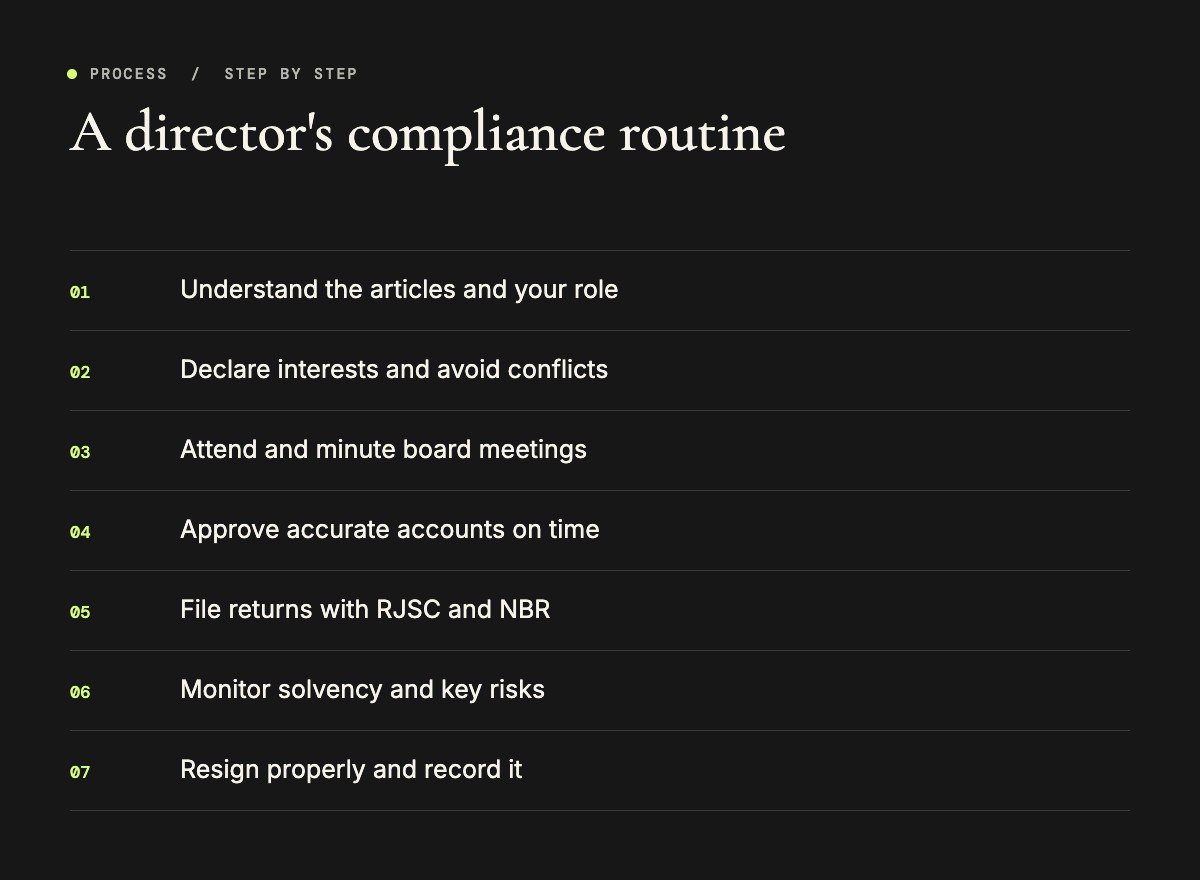
- Read the memorandum, articles and any shareholders' agreement.
- Obtain the latest accounts, board minutes and compliance reports.
- Check RJSC filings are up to date and that your appointment is filed.
- Declare any interests in writing at the first board meeting.
- Understand the company's borrowing and any guarantees you may be asked to give.
- Ask for regular financial, legal and compliance reporting.
- Take advice on director duties in Bangladesh if anything is unclear.
Shareholder actions against directors
Shareholders who believe directors have breached their duties can take action. Minority shareholders can apply to the High Court Division for relief against oppression or mismanagement under the Companies Act, and courts can make wide orders, including regulating the company's affairs. Claims for breach of fiduciary duty may also be brought by the company itself, sometimes after a change of control. Director duties in Bangladesh are therefore enforceable not only by regulators but also by shareholders and, in insolvency, by liquidators.
Family companies
Most Bangladeshi companies are family-owned, and informal decision-making is common. Yet director duties in Bangladesh apply equally to family boards. Relatives who are named directors but take no part in management can still be held responsible for failures they should have noticed. Clear roles, regular meetings and written records protect every family member who holds a directorship, and they reduce the risk of disputes between branches of the family over control and dividends. Understanding director duties in Bangladesh helps family businesses grow into well-governed companies.
Frequently asked questions about director duties in bangladesh
To whom do directors owe their duties?
Primarily to the company, though in practice they must consider shareholders and, near insolvency, creditors.
Can a nominee director follow the parent company's instructions?
Only so far as consistent with the Bangladeshi company's interests; nominee directors owe full duties to the company.
Are directors personally liable for company debts?
Not normally, but they can be through guarantees, fraudulent trading, misfeasance, certain tax provisions and criminal attribution.
What must a director disclose?
Interests in contracts or arrangements with the company, and shareholdings and other information required by law.
Do listed company directors have extra duties?
Yes, under the BSEC Corporate Governance Code 2018 and securities rules.
How should a director resign?
In writing, followed by board acceptance where required and filing of the change with RJSC.
How we can help
We advise directors, boards and investors on director duties in Bangladesh: board structures, conflict policies, governance codes, director service agreements, resignation and removal, regulatory investigations and personal liability claims. Learn more about our corporate practice and our corporate governance practice.
Joining a board or worried about personal exposure?
We explain your duties clearly and help you put in place the records and processes that protect you.
Book a consultationCorporate practicePrimary sources: the Companies Act 1994, Bank Company Act 1991 and Negotiable Instruments Act 1881 on the Laws of Bangladesh portal; company filings at RJSC; the Corporate Governance Code published by BSEC.
This article is general information about Bangladeshi company law as of October 2026 and is not legal advice. Duties depend on the company's constitution and sector; take advice from a qualified lawyer on your specific position.



0 Comments